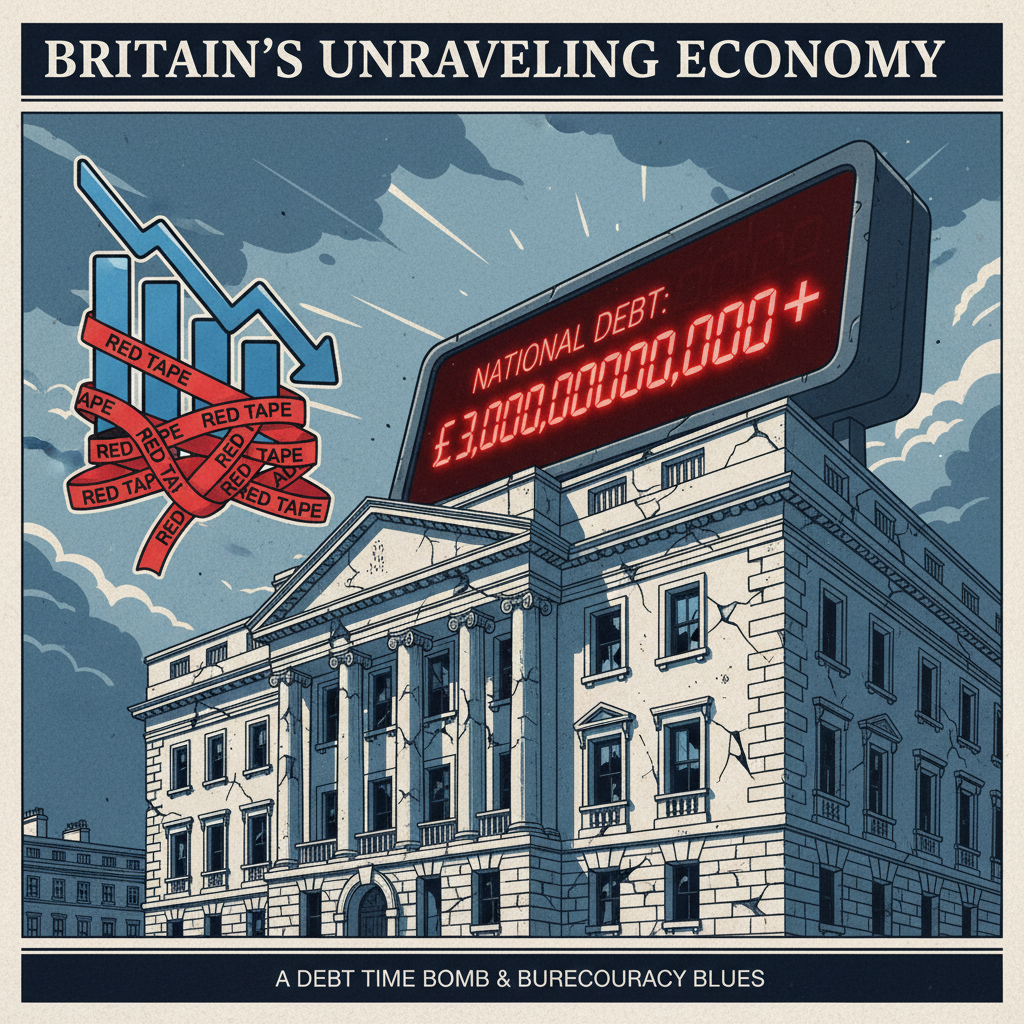
Labour's tax and regulation agenda stalls UK business investment
Private sector capital expenditure has fallen by 3.2% since the election, as CEOs cite punitive fiscal policy and political instability.
Labour's tax and regulation agenda stalls UK business investment
Private sector capital expenditure has fallen by 3.2% since the election, as CEOs cite punitive fiscal policy and political instability.
The scene at the last CBI dinner was a study in polite despair. Around the tables at the Grosvenor House Hotel, the talk wasn't of expansion or innovation, but of regulatory impact assessments and the latest tweak to the Apprenticeship Levy. One FTSE 100 chairman leaned over his untouched dessert and muttered, “We’re not investing a penny more here until this lot show they understand how wealth is created.” He’s not alone. The latest Office for National Statistics figures show business investment fell by 0.9% in the final quarter of last year. For 2025 as a whole, it was down 3.2%. In a global race for capital, Britain is tying its own ankles together.
This isn't just a cyclical downturn. It’s a deliberate chilling effect, engineered from Whitehall. The Labour government, elected on a promise of “securonomics” and “fairness,” has interpreted its mandate as a licence for a slow-motion raid on enterprise. The headline corporation tax rate remains at 25%, the highest in the G7. The capital gains tax regime has been tightened, with the annual exempt amount slashed to a paltry £3,000. And then there’s the regulatory blitz: the sweeping “New Deal for Working People,” promising a default 35-hour week and extensive union powers; the aggressive net zero targets that are forcing energy-intensive industries to look abroad; and the constant, threatening rhetoric about “tax justice” and “predatory” business models. Faiza Shaheen of Tax Justice UK, grilling a Palantir executive on the BBC last week about NHS data contracts, embodies this new, suspicious orthodoxy. The message to boardrooms is clear: you are not a partner in growth, but a problem to be managed.
The Reform mirage and the investment freeze
Into this vacuum steps the populist right. Nigel Farage, visiting a winner of Reform UK’s gimmicky free energy bills draw, offers simplistic rage against the machine. His party’s latest wheeze, floated by Zia Yusuf, is to block visas from countries that dare to mention slavery reparations. It’s nonsense, of course—the kind of performative politics that solves nothing—but it resonates because the government’s economic story is so weak. When growth is stagnant and living standards are falling, people grasp for easy answers and easy villains. The real damage, however, is less about Reform’s poll numbers and more about the political instability it fuels. CEOs hate uncertainty more than almost anything. A single-party Labour government implementing a high-tax agenda is one thing; a fragile government facing a rising populist insurgency is quite another. It makes five-year investment cycles look like a fool’s gamble.
Look at the high street. The threat of an energy bill crisis may have receded, as City AM noted, but retail and hospitality are on the brink. This isn't just about consumer confidence. It’s about the cumulative burden of a 12.5% minimum wage hike over two years, skyrocketing business rates, and the impending costs of the new workers’ rights framework. The Cornishview tweet had a blunt point: “You have no workers rights when you have no job.” The government’s approach treats business as a bottomless pit of funding for its social projects, forgetting that capital is mobile and profit margins are finite. A pub in Portsmouth isn't competing with the pub down the road; it’s competing with a café in Portugal where the employer NICs are half the rate.
The structural rot no one wants to fix
Beneath this political failure lie the chronic, unaddressed sores of the UK economy. That anonymous tweet from ‘WaterRabbitt’ was spot on: “The UK’s problems stem from long‑term structural weaknesses — stagnant productivity, low business investment, high borrowing costs and an ageing population.” Productivity growth has averaged a pathetic 0.4% a year since the financial crisis. We have an ageing demographic timebomb, with the ratio of workers to pensioners set to plummet. And we’re funding it all with eye-watering levels of public debt, now hovering at 98% of GDP, which keeps borrowing costs higher than they should be. The Bank of England is trapped; it can’t cut rates aggressively to stimulate growth because it’s perpetually worried about inflation stoked by government spending and a weak supply side.
Labour’s response? More of the same medicine that caused the sickness. The Scottish nationalists, like ‘The_Foe_Malign’, scream for full fiscal autonomy, blaming Westminster for everything. But the idea that control over benefits or the minimum wage in Edinburgh would magically spark a productivity revolution is a fantasy. The problem is the philosophy, not the postcode. The state has become a Leviathan that consumes capital and stifles initiative. It believes its role is to redistribute a shrinking pie ever more “fairly,” rather than to create the conditions for the pie to grow. The result is what that old tweet from James Melville quoted: a “low-growth, high-regulation economy, which shot itself in the foot with a tax-driven assault on the economic progress it needs most.”
The path back is simple, but politically painful. It requires a radical supply-side shift: slashing corporation tax to 15% to trigger an investment surge, rolling back the vast swathes of employment regulation that disincentivise hiring, and declaring a moratorium on all new net zero costs for industry. It means telling the Faiza Shaheens of this world that wealth creation is not a crime. It won’t happen. This government is committed to its course. So the investment strike will continue, the slow bleed of capital and talent will accelerate, and the polite despair in those hotel ballrooms will turn into a quiet exodus. The figures don’t lie. We’re governing ourselves into genteel decline.
메타데이터
- post_id
- d6e4739d4c86
- slug
- labours-tax-and-regulation-agenda-stalls-uk-business-investment-d6e4739d4c86
- url
- https://medium.com/@worldnews99/labours-tax-and-regulation-agenda-stalls-uk-business-investment-d6e4739d4c86
- canonical_url
- https://medium.com/@worldnews99/labours-tax-and-regulation-agenda-stalls-uk-business-investment-d6e4739d4c86
- author_url
- https://medium.com/@worldnews99
- status
- ok
- fetched_at
- 2026-06-09 15:37:30