Enterprise RL: When Fast Vectorized Environments Beat Bigger Models
A dynamic-pricing intuition, tested with a controlled Tic-tac-toe benchmark

Enterprise RL: Fast, Vectorized Environments Matter More Than Bigger Models
Enterprise RL: When Fast Vectorized Environments Beat Bigger Models
A dynamic-pricing intuition, tested with a controlled Tic-tac-toe benchmark
TLDR; In reinforcement learning, the model is not always the first bottleneck. Often, the bottleneck is the environment: how fast it can generate valid experience. This article uses dynamic pricing as the enterprise intuition and Tic-tac-toe as a controlled benchmark. The lesson is not “JAX is always faster.” The lesson is sharper: when environment logic can be expressed as fixed-shape, batched, compiled array operations, JAX jit + vmap can dramatically improve rollout throughput. For enterprise RL systems, simulator engineering, batching strategy, and rollout architecture can matter as much as model architecture or algorithm choice.
The premise: enterprise RL starts with decisions, not models
Most enterprise decision systems do not start with reinforcement learning. They start with rules. Take a dynamic-pricing system for an e-commerce or retail business. A typical first version may look like this:
- if inventory is high, discount by 5%;
- if demand is strong, increase price by 3%;
- if a competitor drops price, match within a fixed band;
- never go below margin floor; → Risk Profile
- never change price more than once in a fixed window. → Risk Profile
This kind of rule engine is attractive because it is interpretable, controllable, and easy to explain to business stakeholders. It is also how many enterprise systems naturally evolve: start simple, encode expert judgment, add guardrails, and keep tuning.
But over time, the rule book starts to crack.
Demand changes by season. Competitors react. Inventory risk accumulates. A discount that improves revenue today may train customers to wait for discounts tomorrow. A price increase that looks profitable in one region may reduce conversion in another. A policy that works for high-margin products may fail for low-margin products. At that point, the problem is no longer just prediction. It is sequential decision-making.
That is where reinforcement learning becomes relevant.
Dynamic pricing as an RL problem
Dynamic pricing maps naturally to reinforcement learning because every pricing decision changes the future operating context.
A simplified formulation looks like this:

RL Components of a Dynamic Pricing Problem (Image by Author)
This framing is not limited to pricing. The same structure appears in resource allocation, routing, scheduling, promotion planning, inventory replenishment, and cloud autoscaling.
Rules prescribe what to do. RL learns what to do from interaction outcomes aka experiences.
That sounds powerful, but it creates a practical systems problem: the agent needs experience. And experience has to come from somewhere — an environment.
The hidden bottleneck: rollout generation
In enterprise RL, the expensive part is often not the neural network. It is the environment. For dynamic pricing, the environment could be a simulator that estimates how demand, revenue, inventory, and competitor response evolve after each price action.
If that environment is slow, the RL loop becomes slow. A useful way to think about it:
policy observes state
→ policy selects action
→ environment applies action
→ environment returns next state and reward
→ learner updates policy
→ repeat many times
PPO and similar on-policy methods often require large volumes of environment interaction, especially when rewards are delayed, action spaces are large, or the simulator must expose rare but important scenarios.
Now imagine a pricing simulator that runs at roughly 5,000 environment steps per second on one CPU core. That may sound fast. But a 500-million-transition experiment would still require about 28 hours of simulator time before counting policy updates, evaluation runs, tuning, failed experiments, or safety checks.
That is the real wall.
The model can be small. The learner can be efficient. The GPU can be available. But if the simulator is slow, stateful, or hard to parallelize, the learning loop waits.
This is why environment engineering matters.

From Rule-Based Logic to Scalable RL Environments (Image Conceptualized by Author, Generated by AI)
Why this matters more in enterprise settings
Enterprise environments are rarely clean games.
They include:
- business constraints;
- delayed outcomes;
- partial observability;
- noisy rewards;
- safety requirements;
- hard action limits;
- non-stationary demand;
- simulation gaps between offline training and production;
- and stakeholders who need explanations.
That is why RL is not just “choose PPO and train.” It is a systems design problem. A slow simulator limits experimentation. A wrong simulator teaches the wrong behavior. A simulator that cannot be parallelized makes every policy iteration expensive. So before scaling the policy network, ask a simpler question:
Can the environment generate enough correct experience fast enough?
If the answer is no, a bigger model will not fix the bottleneck.
Why JAX enters the story
A conventional Python/NumPy simulator is often written as a loop:
for each episode:
    reset environment
    while not done:
        compute valid actions
        apply action
        compute reward
        update state
That is easy to write and debug. But it often executes one environment at a time through Python control flow. JAX changes the shape of the problem. Instead of stepping one simulation at a time, environment logic can be written as pure array transformations.
What is JAX
JAX is python library designed for high-performance numerical computing and large-scale machine learning.

Brief Overview of JAX (Image Generated by AI)
Two JAX features are especially relevant:
-
Just in time compilation (JIT): JAX provides jax.jit, which uses the XLA compiler to transform a sequence of array operations into an optimized executable representation. In the context of reinforcement learning environments, JIT compilation is useful when the same transition logic is executed repeatedly across many rollout steps
-
Vectorizing Map (VMAP): JAX provides vmap to transform a function that operates on a single simulation instance into a function that operates across an additional batch dimension. For reinforcement learning, this enables thousands of independent environments to be advanced in parallel
For more information on JAX, visit docs.
This matters because RL rollout/experience generation is naturally parallel. Thousands of independent pricing simulations can often be advanced side by side if the environment is represented with fixed-shape tensors. But there is an important caveat.
JAX is not a magic speed button for arbitrary Python. Small single-instance workloads may not benefit. Python objects, irregular control flow, dynamic shapes, side effects, and host-device transfers can reduce or eliminate the benefit. JAX also uses asynchronous dispatch, so benchmarks should synchronize with block_until_ready() when measuring execution time.
The real win appears when the environment is designed for batching.
Enterprise intuition vs controlled benchmark
The enterprise example above explains why the bottleneck matters. The experiment below tests one narrow systems question:
If we express environment rollout logic as batched, compiled JAX computation, how much faster can rollout generation become compared with sequential Python execution?
For that controlled test, I used Tic-tac-toe. Tic-tac-toe is obviously not dynamic pricing. That is the point. It is small, deterministic, and easy to verify. It has states, actions, legal moves, terminal conditions, rewards, and complete episodes. That makes it a useful toy benchmark for isolating environment execution overhead without mixing in domain complexity.
Experimental setup: Tic-tac-toe rollout benchmark
The benchmark compared two implementations of the same environment:
- Python/NumPy baseline A conventional sequential simulator that plays games one after another.
- JAX implementation A JAX version where core transition logic is compiled and vectorized so many independent games can be advanced in parallel.
The objective was not to learn the best Tic-tac-toe strategy. The objective was to isolate the impact of environment execution speed on RL-style rollout generation.
The Python baseline was executed for 5,000, 10,000, and 15,000 simulated games. The measured times were:
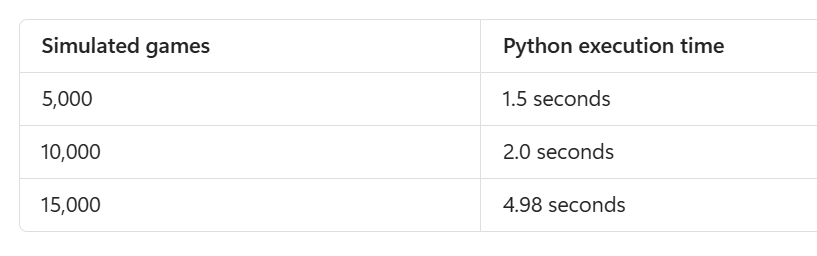
Python baseline for different sets of simulated games (Image by Author)
The JAX version was evaluated with batch sizes of 256, 1,024, and 4,096, matching the setup in the original draft.
For more details on bechmark experiement, JAX version, setup, visit the Kaggle notebook here.
Result 1: JIT alone was not enough
The first observation was counterintuitive but important:
JIT-compiling a single-game step did not automatically make the simulator faster.
For a tiny environment like Tic-tac-toe, a single transition does very little computation. The overhead of dispatching work to the accelerator can dominate the useful work. In the original measurement, single-instance JAX was slower than the NumPy baseline for the 5,000-game case shown in the draft’s chart. [Check the image below, JAX-Single]
That does not mean JAX is slow. It means the workload was too small and too scalar-like to benefit from accelerator execution.
This is a critical enterprise lesson. If a pricing simulator, routing simulator, or resource-allocation environment is still stepping one scenario at a time, JAX may not help much. The simulator must be reshaped into batched computation.
Result 2: vectorization changed the economics
The picture changed when the same environment logic was executed across a batch dimension.
With vmap, the simulator could advance many independent games in parallel. This amortized fixed overhead across many rollouts and gave the accelerator enough work to do.
In the measured 5,000-game benchmark, moving from single-instance execution to batched execution produced the major improvement. The original draft reports a shift from a single-instance regression to an approximately 3× speedup at batch size 256, and a much larger improvement at batch size 1,024.
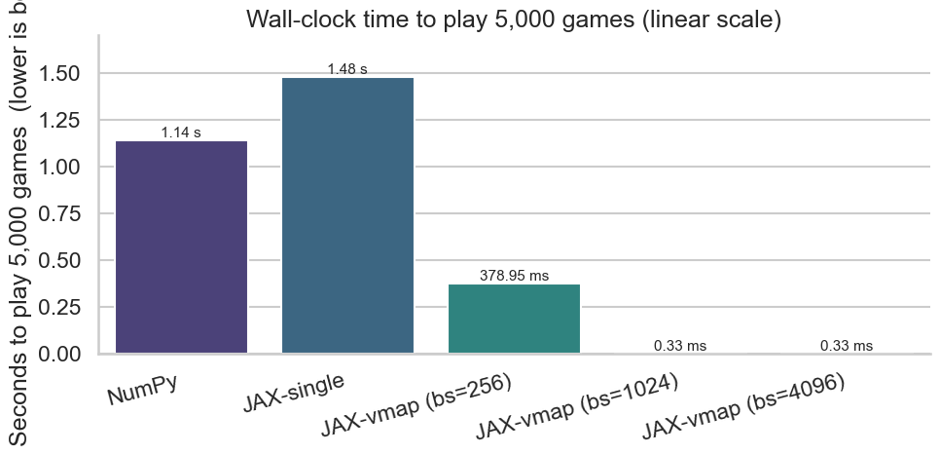
Time taken to play 5K games by Numpy function vs JAX (w/o vmap) under different batch sizes (Image by Author)
The safest way to state the result is:
The major speedup came from
jitplus vectorization, not fromjitalone.
That distinction matters. For enterprise RL, the lesson is not “rewrite everything in JAX.” The lesson is:
Design the environment so many independent rollouts can be represented as batched tensor operations.
That is what changes the economics of experimentation.
Result 3: batch size eventually saturated
The benchmark also showed that increasing batch size did not keep improving performance forever. Between batch 1024 and 4096 the wall-clock is statistically indistinguishable (both ≈ 0.33 ms, well under 1 % apart).
At that point we’re kernel-launch-bound, not compute-bound; buying a larger batch stops buying more throughput.

Graph depicting that improvements saturate at certain batch dimension (Image by Author)
This indicates that beyond a certain batch size, further scaling is unlikely to come from increasing the local batch dimension within a single call, because each call still pays a fixed dispatch cost.
For realistic enterprise environments, additional scale may require distributed reinforcement learning architecture, such as an IMPALA-style design, where independent workers execute JAX-based rollouts and stream trajectories to a central learner.
Conclusion:
- Enterprise RL is often discussed as an algorithm choice: PPO vs DQN, bigger model vs smaller model, centralized learner vs distributed learner. But the less glamorous layer can matter more: the environment.
- A slow environment starves the learner. A flawed environment teaches the wrong policy. A non-vectorized environment makes experimentation expensive.
- A well-designed environment turns RL from an interesting prototype into an iterative engineering system. The results reinforce that environment throughput can become the dominant constraint, especially when policy learning depends on large volumes of simulated experience.
- The experiments show that JAX does not automatically improve performance at small scale; single-instance execution can be dominated by compilation, dispatch, and kernel-launch overhead.
- The major performance gain emerges when the environment is expressed as batched, vectorized computation that allows accelerator resources to be used more effectively.
- For enterprise reinforcement learning systems, the practical path to scalable learning is to treat simulator engineering, batching strategy, and rollout architecture as first-class design concerns alongside policy optimization.
메타데이터
- post_id
- db6f958eb424
- slug
- enterprise-rl-when-fast-vectorized-environments-beat-bigger-models-db6f958eb424
- url
- https://medium.com/@techtalkwithsriks/enterprise-rl-when-fast-vectorized-environments-beat-bigger-models-db6f958eb424
- canonical_url
- https://medium.com/@techtalkwithsriks/enterprise-rl-when-fast-vectorized-environments-beat-bigger-models-db6f958eb424
- author_url
- https://medium.com/@techtalkwithsriks
- status
- ok
- fetched_at
- 2026-07-18 09:10:59



