Weather Impact on Navigation and Military Campaigns in 17th Century East Asia
Sailing for both commercial and military purposes in 17th century East Asia was strongly influenced by the seasonal monsoons. This blog…
Weather Impact on Navigation and Military Campaigns in 17th Century East Asia
Sailing for both commercial and military purposes in 17th century East Asia was strongly influenced by the seasonal monsoons. This blog post aims to explains how the patterns of navigation and timing of military campaigns were dictated by the weather and winds, with the Taiwan strait as the main area of focus.
Basics of Sailing
A sail boat is propelled by the winds. Sailing technologies, progressing throughout millennia, have allowed sail boats to sail in most directions except directly towards the prevailing wind. Of course, if the wind is directly behind the sail, the boat can travel at the highest speed; this is called running in sailing terminology. However, sail boats are able to tack into the wind by zigzagging around the coming wind. Maintaining the momentum while zigzagging is important as if the boat stops while facing the wind it is difficult to get the boat to start moving again. In this case, the boat is said to be in the irons.
As with all things, a right amount of winds in the right direction is ideal for sailing. When the wind is too strong, sail riggings can be damaged and masts can break. Strong winds and rough seas are of course dangerous for navigation.
Sailing with Winds: https://www.facebook.com/photo/?fbid=122204582306027686&set=gm.1535661104496666&idorvanity=1348626203200158
Monsoon Pattern in the Taiwan Strait
The Taiwan strait has two alternating seasonal monsoons. In the winter months, starting from late September to next March/April, the Northeast monsoon dominates. The Northeast monsoon is characterized by strong, cold northerly winds and rough seas. In the summer months, typically between April and September, the Southwest monsoon allows for faster northbound journeys. The Southwest monsoon is milder and gentler for the sailing ships; however summer is also typhoon season in the western Pacific, which is always a risk to navigation.

Monsoons in the Taiwan Strait: https://journals.sagepub.com/doi/10.1177/0309524X221108423
Dutch East India Company Sailing Patterns in East Asia
The Dutch East India Company (de Vereenigde Oost-Indische Compagnie, VOC) established their presence in Tayouan (Modern day Anping, Taiwan) in the 1620’s. The company’s official diary for their Tayouan office offers an important source for historic research. Based on this diary from the first part of 1630’s, we can identify a few important sailing itineraries and glimpse the impacts of monsoons on these sea lanes.

The Sardam, Active in the Taiwan Strait in 1630’s: https://en.wikipedia.org/wiki/Sardam_(1628)
Between Tayouan (Taiwan) and Batavia (Indonesia)
The VOC fleet traveling between their Tayouan office and Batavia headquarters followed a clear pattern based on the monsoons. The Tayouan office often sent ships loaded with goods for Batavia in the winter months, taking advantage of the Northeastern monsoon, while the fleet from Batavia headed to Tayouan and Northeast Asia, e.g. Japan, during the summer months.
Fort Zeelandia, Tayouan in the 1630’s: https://commons.wikimedia.org/wiki/File:Zeelandia_from_Dutch.jpg
Between Tayouan and Chincheo (south Fujian) Coast
The coast of south Fujian, known as the Chincheo coast by the Europeans in the 17th century, is across the Taiwan strait, northwest to VOC’s Tayouan office. While the voyage from Tayouan (southeast) to the Chincheo coast (northwest) was possible during the northeast monsoon, it was challenging and often required waiting for a lull in the strong winds, as the VOC diary mentioned several occasions of delays due to winds. The journey from the Chincheo coast to Tayouan was favored by the northeast monsoon during winter months. During summer, the sailing between Tayouan and Chincheo coast was usually not impeded by strong winds but the risks of typhoon were always present.

Ming Junk in the 1630’s: https://upload.wikimedia.org/wikipedia/commons/thumb/2/27/A_Ming_junk_1637.jpg/250px-A_Ming_junk_1637.jpg
Between Tayouan and Japan
The voyages between Tayouan and Japan followed closely to the seasonal monsoons. The ships traveled from Tayouan to Japan during the summer months taking advantage of the southwest monsoons, and returned from Japan to Tayouan in the winter months.
VOC Ship Visiting Japan: https://www.reddit.com/r/vexillology/comments/3vnmxy/japanese_art_of_dutch_voc_ship_rthenetherlands/
VOC Campaign Against the Ming Empire in 1633
The VOC launched a military campaign against the Ming empire and its South Fujian merchant networks in July 1633. The campaign’s launch coincided with the Southwest monsoon season as that is when the fleet from Batavia could sail north to the south Fujian coast. The VOC launched the campaign knowing fully that summer was also typhoon season and the associated risks. There was no alternative; a military campaign by sailing ships could not be launched in the winter with the northeast monsoon. The VOC did suffer damages to ships due to storms in August and October prior to the final naval engagement with the Ming navy at the battle of Liaoluo bay in late October.
Coxinga’s Invasion of Dutch Taiwan in 1661
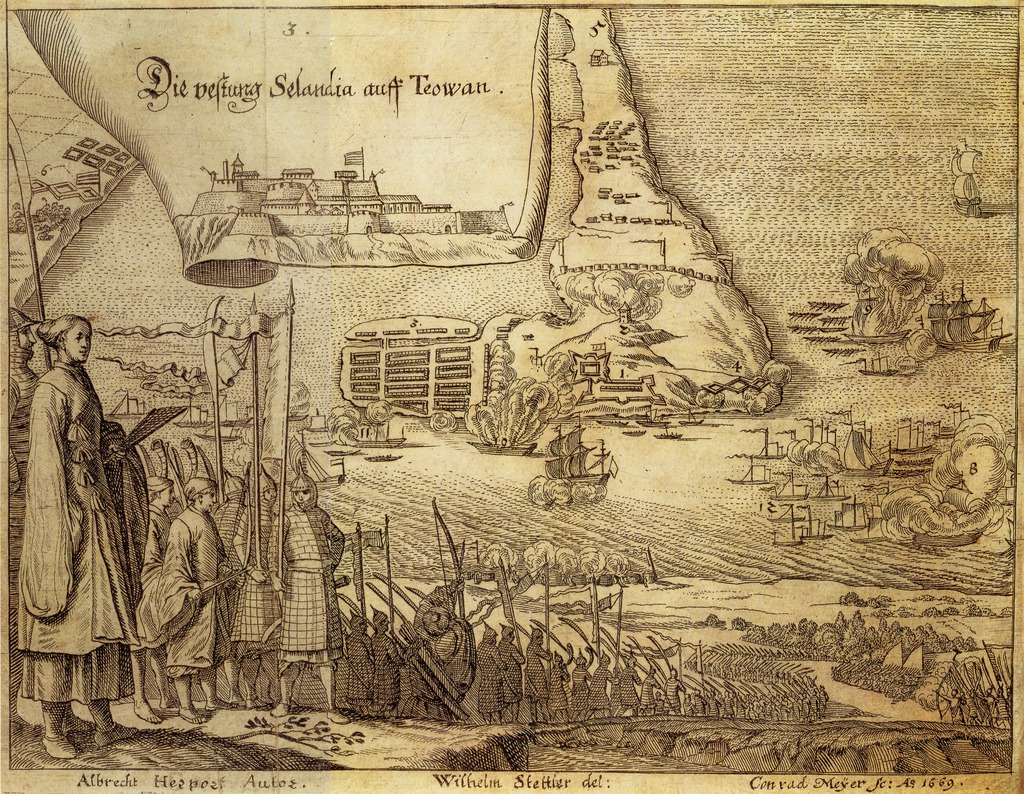
Coxinga (Zheng Chenggong), a Ming loyalist general and leader of the Zheng merchant networks in south Fujian, launched his invasion of Dutch of Formosa in late March 1661. He timed his invasion with both tide water level and the beginning of the Southwest monsoon. The higher tide would allow his fleet to navigate in Tayouan’s shallow coastal waterways, while the Southwest monsoon would ideally block VOC vessels from making the journey to Batavia to request reinforcement. On the latter point, Coxinga was disappointed as one VOC vessel from Tayouan was able to tack to the winds and made the journey to Batavia, which sent reinforcements that arrived Tayouan in July.

Dutch Illustration of the Siege of Fort Zeelandia, Tayouan: https://upload.wikimedia.org/wikipedia/commons/7/77/Die_Festung_Selandia_auff_Teowan.jpg
Shi Lang’s Invasion of Zheng Taiwan in 1683
Shi Lang was the Manchu Qing dynasty admiral that defeated the Zheng navy in the battle of Penhu (the Pescadores) in 1683, which led to the annexation of Taiwan to Qing empire. One of the sources on this event was the historic novel Taiwanwaiji (臺灣外記). Though Taiwanwaiji is with apocryphal details that glorify characters in the story, the author had direct family connection with the Zheng Chenggong’s military. According to Taiwanwiji, Shi Lang had planned to launch his invasion in the 11th month of lunar calendar in 1682 but he was thwarted by the north winds.
(十一月,琅因北風太硬,未敢進剿。令各鎮協營暫歸汛,自統船回廈 — in the eleven month, Shi Lang did not launch his campaign due to the strong north winds. He ordered his troops to return to Xiamen with their own ships.).
In summer 1683, Shi Lang was able to launch his campaign, although this was considered a calculated risk as his opponent Liu Guoxuan commented.
(劉國軒雖各島築臺提防;每與諸將諭「六月風波不測,施琅是慣熱海務者,豈敢故犯突然興師乎?不過虛張聲勢,如甲辰年出船,復請旨寬限做官而已。」- Although Liu Guoxuan was building defensive works on the Pescadores islands, he kept telling his commanders “The seas can be rough in the sixth month. Shi Lang is a seasoned sailor; why would he launch a campaign now? He is just making a gesture like previously so that he can continue to hold command of troops in the Qing government.)
Conclusion
This blog post goes through how the pattern of seasonal monsoons impacted navigation and military campaign timing in the 17th century East Asia. With the strong Northeast monsoons, military campaigns tended to be launched in the summer months even with the ever present typhoon risks. Commercial voyages were also timed with the monsoons to achieve the best travel time.
메타데이터
- post_id
- e22d60f00f3d
- slug
- weather-impact-on-navigation-and-military-campaigns-in-17th-century-east-asia-e22d60f00f3d
- url
- https://medium.com/@lwjuang/weather-impact-on-navigation-and-military-campaigns-in-17th-century-east-asia-e22d60f00f3d
- canonical_url
- https://medium.com/@lwjuang/weather-impact-on-navigation-and-military-campaigns-in-17th-century-east-asia-e22d60f00f3d
- author_url
- https://medium.com/@lwjuang
- status
- ok
- fetched_at
- 2026-07-15 23:42:37