What Quality-Conscious Software Delivery Means to Me
“Let’s build it fast, we will fix it later.”
What Quality-Conscious Software Delivery Means to Me
“Let’s build it fast, we’ll fix it later.”
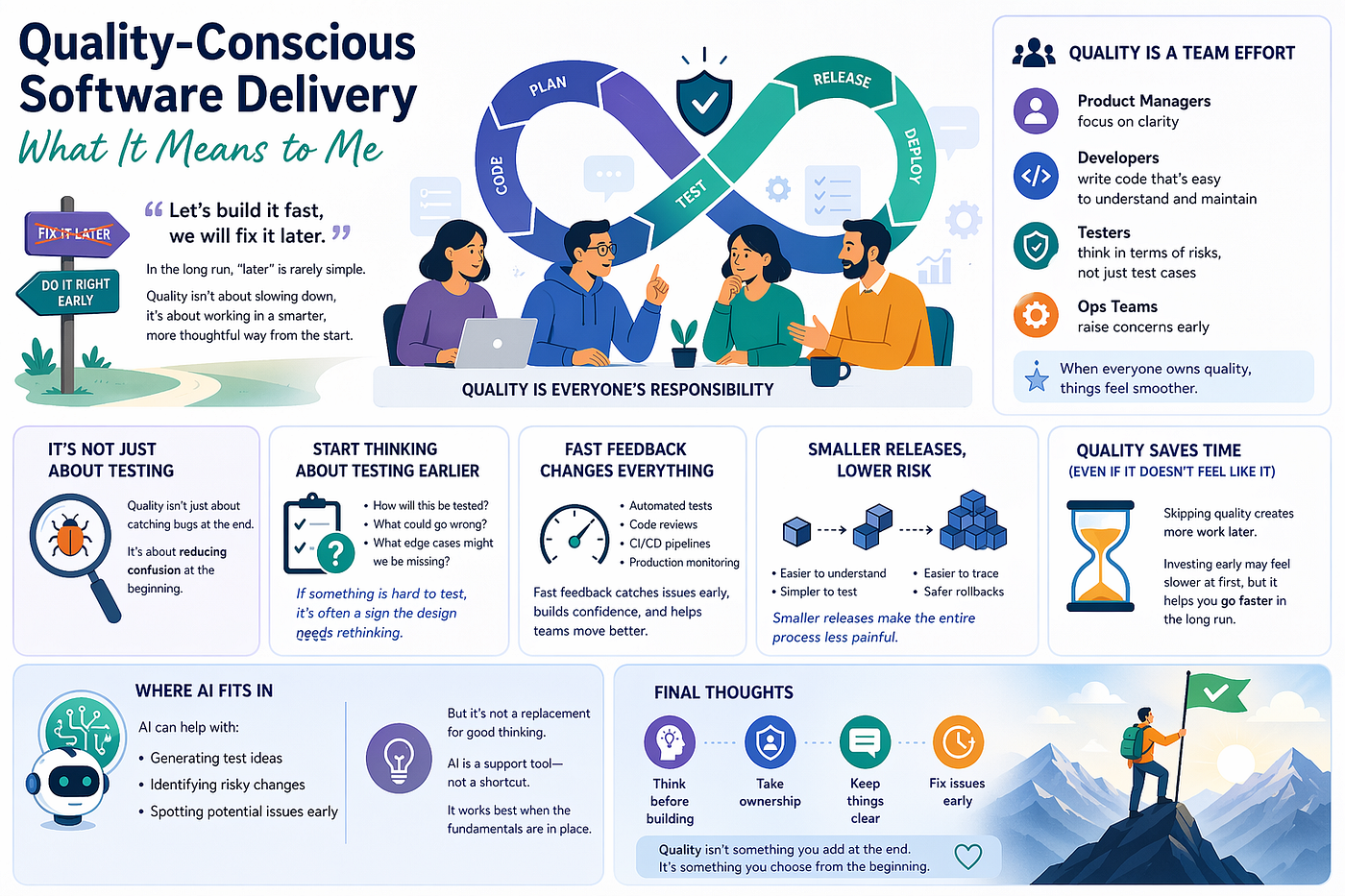
Quality-Conscious Software Delivery
If you have worked in software long enough, chances are you have heard this statement before. I definitely have, and at some point, I have even said it myself. In the moment, it often feels like the most practical option. Deadlines are tight, expectations are high, and teams are focused on moving quickly. Fixing issues later can seem like a reasonable compromise if it helps maintain delivery speed.
The challenge is that “later” is rarely as simple as it sounds. Issues that make it into production often require much more effort than expected. Teams end up revisiting work they believed was complete, priorities shift unexpectedly, and users may lose confidence when problems affect their experience. Instead of progressing forward, teams can find themselves repeatedly solving the same problems.
Over time, these experiences changed my view of quality. I no longer see it as something that slows delivery down. To me, quality is about making thoughtful decisions early so that teams spend less time dealing with avoidable problems later.
It’s Not Just About Testing
Earlier in my career, I viewed quality as primarily a testing responsibility. The process seemed straightforward: write the code, test it, fix defects, and release the product.
However, when issues appeared in production, the problem usually was not that the team had tested too little. In many cases, the causes were much broader and started much earlier in the process. Common examples included:
- Unclear or incomplete requirements
- Decisions made under time pressure
- Assumptions that were never validated
- Feedback arriving too late in the lifecycle
Experiences like these changed my perspective. Quality is not simply about finding bugs before release. It is about reducing confusion and uncertainty before development even begins.
Quality Is a Team Effort
One pattern I have noticed in teams that struggle is the belief that quality belongs to someone else. Comments such as “QA will handle it” or “we can test it later” often sound harmless, but they create gaps in ownership.
The strongest teams I have worked with treated quality as a shared responsibility, where each role contributed in a different way:
- Product managers focused on clarity and making sure requirements were well understood
- Developers wrote maintainable and understandable code
- Testers focused on risks rather than simply executing test cases
- Operations teams raised concerns and risks early in the process
When ownership is shared, the entire delivery process becomes smoother. Teams spend less time pointing fingers and more time solving problems together.
Start Thinking About Testing Earlier
One small shift that made a meaningful difference for me was thinking about testing before writing code rather than after development was complete.
Simple questions often helped uncover issues early:
- How will this feature be tested?
- What could potentially go wrong?
- Which edge cases might be overlooked?
These questions do more than improve testing. They often reveal weaknesses in the design itself. Over time, I noticed a recurring pattern: when something becomes difficult to test, it is frequently a sign that the design may need to be reconsidered.
Fast Feedback Changes Everything
High-performing teams do not wait until the end of a project to understand whether something is working correctly. Instead, they build mechanisms that provide feedback throughout the delivery process.
Some examples include:
- Automated testing
- Code reviews
- CI/CD pipelines
- Production monitoring
Fast feedback allows teams to detect problems while they are still small and manageable. Without it, teams often slow down — not because they are being cautious, but because they lack confidence in the changes they are making.
Smaller Releases, Lower Risk
I have worked on projects where releases were large and stressful. Multiple changes were bundled together, making it difficult to identify the source of problems when something went wrong.
Later, I worked with teams that released smaller and more frequent changes, and the difference was noticeable. Smaller releases brought several advantages:
- Changes were easier to understand
- Testing became more manageable
- Defects were easier to trace
- Rollbacks became safer
Smaller releases do not simply reduce risk; they also make the entire delivery process less painful and easier to manage.
Quality Saves Time (Even If It Doesn’t Feel Like It)
Focusing on quality can initially feel slower because it requires additional thought and discipline early in the process. However, skipping those activities often creates much more work later.
I have seen teams rush delivery only to spend weeks fixing production issues afterward. Eventually, teams become trapped in a cycle of rework and firefighting. Teams that invest in quality early may appear slower at first, but they avoid repeated fixes and unnecessary effort. Over time, they often deliver more effectively and move faster overall.
Where AI Fits In
AI is becoming an increasingly important part of software delivery and can provide significant value. It can support teams by:
- Generating testing ideas
- Identifying potentially risky changes
- Highlighting issues early in the process
At the same time, AI should not replace critical thinking. Overreliance on tools can encourage people to skip important analysis and decision-making steps. I see AI as a support mechanism rather than a shortcut. Its value is greatest when strong fundamentals already exist.
If this topic resonates with you and you would like to explore quality-conscious software delivery in greater depth, continue reading here: | Tales of Testing
Final Thoughts
For me, quality-conscious software delivery is not about rigid processes or heavy governance. It is a mindset built around a few principles:
- Think before building
- Take ownership
- Keep communication clear
- Address issues early
Quality is not something added at the end of the process. It is a choice that begins from the start.
메타데이터
- post_id
- e3c7ea7d24cf
- slug
- what-quality-conscious-software-delivery-means-to-me-e3c7ea7d24cf
- url
- https://medium.com/elevate-tech/what-quality-conscious-software-delivery-means-to-me-e3c7ea7d24cf
- canonical_url
- https://medium.com/elevate-tech/what-quality-conscious-software-delivery-means-to-me-e3c7ea7d24cf
- author_url
- https://medium.com/@s.saraf
- status
- ok
- fetched_at
- 2026-06-11 16:11:38