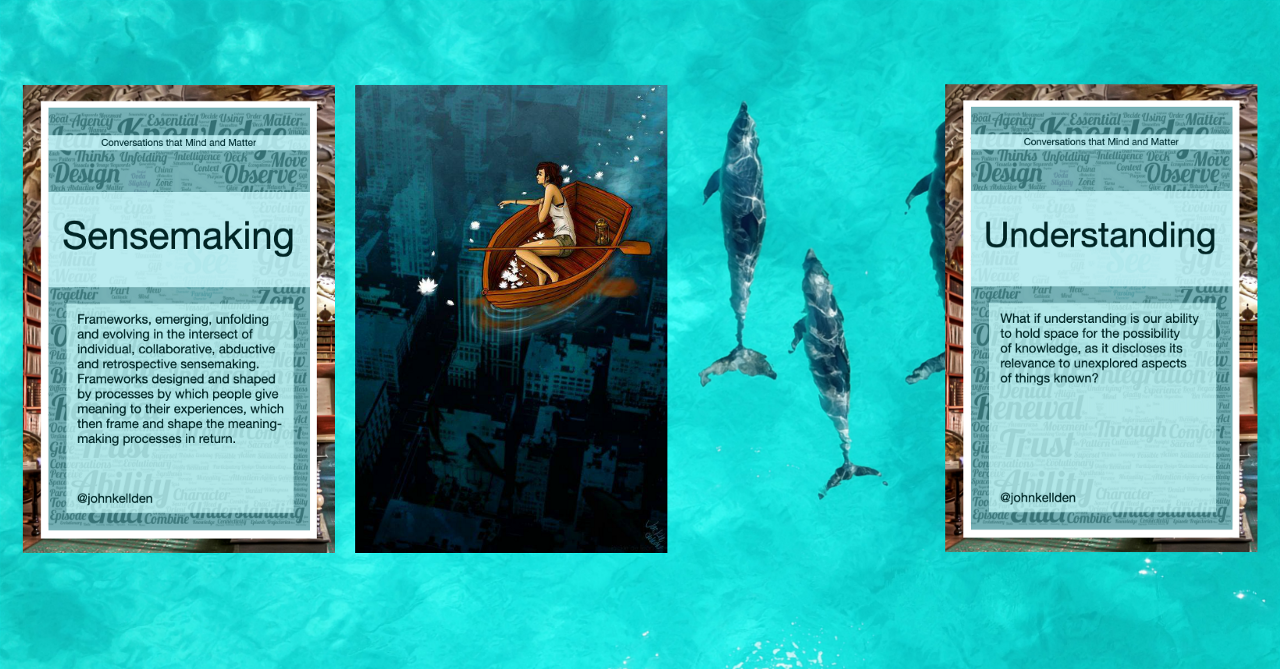
Playⁿ: Purpose
How signs become questions, questions become shared understanding, and shared understanding becomes ability and response-ability
Playⁿ: Purpose
How signs become questions, questions become
shared understanding, and shared understanding becomes ability and response-ability
Why: Purpose, in Playⁿ, is not a statement imposed before participation begins, but a living orientation cultivated through signs, questions, cards, conversations, insights, small different moves, understanding and the shared realization of potential.
How: Finite cards become cards-in-play within a situated field, bringing worthwhile dilemmas, generative questions, currencies, flows and perspectives into relation, and catalysing small different moves through which play, understanding, capability, and the conditions of participation can evolve.
Purpose as a Living Orientation
Purpose is often treated as something an individual, community, or organization should already possess.
A declaration. A mission. A north star. A destination selected before the journey begins.
Playⁿ begins somewhere else.
It begins with the possibility that purpose is not fully known in advance. Purpose may be latent in a situation, distributed among participants, obscured by inherited narratives, or waiting to emerge through interaction. It may need to be sensed before it can be stated, played before it can be understood, and enacted before it can be named.
In this sense, purpose is less like a command and more like an orientation.

Orientation, one of the 504 cards in the Playⁿ Source Deck.
Card: Orientation Cultivating unfolding purposeful paths of action, translating our beliefs, values, and insights into preferable outcomes.
It is neither entirely subjective nor entirely external. It arises between people, signs, situations, questions, technologies, histories, and possible futures. It becomes perceptible through the ways participants respond to what matters.
Purpose is therefore not only something we have. Purpose is something we form, share, test, revise, orchestrate and become capable of serving.
This is the Playⁿ RSSSSP context of purpose: recursive, systemic, semiotic, sympoietic, symbolic play.
Recursive, because each move changes the field from which the next move is made. Systemic, because no purpose exists in isolation from the relations, structures, histories, and consequences through which it operates. Semiotic, because purpose becomes available through signs: wicked problems, worthwhile dilemmas, words, images, ideas, gestures, questions, metaphors, cards, diagrams, narratives, voices, subtext, and patterns. Sympoietic, because worthwhile purpose is made-with others rather than produced by an autonomous self.
Symbolic, because purpose gathers more meaning than can be contained in literal description alone.
The generative review of RSSSSP turned cards-in-play, and card sessions:
flow = structure x process, with
“x” representing pattern, patterned intelligence, patterns of play and leveraged currencies

Currencies, one of the 504 cards in the Playⁿ Source Deck.
Playful, because purpose is not merely discovered as a fixed object. It is explored, rehearsed, recombined, interpreted, embodied, and brought into relation with an adjacent possible.
Purpose, in Playⁿ, is the play and small different moves turned movement through which potential learns how to participate in its own realization.
A Glimpse of a Card Session
Four participants gather around a worthwhile dilemma. The opening question is deceptively simple:
How do we make worthwhile dilemmas impossible to ignore?
Mara hesitates. “I’m not sure we actually want that. In order to function, we have to ignore most of the dilemmas out there.”
Sam nods. “Filtering isn’t a bug.”
Nora adds: “But the interesting part might be how we filter. There’s a difference between choosing what not to attend to and developing a coping pattern that makes something effectively invisible.”
The question changes.
GCQ, Generative Center Question
How might we create conditions in which worthwhile dilemmas can become sufficiently visible, bearable and shared that we can stay with them long enough to respond differently?
They begin adding cards.
Card: Personal Ken Comfort Zone The familiar territory of what we already know, recognize, assume and can readily explain — useful for orientation, limiting when mistaken for the whole field.
Mara notices something.
“A coping pattern can operate as a filter. It doesn’t merely hide information. It changes what the information appears to mean.”
Another card enters the field.
Card: Inference Ladder Between what happens and what we do, we select, interpret, assume and conclude. Making those moves visible gives thought another place from which to move.
Sam sketches:
Events → what becomes noticeable → what gets selected → meaning → assumptions → conclusions → action
Beside the whole sequence he writes:
coping patterns ↔ every rung
A third card shifts the conversation again.
Card: Worthwhile Dilemma A worthwhile dilemma holds enough tension to resist premature resolution while making possible new distinctions, questions, relations and purposeful paths of action.
Elias looks back at his original question. “Maybe the purpose isn’t to make a worthwhile dilemma impossible to ignore.”
A pause. “Maybe it is to make it possible to stay with.”
That distinction changes the field. Making something impossible to ignore can produce overwhelm — and stronger defenses against attention. Making something possible to stay with requires something different:
a question; a boundary; time; other perspectives; cards; voice; subtext; silence; presence; anticipation; memory;
and enough trust for uncertainty not to demand immediate closure.
The next card gives that something a name and a place.
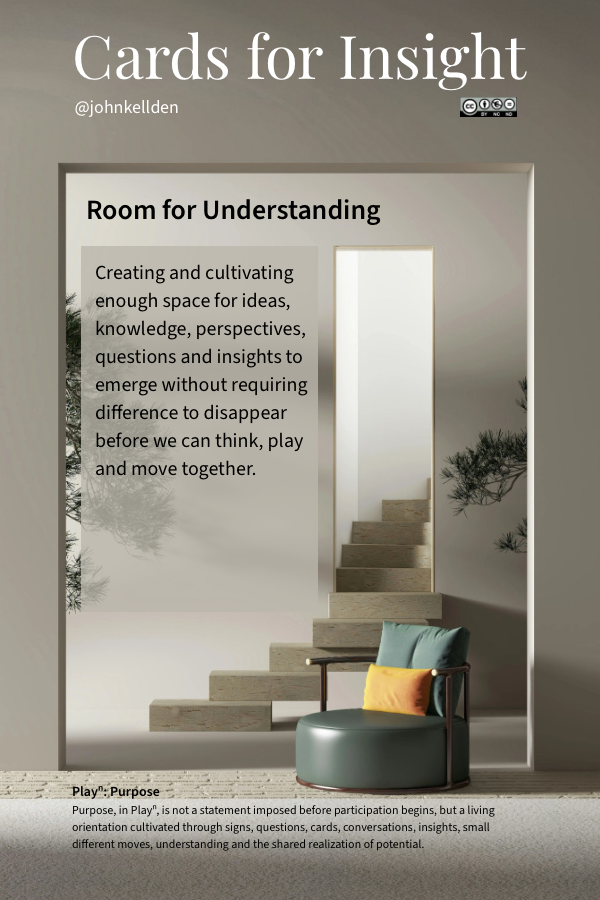
Room for Understanding, one of the 504 cards in the Playⁿ Source Deck.
Card: Room for Understanding Creating and cultivating enough space for ideas, knowledge, perspectives, questions and insights to emerge without requiring difference to disappear before we can think, play and move together.
By the end of the session, the original problem has become a different kind of possibility.
Not: How do we force attention toward what matters?
But: How do we create enough room to notice what we have learned not to notice?
The group keeps one sentence as a shard:
A worthwhile dilemma becomes generative when we can make enough room to stay with it without either ignoring it or being overwhelmed by it.
And from that shared understanding, four small different moves become possible.
The full session — moving through several cards — Personal Ken Comfort Zone, Inference Ladder, Worthwhile Dilemma, Room for Understanding, Coping Patterns, Small Different Moves, and Stewardship — continues in Postscript II: A Playⁿ Card Session — Making Worthwhile Dilemmas Visible.
The Diagram as a Purpose Field
Playⁿ triangle — A More Developed Sign, A More Developed Cognition, Conscious Evolution]

The Triangle: One of the Playⁿ diagrams
The diagram presents purpose not as a linear ladder but as a triangular field. At its center is the GCQ: a worthwhile dilemma formulated as a Generative Center Question.
Around the center are three points:
- A More Developed Sign
- A More Developed Cognition
- Conscious Evolution
Between them are three relational sides:
- Sensemaking
- Response-ability
- Stewardship
Inside those sides is what Playⁿ calls the Room for Understanding. The phrase names an analogy, a metaphor, a playable space, and one of the 504 cards in the Playⁿ Source Deck.

Understanding, one of the 504 cards in the Playⁿ Source Deck.
Card: Understanding Understanding is our ability to create and cultivate space for knowledge as it emerges, unfolds, directs, and reshapes our perspectives on the known, the adjacent possible and the unknown.
The room is not a neutral container. It is brought into being by the way participants attend, gather, pick cards, question, listen, make small different moves, and interpret and respond, together.
It is held by three sides because understanding needs more than information. Without sensemaking, signs remain fragments. Without response-ability, understanding remains spectatorship. Without stewardship, action may serve only immediate preference, power, or convenience.
The Room for Understanding is therefore a relational achievement: a temporary field cultivated by play, in which people can move beyond exchanging opinions and begin forming a shared orientation toward what matters.
The Diagram: The three centers
Personal Ken Comfort Zone The familiar field of what a participant already takes for granted, knows, assumes, infers, recognizes, prefers, reproduces or reinforces.
GCQ — Generative Center Question A worthwhile dilemma formed as a question capable of holding multiple perspectives, sustaining inquiry, and generating moves, from small different moves to paths of purposeful action.
Entelechy The realization of potential — not as a predetermined endpoint, but as potential becoming more fully itself through participation.
The Diagram: The three points of the triangle
A More Developed Sign A situation rendered more intelligible, playable, and shareable through discernment, sign use, symbols, cards, questions, diagrams, narratives, boundary objects and knowledge artifacts.
A More Developed Cognition Individual cognition becoming social, relational, distributed, reflective, embedded, extended, and increasingly capable of thinking with others.
Conscious Evolution Participants becoming more aware of and more responsible for the patterns, systems, technologies, narratives, and futures they are helping to bring forth.
The Diagram: The three sides
Sensemaking Relating signs, perspectives, experiences, trajectories, learning, stories, narratives, forces, and possibilities until more generative paths and coherent patterns can be seen and understood.
Response-ability Developing the ability to respond and interact creatively, convivially, and wisely, together.
Stewardship Caring for the longer arc: the shared field, its participants, its consequences, and the possibilities entrusted to it.
“It is the first step in sociological wisdom, to recognize that the major advances in civilization are processes which all but wreck the societies in which they occur — like unto an arrow in the hand of a child. The art of free society consists first in the maintenance of the symbolic code; and secondly in fearlessness of revision, to secure that the code serves those purposes which satisfy an enlightened reason. Those societies which cannot combine reverence to their symbols with freedom of revision, must ultimately decay either from anarchy, or from the slow atrophy of a life stifled by useless shadows.”
- — Alfred North Whitehead*
The center
GCQ The living hinge around which interpretation, enaction, participation, and action can gather.
The surrounding movement
Behavior → small moves → agency Purpose becomes real when insight changes and improves what participants are capable of noticing, choosing, and doing.
Intelligence → response-ability Purpose is not intelligence alone, but intelligence responsive to events, others, situations, feedback, context and anticipated outcomes.
The generative vector spiraling around the diagonal
Information → knowledge → understanding Information becomes knowledge when it is selected, related, and situated. Knowledge becomes understanding when it is tested through dialogue, reframed through other perspectives, and made capable of guiding response.
The movement is not linear but recursive: each card, question, conversation, note, and small different move returns participants to the diagonal with a more developed sign, a more developed cognition, and a more purposeful capacity to act.
The Room for Understanding
The Room for Understanding may be physical, digital, conceptual, symbolic, or all four at once.
It can be a table and a 3x3 gameboard, on and around which cards are placed.
It can be a groupchat in which a question is held open.
It can be a diagram that allows several different perspectives to occupy the same visual field.
It can be the moment when participants realize that they are no longer defending isolated positions, but helping one another perceive the system in which those positions arose.
The card Understanding gives this room a generative definition:
Understanding, one of the 504 cards in the Playⁿ Source Deck.
Card: Understanding Understanding is our ability to create and cultivate space for knowledge as it emerges, unfolds, directs, and reshapes our perspectives on the known, the adjacent possible and the unknown.
Understanding, here, is not possession. It is not the victorious conclusion of an argument. It is the ability to create and cultivate conditions in which knowledge can emerge without being prematurely reduced to what any one participant already believes.
This matters because most conversations begin inside what Playⁿ calls the personal ken comfort zone: the region bounded by what we think, recognize, know, presume, and feel able to interpret.
The personal ken comfort zone is necessary. No one begins nowhere. But when it becomes the final boundary of thought, conversation is at of reproducing existing cognition. We exchange and consume content without changing the field from which the content is produced.
Adding cards to the triangle interrupts that closure.
A card may introduce:
- a distinction one participant had not considered;
- a metaphor capable of linking different vocabularies;
- a tension that has remained implicit;
- a question that changes the scale of inquiry;
- a possible action small enough to attempt;
- a symbol through which the group can remember what emerged.
The card is not an answer inserted into the conversation. It is a sign placed into play.
Its meaning is completed neither by its author nor by the text printed on it. Its meaning unfolds through the associations, differences, memories, questions, and possible moves it generates among participants.
Adding cards to the triangle cultivates understanding and shared understanding by creating a visible commons of signs.
The participants can point to the same card without needing to mean precisely the same thing by it. Their differences remain available, but those differences now gather around a shared object of attention.
They begin to become, provisionally, on the same page. Not because their minds have been made identical. Because their minds are now participating in one evolving field.
The Three Points as Dimensions of Purpose
The three points of the triangle can be understood as three distinct but interdependent dimensions of purpose. They are also hinges. Each point connects two sides of the triangle, allowing purpose to turn from one mode into another.
A More Developed Sign: Infrastructure Purpose
A purpose cannot be played when it cannot be signified.
Before a group can respond together, the situation has to become sufficiently visible, nameable, and shareable.
This is the work of infrastructure purpose.
Infrastructure purpose creates the semiotic and procedural conditions through which participation becomes possible.
Its sequence may include:
Wicked Problem → Worthwhile Dilemma → GCQ → Card → Cards-in-Play → Small Different Moves → Notes → Insight → Shards
A wicked problem is often too entangled, contested, and expansive to enter directly.
Playⁿ therefore does not pretend to solve it through a single formulation. Instead, participants identify a worthwhile dilemma: a tension specific enough to gather around, yet rich enough to preserve the complexity of the wider situation.
The dilemma is then formulated as a Generative Center Question.
The GCQ turns the problem from an object people confront into a field in which they can participate.
Cards introduce developed signs into that field.
Small different moves translate signs into experiments.
Notes preserve traces of the inquiry.
Insights name emergent shifts.
Shards identify notes worth returning to: fragments carrying unfinished generative potential.
Infrastructure purpose is not merely technical infrastructure. It includes the signs, rituals, distinctions, interfaces, containers, questions, and memory structures that allow meaning-making to continue across time.
Its question is:
What must become visible, shareable, playable, and returnable for purposeful participation to occur?
A More Developed Sign as a hinge This point connects:
- Sensemaking, because signs allow situations to be interpreted;
- Response-ability, because better signs expand the range of possible responses.
A poorly developed sign compresses a complex field into a slogan. A more developed sign preserves enough complexity to provoke inquiry while providing enough form to support participation.
The purpose of a Playⁿ card is not to close meaning. It is to develop a sign capable of carrying meaning further.
A More Developed Cognition: Pivotal Purpose
The second dimension is pivotal purpose.
A pivot is a turning point. It changes not only what people think about, but how cognition itself is organized.
Pivotal purpose concerns the transition from isolated interpretation toward extended social cognition.
Its central question is:
How might we become capable of thinking together about what none of us can adequately understand alone?
In a networked world, many situations exceed individual cognitive capacity. The original Between Narratives post already located its card session within this predicament, arguing that complexity requires diverse perspectives as well as structured processes of discovery, sensemaking, and action.
Playⁿ develops this proposition further.
Social cognition is not achieved simply by putting many individual opinions in the same comment thread.
Aggregation is not yet understanding.
Communication is not necessarily cognition.
Conversation is not automatically collective intelligence.
A more developed internal cognition, involves becoming aware of our thinking, our inference ladder and our taking thought.

Taking Thought, one of the 504 cards in the Playⁿ Source Deck.
Card: Taking Thought A dynamic process where experience and reflection converge to shape present action and future outcomes.
Relationally, it requires structures and processes that help participants:
- notice how their assumptions are shaping perception;
- encounter perspectives without immediately assimilating or rejecting them;
- externalize thought through cards, maps, diagrams, and notes;
- observe how meaning changes during interaction;
- remember insights beyond the life of a single conversation;
- distinguish intelligence, ability, behavior, agency, information, knowledge, understanding, and shared understanding;
- make small different moves and create possible moves that no participant had brought into the room alone.
The original card session already performs this transition. Aria, Jules, and Kai bring different domains — education, community organizing, and sustainability design — into a shared exploration of information overwhelm. Their perspectives remain distinct, but the cards give those differences a common terrain.
Pivotal purpose is the point at which cognition ceases to defend itself and becomes capable of changing through relation.
A More Developed Cognition as a hinge
This point connects:
- Sensemaking, because cognition develops by encountering and patterning differences;
- Response-ability, because cognition is incomplete until it enlarges the ability to respond.
This is where Playⁿ moves from personal insight to shared understanding.
Not: I now possess the right interpretation.
But: We have become more capable of noticing, observing, questioning, and moving with this situation together.
Conscious Evolution: Orchestrating Purpose
The third dimension is orchestrating purpose. Orchestration does not mean controlling every voice, instrument, or outcome. It means arranging conditions so that differentiated forms of agency can become coherent without becoming uniform.
Conscious Evolution names the capacity to notice that human beings are not merely adapting to systems — we are also making, maintaining, modifying, and legitimizing them.
We are shaping technologies while technologies shape attention. We are governing AI while AI systems increasingly participate in the production, filtering, recombination, and circulation of signs. We are inheriting and adopting narratives while amplifying some, defending some, and abandoning others.
We are selecting infrastructures while those infrastructures change what can be visible, significant, rewarded, and acted upon.
Orchestrating purpose asks: What are we becoming through the systems, signs, narratives, perspectives, languages, tools, practices, social learning and relationships we are bringing into the world?
AI Governance This is where AI governance can be meaningfully addressed. Not only at the level of abstract principles. Not only by imposing governance and policies after systems have already been built. Not only through a binary choice between adoption and refusal. AI governance becomes a matter of orchestrating purpose when participants can safely and repeatedly inquire:
- What function is the AI performing in this field?
- Whose purposes are legible to it?
- Whose purposes remain invisible?
- What is being amplified, compressed, automated, or excluded?
- What should remain subject to human interpretation, sensemaking, intelligence, ability and responsibility?
- Where is the AI extending cognition?
- Where might it be substituting coherence with fluent closure?
- What worthwhile dilemmas, centers, questions, lines of inquiry, notes, insights and seed stories provide ground truth for the group’s own developing understanding?
- What small governance move can be made now?
- What can be revisited after feedback is turned into design cybernetics( navigating the new), and paths are aligned with default outcomes and preferable outcomes?
Playⁿ does not resolve AI governance all at once. It creates a structure through which governance, design cybernetics and navigating complexity can be integrated and then approached as a sequence of small, playable, revisable and meaningful acts of sensemaking and stewardship.
Conscious Evolution as a hinge This point connects:
- Response-ability, because conscious evolution depends on recognizing and accepting participation in consequences;
- Stewardship, because evolution becomes conscious only when power is accompanied by care for the field being changed.
Conscious Evolution is not a claim that we can control evolution. It is a commitment to stewardship, becoming more conscious of how we participate in it.
The Three Sides as Living Relations
The points of the triangle name dimensions of purpose. The sides name the relations through which those dimensions become active.
A point can be named. A side has to be traversed.
Sensemaking: From Sign to Cognition
Sensemaking connects A More Developed Sign with A More Developed Cognition. A sign does not become meaningful only by existing. It has to enter relation with narratives, experiences, context, paths, learning, signs, other people, anticipation and preferable outcomes.
Sensemaking is not only encoding and decoding. It is the recursive activity through which a group asks:
- What are we noticing?
- What appears significant?
- What remains absent?
- What pattern may be forming?
- What assumptions make that pattern visible?
- What alternative pattern might another participant perceive?
- What happens when these signs are placed beside one another?
Through card-play, sensemaking becomes tangible. One card can be read as an image, a metaphor, a question, an instruction, a cue, a catalyst, a memory affordance, and a provocation.
The same card moves through several modes during a session. Sensemaking is therefore not the elimination of ambiguity. It is the cultivation of a sufficiently coherent field within which ambiguity becomes generative rather than something to deflect, avoid or ignore..
Response-ability: From Cognition to Conscious Participation
Response-ability connects A More Developed Cognition with Conscious Evolution. Knowing does not guarantee acting wisely.
Information overload often produces the opposite: fatigue, paralysis, outrage cycles, performative reaction, or retreat into the personal ken comfort zone.
Response-ability names a developed capacity:
the ability to remain present to complexity while making a proportionate, meaningful move.
This is why Playⁿ emphasizes Small Different Moves. A small move is not necessarily trivial.
It can change: the next question; who is invited; what is brought to the room, table and the board, what is shared, what is captured, what is documented; what is slowed down; what assumptions are surfaced; what signal is treated as relevant; what heuristisc are used, which decision is deferred; what experiment is tried; what pattern is interrupted; and what relationship is repaired.
The move becomes different when it imoves beyond habitual response. Response-ability is intelligence converted into agency under conditions of information abundance, attention scarcity and meaning-making.
Stewardship: From Conscious Evolution to More Developed Signs
Stewardship connects Conscious Evolution with A More Developed Sign. This side completes the recursive triangle. The results, consequences, feedback and interaction from action returning to the situation.
What happened needs to be noticed, and embraced as experience. What best options turned into best path unfoldment, aligned with. What was learned needs to be articulated, curated and shared. What seed stories were created, compared with the narratives. What novelty was encountered, what stayed the same, and what changed needs to become available for the next round of inquiry.
Stewardship thus includes memory, presence and anticipation. Notes, diagrams, cards, session traces, questions, reflections, and knowledge artifacts allow the field to remember forward. They prevent every conversation from starting again at zero.
But stewardship is more than documentation. It also asks what should be preserved, revised, retired, shared, protected, or returned to the commons.
A sign developed without stewardship is branding. A cognition developed without stewardship is too often expertise serving itself. An evolutionary move without stewardship can become extraction.
Stewardship returns purpose to conversation, community and care.
Why the Diagram Is a Hypoicon
The diagram can be understood through the Peircean notion of the hypoicon: a sign that represents through a relation of resemblance.
A hypoicon may operate as an image, diagram, or metaphor. The Playⁿ triangle does all three.
As image
It offers an immediately perceptible whole. Three points. Three sides. A center. A surrounding field. A movement from personal ken comfort zone to entelechy. Before interpretation, the image presents a pattern.
As diagram
It makes relations visible. The points are not a list. Their position and placement matters. The sides are not decorative. They connect dimensions of purpose.
The GCQ is not located outside the system. It is placed at the center, suggesting that generative inquiry mediates the movement among sign, sign use, cognition, social cognition and conscious evolution.
As metaphor
The triangle becomes a room. The points become hinges. The sides become practices. The center becomes a gathering place. Cards enter the room and the room for understanding. Participants encounter, make sense of and move between positions.
Meaning does not only appear within the diagram; meaning is enacted through it.
As symbol
The diagram accumulates significance through repeated use. Over time, its points and sides can become a compact symbolic grammar through which participants remember a larger body of practice.
“A More Developed Sign” can invoke the whole infrastructure chain.
“A More Developed Cognition” can invoke cognition, taking thought, social cognition and shared understanding.
“Conscious Evolution” can invoke intelligence, ability, responsibility, governance, stewardship, and entelechy.
As meaning-making apparatus
The diagram is not only something to look at. It is something to play.
Participants can:
- place a GCQ at the center;
- add cards to the points, sides, or interior;
- explain why each card belongs where it has been placed;
- notice clusters, absences, contradictions, and affinities;
- invite others and/or AI to annotate relations or suggest alternative configurations;
- write down an insight on a note;
- identify a shard worth preserving;
- name one small different move;
- co-create a seed story;
- return later and ask how the diagram has changed.
The diagram is thus both a representation of purpose and an apparatus through which purpose can be developed.
How: Cards-in-Play
The 504 cards in the Playⁿ Source Deck can be imagined as if they are gradually unpacking themselves through play. Not because the cards contain a complete system waiting to be decoded. Because each card enters new relations whenever it is played.
A card acquires situated meaning through:
- the GCQ around which the group has gathered;
- the other cards already in the field;
- the participant who selected it;
- the associations it evokes;
- the tension or affinity it creates;
- the histories and experiences entering the conversation;
- the pattern of play being used;
- the notes and shards preserved from earlier sessions;
- the contribution of the human–AI metalogue;
- the move that follows.
Cards-in-Play are therefore different from cards stored in a deck. In the deck, a card is potential. In play, it becomes occasion. Across the conversation, it becomes relation. In a note, it works as insight capture. Shards and seed stories, shapes memory.
In a small different move, it becomes agency. Across repeated sessions, it may become pattern. The Source Deck does not provide 504 conclusions. It provides 504 possible entrances into a living grammar.
Human Meaning-Making and Human–AI Metalogue
Human–AI metalogue is not merely a conversation in which a person asks an AI to produce text. A metalogue includes reflection on how the conversation itself is shaping what can be thought.
The AI may:
- suggest associations among cards;
- surface contrasting interpretations;
- name recurrent patterns;
- reframe a dilemma;
- offer questions;
- compress a conversation into provisional shards;
- help compare the present session with earlier ones;
- generate alternative arrangements of the diagram;
- identify places where closure may have become premature.
- transpose between texts, sessions and contexts
But the AI does not determine what matters. It does not possess the lived stakes of the participants. It does not carry the results or the consequences in the same way. It does not replace the human work of
intelligence, ability, response-ability, thought, behavior, agency, information turning knowledge, interpretation, social cognition, sensemaking, and stewardship.
The purpose of the AI contribution is not to become the center. The GCQ remains at the center. The card session co-evolving with the awareness of the human situation remains the ground.
The AI becomes one participant in the semiotic field — capable of expanding the adjacent possible, but requiring governance by the purpose and values of the people who are playing.
Purpose as a Recursive Sequence
The diagram can now be read as a recursive sequence:
A situation produces signs. Some signs become sufficiently developed to reveal a worthwhile dilemma. The dilemma becomes a GCQ. Cards gather perspectives around the question. Sensemaking turns fragments into provisional patterns. A more developed cognition then becomes possible. Understanding becomes shared without requiring framework, platform adoption or sameness. Shared understanding augments ability and enhances response-ability.
Response-ability becomes one or more small different moves. The consequences of those moves are observed. Stewardship preserves and interprets what happened. New signs emerge.
Purpose as recursive play The triangle begins again, but not from the same place.
Purpose, Entelechy, and Realization of Potential
The diagram places entelechy beyond the triangle, not as an escape from it, but as its deep orientation.
Entelechy can be interpreted as the actualization of a fixed essence. In Playⁿ, it can be read more relationally and related to potential. Potential is not exclusively individual.
A person’s potential depends on environments, invitations, relations, practices, technologies, narratives, and possibilities of participation.
A group’s potential does not exist apart from how its members become capable of listening, learning, coordinating, and making meaning together.
A system’s potential is never only technical. It also depends on whether participants can perceive and redirect its patterns.
Purpose is therefore the process through which potential becomes imagined, envisioned and achieved through response-ability.
Entelechy is not so much a reaching a destination, but a cultivation of generativity in service to seeds of entelechy, flourishing in fields, fields of plenitude. It scaffolded by growing coherence:
- what a situation might become;
- what participants can perceive;
- what they care enough to serve;
- and what they become capable of doing together.
Generative Closure: Purpose Is What the Field Can Now Do
A Playⁿ session does not need to end with consensus. It can end with a more preferable outcome, with a more developed field.
With the participants now possessing:
- a better question;
- a more developed sign;
- a shared distinction;
- a newly visible tension;
- a shard worth returning to;
- a small different move;
- a clearer responsibility;
- a promise to reconvene;
- a greater capacity to remain with uncertainty;
- a more coherent sense of what they are becoming together.
Purpose rather than finalized, becoming more playable.
The group has moved from separate personal ken comfort zones toward a Room for Understanding. The room is held by Sensemaking, Response-ability, and Stewardship. Its hinges are A More Developed Sign, A More Developed Cognition, and Conscious Evolution.
Its center is a question that no one participant owns. Its method is Cards-in-Play. Its movement is from behavior toward agency, from intelligence toward ability, and from information overwhelm and isolated individual knowledge toward shared understanding.
Its horizon is entelechy: potential participating in its own realization.
Purpose, then, is not the answer above the field.
Purpose is the coherence becoming possible within it, a coherence field and a generative vector.
Simplicity beyond complexity: After playing, the field can perceive, unfold, reflect, evolve, and respond in ways it could not before.
Postscript I: John Kellden
Participate well. Sing out for yourself. Hold still for three seconds — long enough for the noospheric transception to land (and remain perfectly yourself if it does not), and let the rest unfold.
I am less interested in being right than in remaining responsive to what feels meaningful and true, building further on what is already there, while occasionally adding something new.
Card: Bounded Infinity The bounded infinity of the 504-card Source Deck is a finite symbolic grammar providing unbounded generative possibility.
Through the Modular Process Onto-Epistemology (MPOE), these finite symbolic elements (the cards) become vessels of recursive systemic semiotic sympoietic and semantic play.
My work, centered on cards, large finite sets, and bounded infinity, explores conscious evolution, cultural sensemaking, and human–AI metalogue as practices of becoming rather than systems of certainty.
I do not assume understanding will be immediate or universal. I assume only that careful attention, small moves, and shared inquiry can make a difference over time.
If there is a through-line, it is this:
to participate, as best I can, in the ongoing experiment of human becoming.

Participation, one of the 504 cards in the Playⁿ Source Deck.
Card: Participation Participation is presence becoming consequential contribution. A participant affects what the field can notice and do, remains open to being affected, and shares responsibility for the conditions through which later participation becomes possible.
What remains will remain.
The work is simply to participate well — guided by living into our own questions, and leaving concerns about lasting meaning and purpose to those who follow. In the end, we add our own unique touch to the larger canvas, meeting ourselves, others, the world, and the universe halfway.
We made it? What happened? We happened.
John Kellden is a Swedish facilitator, storyteller, and creator of Playⁿ, a card-based practice for navigating complexity through playful and structured inquiry. For more than two decades he has developed and field-tested a 504-card source deck designed to spark perspective shifts, generative dialogue, and new patterns of understanding in individuals and small groups.
At the core of his work is a simple practice:
- pick a card,
- make a move,
- notice what shifts,
- sing out for yourself,
- listen for what becomes possible,
- and follow where the inquiry leads.
John lives in Sweden with his family and continues to explore how play, storytelling, and human–AI collaboration can support conscious evolution and meaningful cultural change.
Postscript II: A Playⁿ Card Session
Making Worthwhile Dilemmas Visible
Worthwhile dilemma
Much of what shapes a difficult situation remains tacit.
At the same time, human beings cannot attend to every tension, contradiction, risk, injustice, possibility, or unresolved question around them. In order to function, we necessarily ignore most of what could demand our attention.
The dilemma is therefore not simply: How do we make worthwhile dilemmas impossible to ignore?
There is a deeper tension underneath it: How do we distinguish between necessary filtering and coping patterns that prevent us from seeing what most needs our attention?
And further: How do those coping patterns shape our inference ladders before we are even aware that an inference has been made?
The players
Mara — works with organizational learning and has become increasingly interested in why groups repeatedly avoid questions everyone privately knows matter.
Elias — works in product and strategy and tends to ask what would make an important issue sufficiently concrete that people actually respond.
Nora — facilitates groups and notices how quickly discomfort is converted into skillful avoidance, silence, opinion, humor, explanation, abstraction, or premature action.
Sam — works with technology and systems and is interested in the relationship between attention, information overload, filtering, and collective cognition.
They gather online for a forty-five-minute Playⁿ session. The starting question comes from Elias.
The opening
Elias leans toward his camera. “I’ve been thinking about worthwhile dilemmas.”
He pauses. “More specifically: How do we make worthwhile dilemmas impossible to ignore?”
Mara smiles slightly. “That sounds compelling, but I’m not sure we actually want that.”
Elias raises an eyebrow. “Why not?”
“Because most of what is happening around us is potentially significant,” Mara says. “There are thousands of dilemmas we could pay attention to. In order to function at all, we have to ignore almost all of them.”
Sam nods. “That’s probably true, both regarding computation as well as psychologically. Attention is scarce. Filtering isn’t a bug.”
Nora adds: “But the interesting part might be how we filter. There’s a difference between choosing what not to attend to and developing a coping pattern that makes something effectively invisible.”
Mara looks back at the question. “Exactly. Maybe the question isn’t how to make dilemmas impossible to ignore.”
She types into the shared space.
What worthwhile dilemmas have our coping patterns taught us not to see?
Elias reads it. “That feels sharper.”
Sam adds: “And then perhaps: how are those coping patterns affecting the inference ladder?”
A silence.
Nora smiles. “Now we have a dilemma inside the dilemma.”
From Wicked Problem to Worthwhile Dilemma
They name the larger field:
Attention under conditions of complexity.
They name some of its forces:
information overload; habituation; organizational routines; cognitive economy; identity protection; social conformity; platform incentives; urgency; fatigue; fear; learned helplessness; professional specialization.
Mara says: “We can’t solve ‘attention under complexity.’ That’s too large.”
Nora replies: “But we can find a tension worth staying with.”
Together they formulate it:
Worthwhile Dilemma
We need coping patterns in order to function, yet those same coping patterns may prevent us from noticing the dilemmas that most require a different response.
Sam reads it twice. “That preserves both sides. Coping isn’t being made into the villain.”
“Right,” Mara says. “The problem isn’t that we filter. The question is whether our filtering still serves us.”
The GCQ, Generative Center Question
They spend several minutes adjusting the wording.
The first version is:
How might we notice the worthwhile dilemmas our coping patterns help us ignore?
Nora suggests adding action.
How might we notice and respond to worthwhile dilemmas our coping patterns help us ignore?
Sam wants the connection to inference.
How might we notice when coping patterns are shaping what we infer, ignore, and consider possible?
Elias looks at all three. “What if we make the center about developing the capacity, rather than detecting the error?”
Mara begins typing.
GCQ
How might we become more capable of noticing when our necessary coping patterns are hiding a worthwhile dilemma — and create enough room to respond differently?
The four sit with it.
Nora says: “That’s playable.”
Pattern of Play: Notice Before Naming
Before choosing cards, they agree on a simple pattern:
Notice → Name → Relate → Reframe → Move
Nora reads the instructions aloud.
First notice what the card evokes before explaining it. Then name the association. Relate it to the GCQ. Allow the other cards and perspectives to reframe it. Only then ask whether a small different move becomes possible.
Sam laughs. “So we’re deliberately slowing the inference ladder.”
“Exactly,” Nora says.
First Card: Personal Ken Comfort Zone
Mara draws the first card.
Card: Personal Ken Comfort Zone The familiar territory of what we already know, recognize, assume and can readily explain — useful for orientation, limiting when mistaken for the whole field.
Mara does not speak immediately.
Nora reminds her: “Notice before naming.”
Mara nods. “My first response is actually relief.”
“Relief?” Elias asks.
“Yes. The comfort zone isn’t being treated as something stupid that we need to escape. It’s necessary. We need somewhere from which to perceive.”
Sam says: “So maybe coping patterns partly constitute the comfort zone.”
“Exactly,” Mara replies. “They help maintain a workable world.”
Elias looks at the card. “But then the danger is that what is outside the comfort zone becomes not merely unfamiliar, but imperceptible.”
Nora adds: “Or perceptible only in forms that allow us to dismiss it.”
“What do you mean?”
“Think of something uncomfortable appearing in a meeting,” she says. “It might get coded as negativity. Or resistance. Or ‘not strategic.’ The dilemma appeared, but the group’s existing categories transformed it into something they already knew how to ignore.”
Sam types:
A coping pattern can operate as a semiotic filter: it does not merely hide information; it changes what the information appears to mean.
Mara looks at the sentence. “That feels important.”
Second Card: Inference Ladder
Sam chooses next.
Card: Inference Ladder Between what happens and what we do, we select, interpret, assume and conclude. Making those moves visible gives thought another place from which to move.
Sam laughs softly. “Well, there it is.”
Elias says: “This connects directly to the original thought. Coping patterns probably aren’t sitting at just one rung.”
“No,” Sam replies. “They shape what even gets onto the ladder.”
Nora gestures toward the card. “That’s the key distinction.”
She draws an imaginary ladder in the air. “We usually think: data, selected data, interpretation, assumptions, conclusions, action.”
Mara continues: “But coping happens before and throughout the sequence.”
Sam begins sketching in the shared workspace:
Events ↓ What becomes noticeable ↓ What gets selected ↓ Meaning assigned ↓ Assumptions ↓ Conclusions ↓ Action
Then beside it:
coping patterns ↔ every rung
Elias looks at the diagram. “So a worthwhile dilemma can be ‘ignored’ without anyone consciously deciding not to look at it.”
“Yes,” Nora says. “The system may have already rendered it irrelevant before conscious deliberation begins.”
Mara adds: “Which means that telling people to ‘pay more attention’ may not help.”
“That sounds like an important shift,” Elias says.
“What would help?”
Mara points toward the center question. “Creating conditions in which our own selection and interpretation can become objects of inquiry.”
Pattern of Play: Turn the Card
They ask the AI participating in the session for a pattern that might prevent the conversation from settling too quickly around the emerging explanation.
The suggestion is:
Turn the Card
For each apparent insight, ask: What does this explanation allow us to see?
Then: What might this explanation itself allow us to ignore?
Nora grins. “That’s suitably recursive.”
They apply it immediately. Sam reads their current insight:
Coping patterns shape what reaches the inference ladder.
“What does this let us see?” he asks.
Elias answers: “That avoidance isn’t always conscious.”
Mara: “That collective blind spots may arise from entirely reasonable individual adaptations.”
Nora: “That attention problems are partly relational and systemic.”
Then Sam asks: “And what might this explanation allow us to ignore?”
Silence.
Finally Elias says: “Agency.”
Mara nods. “Yes. We could make the coping pattern so systemic that nobody remains responsible for anything.”
Nora adds: “Or we turn reflexivity itself into another coping strategy. We endlessly analyze how our filters work instead of doing anything.”
Sam smiles. “So even ‘understanding our inference ladder’ can become a way of climbing down from response-ability.”
Third Card: Worthwhile Dilemma
Elias draws.
Card: Worthwhile Dilemma A worthwhile dilemma holds enough tension to resist premature resolution while making possible new distinctions, questions, relations and purposeful paths of action.
Elias reads it twice. “My original question was basically about salience. How do we make the dilemma impossible to ignore?”
He pauses. “I think I now want to change that.”
“To what?” asks Mara.
“Maybe the function of a worthwhile dilemma isn’t to become impossible to ignore. Maybe it is to become possible to stay with.”
Nora immediately looks up. “That’s a very different thing.”
Sam adds it to the shared notes:
Not impossible to ignore. Possible to stay with.
Mara thinks aloud. “If you make something impossible to ignore, you may simply overwhelm people. Then stronger coping mechanisms emerge.”
“Exactly,” says Nora. “Urgency can decrease response-ability.”
Elias nods. “So the design problem becomes: how do we give a dilemma enough form that people can encounter it without either trivializing it or being consumed by it?”
Sam points at the GCQ. “That’s where the word room matters.”
Fourth Card: Room for Understanding
Nora picks the next card.
Card: Room for Understanding Creating and cultivating enough space for knowledge, perspectives and questions to emerge without requiring difference to disappear before we can move together.
She smiles. “This feels almost literal now.”
Mara says: “The room is what sits between ignoring the dilemma and being overwhelmed by it.”
“Yes,” Nora says. “A worthwhile dilemma needs somewhere to exist.”
Elias asks: “What makes such a room?”
They begin naming conditions.
Time. A question instead of a demand. A boundary. A few cards. Different perspectives. Permission not to know. A center, a shared object of attention. Presence. Anticipation. Memory. A facilitator.
Voice. Subtext. Silence. A way to make differences visible. An AI that facilitates, rather than resolves the inquiry.
Sam says: “And some protection from the usual attention machinery.”
“What do you mean?”
“If every question immediately becomes a notification, post, argument, metric, task, or performance, there’s no room.”
Mara says: “So infrastructure purpose matters even here.”
She sketches a sequence:
signal → worthwhile dilemma → GCQ → cards → conversation → notes → shard → small different move
“What we’re doing,” she says, “is building enough infrastructure around the dilemma that it can remain present without needing to shout.”
The midpoint: A different question appears
Elias returns to his original question.
How do we make worthwhile dilemmas impossible to ignore?
He crosses out impossible to ignore.
Underneath he writes:
How do we make worthwhile dilemmas possible to encounter, stay with, and respond to?
Sam adds: “Without pretending we can attend to all of them.”
Mara: “And without treating every discomfort as a worthwhile dilemma.”
Nora: “That distinction matters. Otherwise the method becomes an engine for manufacturing significance.”
They revise again.
Revised GCQ
How might we create conditions in which worthwhile dilemmas can become sufficiently visible, bearable and shared that we can stay with them long enough to respond differently?
The four agree that the question has changed substantially.
Elias laughs. “My opening question has already been played out of existence.”
“Not existence,” Mara says. “Into a more developed sign.”
Fifth Card: Coping Patterns
Sam draws a card that has been added provisionally to the session.
Card: Coping Patterns Ways of filtering, simplifying, avoiding and stabilizing experience that help us keep functioning — and sometimes keep the field from telling us something new.
Nora reads the last line again. “Keep the field from telling us something new.”
Mara says: “That makes coping semiotic as well as psychological.”
Sam agrees. “If the world produces more difference than we can process, coping compresses difference.”
Elias: “And sometimes that compression is exactly what allows agency.”
“Right,” Mara says. “Which means we shouldn’t frame the goal as eliminating coping.”
Nora asks: “What would a developed coping pattern look like?”
They sit with the question.
Sam: “One that knows it is a coping pattern.”
Mara: “One that can loosen when conditions change.”
Elias: “One that preserves enough sensitivity to anomaly, to novelty, and to volatility, uncertainty, complexity and ambiguity. ”
Nora: “One that can be interrupted without making the person or group collapse.”
Mara types:
Healthy coping does not eliminate filtering. It makes filtering more revisable.
Sam adds:
A developed coping pattern includes the possibility of noticing when yesterday’s protection has become today’s blindness.
Sixth Card: Small Different Moves
Mara chooses.
Card: Small Different Moves Purposeful departures from habitual response: small enough to make, different enough to reveal something the existing pattern could not.
Elias says: “This solves something for me.”
“What?”
“I was still thinking that once we expose the hidden dilemma, we need to resolve it.”
Mara shakes her head. “No. We need a move that teaches us something.”
Sam points at the card. “That’s the systemic aspect. A move generates feedback.”
Nora: “And the feedback can revise the inference ladder.”
Elias: “So a small different move is partly an epistemic intervention.”
“Exactly,” says Mara. “We do something differently partly to discover what the situation actually is.”
Nora looks at the shared notes. “That turns action into inquiry.”
Human–AI Metalogue
At this point they ask the AI:
What pattern appears across the six cards? Do not resolve the dilemma. Give us three possible readings and one question that might disturb all three.
The AI offers three provisional readings.
Reading one: Attention The cards describe a movement from automatic filtering toward deliberate attention.
Reading two: Learning The cards describe a mechanism through which hidden assumptions become available for revision.
Reading three: Governance The cards describe the conditions through which a group determines what becomes salient enough to deserve collective response.
Then the disturbing question:
Who — or what — gets to decide that a dilemma is worthwhile in the first place?
The group goes quiet.
“That’s good,” Sam says.
“Annoyingly good,” Elias replies.
Nora: “It prevents us from treating ‘worthwhile dilemma’ as an objective category.”
Mara: “And it brings power into the room.”
She writes three possibilities:
self-selected group-recognized systemically imposed
Sam adds a fourth:
algorithmically surfaced
Another silence.
Elias says: “That changes the AI governance dimension too.”
Seventh Card: Stewardship
Elias picks the final card.
Card: Stewardship Caring for the field beyond the immediate move: noticing what we amplify, what we neglect, what we inherit, and what our participation makes more possible for others.
Elias exhales. “That’s probably the answer to the AI question.”
“Not an answer,” Nora says. “A constraint?” “A responsibility.”
Mara looks at the four categories they just named. “If determining what is worthwhile involves power, then stewardship becomes part of the mechanism.”
Sam: “Which means a good Playⁿ session shouldn’t simply help us gather and attend to a dilemma. It should also let us question why this dilemma has entered the center and what has been displaced by it.”
Nora says: “So every GCQ casts a shadow.”
Mara immediately writes it down.
Every GCQ casts a shadow: centering one question necessarily backgrounds others. Stewardship includes remembering this.
Pattern of Play: The Missing Card
For the final round, each participant names the card they believe is missing from the session.
Mara chooses Assumptions. “We’ve talked about inference, but assumptions are where the apparently obvious often hides.”
Sam chooses Signal. “Because we need to understand what allows something to cross the threshold into awareness.”
Nora chooses Silence as Data. “Because what repeatedly cannot be spoken may be exactly where the worthwhile dilemma is.”
Elias chooses Response-ability. “Because the point isn’t endless revelation. Eventually increased visibility has to change our capacity to respond.”
They place the four imaginary cards around the GCQ.
The field now reads:
Assumptions Signal Silence as Data Response-ability
Around:
How might we create conditions in which worthwhile dilemmas can become sufficiently visible, bearable and shared that we can stay with them long enough to respond differently?
Generative Review
Before closing, they review the movement of the session.
The original question:
How do we make worthwhile dilemmas impossible to ignore?
became:
How might we create conditions in which worthwhile dilemmas can become sufficiently visible, bearable and shared that we can stay with them long enough to respond differently?
Mara notices the transformation. “We moved from forcing attention to cultivating conditions.”
Sam adds: “From salience to sensemaking.”
Nora: “From exposing avoidance to understanding the function of coping.”
Elias: “And from ‘make people notice’ to stewardship of what gets centered.”
They look at the seven cards:
Personal Ken Comfort Zone Inference Ladder Worthwhile Dilemma Room for Understanding Coping Patterns Small Different Moves Stewardship
Mara draws a line through them:
comfort → inference → dilemma → room → pattern → move → stewardship
“That feels almost like a generative sequence,” she says.
Sam replies: “And because stewardship changes what we notice next, it loops.” He adds an arrow back to the first card.
Shards
They end by asking: What from this session is worth returning to?
Several candidate shards emerge.
A worthwhile dilemma does not need to become impossible to ignore. It needs to become possible to stay with.
Coping patterns are not merely barriers to understanding; they are necessary filters that become problematic when they can no longer revise themselves.
A coping pattern can shape the inference ladder before conscious inference begins.
A small different move is an epistemic intervention: acting differently can reveal, disclose or elevate something the existing pattern could not perceive.
Every GCQ casts a shadow. Centering one question necessarily backgrounds others. Stewardship includes remembering this.
After some discussion, they select one as the session shard:
Shard
A worthwhile dilemma becomes generative when we can make enough room to stay with it without either ignoring it or being overwhelmed by it.
Small Different Moves
Each participant ends with one move.
Mara At the next meeting where a recurring issue is dismissed as “something we already know,” ask:
What might this familiar explanation be helping us not notice?
Elias When framing the next strategic problem, replace:
How do we get people to pay attention to this?
with:
What would make this dilemma possible to encounter and stay with?
Nora During her next facilitated session, notice the first moment when discomfort turns into humor, abstraction, blame, or premature solution — and treat the transition itself as data.
Sam When using AI to summarize a complex discussion, add:
What tensions, minority perspectives, unanswered questions, and silences may this summary have made easier to ignore?
Generative Closure: From impossible
to ignore to possible to respond
The session began with a compelling question:
How do we make worthwhile dilemmas impossible to ignore?
But card-play complicated the premise. Ignoring is not simply failure.
Human beings survive through selective attention. Individuals, groups, organizations, and societies construct coping patterns that compress complexity into something inhabitable.
The same patterns that protect cognition, however, can become filters through which certain signals cease to register as meaningful.
A dilemma can therefore disappear long before anyone consciously decides to avoid it. It may be filtered at the edge of the personal ken comfort zone. Selected out before climbing the inference ladder. Translated into familiar language. Dismissed as noise. Absorbed into organizational routine.
Turned into somebody else’s responsibility. Or looked at as so distant or overwhelming that disengagement becomes the only workable response.
The Playⁿ move is therefore not to abolish coping, defeat filtering, or make every worthwhile dilemma scream louder.
It is to cultivate a Room for Understanding in which filtering itself can be slowed down, and, with practice, occasionally become visible.
A worthwhile dilemma becomes a GCQ a Generative Center Question. The GCQ gathers cards. Cards externalize distinctions. Different participation expose and explore different inference ladders. Metalogue and Human–AI metalogue enlarges the problem space, the possibility space and the semiotic field underneath both.
Coping patterns become discussable rather than invisible. A note captures an insight, and a shard preserves what builds and evolves. Cards-in-Play and their small different move turns understanding into actionable insight and inquiry-through-action: behavior turned agency and agency turned Gameⁿ, and, eventually, Winⁿ.
And stewardship returns the results, consequences and outcomes, however small, of that move to the next round of sensemaking.
The purpose is not maximal attention. It is different and better selective attention in service of better response.
Not: Make this impossible to ignore.
But perhaps: Make enough room for us to notice what we have learned not to notice.
Then stay with it long enough for another move to become possible. And different enough for small moves turning into paths of purposeful action to preferable outcomes, for the field to tell us something new. Then, taking thought in service to navigating complexity, and the new.
Postscript III: Taking Thought
Playⁿ as playable RSSSSP, thinking with Latour, Stengers, and Whitehead
There is another way to widen the notion of purpose.
Not purpose as intention. Not purpose as mission. Not purpose as the destination chosen before the path begins.
Purpose, here, becomes something closer to taking thought.
Not merely having thoughts. Not merely exchanging thoughts. Not merely producing thoughts.
Taking thought.
A phrase with a slightly older register, yet one that feels right for Playⁿ: thought as something received, shaped, tested, carried, and returned to the world through action.
Card: Taking Thought A dynamic process where experience and reflection converge to shape present action and future outcomes.
This card belongs near the center of Playⁿ: Purpose because it names what happens when purpose stops being a declaration and becomes a process of participation.
A situation is encountered. A sign is noticed. A card enters play. A question gathers people. A room for understanding appears. Experience and reflection begin to converge.
Thought is no longer a private possession. It becomes an event in the field.
This is where Bruno Latour’s introduction to Isabelle Stengers’s Thinking with Whitehead becomes strangely close to Playⁿ.
Latour’s question is simple and radical:
What is given in experience?
The question matters because modern thought has so often thinned experience before beginning to think. It has separated the world into what is supposedly real, objective, measurable, and primary, and what is supposedly added later: color, value, meaning, feeling, beauty, purpose, concern, and importance.
Whitehead called this the bifurcation of nature.
Stengers, as Latour reads her, does not treat Whitehead as a system to be summarized from outside. She thinks with him. She lets his concepts become occasions for thought. She refuses to let experience be reduced before it has been adequately encountered.
That refusal is also a Playⁿ move.
A worthwhile dilemma is not reduced to a problem too quickly. A GCQ does not eliminate tension in order to produce an answer. A card does not impose meaning. A diagram does not replace the field. An AI interpretation does not become authority. A small different move does not pretend to solve the whole.
Instead, Playⁿ asks:
What is given in experience? What has become too obvious to notice? What has been filtered out? What signs are asking to become more developed? What question can hold the field without closing it? What might become possible if we stop splitting fact from meaning, matter from value, cognition from participation?
This is where the three centers of the post begin to form a triple helix.
1. Personal Ken Comfort Zone
What is given in experience?
The Personal Ken Comfort Zone is not a defect.
It is where experience begins: the familiar region of what we already know, assume, recognize, prefer, and feel able to interpret.
No one begins nowhere.
But if the Personal Ken Comfort Zone becomes the final boundary of thought, then experience is narrowed before inquiry begins. We keep seeing what we already know how to see. We keep asking questions that protect our existing answers. We keep interpreting the new through inherited reflex.
Playⁿ begins by making this boundary playable.
A card appears. A phrase catches. A metaphor unsettles. A diagram holds several relations at once. Another participant sees differently. A silence becomes data. A question becomes more interesting than the answer we arrived with.
The given in experience is not abandoned. It is widened.
The comfort zone becomes a threshold.
2. Generative Center Question
What happens when we stop playing the game of bifurcation?
The second center is the GCQ.
A Generative Center Question asks a group to stop treating the world as if facts and meanings belonged to separate realities.
The question does not ask only:
What are the facts?
Nor does it ask only:
How do we feel about them?
It asks:
What field are we already inside, and how might we become capable of responding to it together?
This matters because many of our most serious dilemmas cannot be entered well if we split them too early.
Climate is not only data. AI is not only technology. Education is not only curriculum. A community is not only demographics. A conflict is not only positions. A person is not only behavior. A society is not only institutions. Purpose is not only intention.
Each is an entanglement of matter, meaning, memory, technology, value, history, language, care, fear, and possibility.
The GCQ is the Playⁿ apparatus for entering such entanglement without pretending to master it.
It gives the field a center.
Not the facilitator. Not the loudest participant. Not the AI. Not the prewritten model.
The question.
Around that question, cards become signs-in-play.
Card: Hypoicon-Play In hypoicon-play, the mind tests patterns, models, and analogies across symbolic space, letting meanings and meaning- making recombine through play and speculative exploration.
Biosemiotic interpretation supplies the living grammar of meaning; hypoicon-play supplies the creative syntax that rearranges meanings.
Together, they form the cognitive ecology within which metacognition becomes both diagnostic and generative.
Hypoicon-play is what happens when a card, diagram, image, metaphor, or analogy becomes more than illustration.
It becomes an instrument.
A hypoicon does not merely point. It resembles, relates, maps, and invites.
A card may be read as a symbol. A diagram may be entered as a room. A metaphor may become a bridge between vocabularies. A pattern may become visible because something was placed beside something else.
Through hypoicon-play, thought becomes spatial, relational, and movable.
This is why cards matter.
They let participants think with small symbolic forms before those forms harden into systems. They allow meanings to recombine without requiring immediate agreement. They create a temporary commons of signs where differences can gather without becoming opposition.
This is also why hypoicon-play can be understood as a precursor to a Whiteheadian take on understanding.
Card: Understanding Understanding is our ability to create and cultivate space for knowledge as it emerges, unfolds, directs, and reshapes our perspectives on the known, the adjacent possible and the unknown.
Understanding, in this sense, is not possession.
It is not the winning argument. It is not the final model. It is not the summary that sounds complete.
Understanding is the cultivated room in which knowledge can emerge without being prematurely reduced to what one participant already believes.
This is very close to Whitehead’s temperament.
The world is not a collection of dead objects waiting to be sorted. It is process, relation, occasion, feeling, prehension, and becoming. Every synthesis begins anew because every occasion inherits a world and adds something to it.
A Playⁿ session does the same.
The cards do not contain the whole system. The players do not bring the whole answer. The AI does not possess the whole interpretation. The GCQ does not close the dilemma. The small different move does not complete the work.
Each element participates in a new occasion of understanding.
The many become one, but only provisionally. The one returns to the many as a shard, a question, a distinction, a small move, a changed relation, or a field capable of continuing.
3. Seeds of Entelechy
What God awaits our rediscovery, beyond the bifurcation of nature?
The third center is more speculative.
Whitehead’s God is not easily reduced to doctrine. In Stengers’s and Latour’s reading, this God is not the sovereign ruler outside the world, explaining it from above. It is closer to the lure within the world toward richer possibility: a lure toward positive prehension, novelty, value, and becoming.
For Playⁿ, the important word may be lure.
Purpose is not imposed from outside the field. It is lured from within participation.
A sign becomes more developed. A cognition becomes more relational. A field becomes more coherent. A small move becomes possible. A group becomes more capable of perceiving, caring, and responding.
This is entelechy without determinism. Not a fixed essence unfolding according to plan, but potential becoming more fully itself through relation, participation, and response.
Seeds of entelechy are therefore not hidden certainties. They are invitations. They appear as moments when the field seems to know a little more than any participant knows alone.
A better question. A more generous distinction. A silence that changes the room. A card that suddenly belongs. A tension that becomes bearable. A next move that feels small, different, and real.
Here purpose widens again.
Purpose is not only what we intend. Purpose is what the field is becoming capable of serving.
Sociological Wisdom
At this point, purpose becomes civilizational. Not in the grandiose sense. In the practical sense.
Every society lives through symbols. Every group lives through shared codes. Every practice lives through forms that gather attention, memory, trust, and possibility.
But symbols can die. Codes can harden. Rituals can become empty. Institutions can mistake preservation for life. Movements can mistake disruption for renewal.
This is where sociological wisdom enters Playⁿ.
Card: Sociological Wisdom Sociological wisdom is the capacity to honor the symbols that bind a society together, while remaining fearless in revising them so they continue to serve life, reason, and shared flourishing.
Card: Sociological Wisdom Civilization advances through forces that disrupt the very societies that produce them. Sociological wisdom is learning to transform disruption into renewal rather than decay.
Card: Sociological Wisdom A living society is one that holds its symbolic codes lightly enough to evolve, yet dearly enough to cohere. Too much reverence breeds stagnation; too little breeds collapse. Sociological wisdom dances the fertile edge between.
These three cards extend the post’s purpose architecture beyond the individual and the group.
Purpose becomes not only personal orientation. Not only shared understanding. Not only small moves.
Purpose becomes the civic art of tending the symbolic forms through which a society remains capable of renewal.
This is why Playⁿ needs both cards and stewardship.
A card is a sign. A session is an occasion. A shard is memory. A small move is inquiry-through-action. A pattern of play is a social form. A living grammar is a way for a field to remember how to become more alive.
Sociological wisdom asks whether our signs still serve life.
Which symbols bind us? Which symbols blind us? Which codes preserve coherence? Which codes prevent evolution? Which disruptions are merely noise? Which disruptions carry the seed of renewal?
A society without coherence fragments.
A society without revision stagnates.
A society with sociological wisdom learns to play near the fertile edge: honoring what still carries life, revising what has become lifeless, and cultivating new forms before old forms collapse into either nostalgia or cynicism.
Playⁿ as playable taking thought
The deeper movement of this postscript is therefore simple:
Playⁿ takes thought.
It takes thought from experience. It takes thought into signs. It takes thought through cards. It takes thought around a GCQ. It takes thought into a Room for Understanding. It takes thought through human–AI metalogue. It takes thought into shards. It takes thought into small different moves. It takes thought back into the world.
This is RSSSSP in practice:
recursive, because every synthesis begins anew; systemic, because no sign, person, tool, or question stands alone; semiotic, because purpose becomes apprehensible through signs; sympoietic, because meaning is made-with; symbolic, because the field always exceeds literal description; playful, because finite forms can open onto becoming.
The triple helix can now be named:
Personal Ken Comfort Zone: What is given in experience?
Generative Center Question: What happens when we stop splitting fact from meaning, world from value, nature from purpose?
Seeds of Entelechy: What lure toward fuller becoming waits inside the field?
Around these three centers, Playⁿ becomes a semiosphere slingshot.
A sign catches. A card enters. A question forms. A field gathers. A pattern appears. A move becomes possible. The move returns to the field. The field begins again, but not from the same place.
Every synthesis begins anew.
Generative Closure: Purpose as the field taking thought
Purpose is often imagined as something we need to find before we can act. Playⁿ suggests something different. Instead, purpose emerges, unfolds and evolves, co-extensive and co-extending with what the field is able to take thought about.
Not everything. Not all at once. Not finally. Meeting ourselves, others, the world and the universe — halfway. Small different moves, satisficing the generative review: good enough.
Enough experience to matter. Enough signs to gather. Enough structure to hold. Enough play to explore. Enough understanding to move. Enough stewardship to return.
Purpose is what happens when experience and reflection converge into response-able participation. It is the field learning to think with itself. It is the group discovering that it can perceive, orient, enact, and respond in ways it could not before. It is potential learning how to participate in its own realization.
We made it? What happened? We happened. We took thought. We helped each other make small different moves, seeing ourselves through.
Meeting the field, consciously, as if for the first time.
메타데이터
- post_id
- e42a5dfc8b0e
- slug
- playⁿ-purpose-e42a5dfc8b0e
- url
- https://medium.com/@johnkellden/play%E2%81%BF-purpose-e42a5dfc8b0e
- canonical_url
- https://medium.com/@johnkellden/play%E2%81%BF-purpose-e42a5dfc8b0e
- author_url
- https://medium.com/@johnkellden
- status
- ok
- fetched_at
- 2026-08-28 18:17:52