Strategy: The Promise of Transformation and Why It Dies in the Middle
By Christopher Reep
Strategy: The Promise of Transformation and Why It Dies in the Middle
By Christopher Reep
Strategy is not a document; it is a promise. It is a commitment to evolve, to shed the old skin of an organization and become something fundamentally different. Yet, for most companies, this promise remains unfulfilled. The failure is rarely due to a lack of vision or effort; rather, it is mechanical.
In the complex machinery of a modern business, transformation is often caught in a vice, squeezed between structural inertia at the top and human resistance at the bottom. To succeed, leaders must understand why strategy dies in the middle and why the order of execution is the only thing that can save it.
The Two Walls of Strategy Execution
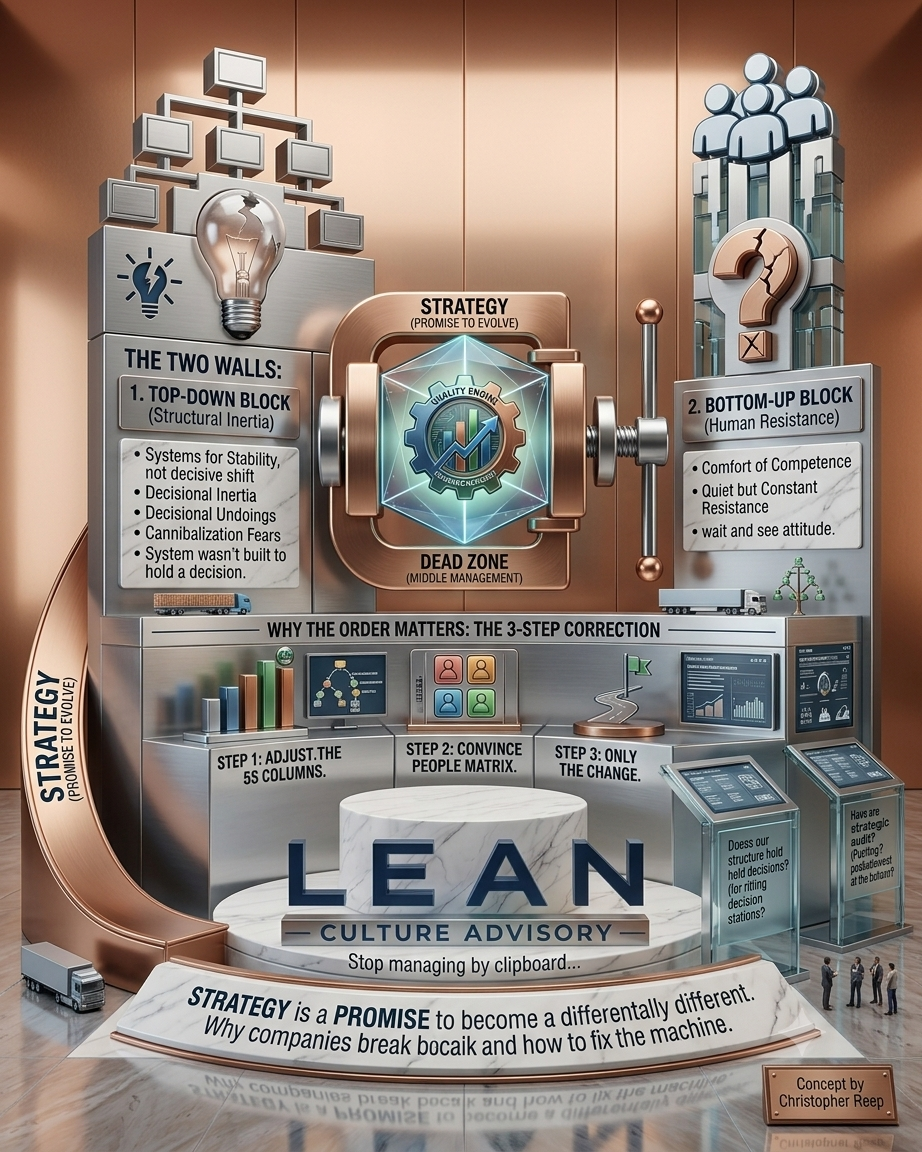
Real strategy is movement toward a vision. This movement is, by definition, a transformation. However, this transformation is systematically blocked from two sides, creating a “dead zone” in the middle of the organization.
1. The Top-Down Block: Structural Inertia
From the top, the very structure of the organization often acts as a barrier. Many systems are designed for stability and risk mitigation, not for holding a decisive strategic shift.
- Decisional Undoings: An organization may decide on a new direction, but its internal mechanisms keep undoing that decision. A project might gain momentum and budget, only to be “killed” by a strategy department that claims it no longer fits a shifting direction.
- Cannibalization Fears: Boards often pull the plug on new models when they see them “eating” old revenue streams. The system was never built to hold a decision that requires short-term sacrifice for long-term transformation.
2. The Bottom-Up Block: Human Resistance
From the bottom, the people within the organization provide a quiet but constant resistance. This is not necessarily malicious; it is a natural human tendency.
- The Comfort of Competence: Most employees prefer to remain what they are and do what they are already good at. Transformation asks for the opposite — it requires unlearning old habits and embracing the discomfort of new ones.
- Quiet Resistance: Unlike structural blocks, human resistance is often silent. It manifests as a lack of engagement, a return to old processes, or a “wait and see” attitude that slowly drains the life out of a new strategy.
Why the Order of Execution Matters
Most companies fail because they start at the end. They jump straight into “running the change” (execution) without removing the two walls standing in their way. They drive straight into a structural ceiling and a human floor. To break the cycle, the order must be reversed.
Step 1: Adjust the Structures First
Before you ask people to change, you must build a system that can hold a decision after it is made. This means aligning budgets, KPIs, and governance models so they don’t “undo” the strategy midway through. If the structure is not prepared to support the new vision, no amount of leadership talk will matter.
Step 2: Convince the People
Once the “mechanical” path is clear, you must address the human element. This isn’t just about a town hall meeting; it’s about giving people a clear path to become the new thing and a compelling reason to want that change. People will move when they see that the destination is better than the status quo and that they have the support to get there.
Step 3: Only Then, Run the Change
Execution is often described as the hardest part of strategy, but in reality, it is the easiest part — provided you have completed steps one and two. When the top and bottom stop fighting the movement, execution becomes a natural flow rather than a constant battle.
The Strategic Audit: Where Does Your Strategy Die?
The mechanical failure of strategy is a choice. It depends on the company, but the pattern is nearly universal. Most leaders start at step three, hitting two walls that were never removed.
To evaluate your own organization, ask these critical questions:
- Does our structure hold decisions? Or do we find ourselves re-litigating the same strategic choices every quarter?
- Have we given our people a reason to evolve? Or are we asking them to embrace discomfort without a clear personal “win”?
- Are we starting at Step 3? Are we pushing for execution before we’ve aligned the top and won over the bottom?
Strategy is a promise to become a different company. To keep that promise, you must first fix the machine that is meant to deliver it.
메타데이터
- post_id
- e5ff198cfb5d
- slug
- strategy-the-promise-of-transformation-and-why-it-dies-in-the-middle-e5ff198cfb5d
- url
- https://medium.com/@christopher.reepsr/strategy-the-promise-of-transformation-and-why-it-dies-in-the-middle-e5ff198cfb5d
- canonical_url
- https://medium.com/@christopher.reepsr/strategy-the-promise-of-transformation-and-why-it-dies-in-the-middle-e5ff198cfb5d
- author_url
- https://medium.com/@christopher.reepsr
- status
- ok
- fetched_at
- 2026-06-15 20:49:13




