The Black Internment Camps America Tried to Forget
The untold history of Black internment in America, from the Devil’s Punchbowl to the levee camps of the Mississippi Flood
The Black Internment Camps America Tried to Forget
The untold history of Black internment in America, from the Devil’s Punchbowl to the levee camps of the Mississippi Flood
Public Domain, https://commons.wikimedia.org/w/index.php?curid=15065
America’s history of interning Japanese Americans and immigrants during World War II is well known. From 1942 to 1945, American policy was to imprison those of Japanese descent in response to the Pearl Harbor attack in 1941. Eventually, after a decades-long campaign, survivors of the camps were awarded $20,000 in reparations.
How Japanese Americans Campaigned For Reparations — And Won : Code Switch : NPR
The Japanese weren’t the only ones interned in American history. A small percentage of Germans and Italians were interned during World War II. They blended in better with the general population and were harder to pick out. Like the Soup Nazi might say, “No reparations for you!”
Native Americans have been sent to prison camps and reservations, which, for the life of me, I can’t differentiate from the internment camps suffered by others. Native Americans were also put in prison camps at various times in American history, including Alaskans during World War II.
The Wartime Internment of Native Alaskans | The National WWII Museum | New Orleans
You probably heard of Japanese internment camps, perhaps heard of German and Italian internment camps, and have no doubt heard of reservations for Native Americans, though you may not have considered them as internment camps. How many of you have heard of Black internment camps, which existed before the camps involving the Japanese, Germans, and Italians?
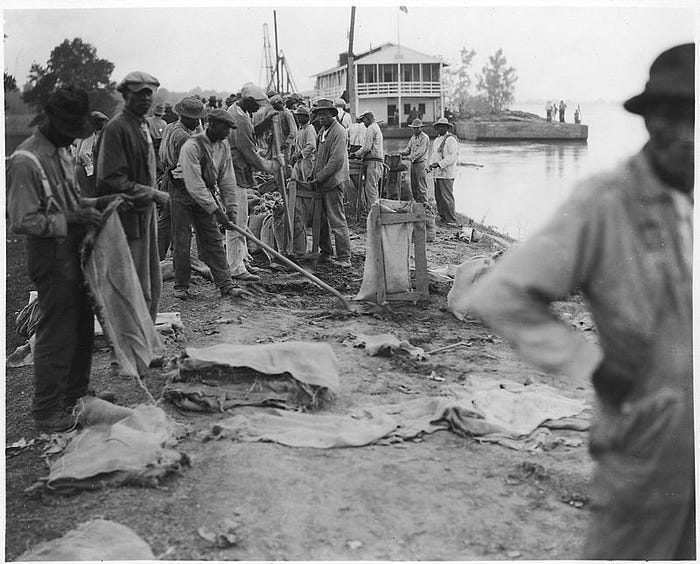
Public Domain, https://commons.wikimedia.org/w/index.php?curid=17160837
Natchez, Mississippi, was one of several hubs for the slave trade before the end of enslavement, along with Atlanta and New Orleans. Natchez was where domestic-bred enslaved people were sent from slave-selling states to states further South that needed them. They came by ocean, river, and train, and sometimes walked in coffles to these hubs, where they were sold to plantation owners and brothels as desired.
Natchez became important after the Civil War, but for a different reason. The population increased from 10,000 to over 100,000 with the influx of recently freed slaves. Union soldiers created a concentration camp in the Devil’s Punchbowl at the bottom of a hollow surrounded by trees and bluffs.
“So, they decided to build an encampment for ’em at Devil’s Punchbowl, which they walled off and wouldn’t let ’em out,” — Don Estes, Former Director of Natchez cemetery
Concrete walls were erected to contain the formerly enslaved, and over 20,000 people died from starvation. Men were taken from the camps daily to perform forced labor. The camps were ravaged by smallpox, and the bodies weren’t allowed to be removed. The “free” Black people had to bury them where they were. The land is currently used for peach groves, but the locals won’t eat the fruit because they understand how it was fertilized.
The Devil’s Punchbowl (Mississippi), a story — African American Registry
1921 was the year of the Black Wall Street Massacre in the Greenwood District of Tulsa, OK. What is rarely mentioned is that over 6,000 Black Tulsans were taken into “forced custody” and held in internment camps. The National Guard sent to save them forced survivors to work or be jailed for vagrancy on the order of the Mayor.
Tulsa Race Massacre: Black Tulsans were detained in camps throughout the city
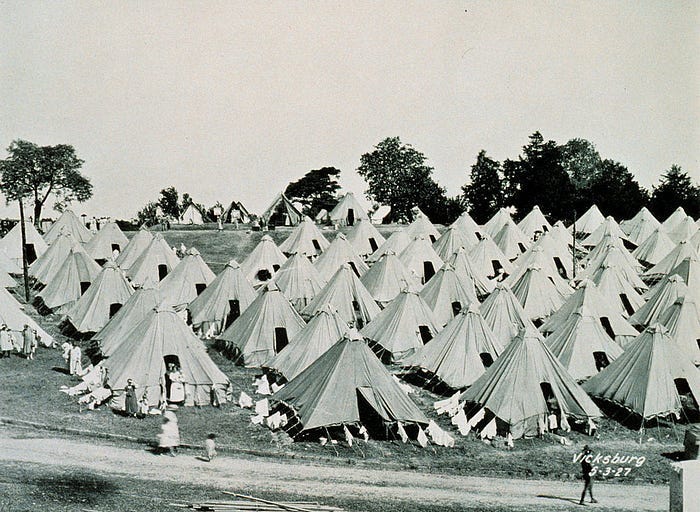
In 1927, the Mississippi River experienced some of its worst flooding ever. Most of the damage occurred in Mississippi, Arkansas, and Louisiana. Over 500 people died, and more than 630,000 were directly affected. Calvin Coolidge was the President, and Herbert Hoover was the Secretary of Commerce. Hoover is credited with implementing a plan to prevent future floods by constructing a series of levees and floodways. The Mississippi River was diverted to make the Mississippi Delta safer in the coming years.
The Great Mississippi (River) Flood | by William Spivey | Black History Month 365 | Medium
Coolidge and Hoover chose to flood African American communities along the river for the greater good. Some white Americans were displaced to a lesser degree. Refugee camps were set up to provide aid, with white people receiving it first. While under government supervision, white people received supplies first, and Black people might get leftovers. Black people could obtain supplies only by providing the name of their white employer or a voucher from an authorized white person.
Violence and sexual assault were common in the camps. A Black man was shot and killed for refusing to unload a relief boat for white citizens at gunpoint. Another was lynched after killing an overseer who tried to force him to rescue a plantation owner’s mules. Black people were forced to remain in the camps and provide labor to repair levees and dams, sometimes without pay. Black women were raped by guards. Commerce Secretary Hoover promised the Black community that there would be changes, though none occurred.
Hoover was credited for performing admirably during the flood and rode that “success” to being elected President in 1928. Over 300,000 Black people were permanently displaced, joining the Great Migration to northern cities. Media reports about conditions in the camps were suppressed at Hoover’s direction. Before the Civil Rights movement in the 1960s, before the integration of the armed forces in 1948, the first shift of Black voters from Republicans to Democrats began after broken promises on the Mississippi River.
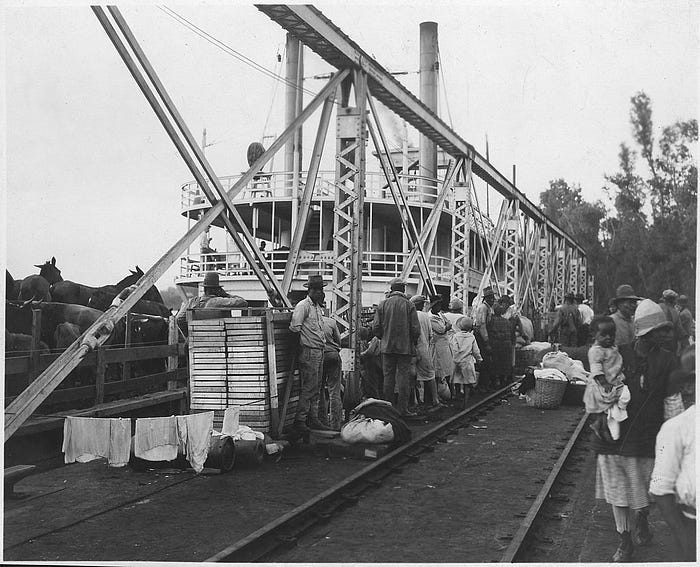
Public Domain, https://commons.wikimedia.org/w/index.php?curid=17160853
Make no mistake; all of America’s internment camps were wrong and never should have happened. Each is an integral part of American history that should be taught, not whitesplained away. We haven’t learned enough from our history not to stop replicating it. We now have Hispanic internment camps along our Southern border, Alligator Alcatraz, and more. We give them other names, yet we constantly condemn other nations for their human rights abuses. Where do we get the nerve?
메타데이터
- post_id
- f02a7589e8fe
- slug
- the-black-internment-camps-america-tried-to-forget-f02a7589e8fe
- url
- https://medium.com/the-polis/the-black-internment-camps-america-tried-to-forget-f02a7589e8fe
- canonical_url
- https://medium.com/the-polis/the-black-internment-camps-america-tried-to-forget-f02a7589e8fe
- author_url
- https://medium.com/@williamspivey
- status
- ok
- fetched_at
- 2026-08-02 22:05:46