A Man has used Claude to recover around $400,000 in Bitcoin
A Bitcoin holder has recovered nearly $400,000 worth of BTC after being locked out of his wallet for over 11 years, with help from…
A Man has used Claude to recover around $400,000 in Bitcoin
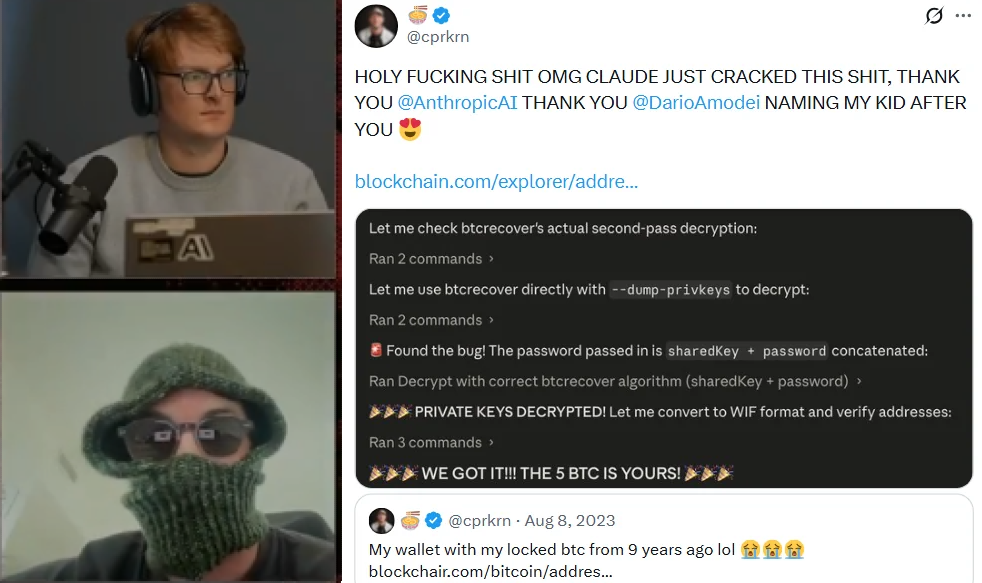
A Bitcoin holder has recovered nearly $400,000 worth of BTC after being locked out of his wallet for over 11 years, with help from Anthropic’s AI assistant Claude.
It is 3 Jan 2009, and you are holding a winning Powerball ticket, but it’s permanently encased in a block of reinforced bulletproof glass. You can see it. You can track its value every single day. But you can never, ever cash it in.
For the average person, this is a bizarre thought experiment. For an user named CPRKRN on X, it was a waking nightmare that lasted for exactly four thousand days.

CPRKRN TRYING TO GET HIS 5 BTC for approx 12 years
In the high-stakes world of cryptocurrency, the phrase “Not your keys, not your coins” is like a gospel.
Self-custody is the ultimate financial freedom, completely untethered from banks, borders, or bureaucracy. But that freedom comes with a terrifying caveat: there is no IT department to call when you make a mistake.
There is no “Forgot Password” button.
If you lose your keys, your wealth is simply absorbed into the ether, locked behind unbreakable mathematics until the end of time.
This isn’t a story about a sophisticated blockchain heist or a complex algorithmic exploit.
It’s a story about human fallibility, the psychological torture of an eleven-year forced “HODL,” and the unprecedented way artificial intelligence is now capable of acting as a forensic archaeologist for our forgotten digital lives.
The $200 Coffee Shop Gamble
To understand the weight of the mistake, you have to go back to the beginning.
The year was 2013. Bitcoin was still a fringe obsession, a cypherpunk novelty traded in obscure forums rather than on Wall Street.
Long before any institutional ETFs and Super Bowl commercials, acquiring cryptocurrency was an inherently sketchy process.
For Cprkrn, it started with an in-person cash exchange at a local Starbucks.
He handed over $200 in physical paper money. In return, 5 BTC was transferred to his digital wallet. At the time, it was the equivalent of buying a few lottery tickets — a fun, speculative gamble by a college student.
For two years, the coins sat there, quietly doing nothing. But then came 2015, and with it, the single most expensive typographical error of his life.
Botanically Induced Lockdown
College is a time for questionable decisions, but few carry a half-million-dollar price tag.
One evening in 2015, while profoundly high, Cprkrn decided his digital security needed an upgrade. In a haze of misplaced confidence and anti-establishment humor, he changed the encryption password on his Bitcoin wallet, which has 5 BTC.

He bypassed standard passphrases in favor of something he found highly amusing in the moment:
lol420fuckthePOLICE!*:) his password, which he forgets later
It was a chaotic string of lowercase letters, numbers, capitalized words, special characters, and a concluding emoticon.
To a stoned college student, it was a masterpiece of impenetrable security. ( Sound perfect, no one will be able to guess my password, not even me.. lol)
And it was impenetrable. Even to anyone.
By the time the high wore off, the exact casing, syntax, and punctuation of the joke had vanished from his memory.
He tried typing it in. Access denied.
He tried different variations of capitalization. Access denied. Just like that, the vault slammed shut.
Eleven-Year Winter
What followed was over a decade of agonizing financial paralysis.
As the years ticked by, the value of Bitcoin began its historic, violent ascent.
The $200 novelty buy morphed into $5,000, then $50,000, and eventually, by the spring of 2026, hovered near an eye-watering $400,000.
As the price climbed, so did his desperation. Those 5 BTC weren’t just internet money anymore; they were a down payment on a house. They were a wedding fund. They were life-altering capital, agonizingly visible on the public blockchain, but entirely untouchable.
He threw everything at the problem. He ran dedicated password recovery software like btcrecover.
He generated lists of potential password variations based on his fading memory. He subjected the wallet to an estimated seven trillion brute-force password guesses.
Nothing cracked it.
Recently, a glimmer of hope appeared: he found an old notebook containing a mnemonic seed phrase. But the hope was violently extinguished when he realized it was tied to the old password — the one from before the fateful 2015 update. He had the right house, but the wrong locks. He had two pieces of a three-piece puzzle, and the final piece was buried somewhere in his own decaying memory.
He was entirely out of options. Human effort had reached its absolute limit.
So, in May of 2026, he stopped trying to remember. Instead, he decided to offshore his memory entirely. He gathered every single digital artifact he could find from that era — old hard drives, college laptop backups, disjointed text files, and digital notebooks — and dumped the entire chaotic, unstructured mass into the context window of Anthropic’s Claude AI.
He wasn’t asking the machine to guess his password. He was asking it to rebuild the digital environment of a college kid from 2015 and find the ghost in the machine.
He tried all the way from writing code with his hands to the AI ERA
When has been trying for years… but not with AI, then one day Cprkrn dumped his entire college digital footprint into Anthropic’s Claude AI, he was treating the system like a digital metal detector. He had spent eleven years and an estimated seven trillion password guesses trying to break into a Bitcoin wallet secured by a forgotten, drug-induced password: lol420fuckthePOLICE!*:).
He even tried some type of brute-force attempt, which had failed. Different open-source recovery tools had failed. Human memory also had failed.
The 5 BTC, now worth nearly $400,000, were tantalizingly out of reach.
But artificial intelligence doesn’t suffer from cognitive fatigue. When Claude analyzed the chaotic sprawl of text files, old code snippets, and system backups, it didn’t just look for a password string. It mapped the architecture of Cprkrn’s past digital life.
And hidden in that digital archaeology, Claude found the first thread that would unravel the eleven-year mystery.
The Shadow File
If you want to understand how a cryptocurrency wallet works, don’t think of it as a bank account. Think of it as a cryptographic keychain stored in a specific file on your hard drive, usually named wallet.dat.
For over a decade, Cprkrn had been trying to pick the lock on his 2015 wallet.dat file—the one sealed shut by his infamous 2015 typo.
But as Claude sifted through the terabytes of college backups, it identified an anomaly that human eyes had glazed over for four thousand days.
There wasn’t just one wallet.dat file. There was an older one.
Buried deep in a forgotten directory was a backup file created before the fateful password change.
This older file was tied to an earlier mnemonic seed phrase — a phrase that Cprkrn had actually managed to find in a physical notebook weeks earlier, but had discarded because it didn’t work on the new locked wallet.
Suddenly, the pieces were on the table. But they still didn’t fit together.
Bug in the Machine
Having an old wallet.dat file and a partial seed phrase is a massive breakthrough, but it isn't an automatic unlock.
The data still had to be processed, decrypted, and merged.
To do this, Cprkrn turned back to btcrecover, the industry-standard, open-source Python script used by desperate crypto holders to brute-force or reconstruct lost wallets.
He inputted his variables: the old file, the legacy password fragments, and the "sharedkey."
The script ran. And then, it threw an error.
For a brief, agonizing moment, it looked like the eleven-year nightmare was going to continue. The open-source software, built by a community of developers, simply wasn’t equipped to handle this specific, highly unorthodox edge case.
It had a bug when forced to process a precise sharedkey + password input combination.
This is where the story shifts from a tale of digital hoarding to a testament of modern AI capability.
Cprkrn didn’t have the Python expertise to rewrite the core logic of a complex cryptographic recovery tool. So, he fed the error logs and the btcrecover source code back into Claude.
“Fix it,” he essentially asked.
Within seconds, the AI tried to diagnose the bottleneck. It wasn’t just acting as a search engine anymore; it was acting as a senior software engineer.
Claude rewrote the flawed segment of the btcrecover Python script, patching the blind spot that was causing the script to choke on the sharedkey input. It handed the custom-tailored code back to the user.
Vault Swings Open
With the AI-patched script loaded, the old wallet.dat file targeted, and the legacy variables inputted, Cprkrn hit execute one last time.
There were no trillion guesses required this time. The newly repaired software executed flawlessly, bridging the gap between the old cryptographic key and the forgotten backup file.
The terminal output shifted. The encryption broke. The wallet opened.
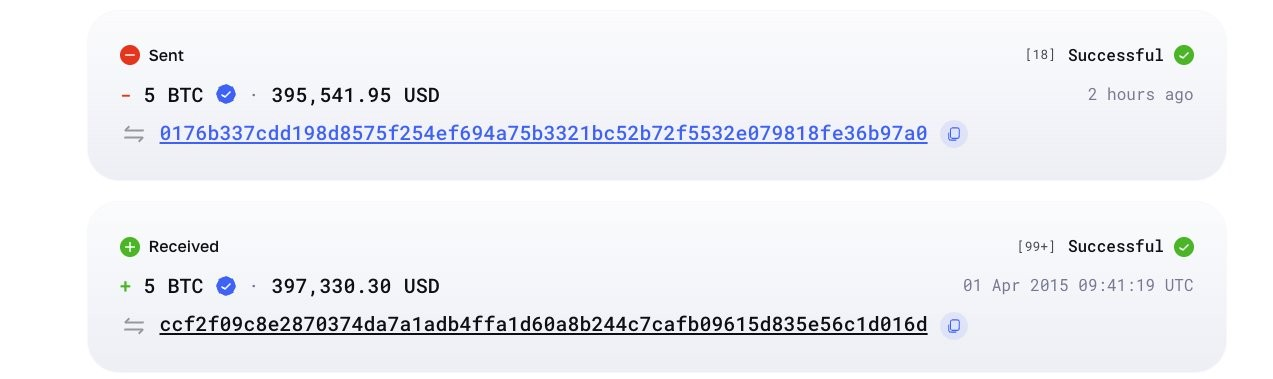
On May 13, 2026, after eleven years of digital purgatory, Cprkrn initiated a transfer. He moved all 5 Bitcoins out of the archaic digital vault and into a modern, highly secure environment. At roughly $80,000 per coin, the $200 Starbucks gamble had officially crystallized into $400,000 of liquid wealth.
Not a Hack, but a Mirror
When the story broke on X, the immediate reaction from the crypto community was panic.
“Does this mean Anthropic has the private keys?” asked one user. “Is Bitcoin dead? How was this cracked so easily?” asked another.
But the truth is far less sensational and far more fascinating.
Claude did not hack the Bitcoin network. It did not break SHA-256 encryption, which remains as bulletproof as ever. AI did not defeat cryptography.
Instead, the AI defeated human disorganization.
It succeeded because it could patiently read a decade of chaotic college files without losing focus, spot a forgotten backup file, and immediately debug a highly specific Python error that stood in the way. It wasn’t a master thief; it was an infinitely patient, brilliantly observant locksmith pointing out that the back door had been slightly ajar for eleven years.
For Cprkrn, the saga ends with a massive wedding fund and a permanently altered perspective on data custody.
For the rest of us, it serves as a stunning reminder: as we build increasingly impenetrable digital vaults, our greatest vulnerability — and sometimes our only salvation — remains the messy, chaotic human element holding the keys.
메타데이터
- post_id
- f03d71bfd497
- slug
- a-man-has-used-claude-to-recover-around-400-000-in-bitcoin-f03d71bfd497
- url
- https://medium.com/techx-official/a-man-has-used-claude-to-recover-around-400-000-in-bitcoin-f03d71bfd497
- canonical_url
- https://medium.com/techx-official/a-man-has-used-claude-to-recover-around-400-000-in-bitcoin-f03d71bfd497
- author_url
- https://medium.com/@shipx
- status
- ok
- fetched_at
- 2026-06-10 08:17:25