Tracking Change: Monitoring Civilian Firearms Circulation in Northern Kenya
By Khristopher Carlson and Francis Wairagu
Tracking Change: Monitoring Civilian Firearms Circulation in Northern Kenya
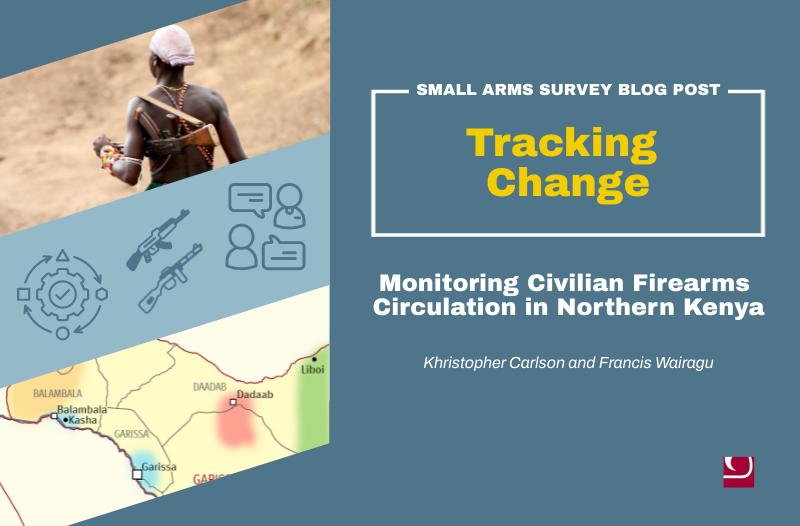
By Khristopher Carlson and Francis Wairagu
Kenya’s northern borderlands are often seen through a prism of insecurity — cattle raids, intercommunal clashes, political unrest, and threats from external actors. Yet mobility, livelihoods, and kinship networks are the bedrock systems through which both communities and state security actors operate, shaping how civilian firearms are acquired, circulated, and ultimately used.
Stretching from Somalia in the east, across Ethiopia, to South Sudan and Uganda in the west, northern Kenya sits within a wider regional web of cross-border movement and informal trade. Within this landscape, firearms move incrementally, and in multiple directions, through informal border crossings, local mobility corridors, and everyday kinship and trade networks.
While broad trafficking patterns are generally understood, there is far less clarity about how many illicit firearms circulate among civilians in these areas. Even less clear is whether stocks are increasing, decreasing, or holding steady year after year.
Against this uncertainty, security responses risk reacting to isolated incidents rather than addressing the underlying dynamics of firearms circulation. What is missing are practical tools to track directional change in civilian firearms stocks over time, particularly how they move, where they concentrate, and what drives changes in their circulation. This approach can be applied by national and county-level security actors responsible for monitoring and responding to dynamics that shape civilian firearms stocks.
Illicit firearms and the analytical gap
In northern Kenya, civilians use firearms to protect communities and animals, confront rivals, or assert power. At an institutional level, armed violence and crime is tracked through incident data — recording cattle thefts, banditry attacks, intercommunal confrontations, or other shifting threats. These incidents can provide important details about civilian firearms dynamics, but they do not, on their own, reveal how civilian-held stocks are changing. For example, election-related clashes do not necessarily mean new weapons have entered into circulation, but may involve weapons already in circulation. Likewise, a decline in reported cattle raiding may reflect seasonal grazing shifts or short-term de-escalation rather than a change in total firearm possession. At the same time, sustained changes in incident patterns may point to broader changes in civilian firearms circulation when interpreted with other indicators.
County-level estimates of civilian firearms stocks rarely incorporate incident trends in a structured way. Instead, they rely on proxy measures — most commonly, set per capita prevalence rates or livestock-to-firearm ratios. These methods, however, assume stable relationships between people, livestock, and guns, but these relationships often collapse in pastoral areas where all three move with considerable fluidity.
The result is a persistent analytical gap between security incidents and the underlying dynamics shaping civilian firearms stocks. Incident data can provide useful insights, but on its own does not explain whether civilian holdings are increasing, decreasing, or remaining stable. Understanding this gap requires moving beyond static estimation towards approaches that interpret incidents alongside other indicators to track how these stocks change over time.
Firearms trafficking and proliferation dynamics
Northern Kenya is part of a broader regional ecosystem defined by political, economic, and social interdependence. In this context, firearms circulation is largely shaped by wider borderland systems, through which mobility, trade, and security are organized. Weapons move across this vast and remote terrain along routes influenced by local governance, kinship, and incentive structures, making the region difficult to monitor and even harder to regulate.
Much of the firearms movement here follows an ‘ant trade’ pattern — small quantities transported incrementally by individuals or informal networks. While each transfer may appear minor, cumulatively they sustain steady inflows that shape security and criminal activity.
Regional conflicts contribute to this circulation. Weapons from conflict zones continue to move through the wider Horn and East Africa region. At the same time, diversion from state stocks, coupled with stockpile monitoring system challenges, can blur the distinction between external inflow and domestic recirculation.
Demand is shaped by intersecting factors, often rooted in pastoral livelihoods, security conditions, and how local governance systems operate. Where livestock represents wealth and mobility is critical, firearms are linked to protection and deterrence. In areas where state security is inconsistent, communities often rely on their own armed capacity for defence. Similarly, in politically contested spaces, weapons can serve as instruments of leverage to manage disputes over territory, resources, and power.
Firearms are, of course, not confined to border zones. An illicit weapon acquired in a cross-border grazing corridor in north-eastern Kenya, for instance, may later resurface in an urban area hundreds of kilometres away. These patterns of movement make it difficult to identify the location of firearms according to fixed administrative boundaries, exposing one of the limitations of static approaches.
The measurement dilemma
Per capita prevalence rates and livestock-to-firearm ratios work on the assumption that linear relationships exist. For example, as a population increases, firearms increase at the same rate. In certain contexts, however, static firearms estimates are unreliable. Mandera county, for instance, shifts in settlement patterns and unregistered migration skews census data, while also stoking local tensions.
Similar limitations apply to collection and disarmament statistics. Surrendered weapons may indicate effective collection efforts, but do not reveal how many remain in circulation. Similarly, seizure spikes may reflect intensified enforcement rather than increased supply. Each indicator, taken alone, reveals only a fragment of a larger picture.
The true limitation is sometimes how available data is used. When used in isolation, indicators cannot reliably show whether civilian holdings are increasing, decreasing, or remaining stable. In such contexts, tracking directional change over time is often more important than chasing a single precise estimate. While counties still require a baseline understanding of scale for planning and response purposes, the key challenge is finding a way to capture both scale and movement.
This approach is not intended to replace national estimation methods, but rather to address what they cannot do. Large-scale surveys provide important snapshots of civilian firearms stocks, but their ability to track how those stocks change over time is limited. The objective here is to enable continuous, locally grounded monitoring.
A new method
Civilian firearms estimates can make for gripping headlines, yet a single total — regardless of methodological rigour — captures only a moment in time and reveals little about how civilian stocks change. Large national surveys — including past Small Arms Survey initiatives in Kenya and South Sudan — have produced credible figures and helped shape national strategies to manage civilian firearms; however, these exercises are resource intensive and therefore do not allow for sustained tracking of changes in civilian firearms stocks over time. This points to a fundamental limitation: civilian firearms stocks are shaped by dynamic circulation processes that are rarely uniform across locations.
The method proposed here begins by recognizing that firearm dynamics vary across, and even within, counties — sometimes significantly. Instead of treating counties as single analytical blocks, this approach divides a county into distinct zones: border areas, grazing corridors, settlement areas, trading hubs, or politically contested spaces. These zones are analytical, rather than sub-county administrative, units. Each zone is defined by the dominant mechanism shaping civilian firearm levels within it: acquisition, retention, or loss.
Given the need for a nationally owned approach that can be implemented and replicated at the county level with existing capacity, this method comprises two phases: initial testing in priority counties, followed by institutional uptake at the national level — in Kenya’s case, the Kenya National Focal Point on Small Arms (KNFP). County-level application thus becomes the foundation for broader adoption.
Within each zone, changes in civilian firearms stocks are driven by three core mechanisms:
● acquisition (inflow): firearms entering civilian hands through cross-border flows, diversion, or local markets;
● retention: firearms remain in civilian hands due to continued insecurity or limited incentives to disarm; and
● loss and removal (outflow): firearms exit civilian hands through surrender, seizure, or confiscation.
A border area, for example, may be shaped primarily by ‘inflow’ pressure, while a contested area may be defined by ‘retention’. Interconnected trading hubs may reflect redistribution (retention) rather than new inflows.
When applying this method, each zone is assessed by identifying the dominant mechanisms at the time of assessment. This determination dictates what evidence or indicators should be monitored to interpret changes in civilian stock.
For each zone, a primary indicator anchors the assessment of the dominant mechanism, supported by secondary, contextual indicators that help further interpret changes in stocks. Instead of producing a single ‘exact’ figure, counties establish a bounded low–high range based on observed indicators and supported by documented assumptions. That bounded estimate becomes a plausible baseline against which change can be measured year after year. This baseline supports policymakers in tracking where and how civilian firearm stocks are shifting, providing a more actionable basis for targeted interventions. This cannot be achieved through large-scale surveys.
These steps can be summarized as follows:
Zone > Dominant mechanism > Primary indicator > Contextual indicators > Low–high estimate range > Trend assessment year after year
This zone- and mechanism-based framework was recently tested in a workshop with county security officials from Garissa, Mandera, and Wajir — three adjacent counties in the north-eastern Kenya–Ethiopia-Somalia tri-border area. The workshop brought together the core security leadership of each county — commissioners, police commanders, and investigations and intelligence coordinators — to apply the framework to their own operational contexts.
While the authors are not at liberty to share specific county outputs from the workshop, the example below illustrates how the methodology’s structure applies at the county level.
Zone: cross-border grazing corridor
Dominant mechanism: acquisition
Primary indicator: reports of new firearm types or ammunition calibres not previously common in the corridor
Contextual indicators: (1) sustained increase in firearm seizures relative to patrol deployment levels; (2) intelligence reports of expansion of firearms into previously low-activity grazing areas
In this example, the primary indicator captures reporting frequency of new firearm types within a zone. When interpreted alongside contextual indicators — such as sustained firearm seizures in relation to law enforcement activity and the spread of firearms into previously low-activity areas — the picture becomes clearer. Together, these indicators suggest not only that firearms remain in circulation, but also that new stock may be entering. These assessments are further refined through consultations with local informants — including security officials, community leaders, civil society representatives, and other actors with direct knowledge of local security dynamics — who help validate and contextualize what is observed through the indicators.
Rather than producing a single figure, the county documents assumed firearms activity, assesses all available data, and establishes a plausible low–high estimate range for each zone based on the mechanism identified. The lower number reflects a more conservative estimate based on observable data, including seizure records, patrol activity, and verified intelligence reporting. The high-range estimate incorporates credible, but perhaps less certain, data on inflows and distribution, gathered through consultations with people on the ground. By recording both the assumptions made and the sources consulted, the estimated low–high range captures existing uncertainty while using a structured approach to estimation that draws on locally provided evidence and observations. The aggregated low–high range from each zone provides a county-wide low–high range.
This bounded approach allows stock changes to be monitored without requiring census-level precision or resource-intensive household surveys. Instead of pursuing a single, precise estimate, counties track movement within a documented range and reassess that range over time using the same indicators for each periodic assessment. Over time, the question shifts from how many firearms there are, to whether their numbers are increasing, decreasing, or remaining stable, and why. This represents a move away from static, proxy-based estimation towards a dynamic, mechanism-based system of analysis.
A new Survey Briefing Paper details the methodological framework and provides practical steps for using it to monitor civilian firearm trends over time.
Conclusion
While establishing the initial zone- and mechanism-based structure requires careful analysis, once the zones, mechanisms, and indicators are defined, the method becomes straightforward to maintain over time. Annual updates involve revisiting the same indicators and reassessing the estimate ranges based on observable changes within each zone, allowing counties to monitor directional change without repeating the foundational analytical work. Testing during the Wajir workshop demonstrated that this approach is both practical and repeatable at the county level.
More broadly, the methodology offers a way of moving beyond static understandings of firearms proliferation. Rather than treating circulation primarily as a problem of ‘porous borders’ or isolated trafficking routes, it provides a structured framework for understanding how firearms movement, retention, and insecurity function within wider borderland and mobility systems.
See also our new Briefing Paper Monitoring Civilian Firearms in Borderlands: A Framework For Trend Analysis And Estimation.
This blog post was produced with generous support from the Government of Japan.
Blog posts are intended as a way for various Small Arms Survey collaborators and researchers to discuss small arms- and armed violence-related issues, and do not necessarily reflect the views of either the Small Arms Survey or its donors.
메타데이터
- post_id
- f1553f7c8bb5
- slug
- tracking-change-monitoring-civilian-firearms-circulation-in-northern-kenya-f1553f7c8bb5
- url
- https://medium.com/@smallarmssurvey/tracking-change-monitoring-civilian-firearms-circulation-in-northern-kenya-f1553f7c8bb5
- canonical_url
- https://medium.com/@smallarmssurvey/tracking-change-monitoring-civilian-firearms-circulation-in-northern-kenya-f1553f7c8bb5
- author_url
- https://medium.com/@smallarmssurvey
- status
- ok
- fetched_at
- 2026-06-09 15:37:30