Frontend Development in 2026: What Every Developer Needs to Know
From AI-powered coding assistants to modern rendering strategies, frontend development is evolving rapidly. Here’s what every developer…
Frontend Development in 2026: What Every Developer Needs to Know
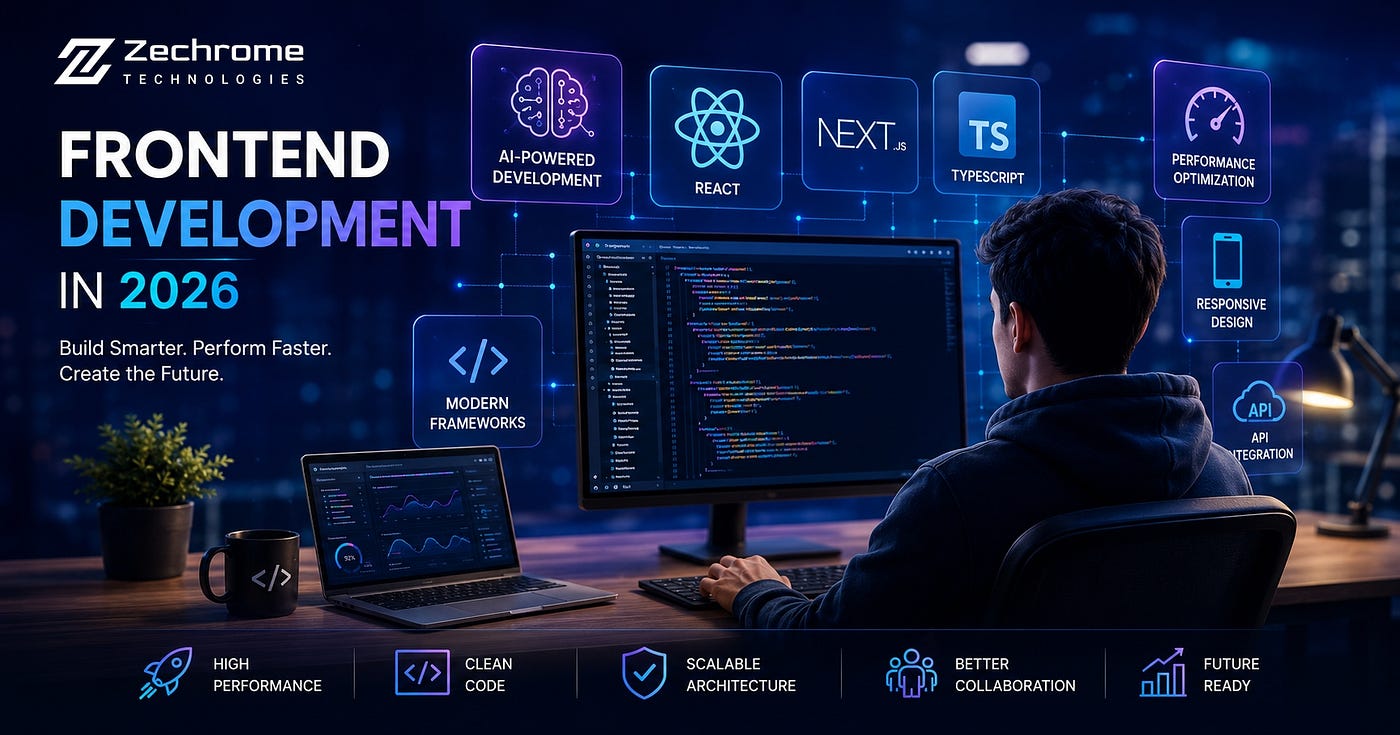
From AI-powered coding assistants to modern rendering strategies, frontend development is evolving rapidly. Here’s what every developer should understand to stay ahead.
Frontend development has always been one of the fastest-moving areas of software engineering. Over the last decade, we’ve seen the rise of responsive design, JavaScript frameworks, Progressive Web Apps (PWAs), and component-based development. Each innovation has changed how we build web applications.
Now, the industry is entering another exciting phase. Artificial Intelligence, modern frontend frameworks, and new application architectures are redefining the way developers write, optimize, and maintain code. Instead of simply building user interfaces, frontend developers are creating intelligent, scalable, and high-performance digital experiences.
So, what does modern frontend development look like in 2026? Let’s explore the trends shaping the future.
AI Is Changing How Developers Build Applications
Artificial Intelligence has become an important part of the development workflow. Rather than replacing developers, AI is helping them work more efficiently by handling repetitive tasks.
Today, AI-powered tools can generate boilerplate code, explain unfamiliar functions, suggest improvements, detect bugs, and even help write documentation. This allows developers to spend more time solving complex problems and designing better user experiences instead of writing repetitive code.
However, AI is still just a tool. Clean architecture, logical thinking, debugging skills, and an understanding of application design remain essential. Developers who combine AI with strong technical knowledge will continue to have a significant advantage.
Modern Frameworks Continue to Raise the Bar
React remains one of the most popular choices for building modern web applications, while frameworks like Next.js have become the preferred solution for many production-ready projects. Features such as Server-Side Rendering (SSR), Static Site Generation (SSG), and built-in image optimization help developers create applications that are both fast and SEO-friendly.
At the same time, Vue, Angular, Svelte, and other frameworks continue to evolve, giving teams more flexibility depending on their project requirements.
Instead of asking which framework is “best,” developers are increasingly choosing technologies based on scalability, performance, maintainability, and the needs of their users.
Performance Is No Longer Optional
Users expect websites to load almost instantly. A slow application can lead to poor user engagement, lower search engine rankings, and reduced conversions.
Because of this, performance optimization has become a fundamental part of frontend development.
Developers now focus on techniques such as:
- Lazy loading
- Code splitting
- Tree shaking
- Image optimization
- Efficient caching
- Content Delivery Networks (CDNs)
Performance isn’t something that’s addressed after development; it’s considered from the very beginning of a project.
TypeScript Is Becoming the Standard
JavaScript continues to power the web, but TypeScript has become the preferred language for many professional development teams.
Its static typing helps catch errors during development, improves code readability, and makes large applications easier to maintain.
As projects become more complex and involve larger teams, TypeScript provides better scalability and a smoother development experience. It’s no longer just a nice-to-have skill; it’s quickly becoming an industry standard.
APIs Power Today’s Web Applications
Modern frontend applications rarely work in isolation. They constantly communicate with backend services, cloud platforms, authentication providers, payment gateways, and third-party APIs.
Understanding REST APIs, GraphQL, authentication, asynchronous programming, and error handling has become an essential skill for frontend developers.
The ability to build seamless integrations is now just as important as creating visually appealing interfaces.
Skills Every Frontend Developer Should Focus On
Technology evolves quickly, but some skills continue to provide long-term value. Developers looking to grow in 2026 should focus on:
- Modern JavaScript (ES6+)
- TypeScript
- React and Next.js
- Performance optimization
- API integration
- Responsive and accessible design
- Component-based architecture
- Git and collaborative workflows
- AI-assisted development
Rather than trying to learn every new framework, developers should focus on mastering core concepts and adapting to new technologies as they emerge.
Frontend development is no longer just about building user interfaces. It’s about creating fast, scalable, accessible, and intelligent web applications that deliver exceptional user experiences.
AI is making developers more productive, modern frameworks are simplifying complex workflows, and performance has become a key part of every project. At the same time, strong fundamentals, clean code, problem-solving, accessibility, and thoughtful architecture remain as important as ever.
For developers, the future isn’t about replacing existing skills with new tools. It’s about combining solid engineering practices with modern technologies to build applications that are ready for the next generation of the web.
As frontend development continues to evolve, one thing is certain: developers who stay curious, keep learning, and embrace change will be well-positioned for whatever comes next.
메타데이터
- post_id
- f4ddbab78a0e
- slug
- frontend-development-in-2026-what-every-developer-needs-to-know-f4ddbab78a0e
- url
- https://medium.com/@zechrome_79222/frontend-development-in-2026-what-every-developer-needs-to-know-f4ddbab78a0e
- canonical_url
- https://medium.com/@zechrome_79222/frontend-development-in-2026-what-every-developer-needs-to-know-f4ddbab78a0e
- author_url
- https://medium.com/@zechrome_79222
- status
- ok
- fetched_at
- 2026-07-16 19:37:43