You Don’t Need More Motivation. You Need a Better Environment.
Motivation is unreliable, temporary, and largely outside your control. Your environment is none of those things.
You Don’t Need More Motivation. You Need a Better Environment.
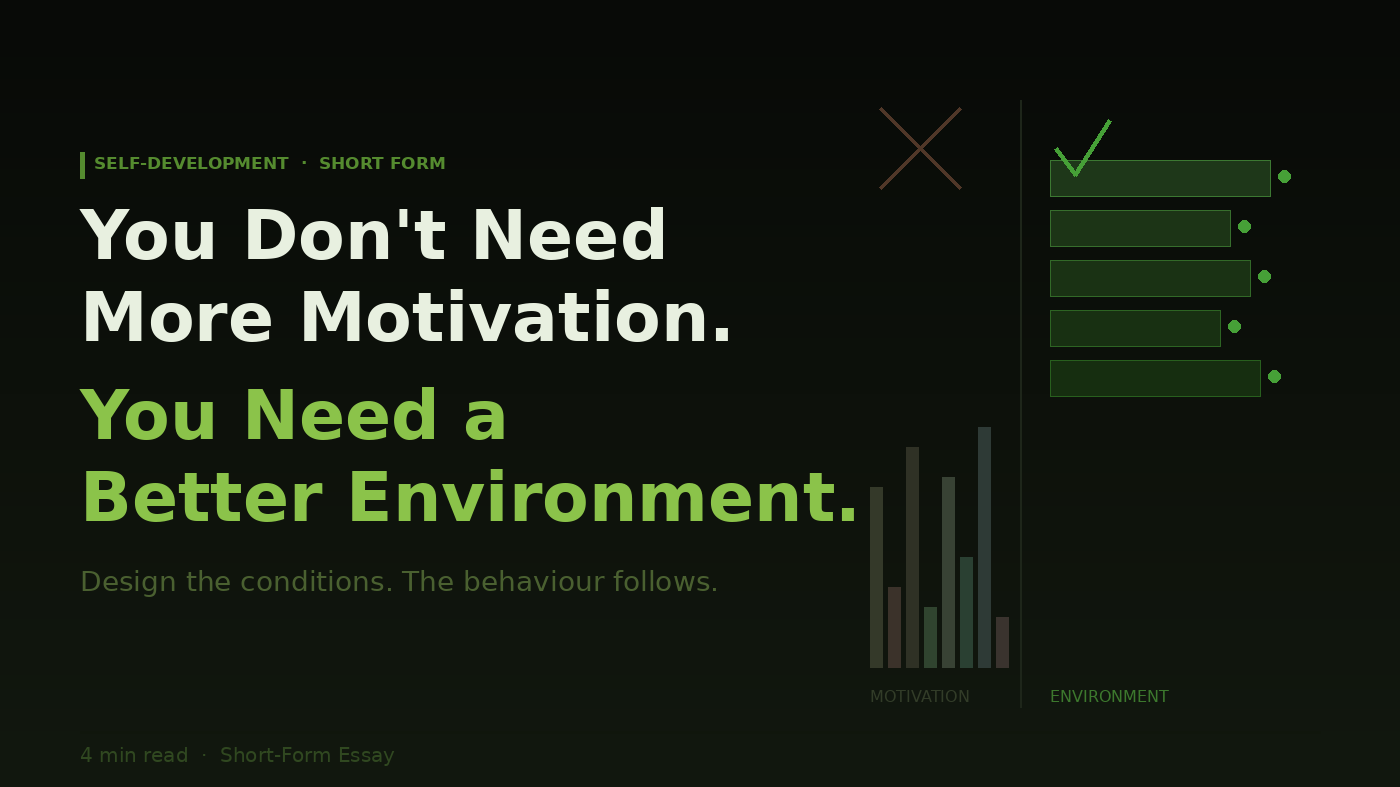
Motivation is unreliable, temporary, and largely outside your control. Your environment is none of those things.
Here is a question worth sitting with: when you imagine finally becoming the person who exercises consistently, reads more, eats better, or does the creative work they keep putting off — what does the version of you who does those things look like?
Most people picture someone with more drive. More discipline. More motivation. Someone who just wants it enough to make it happen every day, regardless of how they feel.
That picture is almost certainly wrong.
Motivation is the wrong target
Motivation is a feeling. And like all feelings, it is produced by circumstances rather than generated by will. You cannot decide to feel motivated any more than you can decide to feel hungry. You can create the conditions that tend to produce it — but those conditions are environmental, not internal.
Behavioural scientists have known this for decades. BJ Fogg at Stanford’s Persuasive Technology Lab has spent twenty years studying why people change their behaviour. His conclusion, backed by extensive research: motivation is the least reliable lever for behaviour change. Environment is the most reliable one.
What you see shapes what you do. What is easy to access gets accessed. What requires effort to reach gets avoided. This isn’t a character flaw — it is how human cognition works, and it has always worked this way. The brain automates as much as possible to conserve energy. It defaults to the path of least resistance. Fighting that tendency with motivation is fighting the tide. Designing with it is sailing.
What environment design actually looks like
The research on environment design — from Richard Thaler and Cass Sunstein’s work on “nudge theory” to the field of choice architecture now used in public health policy across Australia — converges on a simple principle: the most powerful behaviour change interventions change the environment, not the person.
Make desired behaviours easier
Running shoes by the door. A water bottle on the desk. The book on the kitchen table. The instrument in the room where you spend most of your evening, already tuned, already accessible. These are not hacks. They are the practical expression of a fundamental truth about human behaviour: we do what is easy, and we don’t do what isn’t.
The Australian Institute of Health and Welfare consistently finds that the biggest barrier Australians report to exercise isn’t lack of motivation — it’s structural. Time, access, and convenience. The people who exercise consistently have almost universally reduced one of those barriers to near zero: the gym is on the way home, the class is at a fixed time with a friend who expects them, the park is visible from their front window.
Make undesired behaviours harder
Every additional step between you and an undesired behaviour is a decision point where a different choice becomes possible. The phone charger in the kitchen instead of the bedroom. The social media apps in a folder three screens deep. The biscuits in the pantry behind the healthier options. The streaming remote not on the couch.
None of these changes require willpower in the moment. They require a single decision — made once, in advance, when you have full cognitive capacity — that then does the work of many decisions you’d otherwise have to make when depleted.
Redesign your social environment
Of all the environmental inputs that shape behaviour, the people around you are the most powerful. A study from the University of New South Wales found that social norms — what people perceive as normal and expected within their immediate social group — are among the strongest predictors of behaviour change outcomes in Australian adults.
If everyone in your close circle is building something, building becomes normal. If your colleagues discuss books, reading becomes expected. If your training partner is already at the gym, not going requires more effort than going. Social environment doesn’t just make desired behaviour easier. It makes not doing it feel strange.
The motivation you’ve been waiting for
The insight that reframes everything: motivation is often the output of behaviour, not the input.
You don’t feel motivated to write and then write. You sit down and begin writing — in an environment where beginning is easy — and the motivation follows the action. You don’t feel motivated to exercise and then go. You show up — because going is structurally easy — and the motivation arrives once you’re moving.
Waiting to feel motivated before acting is waiting for an outcome that only the action can produce.
Design the environment. Take the action. Let the motivation catch up.
It will. It always does.
I write about the small structural changes that make meaningful personal growth sustainable. Follow for more.
메타데이터
- post_id
- f786dbd73563
- slug
- you-dont-need-more-motivation-you-need-a-better-environment-f786dbd73563
- url
- https://medium.com/@kalpiprasad/you-dont-need-more-motivation-you-need-a-better-environment-f786dbd73563
- canonical_url
- https://medium.com/@kalpiprasad/you-dont-need-more-motivation-you-need-a-better-environment-f786dbd73563
- author_url
- https://medium.com/@kalpiprasad
- status
- ok
- fetched_at
- 2026-08-02 13:06:25