What if the Night’s Watch was never dissolved? — A Song of Ice and Fire
A consequence analysis of institutions that survive their purpose.
What if the Night’s Watch was never dissolved? — A Song of Ice and Fire
A consequence analysis of institutions that survive their purpose.
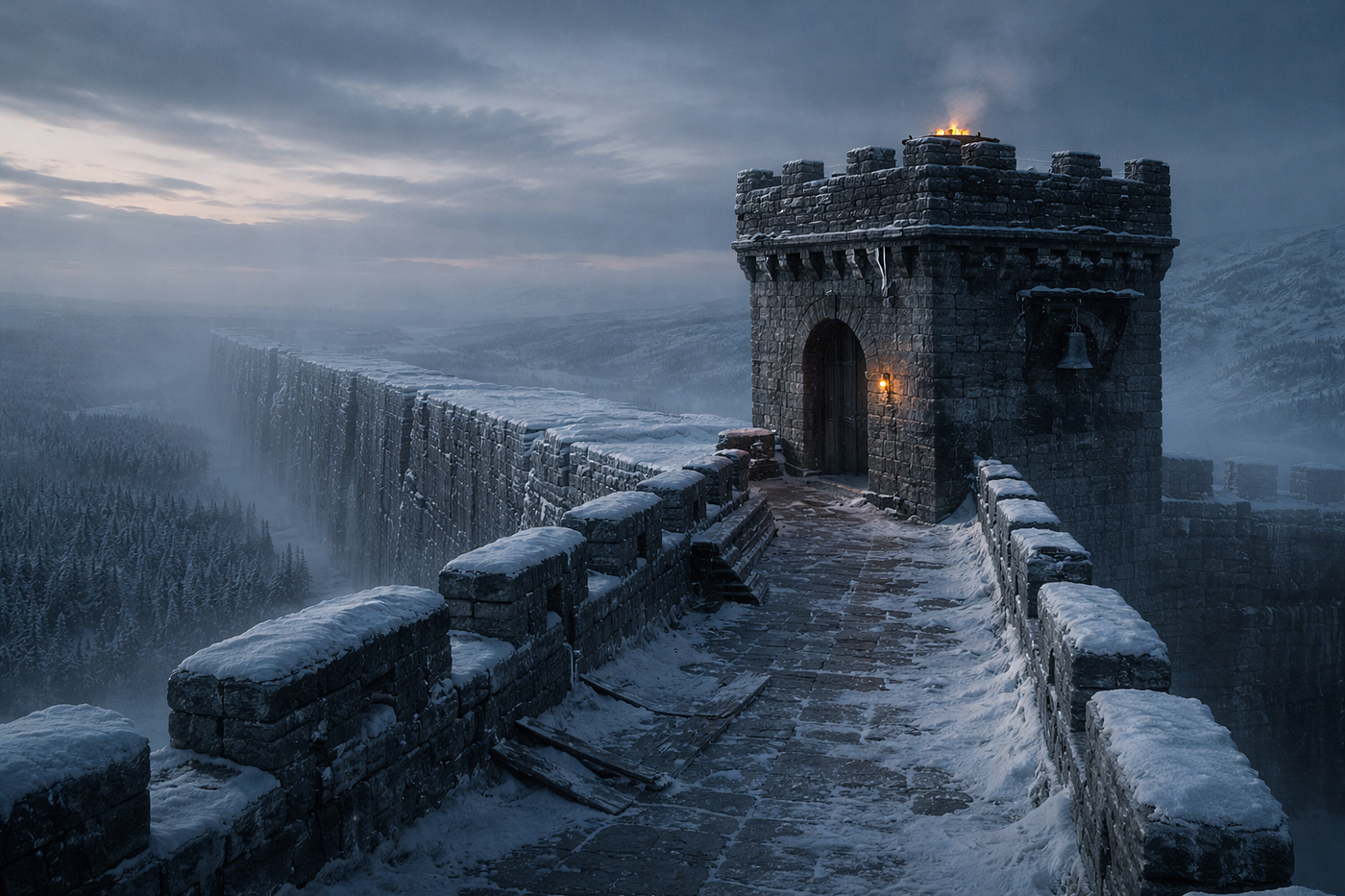
Institutions are not designed to ask whether they are still needed. They are designed to continue. If the Night’s Watch is never dissolved, it does not become heroic again. It becomes something quieter, more dangerous: a purpose that outlives its reason.
On the Wall in A Song of Ice and Fire, the days keep their shape. Horns are sounded on schedule. Patrols move north and return with reports that say the same thing in different words. Snow. Silence. Nothing to note. Fires are kept burning in towers built for warnings that no longer come. The cold remains, but the meaning of enduring it does not.
Training continues because stopping would feel like decay. Men practice killing techniques they will never use, against enemies no one believes in anymore. The body stays ready even when the world no longer asks it to be. That readiness turns inward. Discipline hardens. Minor infractions are punished as if they mattered more than they do. When an institution loses its external threat, it manufactures internal ones.
Sleep becomes fractured. Not because something is approaching from the dark, but because vigilance has become physiological. Some brothers wake convinced they heard movement beyond the Wall, only to find the same empty white. Others stop reacting altogether, moving through their duties with mechanical precision. Both responses are treated as professionalism.
Recruitment does not stop. It changes.
Men still arrive from the south, many of them sent rather than choosing. They swear the same vows, but the words land differently. They do not imagine an apocalypse held at bay by their presence. They imagine a lifetime of cold routine. The Watch is no longer framed as sacrifice for the realm, but as containment for those the realm does not quite want.
The vows are recited exactly as written. That exactness becomes important. When meaning erodes, ritual compensates.
Commanders continue to administer an organization whose function is now symbolic. Supplies are inventoried. Rosters maintained. Reports archived. Everything operates smoothly enough to avoid intervention, not effectively enough to justify itself. The Watch survives because no one in the south wants to be responsible for ending it.
To dissolve the Night’s Watch would require admitting something unbearable: that generations stood freezing at the edge of the world guarding a future that never arrived.
So the Wall remains.
Politically, it becomes a comfort object. Rulers point to it as evidence of responsibility. “The Watch still stands” becomes shorthand for continuity, even though no one can articulate what continuity means anymore. The presence of the Wall reassures people who have never seen it. The cost of maintaining it is abstract. The lives spent there are not.
Over time, new behaviors emerge.
Some brothers begin to interpret anything unusual as a threat, not because they truly believe danger is imminent, but because danger would justify their existence. A missing patrol, a strange sound, a rumor from the far north is inflated, debated, quietly hoped for. Other brothers do the opposite. They retreat inward, performing duties with minimal engagement, counting time rather than watching horizons.
Neither group is punished. Both are useful. One maintains alertness. The other maintains efficiency.
Rumors persist because they are necessary. Not because they are true, but because a Watch without even the possibility of threat would be unbearable. A lie about danger is easier to live with than the truth of redundancy.
The most corrosive effect is not boredom. It is moral drift.
When an institution exists without purpose, obedience replaces judgment. Orders are followed because they are orders. Hierarchies matter more than outcomes. The Wall becomes a place where authority is exercised without being tested by reality. That kind of power does not explode. It calcifies.
Men grow old there. Some die quietly. Others are buried in snowstorms that no longer carry symbolic weight. Their deaths are recorded, honored, and absorbed into routine. Sacrifice continues long after sacrifice stopped meaning anything.
And the realm sleeps easier because of it.
The Night’s Watch, undissolved, becomes a monument to unresolved fear. Not fear of the Others, but fear of admitting that an ending has already happened. It stands not to protect the world, but to protect the story the world tells itself about preparedness and duty.
Nothing comes from the north. Nothing needs to.
The Wall holds because it has forgotten what falling would mean.
메타데이터
- post_id
- f81c3f9d87ff
- slug
- what-if-the-nights-watch-was-never-dissolved-a-song-of-ice-and-fire-f81c3f9d87ff
- url
- https://medium.com/if-this-had-happened/what-if-the-nights-watch-was-never-dissolved-a-song-of-ice-and-fire-f81c3f9d87ff
- canonical_url
- https://medium.com/if-this-had-happened/what-if-the-nights-watch-was-never-dissolved-a-song-of-ice-and-fire-f81c3f9d87ff
- author_url
- https://medium.com/@nibor_95
- status
- ok
- fetched_at
- 2026-06-09 15:37:30