The Raspberry Pi Is Quietly Becoming an RF Research Workhorse
Combined with SDR hardware, GPIO interfaces, and embedded development tools, the platform enables portable labs capable of signal…
The Raspberry Pi Is Quietly Becoming an RF Research Workhorse
Combined with SDR hardware, GPIO interfaces, and embedded development tools, the platform enables portable labs capable of signal collection, protocol experimentation, and automated testing.
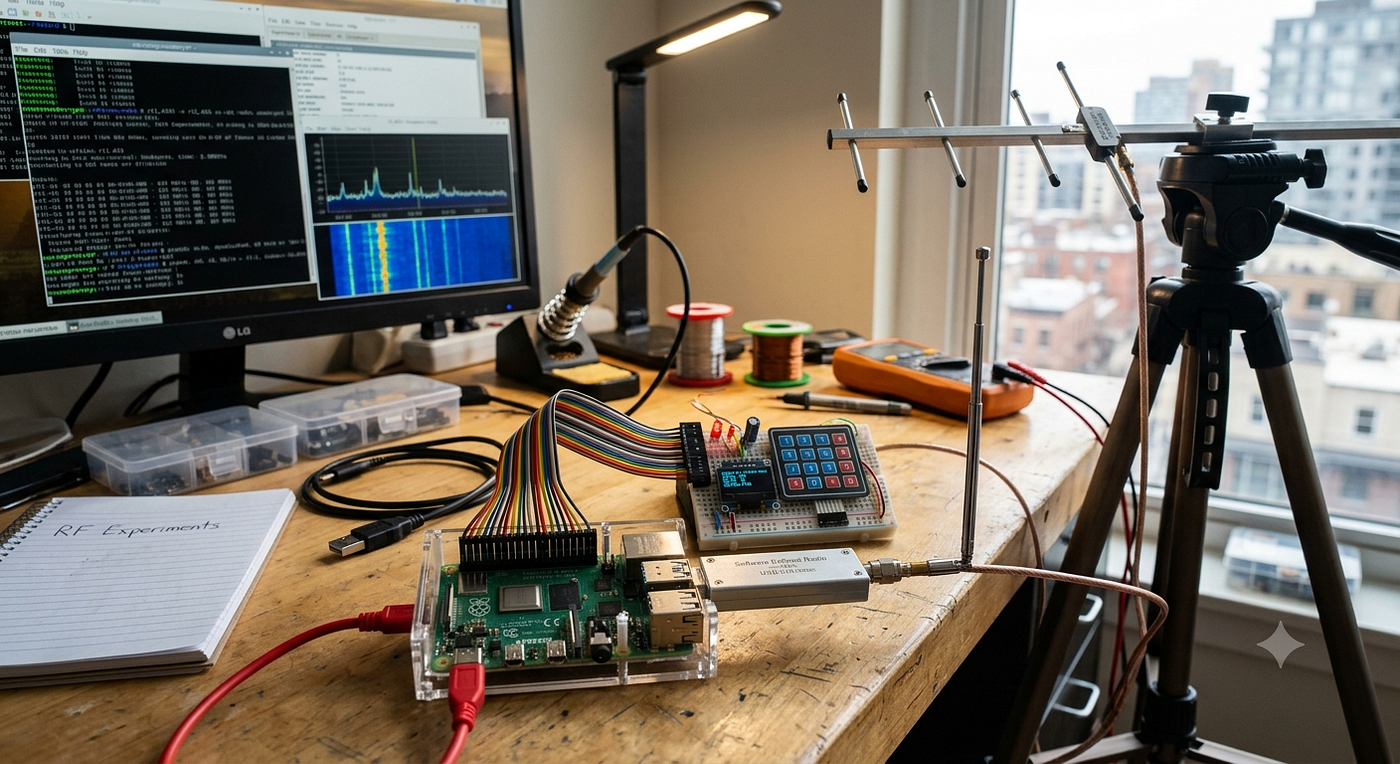
Generated by Gemini
For most of the last decade, using a Raspberry Pi for serious RF work meant accepting a tradeoff. The board was cheap, well-documented, and easy to deploy in the field, but it choked the moment a workload asked for real throughput. Wideband capture stuttered. GNU Radio flowgraphs dropped samples. Anyone who wanted to do more than tune an FM station and watch a waterfall eventually moved the workload to a laptop or a dedicated x86 box.
That tradeoff hasn’t disappeared, but it has narrowed enough that it’s worth re-examining. Five separate developments — none of them announced as an “SDR upgrade,” none of them coordinated with each other — have quietly converged on the same platform. The result isn’t a Raspberry Pi that replaces a proper RF lab. It’s a Raspberry Pi that has become a legitimate node in one, and the reasons why are more interesting than the marketing framing suggests.
The Bottleneck That Used to Rule This Out
The usual complaint about Pi-based SDR work was never about the radios. It was about everything downstream of the ADC: USB bandwidth shared across a hub, a CPU that couldn’t keep up with demodulation at anything beyond narrowband rates, and thermal throttling the moment a workload ran for more than a few minutes. Community threads on RTL-SDR setups are blunt about where the line sits — GQRX audio stuttering and SDR++ refusing to even compile on resource-constrained boards is a documented, recurring experience, and the standing advice is not to bother with older Pi hardware for anything beyond casual reception.
Raspberry Pi 5 changes the shape of that bottleneck rather than eliminating it. The board’s 2.4GHz quad-core Cortex-A76 processor delivers two to three times the CPU performance of the Pi 4, and for the first time a Raspberry Pi exposes a single-lane PCIe 2.0 interface for high-bandwidth peripherals, alongside doubled USB 3 throughput. None of that was designed with SDR in mind — Raspberry Pi’s own framing is about AI accelerators and NVMe storage — but it happens to remove exactly the constraint that made wideband capture painful on earlier boards. A 16GB RAM configuration is now available for workloads that buffer large IQ captures rather than streaming and discarding them.
This matters because it changes which SDR platforms are realistic Pi companions. RTL-SDR-class reception was always fine on a Pi. HackRF-class capture at 20 MHz instantaneous bandwidth, or a coherent multi-channel array pushing five simultaneous streams, was not — until the I/O headroom existed to sustain it without dropped samples. The Pi 5 doesn’t make those workloads effortless, but it moves them from “technically possible if you’re patient” to “a reasonable default.”
The Receiver Landscape Just Reshuffled
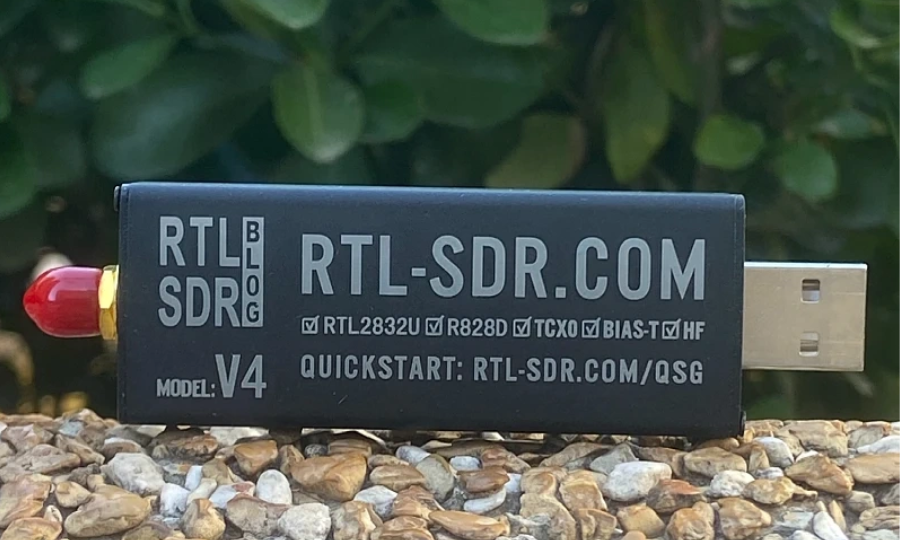
Anyone building an RF setup around dated tutorials is going to hit a wall that has nothing to do with the Pi. RTL-SDR Blog confirmed in 2026 that its popular V4 dongle has reached end of line, because the Rafael Micro R828D tuner chip it depends on is no longer being manufactured and no further usable stock exists. A limited V4 Lite using a different tuner, the R828S, has been announced as a successor, but it requires updated drivers and isn’t a drop-in replacement. That’s a meaningful discontinuity for anyone assuming the V3/V4 lineage would remain the default receive-only entry point indefinitely — it’s worth checking current tuner availability before designing a build around a specific dongle revision.
The broader receiver decision hasn’t changed in shape, even if the specific SKUs have. RTL-SDR remains the right starting point for anyone who mainly wants to receive and learn, while HackRF-class devices make sense once a project genuinely needs wider frequency coverage, higher sample rates, or authorised transmit capability. The PlutoSDR occupies a different niche entirely: it’s a self-contained, USB-powered board that can generate or acquire RF signals from 325 MHz to 3800 MHz at up to 61.44 megasamples per second, with independent receive and transmit channels capable of full duplex operation. For protocol work that requires simultaneous transmit and receive — testing a request/response exchange rather than passively logging one side of it — that duplex capability is the deciding factor, not raw bandwidth.
None of this is a verdict in favour of any single device. It’s a reminder that the SDR hardware layer under a Pi-based lab is not static, and treating a two-year-old blog post as current inventory is a good way to order a discontinued part.
GNU Radio Is Rebuilding Itself Around This Exact Use Case
The software stack underneath most of this hardware is going through its largest architectural change in over a decade. GNU Radio 4.0 reached its first release candidate in March 2026, marking a fundamental re-architecture built around modern C++, deterministic execution, and pipelines intended to scale from embedded systems up to large, complex signal-processing applications. The project describes the core architecture as stable at this stage, with the execution model well-defined and no further breaking API changes expected.
That framing — embedded systems as a first-class target, not an afterthought — is a departure from how GNU Radio 3.x was generally discussed. The 3.10 series remains the production-stable line for anyone building today, and there’s no reason to chase a release candidate onto a board that needs to work reliably in the field. But it’s worth watching, because a scheduler and execution model designed with deterministic, resource-constrained targets in mind is directly relevant to a platform whose entire pitch is doing DSP work on a board that costs less than the SDR plugged into it. If GR4 delivers on that design goal, it closes some of the remaining gap between “flowgraph runs on a Pi” and “flowgraph runs on a Pi without timing jitter you have to engineer around.”
GPIO Turns the Board Itself Into a Transmitter
The most Pi-specific piece of this story doesn’t involve an external SDR at all. Software like rpitx turns a Raspberry Pi into a low-cost RF transmitter by generating signals directly on a GPIO pin, requiring no additional hardware beyond a wire antenna. It works by toggling a clock line fast enough to produce a usable RF carrier — a genuinely clever abuse of hardware that was never designed to be a radio.
That approach has real limitations worth stating plainly. The output is a square wave, which means significant harmonic content, and any serious use requires a low-pass filter to stay within a reasonable emissions footprint. Support has also been uneven across board generations — most rpitx-derived tools historically had partial or beta-level support for anything past the Pi 3, and full support for the Pi 5 running current Raspberry Pi OS releases has only recently caught up. A modernised fork, rpitx-ui, was released in 2026 specifically to rebuild the transmitter chain for 64-bit Raspberry Pi OS on modern hardware, replacing shell-pipeline audio modes with an internal DSP chain and adding safer parsing across its transmit modes.
Engineering-wise, GPIO transmission is best understood as a research and bench-testing tool rather than a production RF front end: it’s useful for validating that a receiver correctly demodulates a known signal, for replaying a previously captured waveform during protocol testing, or for generating test carriers at a bench without dedicated signal-generator hardware. It is not a substitute for a properly filtered, spec-compliant transmitter, and anything transmitted this way is still subject to the same licensing and band-plan obligations as any other radio equipment — the software itself carries no compliance guarantees, and the responsibility for staying within legal transmit authority sits with whoever runs it.
Reverse Engineering Protocols Without a Logic Analyser
A meaningful share of what makes the Pi useful here isn’t the radio hardware at all — it’s that protocol analysis tooling has matured to the point where reverse-engineering an unknown RF protocol no longer requires custom tooling or a spreadsheet. Academic work on this exact problem space, presented at USENIX WOOT, frames it directly: proprietary wireless protocols used by IoT devices are frequently designed under tight size and energy constraints that leave security as an afterthought, which is why understanding what a device is actually transmitting matters for anyone assessing it.
Universal Radio Hacker is the tool that most of this workflow has consolidated around. It’s built as a complete suite for wireless protocol investigation with native support for common SDR hardware, offering automatic demodulation-parameter detection alongside customizable decodings for signals that use non-trivial encodings before transmission. Its workflow splits deliberately into interpretation, analysis, generation, and simulation phases, which gives teams a shared vocabulary when the work is collaborative rather than a solo reverse-engineering exercise — and it includes a fuzzing component built specifically to exercise protocol fields like sequence counters without hand-editing hundreds of messages. Running this stack on a Pi with an RTL-SDR or HackRF attached turns a spare corner of a bench into a standing protocol-analysis station rather than a one-off laptop setup that gets torn down after each session. The legitimate use case here is straightforward: characterising the RF behaviour of your own hardware, verifying that an IoT product actually behaves the way its documentation claims, or validating that a fix addressed a previously identified weakness — the same category of work the academic literature on this tooling was written to support.
Multi-Channel Coherence Turns One Pi Into a Direction-Finding Array
The most architecturally interesting hardware in this space doesn’t treat the Pi as an accessory — it’s designed around the Pi as the reference compute platform from the start. KrakenSDR is a five-channel coherent receiver built from RTL-SDR circuitry, and coherence is the entire point of the design. Because throwing five independent RTL-SDR dongles at a signal doesn’t produce phase-coherent samples — each unit drifts against the others — KrakenSDR drives all five receivers from a single shared clock and includes internal calibration hardware to measure and correct the phase relationship between channels in software.
That coherence unlocks correlative interferometry, a direction-finding technique that uses phase information across a spaced antenna array; running the resulting data through an algorithm like MUSIC produces a bearing toward the transmitter. The reference deployment is exactly the portable-lab framing the subtitle here is pointing at — the antenna array mounted on a vehicle roof, the receiver and a Raspberry Pi inside the cabin, and an Android device fusing the bearing output with GPS to compute a live map heading toward the source as the operator drives. The core acquisition and DSP software is open source and designed to run on a Raspberry Pi 4 or similar single-board computer, though it can also run on a full Linux PC when more headroom is available.
This is a case where the Pi’s role is genuinely architectural rather than incidental. The DAQ layer doesn’t need desktop-class compute — it needs a stable, low-jitter platform that can sit in a vehicle, draw modest power, and run unattended for hours. That’s a Pi-shaped problem, not a laptop-shaped one, and it’s a large part of why hardware vendors in this space are increasingly building around it as a first-class target rather than treating it as a fallback for people who can’t afford a proper workstation.
Where the Pi Actually Earns Its Place in a Test Bench
The “automated testing” piece of this story is less glamorous than direction-finding vehicles, but it’s arguably the most durable use case, because it doesn’t depend on any single SDR vendor’s roadmap. Embedded test benches already lean on the Pi as a controller: a Raspberry Pi acting as a test runner that communicates with the device under test, paired with a power distribution unit to reset the DUT to a known state before each run, integrated into a CI pipeline that executes on every commit and reports results automatically. Extending that pattern to include RF instrumentation — an SDR for passive verification, GPIO-driven transmission for stimulus — turns a firmware CI pipeline into one that also validates the wireless behaviour of a product, not just its logic.
That combination is already showing up outside pure R&D contexts. In manufacturing test environments, RF verification for simple integrated radios is sometimes handled with nothing more than a Raspberry Pi performing a received-signal-strength measurement, since a highly integrated radio IC generally only needs a functional go/no-go check rather than full RF characterisation. Analog Devices has published a reference implementation going the other direction — using a Raspberry Pi-based DDS signal generator as a configurable, calibrated, and reliable RF source for hardware testing, which is the piece most Pi-based RF benches are still missing: a trustworthy, known-good stimulus rather than just a receiver.
A minimal version of this pattern is straightforward to build. The example below isn’t a complete test framework, but it illustrates the shape of it — power-cycle the DUT to a known state, capture a fixed window of spectrum with an RTL-SDR, and flag a regression if the measured power at the expected frequency falls outside tolerance:
import numpy as np
from rtlsdr import RtlSdr
import RPi.GPIO as GPIO
import time

DUT_RELAY_PIN = 17
TARGET_FREQ_HZ = 433_920_000
EXPECTED_DBM = -40.0
TOLERANCE_DB = 6.0

def power_cycle_dut():
    GPIO.setmode(GPIO.BCM)
    GPIO.setup(DUT_RELAY_PIN, GPIO.OUT)
    GPIO.output(DUT_RELAY_PIN, GPIO.LOW)
    time.sleep(2)
    GPIO.output(DUT_RELAY_PIN, GPIO.HIGH)
    time.sleep(3)  # allow DUT boot/settle time

def measure_transmit_power(freq_hz, sample_rate=2_048_000, n_samples=1_048_576):
    sdr = RtlSdr()
    sdr.sample_rate = sample_rate
    sdr.center_freq = freq_hz
    sdr.gain = "auto"
    try:
        iq = sdr.read_samples(n_samples)
    finally:
        sdr.close()
    power_linear = np.mean(np.abs(iq) ** 2)
    return 10 * np.log10(power_linear + 1e-15)

def run_regression_check():
    power_cycle_dut()
    measured_dbm = measure_transmit_power(TARGET_FREQ_HZ)
    delta = abs(measured_dbm - EXPECTED_DBM)
    passed = delta <= TOLERANCE_DB
    print(f"measured={measured_dbm:.1f} dBFS expected={EXPECTED_DBM} "
          f"delta={delta:.1f} pass={passed}")
    return passed

if __name__ == "__main__":
    ok = run_regression_check()
    raise SystemExit(0 if ok else 1)
This is deliberately unremarkable as code — a relay toggle, a fixed-window capture, a power comparison against a tolerance band. That’s the point. The value isn’t in DSP sophistication; it’s in wiring RF verification into the same pass/fail, exit-code-driven contract that the rest of a CI pipeline already understands, so a wireless regression shows up next to a failed unit test instead of being caught three weeks later by a field report.
What This Doesn’t Solve
None of this makes the Pi a replacement for proper RF instrumentation. A calibrated spectrum analyser will always beat an RTL-SDR’s amplitude accuracy, USB-bus contention on a Pi is still a real constraint, the moment you’re running multiple SDRs alongside network and storage I/O, and continuous wideband transmission on GPIO-based tooling runs into the Pi’s power and thermal budget faster than dedicated RF hardware does. For lab-grade characterisation work — noise figure measurements, precise phase-noise analysis, anything requiring traceable calibration — this stack is a complement to proper test equipment, not a substitute for it.
What’s changed is the floor, not the ceiling. A few years ago, a Pi-based RF setup meant compromising on throughput before the project even started. Now the compromise is smaller and more deliberate: a Pi 5 with headroom to spare for a wideband capture, a software stack being rearchitected with embedded targets in mind, and hardware vendors designing coherent, multi-channel arrays around the Pi as their reference platform rather than as an afterthought. That’s a different starting point than the one most engineers remember, and it’s worth re-evaluating the assumption if the last serious look was more than a couple of years ago.
메타데이터
- post_id
- f83e0a1c6673
- slug
- the-raspberry-pi-is-quietly-becoming-an-rf-research-workhorse-f83e0a1c6673
- url
- https://radiohackers.com/the-raspberry-pi-is-quietly-becoming-an-rf-research-workhorse-f83e0a1c6673
- canonical_url
- https://radiohackers.com/the-raspberry-pi-is-quietly-becoming-an-rf-research-workhorse-f83e0a1c6673
- author_url
- https://medium.com/@michaelpreston515
- status
- ok
- fetched_at
- 2026-07-16 02:05:13