The Company Is Not a Family
And other uncomfortable truths from the Netflix experiment
The Company Is Not a Family
And other uncomfortable truths from the Netflix experiment
- Workplace is not Home!
I used to think a great workplace felt like home. Somewhere, people belonged. Were protected. Were loyal — because the organization was loyal back.
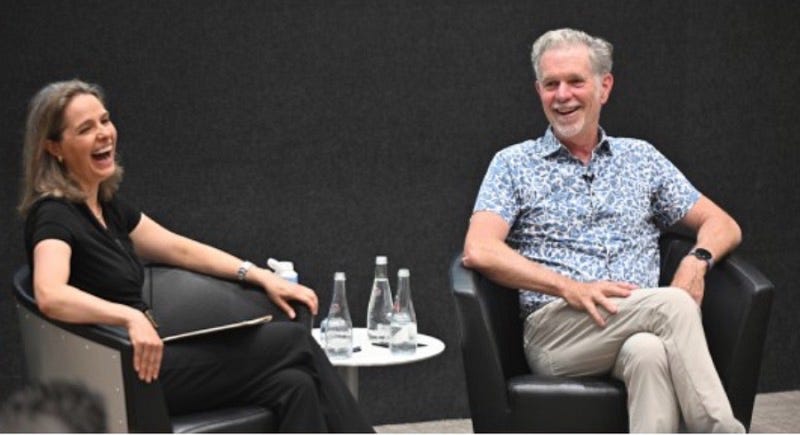
Erin Meyer and Reed Hastings would gently, firmly disagree. The hangover we haven’t named.
2. Industrial Era Mindset
Most organizations today are running on industrial-era logic. Error elimination. Consistency. Control. Built for the factory floor, not the idea economy. The problem isn’t that these principles are wrong. It’s that we’re applying them to the wrong problem.
When the biggest risk isn’t a mistake — but irrelevance — the cure becomes the disease.
Reed Hastings learned this at his first company, Pure Software. Every time something went wrong, he added a process. Every process reduced errors. And quietly, steadily, the best people left. When the market shifted, the rule-followers remained. The original thinkers were gone. His words:
“If you dummy-proof the system, only dummies want to work there.”
3. The Netflix experiment, in plain terms
At Netflix, he tried something different. Three moves. Deceptively simple.
Raise talent density. Hire fewer people. Pay them significantly more. The 10X principle — one exceptional performer delivers 10 to 25 times the value of an average one — means 10 brilliant people outperform 100 adequate ones. Every time.
Build radical candor. Not brutal honesty. Not diplomatic vagueness. Clear, caring, direct truth. The frontal cortex craves it. The amygdala resists it. The leader’s job is to make it safe enough for the frontal cortex to win.
Release control. No approval chains for spending. No vacation policy. No KPIs as leashes. Not because accountability disappears — but because it shifts. From compliance to ownership.
The sequence matters. You can’t skip to freedom. Density and candor have to come first.
4. The Fritz dilemma
Every team has a Fritz. Not a poor performer. Not malicious. Just adequate. Kind. Getting things done. Quietly pulling the average down.
Research is unambiguous: poor performance is more contagious than great performance. The lowest performer predicts team outcomes more reliably than the highest.
The uncomfortable question isn’t whether Fritz should stay. It’s: have you given Fritz the honest feedback he deserved, and didn’t get?
If yes, and you’d still feel relief at his resignation — that’s your signal.
Netflix called this the Keeper Test. Simple question. Significant implications.
If Stanley on your team told you tomorrow he was leaving, would you be devastated, relieved, or quietly excited about who you could bring in?
The answer reveals the choices you haven’t made yet.
5. The pyramid and the tree (resonates with my love for golden triangles)
Most organizations make decisions like a pyramid. Big calls rise to the top. Smaller ones stay below. Clean lines. Predictable bottlenecks.
Netflix thinks like a tree. The CEO is at the roots — not issuing commands, but setting context. This is our direction. These are the dilemmas we lean into. This is what we stand for. And from that rootedness, branches make decisions. Sometimes million-dollar ones. Without asking permission.
Three things follow:
The best young talent wants trees, not pyramids. Build one, and you attract and keep the people you most want.
Trees scale faster. No decision-making bottleneck at the top.
And when the unexpected arrives — a pandemic, a technology shift, a market reversal — trees bend. Pyramids crack.
6. Freedom is not the opposite of accountability
This is Hastings’ most important reframe.
We’ve been taught — implicitly, persistently — that freedom and accountability are in tension. Give people freedom, and accountability suffers. Control is tightly enforced, and accountability is enforced.
He found the opposite.
If you treat employees like adults, they will act like adults. If you give employees control over big decisions, they will become increasingly responsible and conscientious.
Adult to Adult is the essence of professional coaching!
Give freedom to get responsibility. Not the other way around.
7. One thing, on Monday
If you’re sitting inside a pyramid right now — not at the roots, but somewhere in the middle — this might feel distant. It isn’t.
One move this week to increase talent density on your direct team. One conversation to invite honest feedback upward. One control mechanism you can quietly retire.
Culture doesn’t change in announcements. It changes in small, repeated acts — until one day, the room you lead looks different from the house around it.
That’s where it starts. Be Regal.
What’s the one barnacle you’re ready to scrape this week?
Happy leading, blissful coaching.
메타데이터
- post_id
- 00b073935d76
- slug
- the-company-is-not-a-family-00b073935d76
- url
- https://medium.com/@subashcv/the-company-is-not-a-family-00b073935d76
- canonical_url
- https://medium.com/@subashcv/the-company-is-not-a-family-00b073935d76
- author_url
- https://medium.com/@subashcv
- status
- ok
- fetched_at
- 2026-07-09 16:18:44