Difference Between SARSA and Q-learning
Reinforcement learning is one of the most exciting areas of machine learning, where an agent learns by interacting with its environment…
Difference Between SARSA and Q-learning
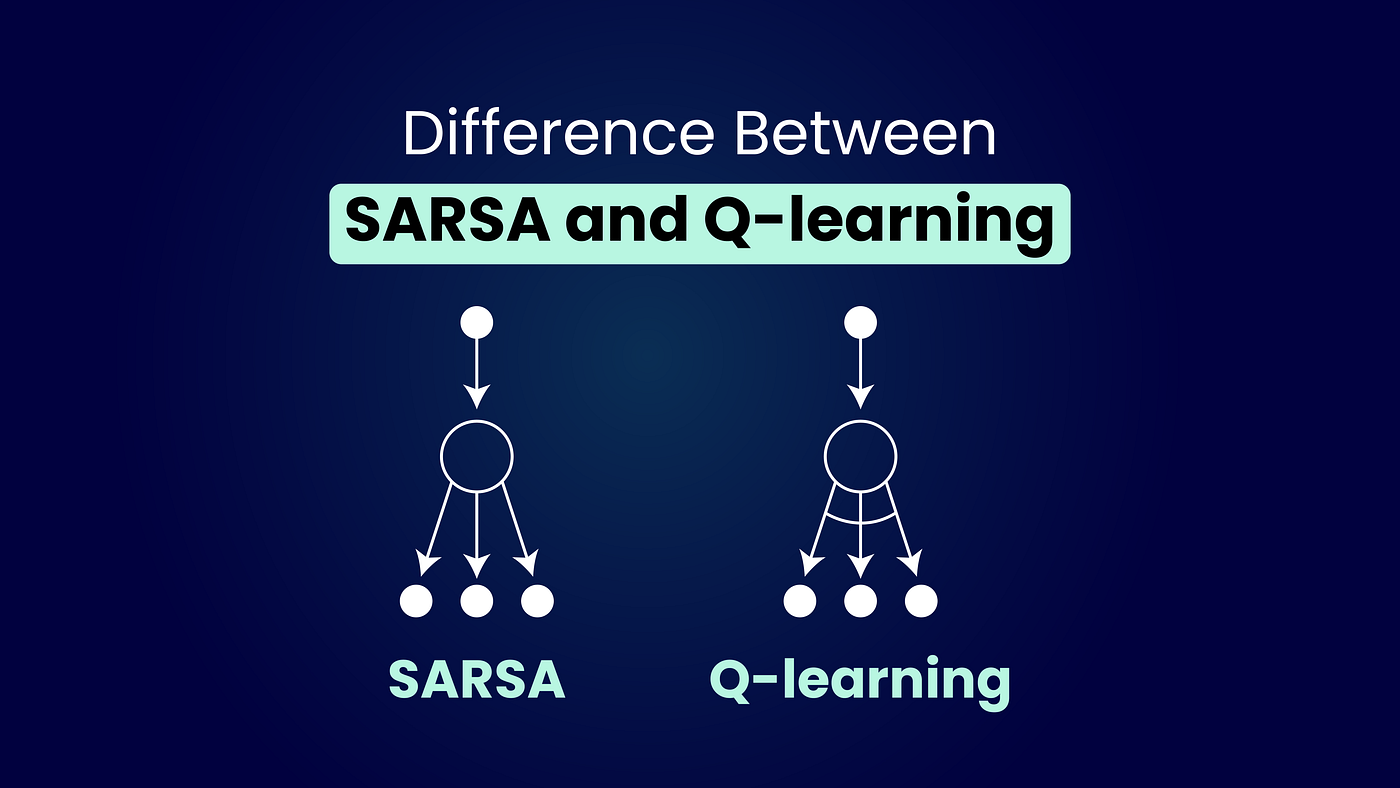
Difference Between SARSA and Q-learning
Reinforcement learning is one of the most exciting areas of machine learning, where an agent learns by interacting with its environment. Instead of learning from labelled data like supervised learning, the system learns through trial and error, receiving rewards or penalties based on its actions. Two of the most commonly used reinforcement learning algorithms are SARSA and Q-learning.
If you are exploring reinforcement learning, understanding SARSA vs q learning is essential because both algorithms help an agent learn optimal decisions in dynamic environments. Although they are similar in many ways, they differ in how they update their learning process and how they approach exploration and exploitation.
In this blog, we will first briefly understand reinforcement learning algorithms and then explore SARSA vs q learning in depth. Understanding reinforcement learning is important because SARSA and Q-learning are both reinforcement learning algorithms, and their concepts, learning process, and updates are based on the RL framework.
Once we understand how reinforcement learning works, it becomes much easier to grasp the core ideas behind SARSA vs q learning, including their working mechanisms, formulas, differences, advantages, and real-world applications.
What Are Reinforcement Learning Algorithms?
**Reinforcement Learning (RL)** is a machine learning approach where an agent learns to make decisions by interacting with an environment and receiving rewards or penalties. The agent observes the current state, takes an action, receives feedback, and updates its learning to improve future decisions.
Over time, it learns a policy, which is a strategy for choosing the best action in each state to maximise cumulative rewards.
In the context of SARSA vs q learning, reinforcement learning provides the framework in which these algorithms operate.
Both SARSA and Q-learning are value-based reinforcement learning algorithms that learn by estimating Q-values, which represent the expected reward of taking a specific action in a particular state. By continuously updating these Q-values through interaction with the environment, the agent gradually learns the optimal policy.
What Is SARSA?
SARSA stands for State Action Reward State Action. The name itself represents the sequence of events used during the learning process.
SARSA is an on-policy reinforcement learning algorithm, meaning it learns the value of the policy that the agent is actually following.
In simple terms, SARSA updates its knowledge based on the action that the agent actually takes next.
How SARSA Works?
The SARSA learning process follows these steps:
- The agent observes the current state.
- It chooses an action using a policy (usually epsilon-greedy).
- The environment returns a reward and a new state.
- The agent selects the next action from the new state.
- The Q-value is updated using the current state, action, reward, next state, and next action.
The update rule of SARSA is based on this sequence of events.
SARSA Update Rule
The SARSA algorithm updates the Q-value using the following formula:
Q(s,a)=Q(s,a)+α[r+γQ(s′,a′)−Q(s,a)]Q(s,a) = Q(s,a) + \alpha [r + \gamma Q(s',a') - Q(s,a)]Q(s,a)=Q(s,a)+α[r+γQ(s′,a′)−Q(s,a)]Where:
- Q(s, a) represents the current Q-value for state s and action a
- α (alpha) is the learning rate
- R is the reward received
- γ (gamma) is the discount factor
- s’ is the next state
- a’ is the next action
The key idea here is that SARSA updates its value based on the actual action taken by the policy.
This makes SARSA more cautious in risky environments.
What Is Q-Learning?
Q-learning is another popular reinforcement learning algorithm that is used to find the optimal action-selection policy for any given environment.
Unlike SARSA, Q-learning is an off-policy algorithm. This means it learns the optimal policy independently of the agent’s current behaviour.
In simple words, Q-learning assumes that the agent will always take the best possible action in the future, even if it explores different actions during training.
Understanding this concept is important when analysing SARSA vs q learning.
How Q-Learning Works
The Q-learning process includes the following steps:
- The agent observes the current state.
- It chooses an action using an exploration strategy.
- The environment returns a reward and the next state.
- The agent estimates the maximum possible future reward.
- The Q-value is updated accordingly.
Unlike SARSA, Q-learning does not depend on the next action selected by the current policy.
Instead, it assumes that the agent will take the best possible action.
Q-Learning Update Rule
The Q-learning formula is:
Q(s,a)=Q(s,a)+α[r+γmaxaQ(s′,a)−Q(s,a)]Q(s,a) = Q(s,a) + \alpha [r + \gamma \max_a Q(s',a) - Q(s,a)]Q(s,a)=Q(s,a)+α[r+γamaxQ(s′,a)−Q(s,a)]Where:
- Q(s, a) is the current Q-value
- α is the learning rate
- r is the reward
- γ is the discount factor
- max Q(s’,a) represents the maximum Q-value for the next state
The use of the maximum Q-value is what makes Q-learning an off-policy algorithm.
SARSA vs Q Learning: Key Differences
Understanding SARSA vs q learning becomes easier when we directly compare their characteristics.
1. Learning Approach
SARSA follows an on-policy learning approach. This means it updates its Q-values based on the actions that are actually taken by the policy.
Q-learning follows an off-policy learning approach. It updates Q-values assuming the agent will take the best possible action in the next step.
This is one of the most important distinctions when studying SARSA vs q learning.
2. Risk Behaviour
SARSA tends to be more cautious because it learns based on the actions that the agent truly performs. If the agent explores risky paths, SARSA accounts for that risk in its learning.
Q-learning is generally more aggressive. Since it always assumes the best possible future action, it may sometimes choose paths that appear optimal but could be risky during exploration.
3. Policy Dependence
In SARSA, the learning process is dependent on the policy being followed. If the exploration strategy changes, the learning outcome may also change.
In Q-learning, the learning process is independent of the current policy. It always aims to learn the optimal policy regardless of the exploration strategy.
4. Convergence Behaviour
Both algorithms eventually converge to optimal solutions in many environments. However, SARSA may converge more safely in environments where exploration involves risk.
Q-learning often converges faster in deterministic environments because it directly estimates the optimal action values.
5. Exploration Impact
Exploration plays a larger role in SARSA since the algorithm updates its Q-values using the next action selected by the exploration policy.
In Q-learning, exploration does not directly influence the update rule because the algorithm uses the maximum future reward estimate.
This difference highlights another important aspect of SARSA vs q learning.
Example to Understand SARSA vs Q Learning
Imagine a robot navigating a grid world where it must reach a goal while avoiding dangerous areas such as cliffs.
In this scenario:
- SARSA learns cautiously because it considers the actions actually taken during exploration. If the robot explores near a cliff, SARSA updates its learning based on that risky move and learns to avoid the cliff.
- Q-learning assumes the robot will always take the best action in the future. Therefore, it may learn a path that is very close to the cliff because it assumes the robot will never make mistakes.
This example clearly illustrates the difference between SARSA vs q learning in terms of risk awareness.
Advantages of SARSA
SARSA has several advantages that make it suitable for certain reinforcement learning environments.
One major advantage is that SARSA learns a policy that reflects the actual behaviour of the agent. This makes it safer in environments where risky exploration could lead to significant penalties.
Another benefit of SARSA is that it produces more stable learning when the environment includes uncertainty or hazards. Because SARSA incorporates the agent’s real actions, it adapts better to environments where mistakes are possible.
For example, in robotics or autonomous driving simulations where risky decisions can cause failures, SARSA can produce more cautious strategies.
Advantages of Q-Learning
Q-learning is widely used because of its simplicity and effectiveness.
One of its biggest strengths is that it learns the optimal policy directly. By always considering the maximum future reward, Q-learning efficiently identifies the best possible actions.
Another advantage is that Q-learning often converges faster than SARSA in deterministic environments where exploration does not significantly affect outcomes.
Because of its efficiency, Q-learning is commonly used in:
- Game AI systems
- Resource allocation problems
- Robotics learning tasks
- Recommendation engines
These advantages make Q-learning a powerful algorithm in reinforcement learning systems.
Applications of SARSA and Q-Learning
Both algorithms are used in real-world reinforcement learning applications.
Some common applications include:
1. Game Playing
Reinforcement learning algorithms like SARSA and Q-learning have been used to train AI agents to play games such as chess, Atari games, and board games.
2. Robotics
Robots can learn navigation and decision-making tasks using reinforcement learning techniques.
3. Autonomous Vehicles
Self-driving cars can use reinforcement learning to optimise driving decisions and improve safety.
4. Recommendation Systems
Reinforcement learning helps personalise recommendations by learning from user interactions.
These applications highlight the practical importance of understanding SARSA vs q learning.
When to Use SARSA vs Q Learning
Choosing between SARSA and Q-learning depends on the nature of the environment.
SARSA is often preferred when the environment is risky or uncertain because it accounts for the actual actions taken during exploration.
Q-learning is usually preferred when the goal is to quickly learn the optimal policy, especially in environments where exploration does not introduce significant risk.
Therefore, selecting the right algorithm requires understanding the trade-offs involved in SARSA vs q learning.
If you want to build strong practical skills in modern AI technologies, enrolling in a **Professional Program in Data Science, Machine Learning, AI & GenAI course** can be a great step. Such programs are designed to help learners understand core concepts like machine learning, reinforcement learning, and algorithms such as SARSA and Q-learning in a structured way. Along with theory, these courses usually focus on hands-on projects, real-world datasets, and industry tools, helping students develop the practical expertise needed to work in data science, AI, and generative AI roles.
Conclusion
Reinforcement learning plays a crucial role in modern artificial intelligence systems. Among the many algorithms available, SARSA and Q-learning are two of the most foundational methods used for learning optimal decision-making strategies.
When comparing SARSA vs q learning, the main difference lies in their learning approaches. SARSA is an on-policy algorithm that updates its learning based on the actual actions taken by the agent, making it more cautious and realistic in risky environments. On the other hand, Q-learning is an off-policy algorithm that always assumes the best possible future action, allowing it to learn optimal policies more aggressively.
Both algorithms have their strengths and are widely used in reinforcement learning applications such as robotics, gaming, autonomous systems, and recommendation engines.
Understanding SARSA vs q learning not only helps in selecting the right algorithm but also builds a strong foundation for exploring more advanced reinforcement learning techniques.
메타데이터
- post_id
- 07da5b445b77
- slug
- difference-between-sarsa-and-q-learning-07da5b445b77
- url
- https://medium.com/@theiotacademy02/difference-between-sarsa-and-q-learning-07da5b445b77
- canonical_url
- https://medium.com/@theiotacademy02/difference-between-sarsa-and-q-learning-07da5b445b77
- author_url
- https://medium.com/@theiotacademy02
- status
- ok
- fetched_at
- 2026-06-25 12:15:08