My Dad Was Out of His Mind
Was prison the best response?
My Dad Was Out of His Mind
Was prison the best response?
A large fraction of people with dementia behave sexually inappropriately, with most choosing to misbehave toward someone they are normally attracted to. But my dad had to be different. My dad chose to stick his tongue into the mouth of an 8-year-old child.
Why? What was the attraction? Was it sexual interest, or was it simple affection with no sexual gratification to speak of?
When asked, Dad made light of it, which was both repulsive and at the same time, informative. What was he thinking?
Regardless, the harm was real, and he was rightly arrested and charged with child molestation. The court was not sympathetic and neither was my family. Neither was I, at first, because my cultural narrative wouldn’t let me consider something strange; something unheard of. My first thought was the same as others: Dad was an intentionally-offending pedophile.
Two things had to happen before I changed my mind, and I’ll tell them to you now.
Dad had no history of sexual misbehavior with any person, adult or child. This was Dad’s only brush with pedophilia. And while calling it a “brush” sounds very dismissive, I use that word with good reason. While adverse childhood experiences (ACEs) are not to be brushed away lightly, neither should they be amplified by empathetic overreach. Truth is more helpful, and here’s the unbiased truth:
I drove Dad to court-ordered assessments, and from my vantage point, I could sense that Dad was undergoing a rigorous process with professionals who knew how to figure out when someone is lying or telling the truth. Their job was to interview, assess, and oversee technicians employing polygraph lie detector tests. They had both the experience and the technology to parse any lie, and the results showed that Dad was acting out of character. He was not a pedophile; not then, not ever.
This matched my own experience and that of his family. Dad had no history of pedophilia. He showed little interest in children, sexual or otherwise, and with others, he could be affectionate, but not overly so. We all made a concerted effort to look for gross, gratuitous intent in Dad’s mind. We poured our collective history into the effort, and… What did we come up with? Nothing. We came up with nothing. Dad was not a pedophile; not at age 77, not at any age.
When all other tests had been completed, a psychologist called to inform me that Dad tested positive for dementia. This was the first time I heard something that made sense. Dad’s mind had become weak, and he slipped into a behavior that was out of place and out of character, matching an ungratuitous urge to show affection, but not finding a proper and right way to do so. In his most clinical voice, this psychologist said, “the medical literature does not support the idea that people over the age of 60 will change their sexual preferences.” He went on to say more simply, Dad “slipped,” and that for dementia patients, doing so is “part of the human condition.” Yet, another psychologist said of my dad, “He does not maintain an interest in children,” and placed those words in the official court record. I’m sure I captured those words right. That really is how two professionals calmly discussed behavior that you or I would find upsetting and repulsive. Their words, the words of unbiased, clinical experts, were the first thing that changed my mind about vilifying my dad.
I’m not an expert, so I use more simple language. I say, “Dad was out of his mind.” It’s simple. It’s short. It makes no apology because an apology is a reasoned excuse, and Dad had no reasonable excuse. I would never say he had an excuse because he didn’t.
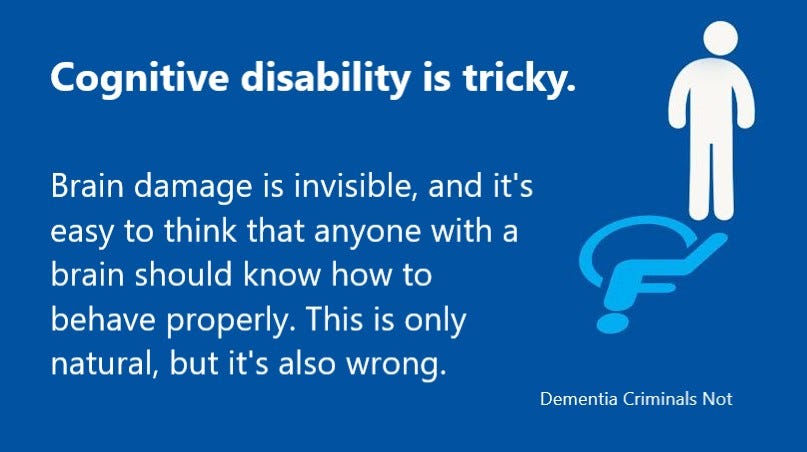
There’s a difference between holding someone responsible and holding them criminally responsible. Experts told me the best thing for Dad’s victim is to not “overreact” (their words, not mine) or make this out to be more than it really was. To do more is to escalate the problem and make things worse for the victim. The truth is better than empathy. It was tempting to abandon the truth and vilify my dad, like so many others did. But devotion to a victim more than devotion to truth is not ethical or helpful to anyone.
I’m writing words of understanding, not of rational explanation. I have no special training in language or philosophy, but please permit me to suggest that to understand is to stand under the weight of something and grasp it such a way that you can better bear the load. I hope readers in a similar situation find their burden lifted better and sooner than I did. Hopefully, a judge also reads it and provides more help than Dad’s did.
What I’m asking is not easy. Most people are not in a position to see beyond the usual cultural narrative surrounding pedophile-like behavior. They haven’t seen what I saw, or heard what I heard.
This article is not easy to write precisely because the subject does not lend itself to rational explanation. The best people to understand it are the people — the one in every nine families who are caring for a loved one with dementia — who’ve seen their loved one do something that every 6-year-old knows is wrong, and try to hide it. For example, many have seen their loved one hide a misplaced feces in a shoe or slipper instead of putting it in the toilet. It stinks, and caregivers do not have a good explanation for this, but they accept and manage it anyway.
Going to court.
The word dementia literally means out of his mind. (de- out of; mentia, mind) And perhaps we can let that word stand on its own and not try to go any farther than that. And yet, a lot of smart people DID go farther, and tried to apply cool, rational justice to what was essentially an irrational situation. Anyone who attempts to create justice out of an unthinking tragedy will be frustrated and worse, they will be compounding a tragedy with talk of criminality.
However, legally speaking, a crime requires a guilty mind i.e. mens rea, and with dementia, there is no guilty mind. Without mens rea, there is no crime, only tragedy.
I’m not trying to justify Dad’s behavior, which was abhorrent and harmful. There is no justification; no justice. Any kind of justice, cool and rational, aims for apology, and Dad’s court did ask him to express remorse, using prior-established terms, as was standard in such cases. But Dad could not form an apology without guidance. Dad had dementia.
My dad’s court was slow to recognize his medical condition. One high-ranking corrections official dissmissed test results by describing dad’s dementia as “impending,” which was his way of trying to peer inside and measure the degree of brain damage, something only an autopsy can do. But the court eventually did recognize Dad’s dementia, probably due to reports from jail officials. I never heard the judge say the words, but after Dad’s release from jail, the court reporter, using the means she had at her disposal, managed to insert something into the court record. Her words were not what I heard spoken in open court. Instead, they were her words, created by her authority and access to a journal entry.
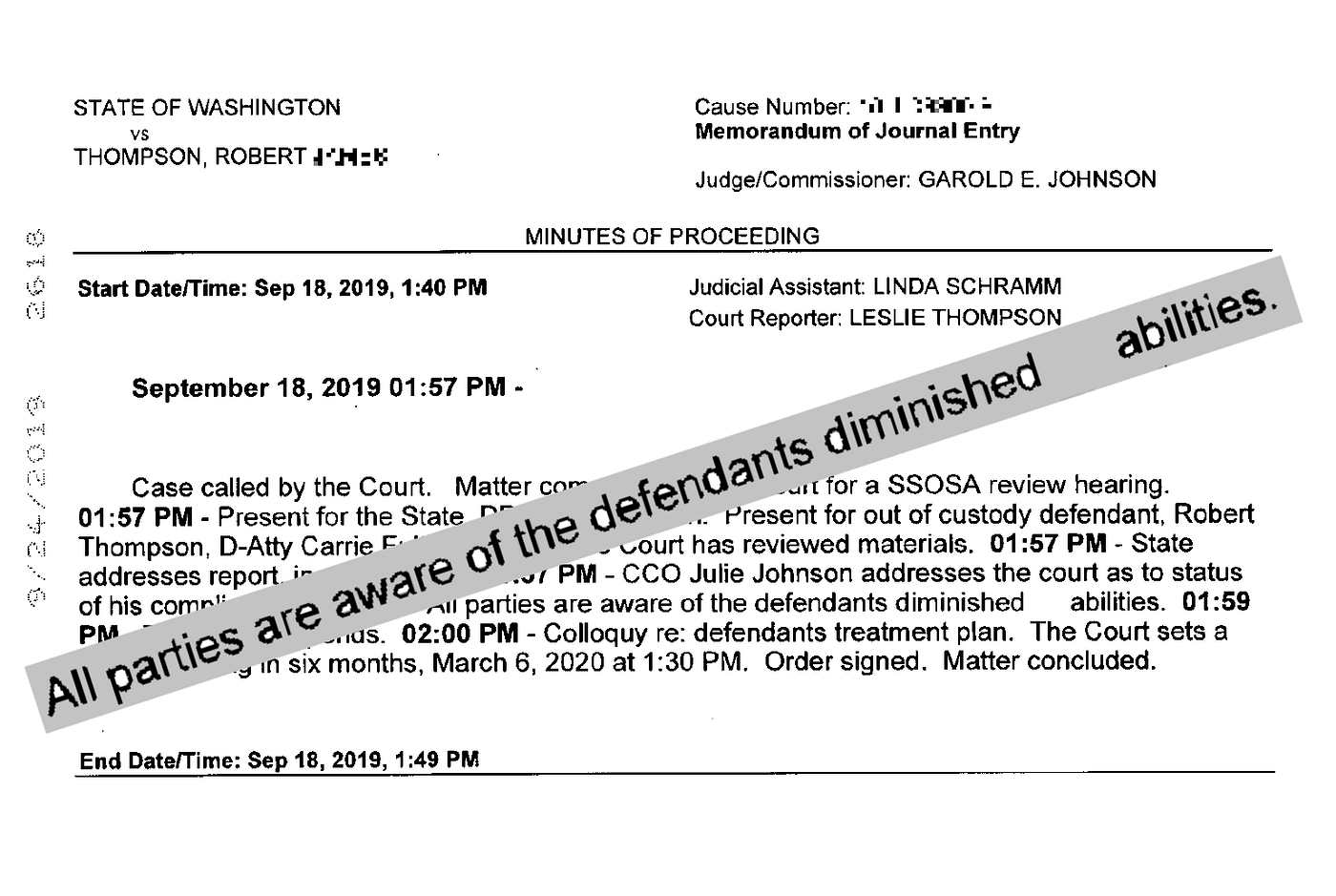
From Dad’s court record
Let’s rewind a bit. I was present at all of Dad’s court hearings, and I heard no deliberation about the role of Dad’s dementia, nor the principles of law governing criminal responsibility. The judge was silent on the issue, and his court treated Dad like it has treated so many before him. At first, I watched hearings with hope, but then with slowly growing suspicion that things were not going in the right direction.
Using standard procedures, Dad was found legally competent, but not medically so, and I’m amazed that both things could be true. The overlap between the legal and medical definitions of competency is not as large as we might want, and my dad fell into the gap between them. He was tested and found competent using the 1960 Dusky criteria because he was able to understand the charges against him and also to aid his lawyer in his defense. He was compliant and when asked questions by the judge and court officers, he responded appropriately with one or two-word answers. However, he failed to pass more probing scientific cognitive tests, like the BIMS, Montreal, and Minnesota tests. It wasn’t easy to see, and I forgive those with untrained eyes who missed it. Modern testing methods are much more sensitive than anything available in 1960, and according to Robert Kinscherff of Harvard’s Center for Law, Brain & Behavior, there is an urgent need for standardization so that legal tests may be brought up to date with advances in neuroscience. (personal correspondence)
Dad was doing what most people with dementia do: going through the paces, not fully conscious, as if sleep-walking He was there, but not really there. When each hearing concluded, Dad would ask feeble questions, and his lawyer would answer them. Then on the drive home with me, he would ask them again, which was very painful for me to witness. This is the second thing that changed my mind about vilifying my Dad, and what most motivates me to tell this story. Dad’s lack of understanding about court proceedings was a great injustice, and it goes against everything I was taught about our justice system. Dad’s lawyer felt the same way, and said so.
Was the court stupid? No. It is not stupid to habitually hold to conventional wisdom. However, it is dangerous when the habit encounters a situation where what has worked before will not work again. Justice takes many forms, and the habitual belief that jail reduces recidivism and “affords public safety” is dangerous for many reasons, including the misplaced idea that someone with dementia will respond well to it. More on that shortly.
Within a year, Dad’s symptoms become more severe and undeniable. This was the year he spent in jail. Guards and inmates had no doubt about his cognitive decline, and made allowances for it. One guard said to me rather sheepishly, “He’s gonna make it. He’s gonna make it.” Upon his release, I moved in with Dad and cared for him until I could no longer do so. I placed him in a memory care facility, and there, he died.
An autopsy showed Dad’s brain was full of diffuse Lewy Bodies, which are the cause of Lewy Body Dementia (LBD), the second most common type of dementia. There are many types of dementia, and the effects are nearly the same. But dementia differs from other types of mental illness in ways that are significant to how courts should address them. This is exactly the conclusion reached by the American Bar Association, which wrote a 92-page report, and in 2023, passed a resolution asking states to “train judges, lawyers, prosecutors… to screen for dementia and understand its impact on… behavior, decision-making, communication, and judgment.”
If a court can’t acknowledge a defendant’s dementia, then I don’t see how it has any business judging it. This is why, in 2023, Washington State passed SB 5440, a law that diverts people with dementia away from criminal courts toward problem-solving court and assisted outpatient treatment, i.e. AOT or “forced treatment.” The governor signed it saying justice is “better served” this way. But the law does so only for misdemeanor cases. Sexual offenses and violent assaults, two common symptoms of dementia, are not misdemeanors; they are felonies. So the effect of the law may not count for much. We’ll see.
However, I have no doubt that a law like SB 5440, if it had been in place, would have been a good influence on the lives of my family and dad’s victim. Our fear, disdain, and horror were harmful in and of themselves. Monsterization is not therapeutic. Experts said so and I believe they were right.
A better reaction would have been to grasp the truth, put it in its proper place, and move forward knowing that Dad was not a predator, that he could be controlled, and that safety concerns, while valid, were manageable. A problem-solving court using AOT would have, I’m sure, communicated this better.
Jail did none of that.
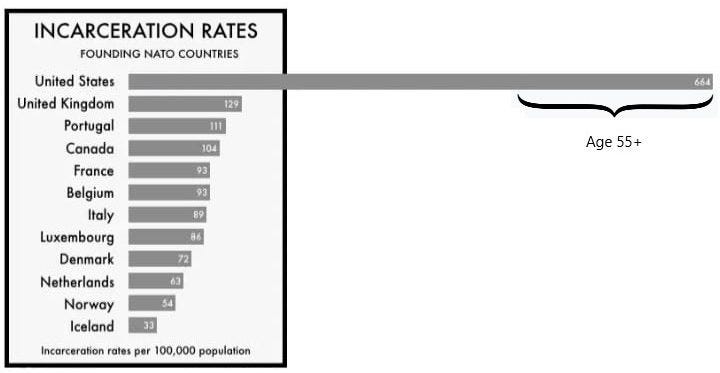
Source: Prison Policy Initiative
Jail is the conventional response that may work for some people, (this is debated) but certainly not someone with dementia. Jail, can only detain, punish, and wait for the inmate to rehabilitate himself with self-administered cognition, and then provide opportunities to for him or her to express the change. Many do this, and we all gain confidence when a former inmate courageously stands up, owns what he did, and expresses remorse. We, then, say they paid their debt to society and we move on. However, Dad was in neurocognitive decline and unable to provide such cognition. …some of it, yes, but not well. He was “slipping,” and his days of inspiring confidence in others were gone, for that is the way of all things.
Almost nobody understands that. Most subscribe to the decades-old, carceral response that has became a habit few can break. Dementia is the exception that reveals the dangerous extent to which people have, over time, habitually accepted ideas unproven. And now, after all these many decades, we are seeing the sunk-cost fallacy that foolishly continues sending so many people jail, including those with disabilities, like dementia.
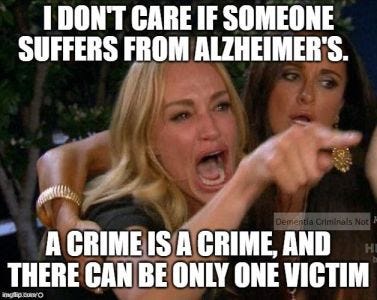
Mosterization
Going to the legislature.
I know how hard this is to accept. It was hard for me, too. But there are experts out there who can confirm what I’m saying. Legislators should be listening and learning, instead of using their own personal biases or cultural framework.
I hope that SB 5440 is one day expanded so that society learns to better manage its cognitively declining, older population. If you witnessed a court attempting to criminalize someone with dementia, please go to my Facebook page, Dementia Criminals Not, and look for a legislative calendar of public hearings. Tell your story. Help lawmakers learn and understand this part of the human condition, and add to the stored-up strength of our nation.

If your elderly relative is, right now, awaiting trial and in need of a lawyer, I recommend going to the website of your state bar association and searching for a “mental health” lawyer. They will know how to present your case. They will know to consult with experts like Elizabeth Kelley. They know the precise legal language that will prompt a judge, and more importantly, a prosecutor in how to “uphold the interests of justice and preserve the peace and dignity of the state.” They will help maintain “respect for the rule of law and the authority of the courts.”
My family did not know Dad had dementia, or we would not have put him in a position of trust and responsibility over a small child. That was our mistake, and our failure led to a tragedy. I don’t make light of the harm he caused, but neither do I call it a crime and try to lay the blame on someone with dementia, living in a dream-like state of consciousness. Doing so only escalates the situation and increases the harm. Our failed attempt to understand Dad’s thinking only made things worse, and I think the better thing would have been to trust the experts and admit that Dad wasn’t himself. He wasn’t all there. He was out of his mind.
메타데이터
- post_id
- 0d111abb111c
- slug
- my-dad-was-out-of-his-mind-0d111abb111c
- url
- https://medium.com/@novamarkseattle/my-dad-was-out-of-his-mind-0d111abb111c
- canonical_url
- https://medium.com/@novamarkseattle/my-dad-was-out-of-his-mind-0d111abb111c
- author_url
- https://medium.com/@novamarkseattle
- status
- ok
- fetched_at
- 2026-07-07 09:05:48