How Economic Segregation Harms the Wealthy, Too
When the rich abandon the Commons, public institutions decline and everyone pays the price
ECONOMICS
How Economic Segregation Harms the Wealthy, Too
When the rich abandon the Commons, public institutions decline and everyone pays the price
Some things belong to humanity. Photo by Spencer Davis on Unsplash
When wealthy people stop using public schools, public transit, parks and other shared institutions, those institutions begin to decline. The people with the most resources and political influence simply opt out.
Someone on another platform recently illustrated exactly how that works while trying to make the opposite point, claiming that you only see homeless people and public drug use in public spaces like sidewalks, not private places like malls.
But what he actually described is the end result of economic segregation.
When the wealthy withdraw into private spaces they control, public institutions lose not only funding but also the attention and political influence of the people most able to improve them.
The rich have abandoned the Commons.
And you’ll see examples everywhere you care to look.
Public schools decline because the wealthy pull their kids out and place them in private schools. This robs the public schools of tax dollars and of the involvement of parents who have the resources to stay involved and invested.
How many wealthy people want their tax dollars to support a school where they won’t send their kids? Those folks commonly argue that they should not have to “pay twice”; that because their children aren’t in the public schools and they’re paying private tuition that they ought not have to support the public option.
You can be sure that if all kids of all socioeconomic groups went to the same schools, people with the means to do so would make certain those schools were appropriately funded and run.
When we all rely on the same spaces and services, we all have an interest in making sure they function well. Once the wealthy step away, taking their resources and influence with them, that incentive weakens.
Private, exclusive spaces thrive. Public places decline.
Matthew Desmond captured this dynamic in Poverty, by America as “private opulence and public squalor.”
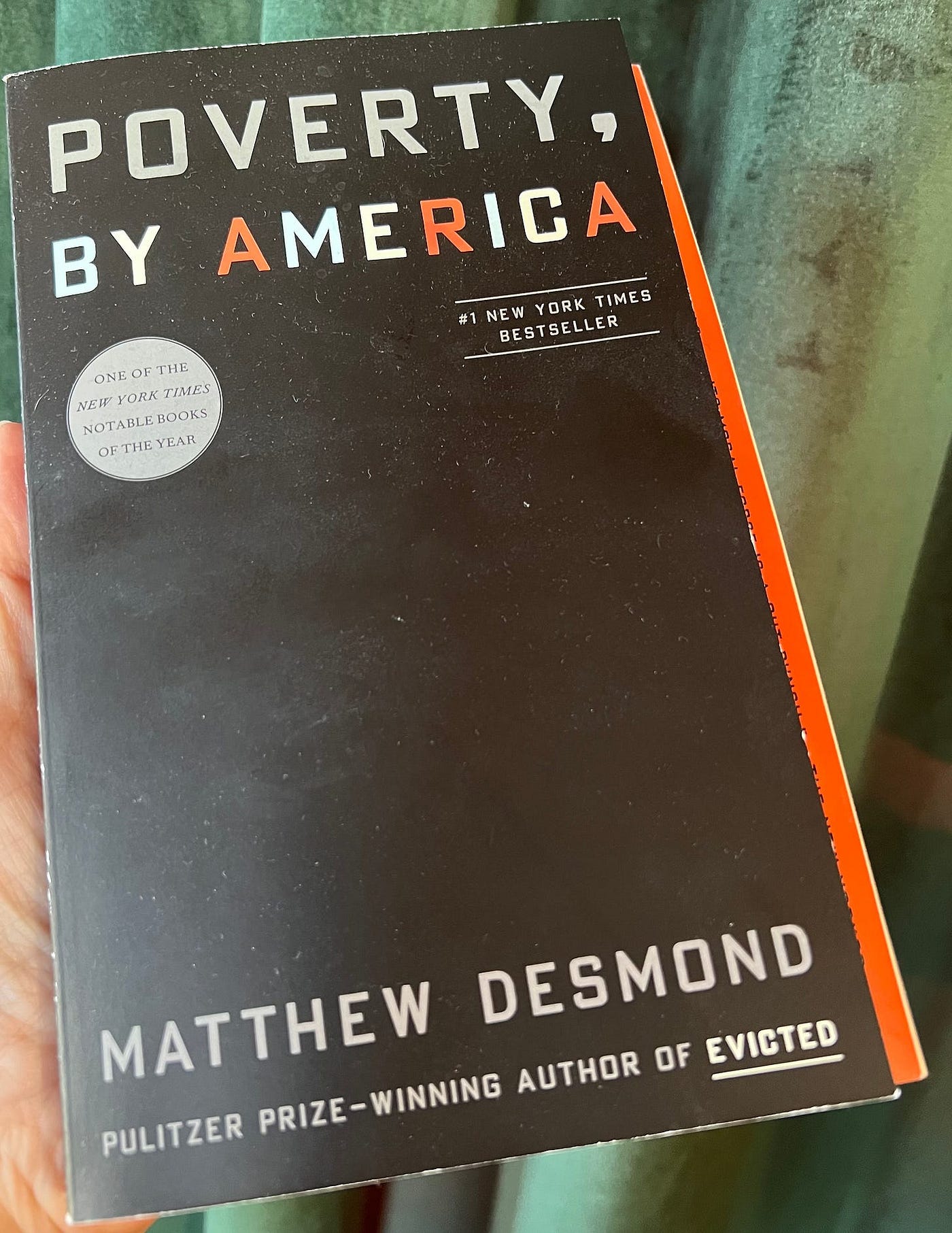
Read this book! (Photo by Michelle Teheux)
My answer to the guy referenced above:
“You’re actually admitting that economic inequality as promoted by the Republicans is killing us. The rich opt out of public spaces in favor of private/inaccessible ones and extra money from the masses, and yes, that shows up as public disorder.”
Economic Segregation Creates Elite Blind Spots
Economic segregation doesn’t just weaken institutions. It also isolates the wealthy from the realities of everyday life.
Jon Husted, a U.S. senator from Ohio, recently suggested that:
*“People living in poverty are just not very, um, experienced at navigating the real world.”*
In truth, it is often wealthy elites who inhabit a very narrow corner of the real world. If Husted knew any actual working class, poor or lower-middle class folks, he wouldn’t spout such lunacy.
Affordability problems are frequently misinterpreted as personal failings rather than structural ones. When you’ve never had to rethink a grocery list halfway through a shopping trip because prices are higher than expected, it’s easy to assume financial hardship reflects poor decision-making rather than limited resources.
People living with tight budgets often develop remarkable financial skills simply to survive — stretching paychecks, repairing instead of replacing and constantly adjusting spending.
But economic segregation means many affluent Americans rarely encounter those realities.
We all live in bubbles, and the most reliable way to pop those bubbles is simply talking to people whose lives differ from our own. Yet our society increasingly sorts itself by income, making those interactions rarer.
A generation or two ago, the son of a doctor might live in the same neighborhood as the daughter of a factory worker. They might attend the same public schools. Their families might shop in the same stores or sit in the same pews at church.
That kind of economic mixing is far less common today.
Why the Wealthy Still Need the Commons
It’s easy to see how economic segregation harms the poor. But it harms the wealthy as well.
Everyone benefits when the commons functions well.
Even the richest members of society still depend on shared systems.
We all breathe the same air.
Even people who fly on private jets rely on the same aviation infrastructure used by commercial flights. If that system becomes unsafe, wealth won’t protect you.
Healthcare provides another example. You might prefer a boutique private clinic for routine care. But if you suffer a medical emergency while traveling, you will go to the nearest hospital. You will want it to be clean, well staffed and well equipped.
Those hospitals depend heavily on shared public resources.
Medical research works the same way. Even billionaires cannot personally fund every laboratory researching treatments for every disease. Scientific progress depends heavily on universities, public grants and collaborative institutions.
Public health is similarly interconnected. Infectious diseases do not respect income brackets. If large segments of society lack access to vaccines or healthcare, everyone faces greater risk.
Somewhere in virtually every supply chain, a poor person literally had a hand in producing almost everything you purchase or eat.
Our lives remain interconnected whether we acknowledge it or not.
Talent and Innovation Come From Everywhere
Economic segregation also wastes human potential.
You wealthy people are not superior to anyone else, although I’ll grant you it might look that way from your perspective. Rich kids enjoy all sorts of privileges that boost them into spheres poor kids struggle to enter. But non-elites contribute in millions of ways — ways you need.
An astonishing number of society’s most valuable contributions come from people who are not wealthy: artists, inventors, scientists, writers, engineers, athletes and entrepreneurs.
When societies allow large portions of their population to struggle unnecessarily, they lose the ideas and innovations those people might otherwise contribute. It’s the old question of how many Einsteins might be toiling away in a sweatshop right now.
Civilization advances because millions of different minds contribute to it.
A society that sidelines the majority of its people ultimately limits its own progress.
The Cost of Abandoning Shared Institutions
When elites withdraw from public institutions, those institutions weaken and societies fragment.
Economic segregation divides neighborhoods, school systems and our understanding of reality itself.
It becomes easier to dismiss the concerns of people we rarely encounter. We assume their struggles reflect personal failure rather than structural problems.
Economic segregation is turning us into one nation, quite divisible.
About Michelle Teheux
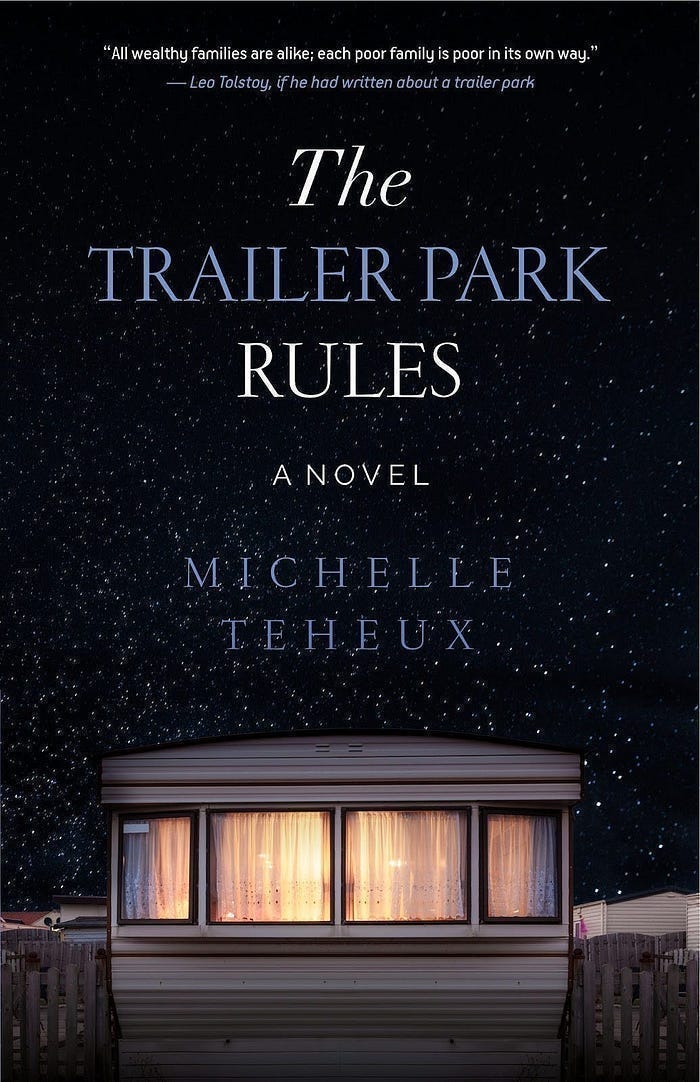
I’m a writer in central Illinois. If you like my work, subscribe! I also have a Substack about economic inequality called *Untrickled and another aimed at authors who want to self-publish books called[ The Indie Author](https://selfpublishingbookauthors.substack.com/). My new book is[ Strapped: Fighting for the soul of the American working class](https://www.amazon.com/dp/B0DJNRCQSJ). And yes, those are my husband’s actual boots on the cover! My most recent novel is[ The Trailer Park Rules](https://www.amazon.com/dp/B0CTHT43L9).* Tips joyfully accepted via Ko-fi:
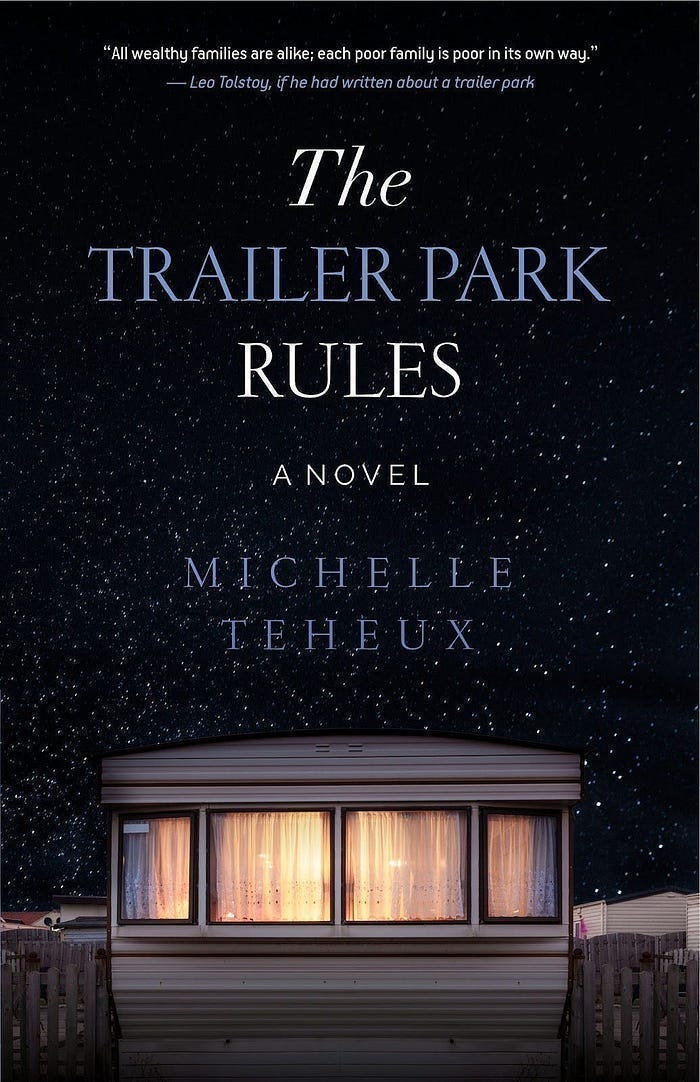
**All wealthy families are alike; each poor family is poor in its own way. ** — Leo Tolstoy, if he had written about a trailer park
For residents of the Loire Mobile Home Park, surviving means understanding which rules to follow and which to break. Each has landed in the trailer park for wildly different reasons.
Jonesy is a failed journalist with one dream left. Angel is the kind of irresponsible single mother society just shakes its head about, and her daughter Maya is the kid everybody overlooks. Jimmy and Janiece Jackson wanted to be the first in their families to achieve the American dream, but all the positive attitude in the world can’t solve their predicament. Darren is a disabled man trying to enjoy his life despite a dark past. Kaitlin is a former stripper with a sugar daddy, while Shirley is an older lady who has come down in the world and lives in denial. Nancy runs the park like a tyrant but finds out when a larger corporation takes over that she’s not different from the residents.
When the new owners jack up the lot rent, the lives of everyone in the park shift dramatically and in some cases tragically.
Welcome to the Loire Mobile Home Park! Please observe all rules.
메타데이터
- post_id
- 12ffaaf7a251
- slug
- how-economic-segregation-harms-the-wealthy-too-12ffaaf7a251
- url
- https://medium.com/minds-without-borders/how-economic-segregation-harms-the-wealthy-too-12ffaaf7a251
- canonical_url
- https://medium.com/minds-without-borders/how-economic-segregation-harms-the-wealthy-too-12ffaaf7a251
- author_url
- https://medium.com/@michelleteheux
- status
- ok
- fetched_at
- 2026-06-14 17:09:17