Queer spaces in San Diego: few and far between
Exploring where the queer spaces in San Diego thrive, and where they lack
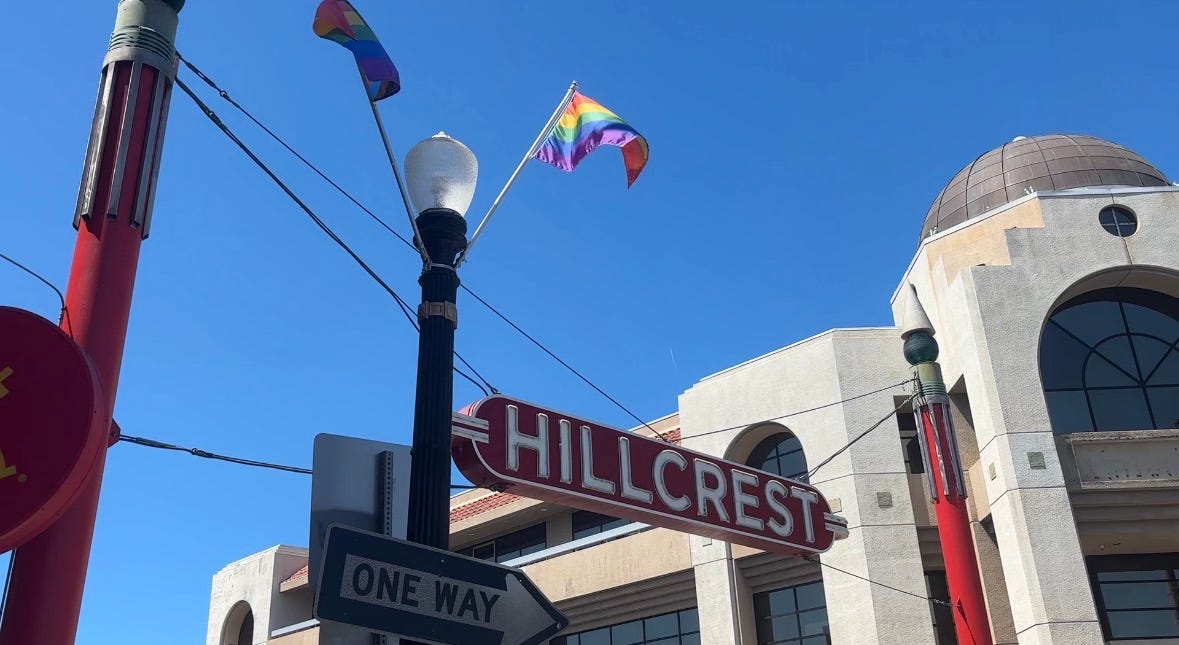
Photo of the entrance of the Hillcrest neighborhood in San Diego, California, on April 8, 2026. (Photo by Lecya Santiago)
Queer spaces in San Diego: few and far between
Exploring where the queer spaces in San Diego thrive, and where they lack
The Flame, one of the few remaining lesbian bars in the United States, closed its doors in 2004. Now, its sign hangs in its typical Art Deco style, serving as a reminder of its history, as the building is now a condo. This isn’t the first time a queer space has been lost, and it won’t be the last.
San Diego’s queer community has embedded itself in society and is gladly welcomed in certain areas, while others leave much to be desired. From Hillcrest to the San Diego LGBT Community Center, founded in 1973, San Diego has a layered history, marked by both community and loss.
It is vibrant, and events are often held across the city; however, there is a distinct lack of queer spaces spread outside the main “gay” neighborhood. Hillcrest is referred to as “the center of San Diego’s LGBTQIA+ community,” according to a tourism website for San Diego. Aside from this neighborhood, many of the spaces in San Diego are limited.
With an increasingly small number of lesbian bars in the country — 36 total are left, six of them being in California and one being in San Diego, according to the Lesbian Bar Project website — and the community concentrated in pockets, the need for queer spaces is crucial. Members of the community have begun to look for other avenues, including online and at their universities, such as San Diego State University.
Queer history
Clarissa Clo, professor and chair of European Studies at San Diego State University, with expertise in queer studies and youth culture, spoke to the history of the queer community and how these spaces began to develop.

Photo of Clarissa Clo holding an Italian LGBTQ+ art book on February 27, 2026. (Photo by Lecya Santiago)
“The Second World War was the largest mobilization of youth in history at that point. What it did was bring together youth from all walks of life, and they were brought together in a cohort in social environments,” Clo said. “Men with men, women with women. The subversiveness of this situation is that people started questioning their identities.”
Clo described this phenomenon as “an immense catalyst for the emergence of what will become the queer movement.”
Historically, queer spaces were never advertised as openly as they could have been. Clo delved into this, describing entering a club, going into another room within the club and only then experiencing a queer space. There have always been limitations and secrecy.
[embed]
Clo, who came to the United States from Italy in the late ’90s, witnessed the slow collapse of The Flame firsthand. Reflecting on San Diego’s gentrification issue, Clo felt this was the natural explanation for the loss of these spaces.
“There, you already know what has happened to these spaces. They have been gentrified, they’ve been bought out,” Clo said.
The digital age
The internet has been a huge enabler, allowing people with similar interests to meet more easily than before.
“Everything moved online. Even the communities that may have seen each other in person then were communicating (online),” Clo said. “The evolution has been the actual place, and the actual moments of community when there is targeted representation on TV, and then everything moves online.”
However, Clo said this is not a replacement for actual queer spaces, but rather a supplementary solution to the cause. Because they are not meeting real people, there are definite limits on how connections are formed and sustained in the queer community.
“When the internet came out, it started with lists. E-mail lists, and it was like, ‘how do I get on that list?’” Clo said.
Amanda Beardsley, a Cayleff & Sakai Faculty Scholar at The Pride Center at SDSU, spoke about how her experience in San Diego — specifically Fairmount Park, known for its military history — compared to her experience in New York, where she is from.
“Being someone who is queer and polyamorous, that was interesting to be surrounded by families and children who are also in the military world,” Beardsley said. “After about a year, I moved to Hillcrest, and that felt more like the vibe. It felt like I was surrounded by a family.”
Working at the Pride Center at SDSU, Beardsley felt that the majority of her community stems from the center. She remarked that it’s a bit isolated, but it serves to protect and support LGBTQIA+ students at the university.
Beardsley appreciates the intersection between the Pride Center and the Women’s Resource Center: both provide safe spaces for students regardless of identity or sexuality.
Beardsley acknowledges dating apps as an extension of the queer community.
“My main one has been Feeld, as that one’s more polyamorous. I’ve gone to some of the bars in Hillcrest, and one of the bars I was really excited to go to is Gossip Grill,” Beardsley said.
Real-world experience
Bianca Ibarra-Olalde is a third-year theater major at SDSU who spoke about the difficulty of finding community.
“I think it’s hard if you maybe don’t know where to look,” Ibarra-Olalde said. “It feels like stepping back into that kindergarten space of, ‘hi, will you be my friend?’”
Similarly to Beardsley, Ibarra-Olalde works at the Pride Center after being exposed to it in her freshman year at SDSU. This opened avenues for her to make connections and build her own community from the ground up considering she came from a smaller town.
“A lot of the friends I have are from that Pride House program or from meeting them at the center, so I feel like I have a very good queer community around me just based off that one area,” Ibarra-Olalde said.

Emily Siekert, a fourth-year journalism student at SDSU who identifies as a lesbian, found Gossip Grill to be welcoming.
“When you go there, it’s more catered for the men. They will probably just assume you’re straight or whatever,” Siekert said. “So, it’s nice to have Gossip Grill that’s more catered for women even though they accept everybody.”
Siekert elaborated on her personal feelings on having spaces like Gossip Grill.
“We finally get a space where we feel safe, and they have a sign in there, ‘consent is sexy,’ and they’re very big on making everybody feel comfortable,” Siekert said. “That’s the one place for women to go and feel safe.”
Siekert also spoke to the broader need for inclusive spaces across the city.
“We should have more areas that focus on not just women and not just men but everyone together as a queer community,” Siekert said. “It should just be for the whole community.”
This project was produced by Lecya Santiago as a published learning experience in JMS 550 Multimedia News Lab, part of the Journalism and Media Studies Program at San Diego State University.
메타데이터
- post_id
- 13c8baf89414
- slug
- queer-spaces-in-san-diego-few-and-far-between-13c8baf89414
- url
- https://medium.com/jms-reports/queer-spaces-in-san-diego-few-and-far-between-13c8baf89414
- canonical_url
- https://medium.com/jms-reports/queer-spaces-in-san-diego-few-and-far-between-13c8baf89414
- author_url
- https://medium.com/@lsantiago3437
- status
- ok
- fetched_at
- 2026-06-11 06:59:45