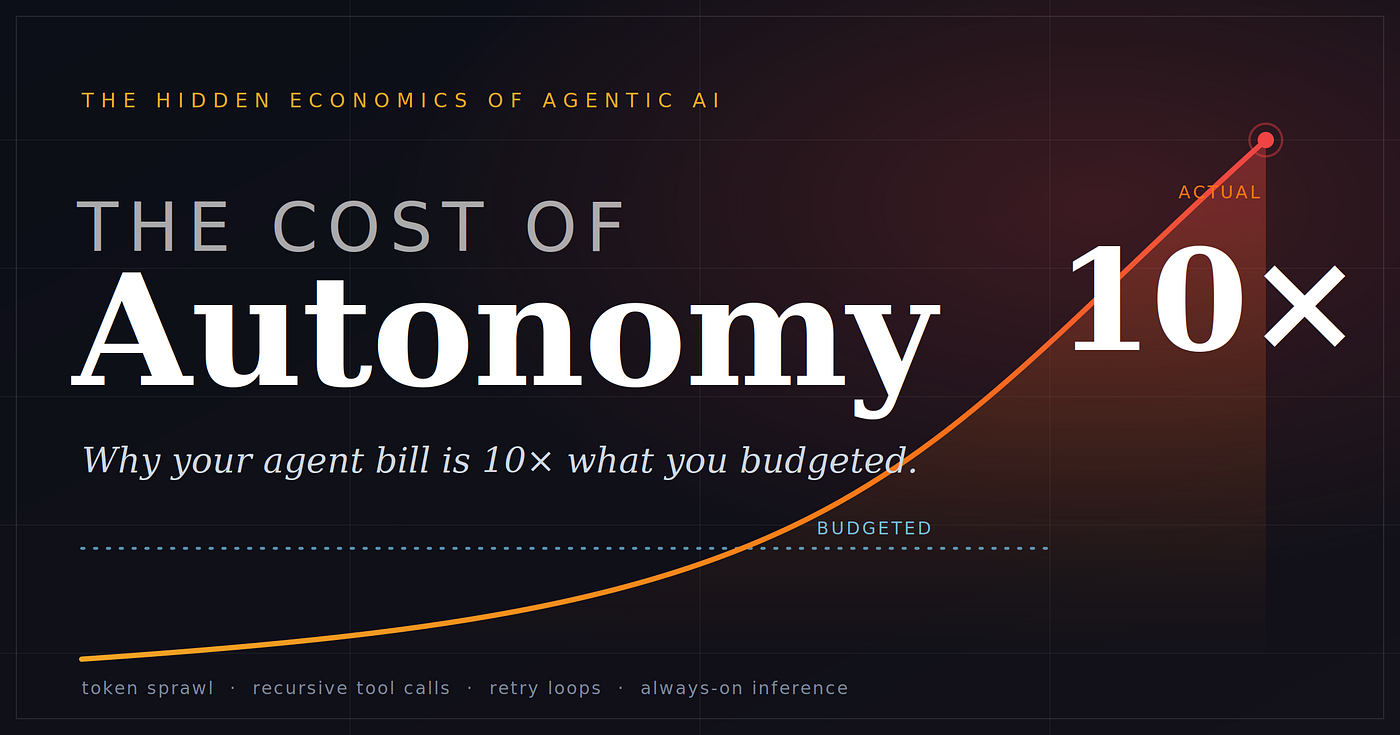
The Cost of Autonomy: Why Your Agent Bill Is 10x What You Budgeted
Token sprawl, recursive tool calls, retry loops, and the hidden economics of systems that plan, reflect, and self-correct.
The Cost of Autonomy: Why Your Agent Bill Is 10x What You Budgeted
Token sprawl, recursive tool calls, retry loops, and the hidden economics of systems that plan, reflect, and self-correct.
In April 2026, Uber’s CTO told the world something most engineering leaders were quietly discovering on their own invoices: the company had burned through its entire annual budget for AI coding tools in four months — a roughly threefold overrun. Microsoft reportedly hit the same wall. The spreadsheets weren’t wrong. The mental model behind them was.
Here is the uncomfortable truth about agentic AI: you didn’t budget for a chatbot, but you also didn’t budget for what you actually deployed. An agent that plans, calls tools, reflects on its output, and retries until it succeeds does not consume tokens the way a chat assistant does. It consumes them in a fundamentally different shape — and that shape is what blows up the bill.
Gartner’s analysis this year put a number on it: agentic systems use roughly 5 to 30 times more tokens per task than a standard chatbot interaction. Per-token prices have fallen about 80% since mid-2023, yet enterprise AI spending still grew nearly fivefold from 2024 to 2026. Cheaper tokens, far bigger bills. That paradox is the whole story, and it has four moving parts.
1. Token sprawl: you pay for the whole conversation, every single turn
Most LLM APIs are stateless. The model has no memory between calls, so to continue a task the agent must resend the entire accumulated context — system prompt, tool definitions, conversation history, every prior tool result — on every step.
This is the part that breaks intuition. Cost doesn’t grow linearly with the length of a task; it grows quadratically. Turn one sends 200 tokens. Turn two resends those 200 and adds more. By turn twenty, the agent has paid for the early context twenty times over. Attention compute compounds the problem: double the context and you roughly quadruple the work. A 20-step loop can consume more than 10x the tokens a naive per-step estimate predicts — which is exactly the gap between what you budgeted and what you owe.
In agentic coding, this shows up as a lopsided ratio. A typical multi-step session runs around a million input tokens against perhaps forty thousand output tokens — roughly 25:1, input to output. Every pricing conversation fixates on the output side because the sticker numbers look scary there. In agentic workloads, the input side is where the money actually goes, and it’s the side nobody models.
2. Recursive tool calls: autonomy means more round trips
A chatbot answers in one shot. An agent decomposes a goal, calls a tool, reads the result, decides what to do next, calls another tool, and repeats. Each of those decisions is a full model inference carrying the entire swollen context with it.
Consider a customer-service request. Answering a question used to cost around 500 tokens. Hand the same task to an autonomous agent that resolves a return, updates inventory, and drafts a follow-up, and you’re looking at roughly 15,000 tokens for the same business outcome — a 30x jump, driven entirely by the multi-step, multi-tool structure. The capability is real. So is the cost, and the two scale together.
When agents move out of interactive sessions and into pipelines — CI/CD, monitoring, batch jobs — the human pacing that naturally throttles a chat window disappears. ReAct-style loops grow context unattended, around the clock.
3. Retry loops and reflection: the cost of getting it right
The features we most want from autonomous systems — self-correction, validation, reflection — are also the most expensive ones, because each retry resends everything.
When an agent’s output fails its own validation criteria, it doesn’t patch the answer; it resubmits the task with the full history attached and tries again. A reflection loop (“Reflexion”-style) running ten correction cycles can consume fifty times the tokens of a single clean pass. Agentic coding tasks routinely land between one and three and a half million tokens per task once retries and self-correction are included.
This is the line item that is almost never in the business case. Retry behavior is architecturally necessary for quality — you want the agent to keep going until it’s right. But “until it’s right” is an open-ended token commitment, and an unbounded one is a budget with no ceiling.
4. Always-on inference: the meter that never stops
The fastest-growing category isn’t interactive at all. Monitoring agents, document watchers, and compliance systems run continuously, spending tokens against every event and data change they observe — whether or not a human ever asked for anything.
These workloads were negligible in 2024 deployments. In 2026 they’re a meaningful and rising share of the monthly bill, and they’re the hardest to cut, because throttling them means degrading the very thing they were deployed to do: watch everything, all the time.
Why the budget missed it: a per-seat model for a per-use product
Every overrun traces back to the same sequence. The team priced the deployment like software — a fixed fee per user, a simple headcount multiplication — then deployed a product whose cost is driven by consumption, not seats. Per-seat budgeting assumes usage is bounded by the number of people. Agentic usage is bounded by nothing but the work itself, and the work is elastic.
The other half of the problem is attribution. The provider invoice tells you precisely how much you spent. It cannot tell you why, or which agent, team, or workflow drove it, or where you could cut without crippling something that matters. Visibility without attribution is just accounting; you can see the number climb but not steer it.
The FinOps Foundation now ranks AI cost management as the single top forward-looking priority for 2026. The discipline is borrowed straight from cloud-cost governance — the structural problem is identical to cloud waste, except it compounds faster and surfaces less visibly.
What to actually do about it
The good news: this is an engineering problem with engineering answers. The teams in control of their spend tend to do some combination of the following.
Constrain the context window — that’s the single highest-leverage move. Most of the bill is re-billed history. Don’t accumulate naively. Use scoped state, summarize or compress prior steps, and reset context between phases. Coordinator-specialist designs, where each sub-agent sees only what its step needs, attack the quadratic growth directly. Recent work shows agents can even self-regulate, compressing their own context for ~20%+ token savings with no accuracy loss.
Route by complexity, not by default. Not every request needs your most expensive frontier model. Classify incoming work and send the easy cases — classification, extraction, summarization — to a budget-tier model. For those tasks, the savings run 15 to 50x, and the quality difference is often invisible.
Tighten what enters the context in the first place. Structured outputs (JSON, markdown) over raw HTML cut tokens by roughly two-thirds. In retrieval, rank and pass ten good chunks instead of stuffing two hundred mediocre ones — beyond a few thousand tokens of retrieved context, quality actually drops, so you’re paying more for worse answers. Less context, better results, lower cost, all at once.
Bound your loops. Put hard caps on retry and reflection cycles. An agent allowed infinite self-correction is a budget with no ceiling. Define “good enough,” and stop there.
Instrument for attribution before you scale, not after. Tag requests at ingest, price them at egress, and fire budget alerts at the threshold between. Per-agent and per-workflow cost visibility is what turns “the bill went up” into “this workflow is the problem.” Teams that stand up real-time token dashboards have cut AI operating costs by around 40% within two months — not by doing less, but by finally seeing where the waste was.
The reframe
Autonomy is not free, and it was never going to be. An agent that plans, reflects, and self-corrects is doing more work than a chatbot — and you pay for work, measured in tokens, compounded by context.
The mistake isn’t deploying agents. It’s deploying them with a cost model built for the previous era. Goldman Sachs projects a 24-fold increase in enterprise token consumption by 2030, driven largely by exactly these workflows. That curve is coming whether you plan for it or not.
So model the consumption before you ship, not after the invoice. Constrain the context, route by complexity, bound the loops, and instrument everything. Do that, and autonomy becomes an investment you can reason about. Skip it, and your agent bill will keep being 10x what you budgeted — and you still won’t know why.
What’s the most surprising line item you’ve found on an agent bill? I’d be curious to hear what’s blowing up other teams’ budgets.
메타데이터
- post_id
- 1a6fa9b30aa5
- slug
- the-cost-of-autonomy-why-your-agent-bill-is-10x-what-you-budgeted-1a6fa9b30aa5
- url
- https://medium.com/signal-structure/the-cost-of-autonomy-why-your-agent-bill-is-10x-what-you-budgeted-1a6fa9b30aa5
- canonical_url
- https://medium.com/signal-structure/the-cost-of-autonomy-why-your-agent-bill-is-10x-what-you-budgeted-1a6fa9b30aa5
- author_url
- https://medium.com/@dnanatihor
- status
- ok
- fetched_at
- 2026-06-13 12:55:53