The Hidden Lives of Numbers
Why a Single Number Is Secretly Many Numbers at Once
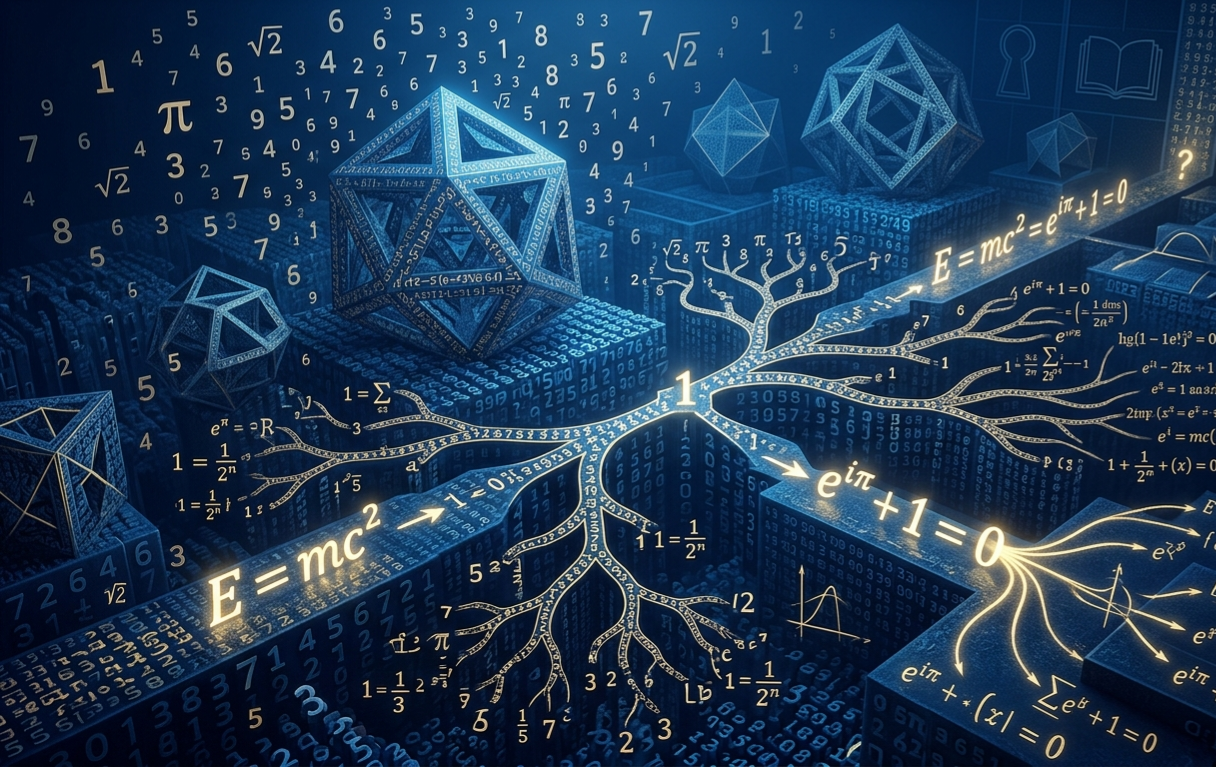
A number is never just a number. It is a universe of hidden relationships.
What if a number is not a single thing at all? Most of us look at a number and see a fixed value. We assume that a number is a rigid object, a static quantity that never changes. But the deeper I looked into mathematics, the more I realized something fascinating: A single number can contain countless versions of itself. Not because its value changes, but because the ways we can understand, deconstruct, and reconstruct it are virtually endless. The Illusion of Numerical Simplicity Take the number: 1900 At first glance, it appears simple and complete. Yet the moment we begin examining its internal structure, the number starts revealing hidden layers. We can rewrite it as: 1900 = 1000 + 900 Or: 1900 = 2000 - 100 Or: 1900 = 19 × 100 Or: 1900 = 950 × 2 The number itself remains unchanged, but its identity seems to shift depending on the lens through which we observe it. This raises an interesting question: If one number can possess countless valid representations, what exactly is the number itself? The Infinite Path of Division Consider the number 1000. We can continuously divide it by two: 1000 → 500 → 250 → 125 → 62.5 → 31.25 → 15.625 → 7.8125 → ... At every stage, the original number is still present within the chain. The same process applies to 900: 900 → 450 → 225 → 112.5 → 56.25 → ... The numbers become smaller and smaller, yet they remain mathematically connected to their origin. The original quantity never disappears. It merely changes form. The Hidden Architecture of Digits Now consider another perspective. The number 1900 consists of four symbols: 1, 9, 0, and 0. By rearranging these digits, entirely different numbers emerge: 9100 9010 9001 0910 0901 0091 The ingredients remain identical. Only the structure changes. A small rearrangement creates a completely different numerical identity. This is remarkably similar to language. The same letters can create entirely different words depending on their arrangement. Numbers behave in much the same way. Representation Versus Reality The deeper insight may be this: A number and its representation are not the same thing. The quantity 1900 exists independently of how we choose to express it. Whether we write: 1900 or 1000 + 900 or 19 × 100 or 950 × 2 the underlying quantity remains unchanged. What changes is merely the perspective. In this sense, numbers resemble physical reality itself. A mountain can be described through poetry, geology, chemistry, or mathematics. Different descriptions. Same object. The Philosophical Question Perhaps mathematics quietly teaches us a broader lesson. Reality may not be defined by a single description. A thing can remain itself while being viewed through infinitely many structures, patterns, and interpretations. The number does not change. Only our way of seeing it changes. And perhaps that is true for far more than mathematics. Perhaps it is true for ideas, people, memories, and even reality itself. Conclusion The next time you see a number, do not ask only: "What value does it represent?" Ask instead: "How many different ways can this same number reveal itself?" Because a number is never just a number. It is a hidden landscape of relationships waiting to be explored.
메타데이터
- post_id
- 1d9653d008df
- slug
- the-hidden-lives-of-numbers-1d9653d008df
- url
- https://medium.com/@dahad2030/the-hidden-lives-of-numbers-1d9653d008df
- canonical_url
- https://medium.com/@dahad2030/the-hidden-lives-of-numbers-1d9653d008df
- author_url
- https://medium.com/@dahad2030
- status
- ok
- fetched_at
- 2026-06-11 15:16:29