The 2022 Nobel Prize in Physics is often described as experimental proof that hidden variables do…
That is the central misconception.
The 2022 Nobel Prize in Physics is often described as experimental proof that hidden variables do not exist.
That is the central misconception.
The Nobel-winning experiments did not eliminate every theory in which quantum mechanics is incomplete. Nor did they solve the measurement problem, the puzzle of why a wave function containing several possible outcomes appears to produce one definite result when a measurement is made.
What the experiments established was more precise: nature cannot be described by a local hidden-variable theory, provided the usual assumptions behind Bell’s theorem are accepted. Nonlocal hidden-variable theories remain possible, and the best-known example is Bohmian mechanics.
The Nobel Committee’s formal citation was careful. Alain Aspect, John Clauser and Anton Zeilinger received the prize “for experiments with entangled photons, establishing the violation of Bell inequalities and pioneering quantum information science.” However, the accompanying public explanation stated more broadly that quantum mechanics could not be replaced by a theory using hidden variables. Without the word “local,” that statement can easily create the wrong impression.
To understand the distinction, begin with the measurement problem.
Quantum mechanics represents a physical system using a wave function. Before measurement, this wave function can include several possible outcomes. Yet every actual experiment gives us one result: a detector clicks in one place, a measuring device points in one direction, or an electron is recorded with one particular outcome.
The standard rules tell physicists how to calculate the probability of each result. What they do not clearly explain is how the collection of possibilities becomes the single event we observe.
A hidden-variable theory proposes that the wave function may not be the complete description of reality. Something additional could determine what happens in each individual experiment, even though ordinary quantum mechanics does not specify that additional information.
Imagine a weather forecast predicting a 60 percent chance of rain. The probability might reflect genuinely unpredictable weather, or it might reflect our incomplete knowledge of atmospheric conditions. Hidden-variable approaches ask whether quantum probabilities could similarly arise from an incomplete description of an underlying physical state.
This question became central to the work of David Bohm.
Bohm studied under J. Robert Oppenheimer at the University of California, Berkeley, during the 1940s. Oppenheimer wanted him to participate directly in the Manhattan Project, but Bohm’s political associations prevented him from receiving the necessary security clearance. After the war, Bohm became an assistant professor at Princeton University, where he wrote his 1951 textbook, Quantum Theory.
At the time, many physicists believed that John von Neumann had already proved hidden-variable theories impossible. Von Neumann’s mathematical argument was widely treated as decisive, although its assumptions were much more restrictive than this reputation suggested.
The weakness had actually been identified as early as 1935 by the mathematician and philosopher Grete Hermann, but her criticism attracted almost no attention. Bohm later demonstrated the limitation in the most convincing possible way: he constructed an explicit hidden-variable theory that reproduced the statistical predictions of ordinary nonrelativistic quantum mechanics.
Bohm’s thinking was influenced by discussions with Albert Einstein at Princeton, but the frequently repeated claim that Einstein personally showed Bohm the precise error in von Neumann’s proof is not firmly established by the historical record.
Bohm’s theory, published in two papers in 1952, was also not the first pilot-wave proposal. Louis de Broglie had introduced an earlier version in 1927. Bohm independently revived and greatly developed the idea, applying it systematically to many-particle systems and to the process of measurement. For this reason, the modern theory is commonly called de Broglie–Bohm theory or Bohmian mechanics.
In Bohmian mechanics, both the wave function and the positions of particles belong to the physical description. A particle follows a definite path, while the wave function guides its motion.
The double-slit experiment provides a simple picture. In Bohmian mechanics, an electron passes through one slit, not both. Its guiding wave passes through both slits, however, and the two parts of that wave interfere. This interference guides different electrons toward different parts of the screen. After many electrons arrive, the familiar interference pattern appears.
The theory therefore explains why each electron is detected at one definite location while still reproducing the wave-like pattern predicted by quantum mechanics.
But the phrase “hidden variables” can itself be misleading. Bohmian mechanics does not say that every measurable quantity is secretly stored inside a particle before the experiment. Particle position is fundamental in the theory, but outcomes such as spin depend on the wave function, the particle’s configuration and the arrangement of the measuring apparatus. Measurement is an actual physical interaction, not always the passive uncovering of a previously stored answer.
Bohm’s theory succeeded in showing that hidden variables were possible, but it came with a remarkable feature: nonlocality.
Locality roughly means that what an experimenter does in one region cannot immediately alter the physical description of something far away. If two objects are separated, each should respond only to conditions in its own surroundings or to influences that have had time to travel between them.
Entangled particles do not fit comfortably into that picture. In Bohmian mechanics, an entangled pair is guided by a single joint wave function. The motion of one particle can therefore depend on the experimental arrangement surrounding the distant particle.
This nonlocal dependence cannot be controlled to send a usable message faster than light. Nevertheless, it is a genuine nonlocal feature of the theory.
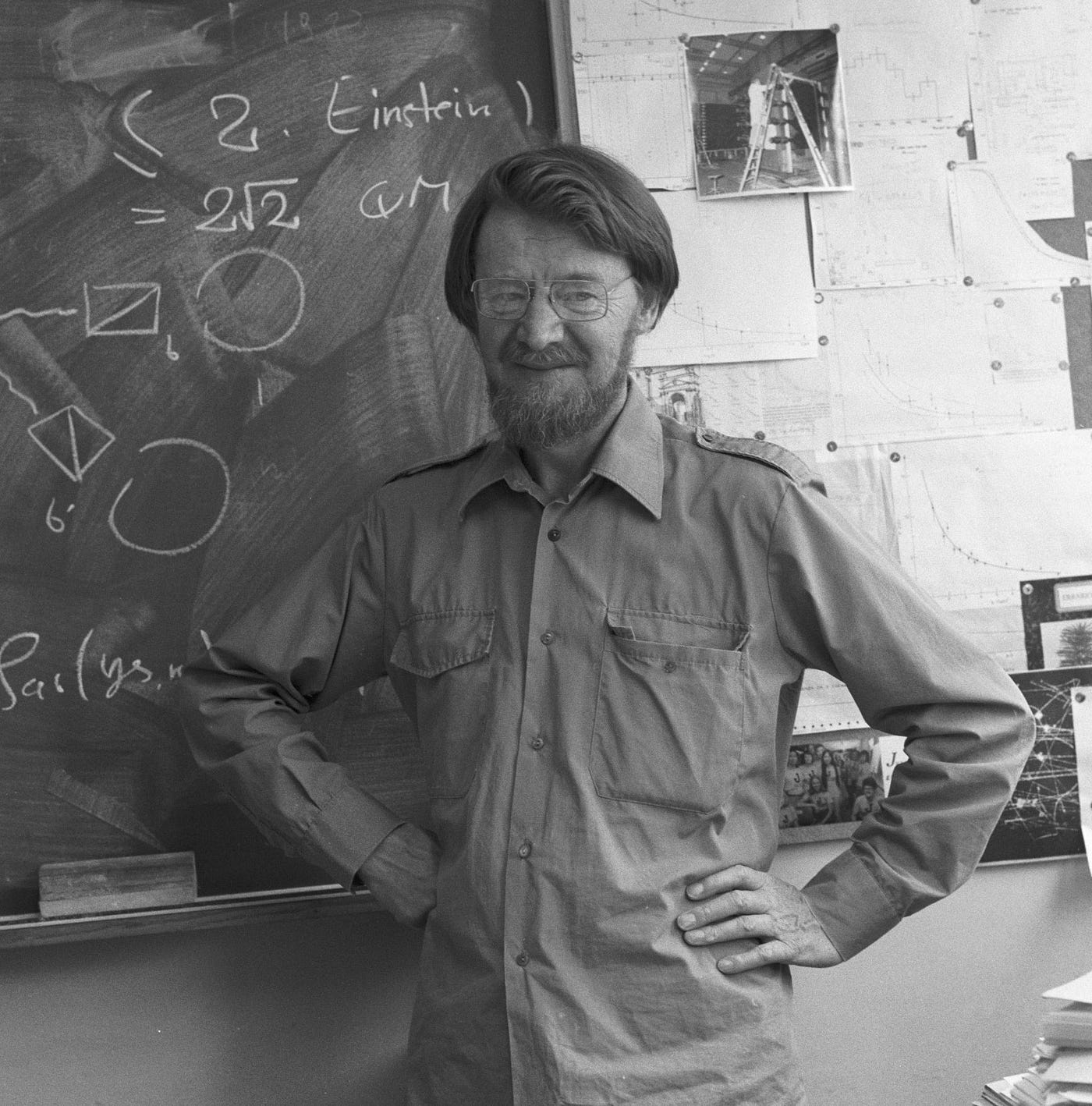
Bohm’s work initially received limited attention. One physicist who recognised its importance was John Stewart Bell. Bell worked primarily in particle physics and accelerator theory, first in Britain and later at CERN, while pursuing questions about quantum foundations alongside his regular research.
Bohm’s model proved that von Neumann’s famous argument could not have excluded all hidden-variable theories. But it left Bell with another question: was Bohm’s nonlocality merely a strange feature of one particular model, or was it unavoidable?
In 1964, Bell transformed that philosophical question into an experimentally testable one.
Imagine that a source sends two entangled particles toward distant laboratories. In each laboratory, an experimenter independently chooses one of several detector settings. A local hidden-variable explanation would say that the particles left the source carrying enough information to produce the observed results, while the choice made at one detector could not affect the distant outcome.
This is sometimes compared to two people receiving sealed instruction sheets before entering separate rooms. Their answers may be strongly coordinated because the sheets were prepared together, but neither person can change the other’s answer after the rooms have separated.
Bell discovered that every such local system of instructions must obey limits on how strongly the results can be correlated. These limits are called Bell inequalities.
Quantum mechanics predicts correlations that exceed them.
In 1972, Stuart Freedman and John Clauser performed an influential test using entangled photons produced in calcium atoms. Their results violated a Bell inequality and agreed with quantum mechanics. Alain Aspect and his collaborators improved the experiments in the early 1980s, including tests in which the detector settings were changed while the photons were travelling. Anton Zeilinger and his collaborators later extended entanglement experiments over greater distances and helped turn entanglement into a practical resource for quantum information.
Later experiments closed several important experimental loopholes that remained in the earlier tests. The accumulated evidence now strongly rejects the broad class of theories satisfying Bell’s locality condition together with the standard independence assumptions used in the experiments.
But Bell’s theorem did not prove that particles simply carry no deeper physical information. It proved that no theory based only on local, independently prepared instructions can reproduce the observed correlations.
Bohmian mechanics survives Bell’s theorem precisely because it is nonlocal.
It also offers a definite account of measurement: particles and measuring devices always possess actual configurations, and their interaction produces a definite recorded result. There is no separate physical law in which observation suddenly collapses the wave function.
That does not mean Bohmian mechanics is universally accepted or complete. Extending its basic picture naturally into relativistic quantum field theory remains difficult, although Bohmian approaches to fields, particle creation and relativistic physics continue to be developed. The theory also requires physicists to accept a form of nonlocality that sits uneasily beside the structure of relativity.
The 2022 Nobel-winning experiments therefore did not solve the measurement problem, and they did not prove that all hidden variables are impossible.
They established something narrower but more profound: the quantum world cannot be explained by objects carrying only local sets of predetermined instructions.
Bell did not eliminate hidden variables.
He showed that any successful hidden-variable account of quantum phenomena cannot preserve locality in its classical form.
메타데이터
- post_id
- 1f200b3f3dc2
- slug
- the-2022-nobel-prize-in-physics-is-often-described-as-experimental-proof-that-hidden-variables-do-1f200b3f3dc2
- url
- https://medium.com/philosophy-of-physics/the-2022-nobel-prize-in-physics-is-often-described-as-experimental-proof-that-hidden-variables-do-1f200b3f3dc2
- canonical_url
- https://medium.com/philosophy-of-physics/the-2022-nobel-prize-in-physics-is-often-described-as-experimental-proof-that-hidden-variables-do-1f200b3f3dc2
- author_url
- https://medium.com/@pioneerinphysics
- status
- ok
- fetched_at
- 2026-07-31 06:51:58