Mother ( A Love That Refuses Justice )
Dear Public Diary ,
Mother ( A Love That Refuses Justice )
Dear Public Diary ,
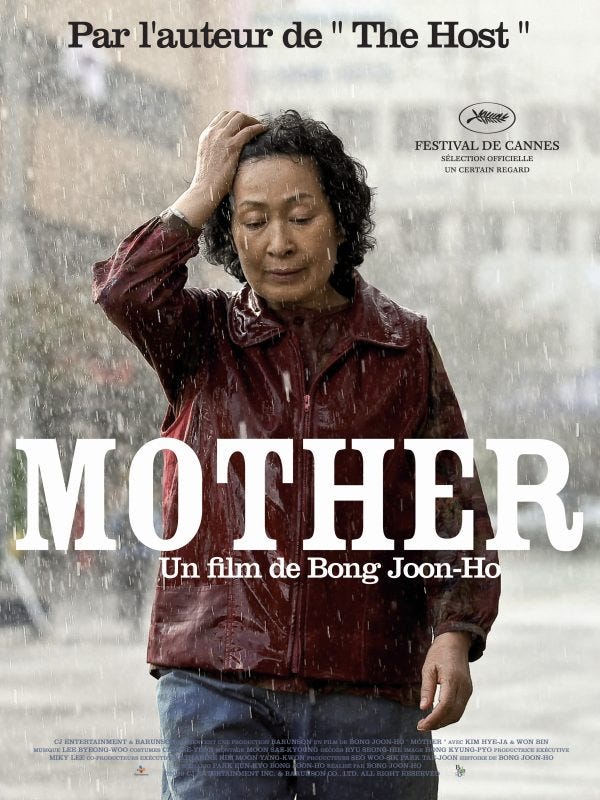
For a long time, Mother was sitting quietly in my watchlist, almost forgotten — one of those films you keep telling yourself you’ll get to “someday,” while you endlessly pick something else instead. I don’t even know why I kept delaying it. But now that I’ve finally watched it, I feel almost irritated at the time I wasted. It’s not just another movie that fills an evening and fades away. It stays. Quietly. In a way that rearranges how you see love, guilt, and moral certainty.
What makes Mother so unsettling is not just its story, but the way it treats love itself. It doesn’t present motherhood as purity or sacrifice in the traditional sense. Instead, it turns it into something unstable — something that can protect, but also distort, justify, and even destroy. Love here is not soft. It is directional. It narrows vision until only one life matters.
At its center is a mother and her son, Do-joon, who lives with an intellectual disability and depends entirely on her. Their life is small, enclosed, almost suspended from the outside world. She is everything to him — protector, provider, interpreter of reality — and he is everything to her world. That fragile balance collapses when a young girl is found murdered and Do-joon is accused of the crime.
And the world does not hesitate.
The system moves quickly, almost carelessly, as if speed replaces truth. Do-joon is reduced before he is even understood. There is a quiet cruelty in how easily people accept a simplified version of reality. At one point, his identity is flattened into something dismissive — “he’s a fool” — as if that single word is enough to explain everything about him.
But the mother refuses that version of reality.
Not because she has proof, but because she has something far more absolute in her mind: recognition. She repeats it like a boundary against collapse — “My son would never do that.” It is not logic. It is not defense. It is identity itself resisting erasure.
Bong Joon-ho never treats this devotion as purely noble. He frames it as something that can twist under pressure. Love does not stay innocent when it is pushed against injustice. It becomes reactive. Excessive. Sometimes blind.
And that is exactly how her journey begins.
She starts searching for truth, moving through fragments of the case, questioning people, revisiting moments that everyone else wants to forget. But the deeper she goes, the less stable truth becomes. Every version of events feels slightly reshaped by fear, guilt, or self-preservation. The film never gives you a clean ground to stand on.
One scene that I simply cannot ignore is the moment when the detective comes to her shop near the end of the film. For a few seconds, the atmosphere becomes unbearable because she genuinely thinks he has come for her. You can see the terror rising inside her before he even says anything. It is not the fear of losing her son anymore — it is the fear of being discovered, the fear of finally facing the consequences of everything she has done. The movie becomes painfully quiet in that moment, and even her expression feels louder than dialogue.
And then the detective tells her they found the “real” criminal.
What makes this scene extraordinary is that she does not react the way we expect her to. She is not fully relieved. She is not suddenly happy that her son is finally free. Instead, her emotions collapse into one another — relief, guilt, sadness, confusion — all existing at the same time. It is one of the rare moments in cinema where a face alone can carry an entire moral conflict.
A normal reaction would have been joy. The nightmare is over. Her son is safe. Everything she fought for finally worked. But instead of celebrating, she asks to see the new suspect.
That detail alone says everything.
Because deep down, she already understands what this means. Her son’s freedom now belongs to someone else’s suffering.
And when she finally sees the boy, the scene becomes heartbreaking in a completely different way. He is vulnerable, fragile, almost painfully similar to her son. Another boy the world can easily dismiss. Another boy who does not know how to defend himself against the machinery of accusation.
Then she asks him softly:
“Do you have a family?”
He looks at her quietly.
And she asks again:
“Do you have a mother?”
And when he answers no, something inside her completely breaks.
Because in that instant, she realizes the cruel difference between her son and this boy. Her son had someone willing to destroy herself for him. Someone willing to cross every moral line imaginable just to protect him. But this boy has nobody. No mother waiting outside for him. No one obsessively searching for the truth. No one refusing to let the world erase him.
And the pain in her face at that moment is devastating because she understands all of this immediately, without needing to say it aloud. She realizes that the system can easily sacrifice people who have nobody to defend them.
To me, that scene carries the entire emotional soul of Mother. Not just motherhood as love, but motherhood as protection, privilege, and survival. The film quietly asks one terrifying question: what happens to the children who have no one willing to fight for them?
And honestly, that was the moment I stopped watching the film as a mystery and started seeing it as a tragedy.
And then there is the physical language of the film — the strange, unforgettable dance scene. It doesn’t function as expression in a traditional sense. It feels closer to emotional overflow, where feeling has exceeded meaning entirely. A body reacting after language fails.
It is not joy. It is not grief. It is something closer to rupture.
Bong Joon-ho builds all of this with a kind of quiet precision that makes the film feel deceptively calm. Nothing is exaggerated. Nothing announces itself. And yet everything feels morally unstable beneath the surface, as if the world itself is slightly misaligned.
By the end, Mother does not resolve itself. It leaves you inside contradiction.
Was she right? Was she wrong? Does love justify what it destroys? And what happens when protection becomes more important than truth?
These questions don’t settle easily, and maybe they are not meant to. Because the film is not interested in giving answers — it is interested in showing how quickly certainty breaks when love is pushed far enough.
And long after it ends, what remains is not the story itself, but the discomfort of realizing how fragile your own moral lines might be when faced with the same impossible choice.
메타데이터
- post_id
- 21ac7420c871
- slug
- mother-a-love-that-refuses-justice-21ac7420c871
- url
- https://medium.com/@sceneandsense/mother-a-love-that-refuses-justice-21ac7420c871
- canonical_url
- https://medium.com/@sceneandsense/mother-a-love-that-refuses-justice-21ac7420c871
- author_url
- https://medium.com/@sceneandsense
- status
- ok
- fetched_at
- 2026-07-23 21:04:19