Foxy Tales: The Story of Foxes Throughout Cultures
Foxes, like any other animal, have inspired awe in humans. However, what makes foxes stand out from other animals is where they’re…
Foxy Tales: The Story of Foxes Throughout Cultures
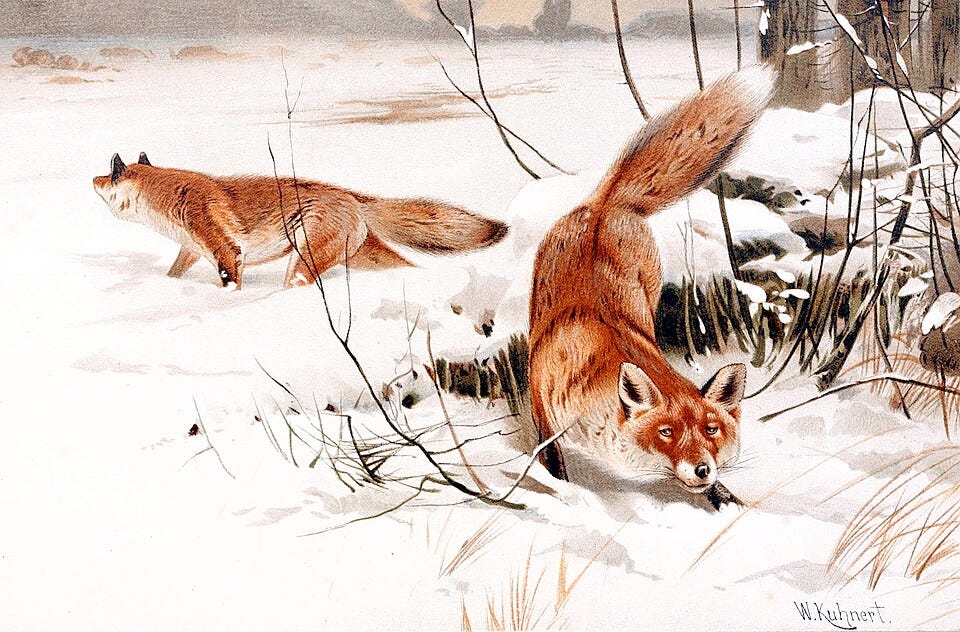
“Common Foxes in the Snow”, by W. Kuhnert. Courtesy of Wikimedia Commons.
Foxes, like any other animal, have inspired awe in humans. However, what makes foxes stand out from other animals is where they’re distributed. Living on every continent except Antarctica and occupying over thirty different species, it is no surprise that the fox has caught the imaginations of generations of people.
One fox species in particular, the red fox (Vulpes vulpes), has a widespread distribution, from the forests of Europe to the Australian Outback, where they are a nuisance.
I have been able to pinpoint at least five different archetypes affiliated with foxes. We’ll start with the iconic Trickster, followed by Supernatural, then the Outfoxed Fox, followed by the Benefactor, and then the Omen. Following this, there will be a discussion on the quintessential fox character who embodies all of these tropes.
The first archetype is the classic Trickster Fox. This is what most people think of when they see a fox in the media — the cunning and sly animal who uses charm and charisma for personal gain. There are multiple examples of this archetype, but for the sake of this essay, we’ll keep it to a few primary examples.
One of the earliest tropes of the Trickster Fox is the Aesop fable of “The Fox and The Crow”. In the fable, the fox tricks the crow into singing so it can steal food.
The fox in this fable establishes the DNA of the Trickster Fox archetype. There is survival through deception, using speech as a weapon and charm to steal. In this case, the fox sweet-talks the crow about their beauty. This leads the fox to encourage the crow to sing, but the crow loses the food they were holding onto. The fox seizes the moment and departs.
However, it seems that in recent years, the fox has received a much more desirable PR overhaul. What I mean is that the foxes still maintain their naughty nature, but instead of playing the role of antagonist, how about they play the role of protagonist?
Nick Wilde is the modern trickster fox. Instead of tricking people for his own gain, he does it out of survival. In the movie, all of the animals are stereotyped. However, in the case of Nick, he is profiled for two aspects:
- He is a predator (a type of animal that is already frowned upon within the society of Zootopia)
- He is a fox. (Stereotyped as being a trickster, from Judy Hopps to even the police chief.)
The first thing we see Nick do is run a scam involving popsicles with his partner, Finnick (who, incidentally, is a Fennec Fox). He buys a Jumbo Pop and turns it into smaller popsicles to resell, a relatively harmless scam. This establishes him as someone resourceful rather than malicious.
What makes this work is the fact that Nick is profiled throughout the movie for being a fox. Instead of proving people wrong directly, he indirectly shows that being a trickster doesn’t involve personal gain. If anything, Nick Wilde teaches how cunning behavior can be tied to social discrimination and survival.
Brian Jacques’ Redwall series features foxes. However, they are one of many species that occupy the role of the villain. In his stories, many of the fox characters are trying to deceive others for personal gain. For example, in Redwall, the fox Sela tricks Cluny by drugging him and stealing the plans for a raid on Redwall Abbey. She goes to the Abbey to warn of Cluny’s upcoming invasion, but it isn’t done with altruistic purposes. Sela, along with her son, Chickenhound, takes advantage of the Abbey’s kindness by stealing. Father Methuselah tries to stop them, but he is killed immediately.
Many of the foxes in Redwall are considered tricksters, albeit in a darker form. Instead of playful trickery, many of the foxes residing in Mossflower Woods manipulate through violence, greed, and survival.
The ultimate example of this is in the book Marlfox. In the book, a family of silver foxes called the Marlfox terrorizes and manipulates others in the pursuit of power. They use elaborate illusions, winding halls, and their reputation as phantoms to their advantage. Their silver fur and aristocratic behavior set them apart from other foxes in the franchise, reinforcing the idea that they are cunning outsiders who weaponize manipulation and intelligence.
In the Animal Crossing franchise, there is the character Redd. However, instead of tricking kings or stealing food, he sells counterfeit paintings.
Making his debut in the Japanese-exclusive Dobutsu No Mori, he swindles the player out of money by having them pay a small fee to enter the tent. From here, the player can take a look at some of his wares. If the player is hesitant, Redd will try to butter them up with a reduced price. He’ll insist that this offer is “exclusive”.
Once the player buys a painting, they can take it to Blathers for inspection. If the player buys a fake, Blathers regrets to inform them that the painting is a forgery.
This makes the player suspicious of Redd, and there are two outcomes: the player can either avoid Redd or beat him at his game.
In Animal Crossing: New Horizons, the player can zoom in on the painting to look for flaws.
Redd is an example of the trickster fox archetype, with aspects of the Kitsune being there. Instead of using force, he uses charm and trickery to get money out of the player.
This is a stark contrast to Tom Nook, a Tanuki who obtains money via a pressure-free, no-interest loan payment to the player. Instead of trickery, he uses actual business. This reflects how Tanukis are often depicted in stories in the media. Tanuki are often depicted as lucky animals associated with trade and commerce. Tanuki statues are often paired with the Maneki-Neko (Beckoning Cat) statues to entice customers and boost business.
These two characters are a prime example of how mythologies evolve into modern character design.
Now, we come to the Supernatural. The shape-shifters. Those who can craft tricks and illusions. Many of the examples provided here primarily come from Eastern sources, but they all serve a purpose: showcasing how an animal thrives on legend.
In Japanese legend, there is the Kitsune. The Kitsune (literally Japanese for Fox) is a yokai that resembles a nine-tailed fox.
They usually trick people by assuming the form of a beautiful woman or by creating elaborate illusions. However, some legends say that inexperienced Kitsune will forget an important detail of the person they’re imitating.
Whether or not Kitsune are evil is up to the storyteller. However, something is interesting about yokai as a whole: Yokai aren’t necessarily evil. The word Yokai can mean “strange” or “bewitching”. However you interpret the word, Yokai refers to spirits that are generally mischievous and don’t actively try to harm people. Granted, there are some cases of Yokai being malevolent, such as the Kuchisake-Onna (Slit-Mouth Woman).
The Kitsune is an iconic Yokai, making many appearances in video games, television shows, and especially in the world of anime and manga.
My personal favorite example is in the Pokémon franchise. The Pokémon Vulpix and Ninetales are based on the physical descriptions of the Kitsune. However, the Pokémon Zorua and Zoroark reflect the Yokai’s more mythical qualities, like shapeshifting and creating illusions. The franchise even has its own version of the trickster fox archetype with the Pokémon Nickit. Its Pokedex entries mention that it steals food from humans and other Pokémon, using its tail to cover its tracks.
In Korea, there is the Kumiho, or Gumiho. The Kumiho are similar to Kitsune in that they are spirits who take on the form of a fox. However, that’s where the similarities end. The Kumiho are far more malevolent, assuming the form of beautiful women to consume hearts and livers. It is said that a Kumiho can change form, but its foxlike nature will always remain.
The third archetype affiliated with foxes is the outfoxed fox. This is where the fox is beaten at its own game. What started as a subversion of the trickster fox became a moral on how using deception and trickery will never get you far.
Nick Jr.’s Dora the Explorer gives us Swiper the fox. The closest thing the show has to a recurring antagonist, Swiper, is a fox who wears a blue mask and gloves. He appears with his theme song, trying to “swipe” things from Dora. To which Dora and Boots (with the help of the audience) ward off Swiper by saying “Swiper, no swiping!” three times. To which Swiper responds with “Oh, man!”.
Swiper is a fascinating character. Instead of playing the traditional trickster, he plays the outfoxed fox role. Although he relies on general trickery, his plans are constantly foiled by the main characters. What makes him even more interesting is the fact that he serves a role similar to Aesop’s fables. He portrays shifty characters and encourages preschool children not just to be proactive but to recognize potential danger.
Another example of the outfoxed fox archetype can be found in the Br’er Rabbit Tales from Uncle Remus. These stories are adaptations. Although Br’er Rabbit is remembered for his trickery, the fox, named Br’er Fox, also has a few tricks up his sleeve.
One of the more infamous tricks done by the fox is to trap Br’er Rabbit with the aid of a Tar Baby. Although Br’er Rabbit falls for the trap initially, he gets himself out of it by manipulating Br’er Fox by tricking him into thinking he was afraid of the briar. Despite this, the fox throws him into it, not realizing Br’er Rabbit was born and raised in a briar.
He realizes the folly of his error too little, too late, and winds up being swindled by Br’er Rabbit.
The fourth archetype is the benefactor. This is a more recent archetype affiliated with these animals. As I mentioned, the fox has been painted in a much more positive light. Nick Wilde, while a subversion of the Trickster Fox trope, could also be argued to fulfillthe benefactor role. However, the benefactor is generally a good fox who doesn’t use any form of deception, and when he does, it is typically directed at the antagonists.
One example of this trope is the fox from “The Little Prince”. In the story, he teaches the eponymous Little Prince about love and friendship via taming. It is an emotional scene where he breaks down the beauty of lasting bonds.
Unlike the foxes, who are neutral at best to liver-eating at worst, “The Little Prince” is an example of a fox that offers emotional insight and serves as a positive influence on the protagonist.
Another example is the book “The Boy, The Mole, The Fox, and The Horse,” a children’s story that explores deeper themes such as emotional intelligence, resilience, and courage. The fox in this story starts antagonistic, largely because of his distrust of humans. Once he realizes the Boy is not a threat, he becomes a central character in the story. The Fox also offers the Boy wisdom and helps him on his adventure.
Disney’s Robin Hood is an interesting blend of trickster and benefactor. He does use trickery, but primarily to disarm the antagonists. Much like its source material, Robin Hood steals from the rich and gives to the poor.
Last but not least, we have The Omen. Not to be confused with the 1976 movie of the same name. In this case, The Omen Fox is a generally neutral archetype that foxes tend to be categorized as.
In Antichrist, the protagonist comes face-to-face with a red fox disemboweling himself. As the fox stops, he utters the words: “Chaos reigns”. Unlike the Kitsune, the fox warns Willem Dafoe’s character that things are quite literally falling apart. The fox in the movie represents unprocessed grief and the self-destructive nature of it. Throughout the film, the couple is mourning the death of their child and is processing it in different ways. The wife lashes out through sexual violence and Willem Dafoe’s character retreats into his hallucinations.
In the VVitch, foxes don’t play a character, but they serve as part of the flavor that is the woods. Set in 1630s New England, the woods are haunted by an evil force. Animals, including the foxes, start acting strangely. Bold, even.
The Omen fox is a warning. If one does not heed it, devastating consequences will follow.
Now that we have listed all of the tropes, we have just one more question to answer: Which fox is the ultimate fox?
Allow me to introduce you to Reynard the Fox.
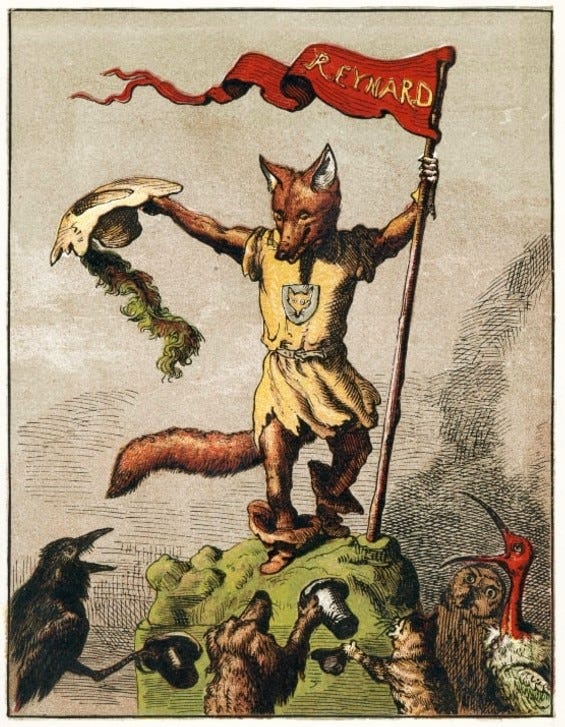
Reynard the Fox, as drawn by Ernest Henri Griset. Courtesy of Wikimedia Commons.
Reynard is a fox character introduced by the Europeans in the 12th century. Reynard has traveled through different countries and different stories have been made about him, so it really boils down to who tells the story. However, the consensus goes like this:
Reynard is a cunning and clever fox who often tricks others for his own gain. His main adversary is Isengrim the Wolf, his uncle. As mentioned, the core stories boil down to who tells them. Some stories may portray him as a hero; others even as a morally grey character. Others depict him as a coward or as cunning and sly.
Reynard is the ultimate fox because not only does he embody all these tropes, but his versatility also helps keep him from being put in a box. What makes it even better is that he is a public domain character, which means you can more or less do whatever you want with him.
Here’s a fun fact: Did you know the Walt Disney Company was set to do an adaptation of Reynard the Fox? Why was it canceled, you may ask? Because Reynard was considered too morally dubious for the company to make into a rootable hero. So, the project was shelved.
As we have seen, foxes awe people not with their perceived abilities, but with their tenacity and adaptability.
메타데이터
- post_id
- 25d69b9d5ee0
- slug
- foxy-tales-the-story-of-foxes-throughout-cultures-25d69b9d5ee0
- url
- https://medium.com/@catalistair/foxy-tales-the-story-of-foxes-throughout-cultures-25d69b9d5ee0
- canonical_url
- https://medium.com/@catalistair/foxy-tales-the-story-of-foxes-throughout-cultures-25d69b9d5ee0
- author_url
- https://medium.com/@catalistair
- status
- ok
- fetched_at
- 2026-06-12 22:02:08