10 Tips to Maximize Claude Code for iOS Development
How to use AI-assisted development the right way and actually get faster, not just feel faster
10 Tips to Maximize Claude Code for iOS Development
How to use AI-assisted development the right way and actually get faster, not just feel faster
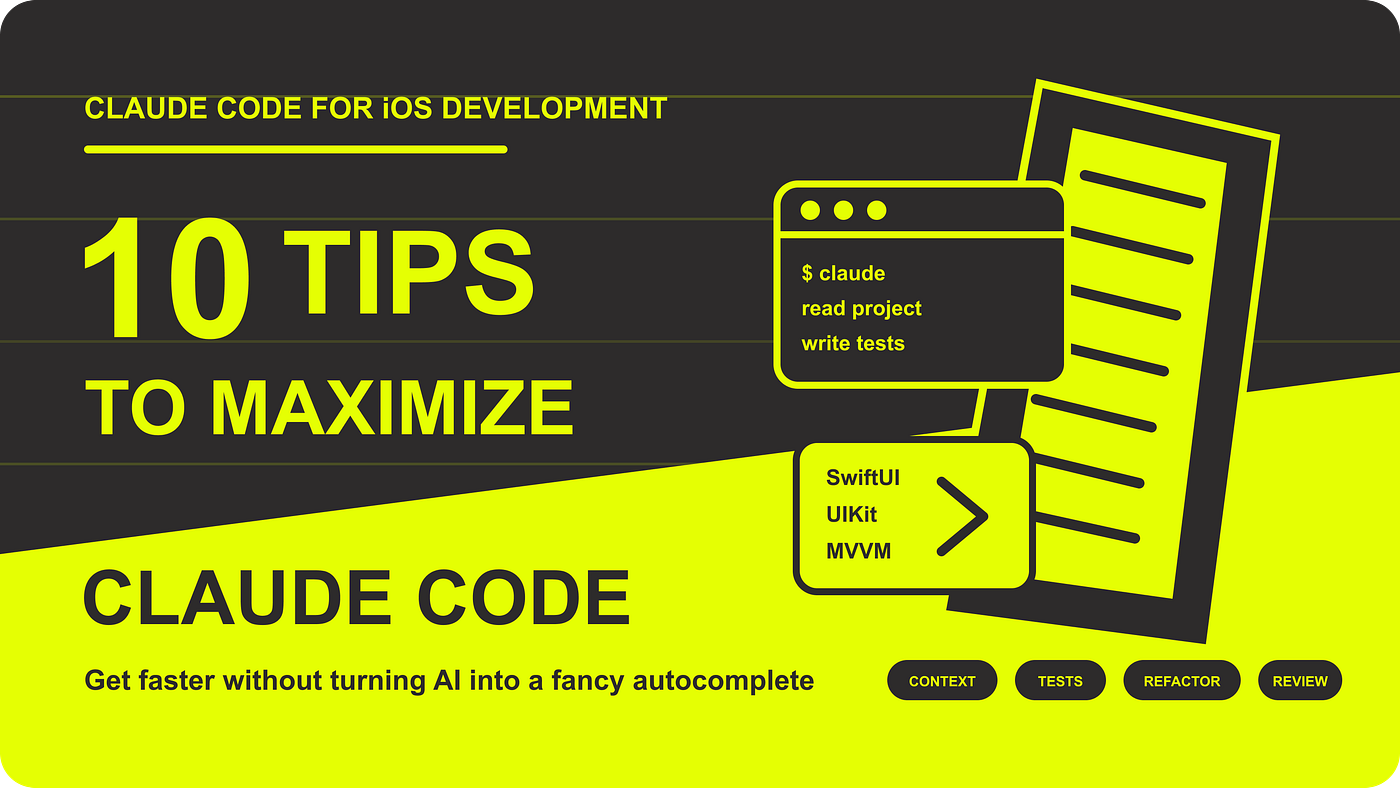
I’ve been using Claude Code in my iOS workflow for a while now, and there’s a clear pattern I keep seeing: developers either use it as a fancy autocomplete, or they don’t use it at all because
“it doesn’t understand my codebase.”
Both camps are leaving a lot on the table.
💥 Master Any Skills in 3 Months 📚 Up to 85% OFF Premium Courses ⏳ Limited-Time Offer *👉 **Enroll Now & Start Learning***

Claude Code is not a replacement for knowing Swift or understanding UIKit and SwiftUI deeply.
If anything, it’s the opposite the more you understand the platform, the better you can direct it, and the faster it works.
Think of it less like a junior developer who writes code for you,
and more like a senior developer who already has the entire Apple SDK memorized and is waiting to help you think through problems.
This article is about how to actually use it well in an iOS context.
Not generic “be specific in your prompts” advice.
Actual patterns that work when you’re building real apps.
1. Give Claude Code Your Project Context First
The single biggest mistake I see is starting Claude Code cold no context, just a question.
You get generic answers that could apply to any iOS project, not yours specifically.
Before anything else, give it the lay of the land.
# From your project root, let Claude Code read your structure
claude "Read the project structure and key files so you understand the codebase before I ask anything"
Or be more deliberate about it:
claude "
Here's the context for this project:
- SwiftUI app targeting iOS 17+
- MVVM with @Observable macro (not ObservableObject)
- Uses Swift Concurrency everywhere (async/await, no Combine)
- Dependency injection via a DependencyContainer singleton
- SwiftData for local persistence, custom API layer for networking
- No third-party UI libraries — everything is native SwiftUI

Keep this in mind for everything I ask from this point forward.
"
Now every subsequent question gets answers that fit your actual architecture not a generic MVVM template that uses @StateObject when you've already moved to @Observable.
2. Use It for Boilerplate You’re Too Bored to Write Correctly
There is a category of iOS code that every developer knows how to write, but finds tedious enough that they sometimes cut corners:
Codable implementations with custom keys, NSPredicate builders, URLRequest constructors,
NotificationCenter observer setup, Core Data fetch request boilerplate.
This is where Claude Code earns its keep fastest.
claude "
Create a Codable struct for this API response. Use camelCase property names and
map from snake_case JSON keys automatically.

{
  'user_id': 'abc-123',
  'display_name': 'Ahmad',
  'created_at': '2026-01-01T00:00:00Z',
  'is_premium': true,
  'profile_image_url': 'https://cdn.example.com/img.jpg',
  'task_count': 42
}

Also write a DateDecodingStrategy extension to handle ISO8601 dates.
"
You’d write this yourself in 5 minutes.
Claude Code does it in 5 seconds and gets all the CodingKeys cases right without a typo.
The time saving per instance is small.
Across a project with 30 API models, it’s significant.
3. Ask It to Write Tests, Not Just Code
Most developers use Claude Code to write implementation code.
The smarter move is to ask it to write tests for code you’ve already written.
This is valuable for two reasons.
First, it’s faster than writing tests manually.
Second and this is the more important one Claude Code will often ask questions or make assumptions that reveal gaps in your own understanding of the feature’s expected behavior.
claude "
Write XCTest unit tests for this ViewModel. Cover:
- Happy path (successful data load)
- Empty state (API returns empty array)
- Error state (network failure)
- The filter logic for each Filter enum case
- That toggling a task correctly updates the local state

Use async/await for all async tests. Mock the use cases with protocol-based fakes,
not mocks libraries.

Here's the ViewModel: [paste code]
"
The protocol-based fakes instruction matters.
Tell it how you want to test, not just what to test.
Claude Code will follow your conventions if you state them.
4. Use It as a Rubber Duck for Architecture Decisions
This is the use case that surprised me most.
Before committing to an architecture decision, describe the problem to Claude Code and ask it to push back.
claude "
I'm designing the navigation architecture for a SwiftUI app.
The app has 5 main tabs, each with their own navigation stack.
Some flows need to navigate across tabs (e.g., tapping a notification
opens a detail view in a different tab).

I'm considering using a Coordinator pattern with a root coordinator
managing tab state. But I've also seen people use NavigationPath
stored in an @Observable class per tab.

What are the real trade-offs between these two approaches for
an app at this scale? What would break first as the app grows?
What would you do and why?
"
You’re not asking it to write code.
You’re using it to stress-test your thinking before you’ve written a single line.
This is where having something that has read thousands of iOS codebases is genuinely useful.
5. Give It the Error, the File, and the Context Together
When debugging, the quality of Claude Code’s help is directly proportional to how much context you give it.
Most people paste just the error message.
That’s the least useful thing you can give it.
Give it everything at once:
claude "
I'm getting this crash at runtime:

[paste full crash log / stack trace]

Here's the file where the crash is happening:

[paste the relevant file]

Here's how this code gets called:

[paste the call site]

The crash only happens when the user navigates back from the detail screen
while a network request is in flight. It doesn't happen in the simulator,
only on device.
"
The “only on device” detail, the navigation timing,
the in-flight request all of that matters.
The more specific you are, the less back-and-forth you need, and the more likely Claude Code’s first answer actually solves the problem.
6. Let It Refactor, But Review Every Line
Claude Code is excellent at refactoring.
It can take a 200-line ViewController, identify the responsibilities, and split it into a proper ViewModel + View pattern.
It can rename every instance of a pattern across multiple files.
It can extract repeated code into a reusable modifier.
The rule: never accept a refactor without reading every changed line.
claude "
Refactor this ViewController to MVVM. Rules:
- ViewModel uses @Observable (not ObservableObject)
- All network calls move to the ViewModel using async/await
- View only contains UI code — no business logic
- Keep the existing error handling behavior exactly as-is
- Do NOT change the public interface — other parts of the codebase
  depend on the completion handlers currently exposed
"
The last two constraints are important.
Claude Code doesn’t know what the rest of your codebase depends on.
You do.
Telling it what to preserve prevents it from refactoring away something that breaks a feature three screens away.
Always run your full test suite after a Claude Code refactor, even if the code looks correct.
7. Use CLAUDE.md to Encode Your Team’s Conventions
If you’re using Claude Code on a team project, or even just want consistent behavior across sessions, create a CLAUDE.md file in your project root.
Claude Code reads this automatically and applies its contents as persistent context.
# CLAUDE.md

## Project: MyApp iOS

### Swift conventions
- Use @Observable macro, never ObservableObject
- Prefer async/await over completion handlers for all async code
- Use Swift concurrency structured tasks — avoid unstructured Task { } unless necessary
- All network errors must be typed (no generic Error throws)
- Never force unwrap — use guard let or if let

### Architecture
- Feature-based folder structure: Features/FeatureName/{View, ViewModel, Model}
- Use cases live in Core/Domain/UseCases/
- Repository pattern for all data access
- DependencyContainer.shared is the composition root

### SwiftUI patterns
- Views are dumb — no business logic, only layout and user actions
- Use ViewModels initialized in the View's init via @State
- Prefer native SwiftUI components before reaching for custom implementations
- All lists use LazyVStack or List, never ScrollView + ForEach for large datasets

### Testing
- Unit tests for all ViewModels and UseCases
- Use protocol-based fakes, not mock frameworks
- UI tests only for critical user flows (onboarding, checkout, auth)

### What to avoid
- Singleton state outside DependencyContainer
- NotificationCenter for cross-module communication — use delegates or callbacks
- DispatchQueue.main.async — use MainActor instead
Now every Claude Code session in this project starts with all of these rules already loaded.
You don’t have to repeat yourself every time.
8. Ask It to Explain Apple APIs Before You Use Them
This is a use case most iOS developers don’t think of: using Claude Code as a deep-dive explainer for unfamiliar APIs before you start writing code.
claude "
I need to implement background app refresh for syncing tasks while
the app is not running. Explain how UIApplication.shared.setMinimumBackgroundFetchInterval
works, what BGTaskScheduler does differently, which one I should use for iOS 17+,
and what the actual gotchas are that Apple's documentation glosses over.
"
Or when you’re about to use something you’ve used before but want to double-check:
claude "
I'm about to use URLSession with a background configuration for file downloads.
What are the behaviors that will catch me off guard — specifically around
how the delegate callbacks work when the app is terminated and relaunched,
and how to handle the completion handler that iOS gives back to the app delegate.
"
This is faster than reading documentation, faster than Stack Overflow, and the answer is tailored to your exact context rather than someone else’s 2019 question.
9. Use It to Generate Realistic Mock Data
One of the most tedious parts of iOS development is creating realistic test data.
Claude Code is very good at generating SwiftUI previews, XCTest fixtures, and mock data that actually resembles real content.
claude "
Generate 10 realistic TaskItem mock objects for SwiftUI previews and unit tests.
Use real-sounding task titles — not 'Task 1', 'Task 2'. Mix priorities,
some with due dates (some overdue, some today, some upcoming),
some completed, some not. A few should have reminderDates set.
Return them as a static array in a PreviewData.swift file using
the #if DEBUG guard.
"
// What you get back — actually usable in previews
#if DEBUG
extension TaskItem {
static let mockTasks: [TaskItem] = [
TaskItem(
id: UUID(),
title: "Review Q2 design specs with product team",
description: "Go through Figma file and leave comments before Thursday standup",
dueDate: Calendar.current.date(byAdding: .day, value: -1, to: Date()),
priority: .high,
isCompleted: false,
createdAt: Date(),
updatedAt: Date(),
reminderDate: Calendar.current.date(byAdding: .hour, value: -2, to: Date())
),
// ... 9 more realistic entries
]
}
#endifReal-looking preview data makes a real difference in how you catch UI issues early when task titles are “Task 1” and “Task 2”, layout problems hide because the content is always the same length.
[embed]An AI Interviewed Me for an iOS Job And I Wasn’t Nervous Oncemedium.com
10. Review What It Produces Every Time
This is the tip that matters more than all the others.
Claude Code is fast and usually correct.
It is not always correct.
It can produce code that compiles, runs, and even passes tests — and still be subtly wrong for your specific situation.
It might use a deprecated API that still works but will be removed in a future iOS version.
It might handle the happy path correctly but miss an edge case you haven’t described.
It might write code that’s architecturally inconsistent with the rest of your codebase in ways that aren’t immediately obvious.
The rule is simple: treat every piece of Claude Code output the same way you’d treat a pull request from a developer you respect but haven’t worked with before.
Read it.
Understand it.
Ask questions if something doesn’t make sense.
Don’t merge it until you can explain why every line is there.
# Good prompt pattern — ask it to explain its own choices
claude "
Here's the code you wrote for the sync manager. Explain:
- Why you chose this concurrency pattern over the alternative
- What happens if two sync operations are triggered simultaneously
- What the failure mode is if the remote API is unreachable mid-sync
- Whether there's any state that could get stuck if the app is backgrounded during sync
"
If Claude Code can’t give a good answer to these questions, the code probably needs rethinking
whether it wrote it or you did.
The developers who get the most out of Claude Code are not the ones who accept its output the fastest.
They’re the ones who use it to move faster while still thinking carefully.
The AI handles the tedious parts.
Your judgment handles the rest.
Putting It All Together
Claude Code changes the math of what’s worth doing manually.
Boilerplate that would have taken 20 minutes is now a 30-second prompt.
Test coverage that would have been skipped under deadline pressure is now feasible.
Architecture questions that would have required a senior developer consultation can be explored in minutes.
But it doesn’t change what good iOS development looks like.
It still requires knowing Swift deeply, understanding Apple’s platform constraints, writing tests, thinking carefully about architecture, and reviewing code rigorously.
The best way to think about it: Claude Code raises the floor of what you can accomplish in a day.
What you build with that extra capacity is still entirely up to you.
Thank you for reading! If you enjoyed it, please consider clapping and following for more updates! 👏.
Thank you for being a part of the community
Before you go:

👉 Be sure to clap and follow the writer ️👏️️
👉 Follow us: **Linkedin| [Medium](https://medium.com/codetodeploy)**
👉 CodeToDeploy Tech Community is live on Discord — **Join now!**
Disclosure: This post includes affiliate and partnership links.
메타데이터
- post_id
- 29027edc51a7
- slug
- 10-tips-to-maximize-claude-code-for-ios-development-29027edc51a7
- url
- https://medium.com/codetodeploy/10-tips-to-maximize-claude-code-for-ios-development-29027edc51a7
- canonical_url
- https://medium.com/codetodeploy/10-tips-to-maximize-claude-code-for-ios-development-29027edc51a7
- author_url
- https://medium.com/@21zerixpm
- status
- ok
- fetched_at
- 2026-07-12 01:24:19