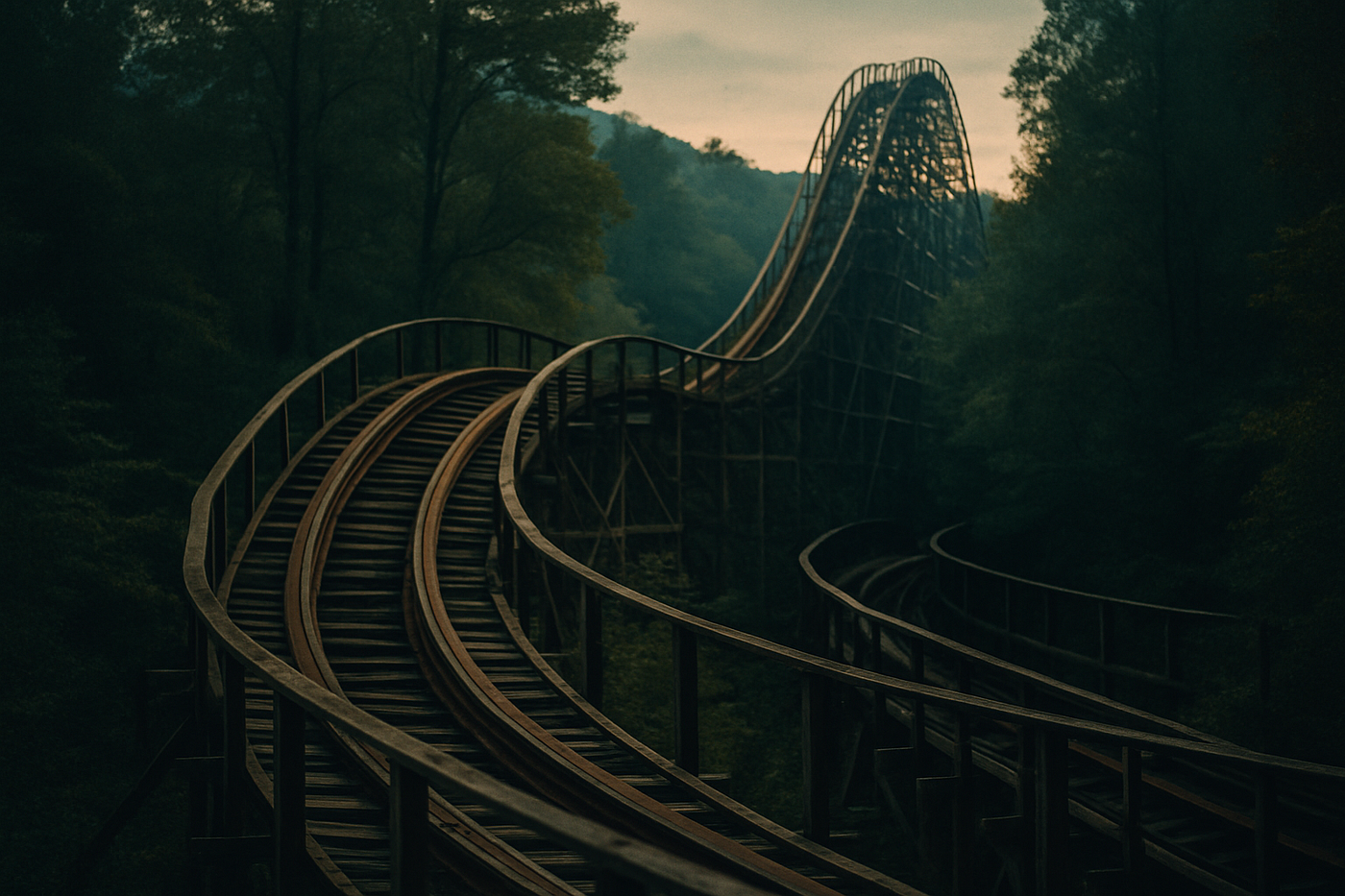
The Rollercoaster
Chapter 12 of The Woods Behind Me
The Rollercoaster
Chapter 12 of The Woods Behind Me
If you are unable to read this article in its entirety, click here.
When we finally crossed back into Kentucky, I didn’t feel relief. I didn’t feel safe. I didn’t feel anything at all, really.
I was coming down off a ten-shot-a-day espresso habit — the only thing that had kept me upright in Washington — and without that caffeine propping me up, the bottom dropped out.
Not the kind of “I’m sad today” depression people joke about. Not the quiet melancholy you medicate with a bath and a candle.
This was the kind of depression that makes your own mother look at you and think: I’m losing her.
And she wasn’t wrong.
I was disappearing in slow motion.
Two weeks after we got home, I went on post, hoping someone in a white coat would finally tell me how to live inside my own mind again.
The military doctor took one look at me, at the fifty-plus pounds Depakote had added to my body, and said almost immediately: “We’re taking you off this.”
No hesitation. No taper. No warning about what that meant.
“Stop the Depakote today and start Topamax tonight.”
Switching a maintenance-level dose of Depakote to a starter dose of Topamax in someone with Bipolar I, Mixed Type should come with flashing lights and sirens. But nobody gave me a pamphlet. Nobody told me the storm I was about to walk into.
Mixed Type means exactly what it sounds like: the depression, the anxiety, and the anger don’t stay in their lanes. Everything overlaps. Everything spills. And when it swings the other direction, the “up” isn’t joy — it’s a blender set to destroy.
I didn’t know any of that then. All I knew was that one day I was depressed, and the next I wasn’t depressed anymore — I was lit from the inside like someone had rewired me with live wires.
I broke.
I went manic.
The Kind of Manic That Happens in Walmart
People think mania happens in movies. It doesn’t.
It happens in Walmart.
I ran through that store with my kids trailing behind me, grabbing everything off the shelves they thought they might ever want or need. I couldn’t tell them no. I couldn’t tell myself no. I had no brakes, no filter, no awareness — just impulse and electricity.
By the time I came down, I had overdrafted our bank account by more than $800. And I couldn’t tell you half of what I bought.
People like to say “just take it back,” like shame and illness are a quick-return item with a receipt. But I couldn’t. I couldn’t face the return desk with a basket full of mania. I couldn’t stand under fluorescent lights and explain myself. I couldn’t bear the judgment I was already drowning in.
The embarrassment pinned me in place. The sadness sealed me there.
And the worst part wasn’t the money. It was knowing my children had seen me like that — electric, frantic, unmoored — and not knowing how to make myself safe for them ever again.
The Fall After the Burn
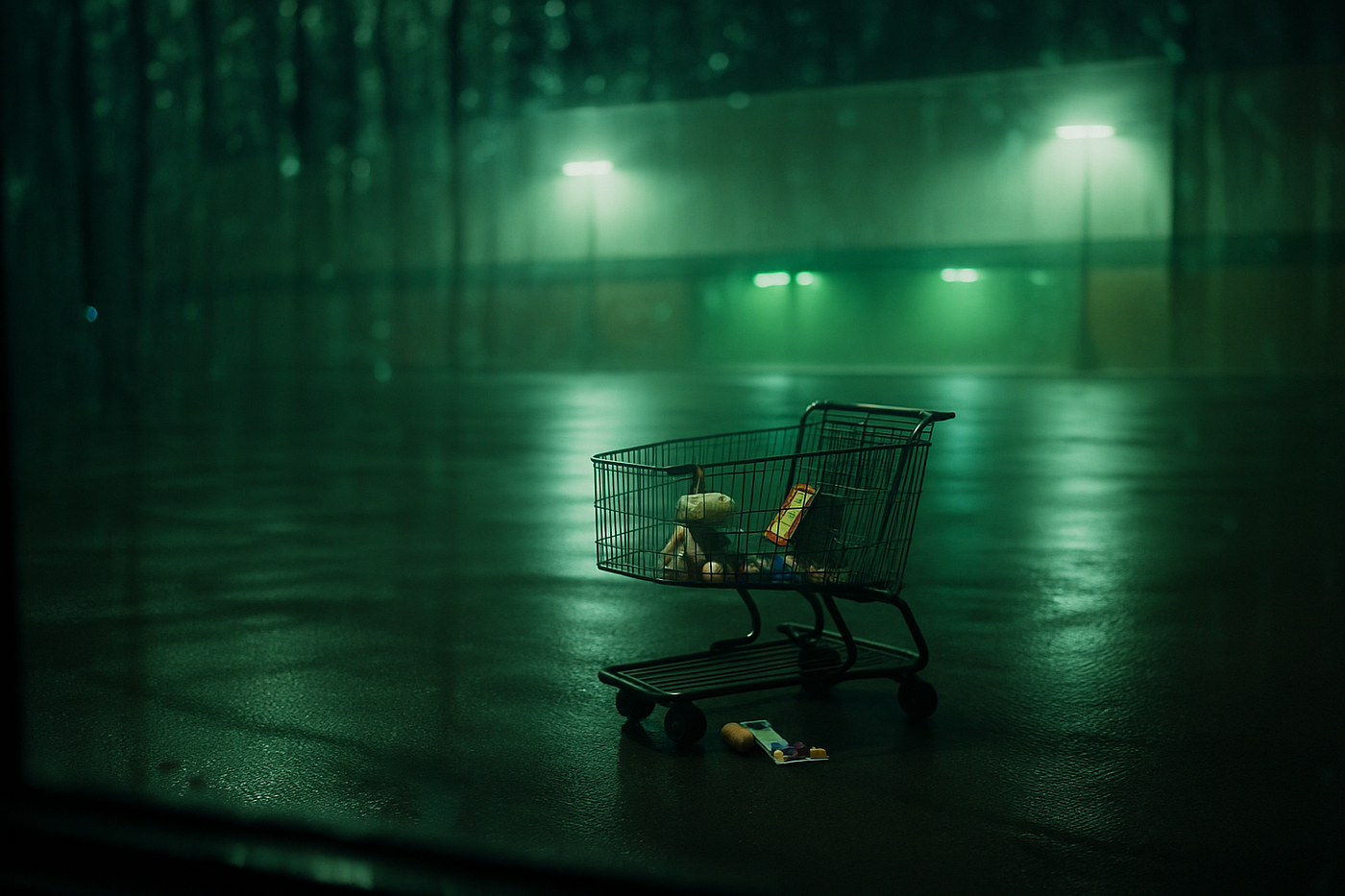
Mania never lasts. It burns hot, then drops you straight through the floor.
Here’s what people don’t understand about Bipolar I, Mixed Type: you don’t swing from one extreme to the other like a pendulum. You can be both. Depressed and manic simultaneously. Racing thoughts in a body that can’t move. Suicidal ideation with enough energy to act on it.
The worst of both worlds, pressing down and spinning up at once.
A week after Walmart, the mania burned out and the rebound depression hit like a freight train. I could feel dangerous thoughts pacing in the corners of my mind the way a wolf paces the edge of a clearing.
I didn’t want my children to watch me lose to that.
For the first time in my life, I chose the hospital myself.
I told my mental health team I was not okay. That the ground under me was gone. That I needed help before I became a danger to myself. I checked in to the closest mental health facility near home — not as a prisoner, not dragged, not court-ordered — but as a mother who wanted to live for her children.
I walked in seeking help.
What They Did With It
The first shock came in the intake interview. The nurse sat across from me with her clipboard and her standard questions.
Where are your kids? Who are they with? Any history at home?
“My kids are with my mom and dad,” I said. “Across the road.”
Something in her face shifted. She glanced down at the file — at whatever Washington-shaped shadow still lived on my record — and said, almost casually:
“If they’re with your dad and there’s a history, I may have to call social services.”
Threaten a mother’s access to her children while she is voluntarily checking herself in to prevent harm, and see what happens to her cooperation.
I was already raw. Already ashamed. Already terrified. That comment lit a fuse.
I hadn’t come there to be punished. I hadn’t come there to be threatened. I had come there to keep my children safe.
Then came the doctor.
I asked about getting my husband home — a Red Cross message, letting Andrew’s command know his wife was in a mental health facility, that his kids needed him.
“He doesn’t even know I’m here,” I said. “He’s in Iraq. I need him to know what’s happening.”
The doctor cut me off.
“I’m not doing that. You’re not going to convince me to bring someone home from war because of this.”
Because of this.
He said it like I was staging drama. Like I wasn’t standing on the edge of my own mind, begging for someone to steady the ground.
I stepped into the hallway, shaking. The nurse handed me two Vistaril to calm down. Calm never arrived.
The words poured out of me before I could stop them. I started screaming at anyone who would listen — the doctor, the nurses, the staff passing by. My voice bounced off the sterile walls, too loud for a place that was supposed to be about healing.
“I came here for help. And you’re threatening to take my kids. You’re treating me like I’m playing games. The one person who could be here for my children is in a war zone, and you won’t even send a message.”
Thirty seconds later, two more Vistaril. Four total. Enough to put a linebacker to sleep, but my mind was crackling too hard for medication to work fast.
I wasn’t being polite. I wasn’t being pretty. I wasn’t being a good patient.
I was a mother who had finally admitted she needed help — and instead of support, I was met with sedatives and threats, like I was a problem to contain instead of a person trying to survive.
I crashed like I knew I would. The meds finally hit hard. I faded into the kind of heavy sleep that doesn’t refresh you — it simply removes you from the room.
When I woke up, I’d missed group. They wrote me up for it.
The Reversal
The next morning, they called me in to see the doctor again. My plan was to sit like a carved statue, blank and uncooperative.
It lasted about three seconds.
“I’ve given it some thought,” he said. “And I sent a Red Cross message to your husband.”
I went still.
The one thing I had begged for. The one thing he had looked me in the eye and refused. He had done it anyway.
I don’t know what changed his mind. I don’t know if it was the screaming or the records or something he saw in me that finally looked like what it actually was. I just know that he said it, and something inside me unclenched for the first time since I’d walked through those doors.
“Now,” he said, voice flat, hands folded, “let’s get you straightened out.”
Sometimes what you need isn’t a luxury or a whim. It’s survival. It’s the one lifeline that ties you back to the person who knows how to anchor you.
He had finally done the one thing that mattered.
What Got Me Out

The days blurred after that — group therapy, medication adjustments, the slow crawl of treatment in a place that felt more like punishment than healing.
They tested me. Evaluated me. Confirmed what I already knew:
Bipolar I Disorder. “A very angry presentation,” the doctor added.
I wanted to laugh. My husband was in a war zone. I’d been overmedicated into unconsciousness. MPs had kicked in my door with a gun drawn. My kids had been taken. I’d been threatened with losing them again while voluntarily seeking help.
Angry seemed about right.
What finally gave me the resolve to do the work and get out was a 30-minute visit with my kids.
I had never wanted them to see me in that place. Never wanted them to associate their mother with locked doors and hospital hallways. But the doctor thought it might help my anxiety to see them. To know they were safe. To remember why I was fighting.
So my mom brought them.
Three little faces walking through that visiting room door — Hannah, CJ, Ivy — looking around with wide eyes, trying to make sense of where Mama was and why she couldn’t come home yet.
I held it together. Smiled. Talked to them like everything was fine. Told them Mama was just getting some help so she could feel better and come home soon.
They hugged me. They told me about their days. They showed me drawings they’d made.
For 30 minutes, I remembered who I was outside of the diagnosis. Outside of the medications. Outside of the system that kept failing me.
I was their mom. And they needed me.
Not perfect. Not healed. Not fixed.
Just there.

After they left, I went back to my room and decided: I was getting out. I would do the groups. I would talk to the therapist. I would take the medications. I would say whatever they needed to hear.
Because my children were across the road with my parents.
And I needed to get back to them.
The hospital hadn’t saved me.
My kids had.
If this stayed with you, save it for a quieter moment or share it with someone who is trying to build a life that does not require pretending to be fine every day.
Follow **Bluedobie Dialogues** for more essays on resilience, systems, memory, and the ordinary architecture of getting through.
Melanie Brown writes the Bluedobie Dialogues series about systems thinking, sustainable business architecture, and what durability actually looks like in practice, as well as The Woods Behind Me memoir series. She is the founder of Bluedobie Developing, a rural Kentucky-based SaaS and web development company, and the creator of DobieCore — an AI content platform for small business owners.
메타데이터
- post_id
- 2b7eb6644f37
- slug
- the-rollercoaster-2b7eb6644f37
- url
- https://medium.com/bluedobie-dialogues/the-rollercoaster-2b7eb6644f37
- canonical_url
- https://medium.com/bluedobie-dialogues/the-rollercoaster-2b7eb6644f37
- author_url
- https://medium.com/@sabrebluedobie
- status
- ok
- fetched_at
- 2026-07-08 17:17:42