The Worms That Never Were
The Earth is five hundred and forty million years old and it is not yet finished trying to kill everything that lives on it.
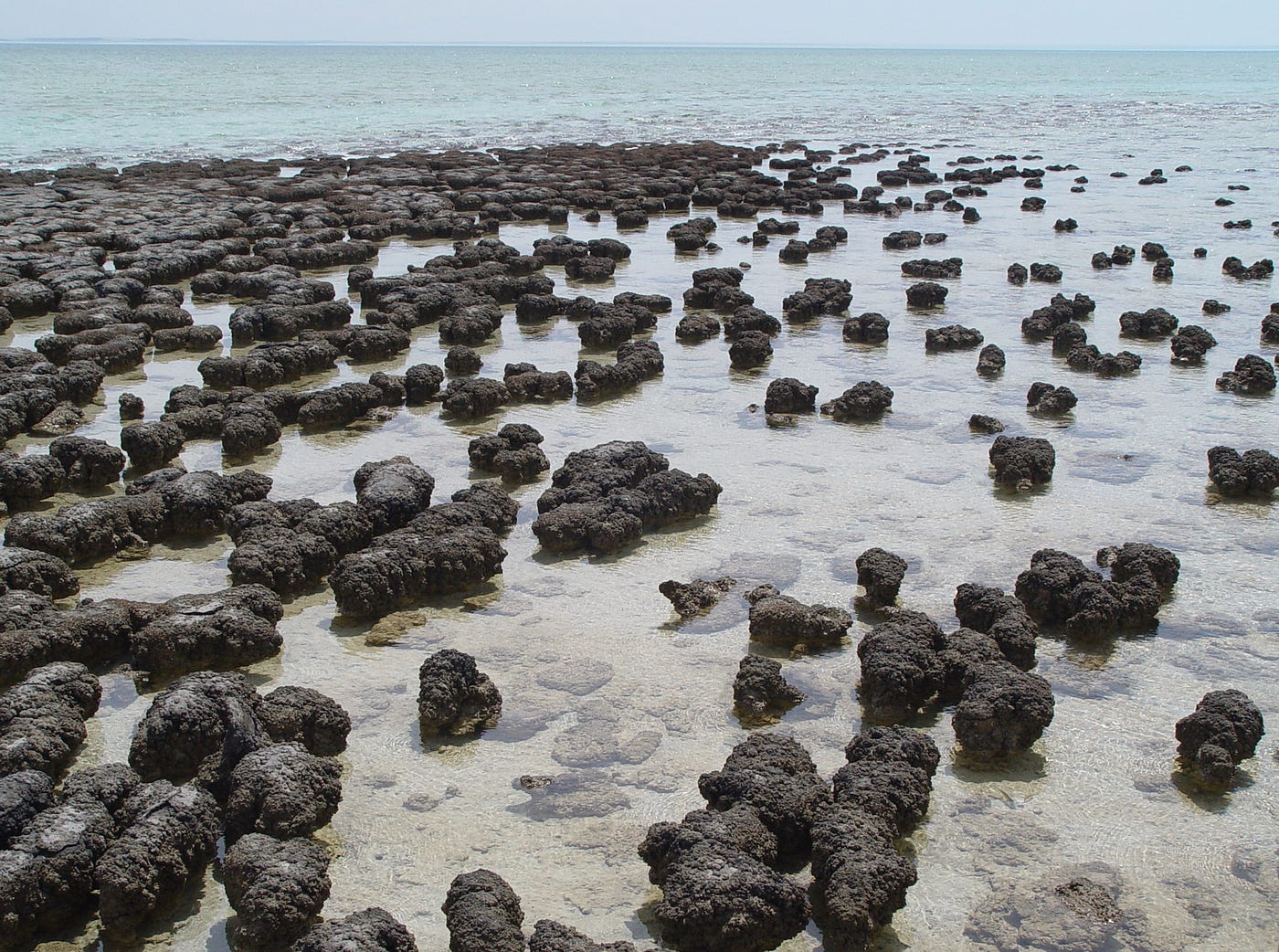
By Paul Harrison — Photograph taken by Paul Harrison (Reading, UK) using a Sony CyberShot DSC-H1 digital camera., CC BY-SA 3.0, https://commons.wikimedia.org/w/index.php?curid=714512
The Worms That Never Were
The Earth is five hundred and forty million years old and it is not yet finished trying to kill everything that lives on it.
The continents are bare. Not a single blade of grass, not a single tree, not a single moss. The land is red and grey and ochre, weathered to dust by rain that has been falling on naked rock for two billion years with almost nothing growing to break its fall. The wind moves across the surface unimpeded. It carries fine grit for thousands of kilometres before depositing it in some other equally barren place. Nothing on land has lungs. Nothing on land has a mouth. No complex life has yet taken hold on the land.
The sky is paler than the blue that human eyes will one day evolve to expect, but it is recognisably a sky. Oxygen is scarce, perhaps a quarter to a half of what will eventually accumulate. The sun is dimmer. The day is shorter, twenty-one hours from sunrise to sunrise. The moon, slightly closer than it will ever be again, drags the oceans into tides higher than any the modern Earth will know. Twice a day, those tides hammer the coast. Twice a day, they retreat. There is nothing on any shoreline to notice.
The shallow seas are warm. They are also hostile. The water holds little oxygen below the surface. Vast dead zones stretch across the seafloor, anoxic and lifeless, fed by chemistry that would suffocate almost every animal that has ever existed. Hydrogen sulphide curls up from the mud in places. Iron is dissolved in concentrations the modern oceans do not approach. The chemistry of the ocean is not yet the chemistry of life as it will come to be understood.
And yet, in the shallow water along certain coasts, in the narrow band where sunlight reaches the seafloor and the worst of the anoxia cannot quite take hold, the planet has built something extraordinary.
A worm.
It is the size of a grain of rice. It has no eyes. It has no skeleton. It has a front and a back, a left and a right, and a simple mouth at one end and a simple anus at the other. It is soft-bodied and almost transparent, and it moves through the mud of the seafloor by undulating its tiny body in slow waves. It is hungry. It is looking for food. It eats by ingesting sediment and digesting the bacterial film that coats every grain.
Behind it, it leaves a track. A thin, sinuous trail no thicker than a human hair, winding through the mud and turning back on itself as the worm searches.
It would be among the earliest known true bilaterians. The ancestor of every creature on Earth with a symmetrical body. The ancestor of the fish, the bird, the elephant, and the species of bipedal ape that will one day stand in a quarry and read these rocks.
Or it would be.
If it existed.
The paper announcing the discovery was published in Nature Ecology and Evolution in October 2017. Twelve authors. The Royal Ontario Museum, the University of São Paulo, the British Geological Survey, the University of Manchester, the University of Oxford, Memorial University of Newfoundland. The press release called it “half-a-billion-year-old worm fossils”. It was reported around the world. It was also, as it would turn out, wrong.
The new paper, published in Gondwana Research in early 2026, is titled with the brutal clarity that scientific journals occasionally permit themselves: Proposed Ediacaran meiofaunal burrows from Brazil are pyritized algal/microbial consortia. The lead author is Bruno Becker-Kerber, a Brazilian palaeontologist who carried out the work at the University of São Paulo and at Brazil’s Sirius particle accelerator, and who is now a postdoctoral researcher at Harvard. He had not been on the 2017 paper. He had, however, been working on rocks from the same region for years, and he was unconvinced by the burrow interpretation.
What Changed
The 2017 paper relied on a technique that uses X-rays to take three-dimensional images of the inside of a sample without damaging it. At the time, that was the best available tool. The filaments were resolved at sufficient detail to be measured, mapped, and identified as discrete, sinuous structures consistent with burrows.
What the 2017 technique could not do, however, was resolve the cellular structure inside the filaments themselves. To do that, you need a more powerful X-ray source. Brazil built one over the course of 2018 to 2020: the Sirius particle accelerator, at the Brazilian Centre for Research in Energy and Materials in Campinas. Sirius is one of the most advanced X-ray imaging facilities in the world. One of its instruments, called MOGNO, was specifically designed for looking inside soft, fragile materials at extremely fine detail. When Becker-Kerber and his team put the Corumbá fossils into MOGNO, they saw something the 2017 team could not have seen.
The filaments were not empty tubes left behind by a moving organism. They contained cellular structures. In some specimens, the team could identify preserved organic material consistent with cyanobacteria and eukaryotic algae. The filaments were not the negative spaces where a body had been. They were the body itself, or rather, what was left of dense intertwined mats of microscopic organisms that had been replaced, atom by atom, with pyrite (the mineral commonly known as fool’s gold) during fossilisation.
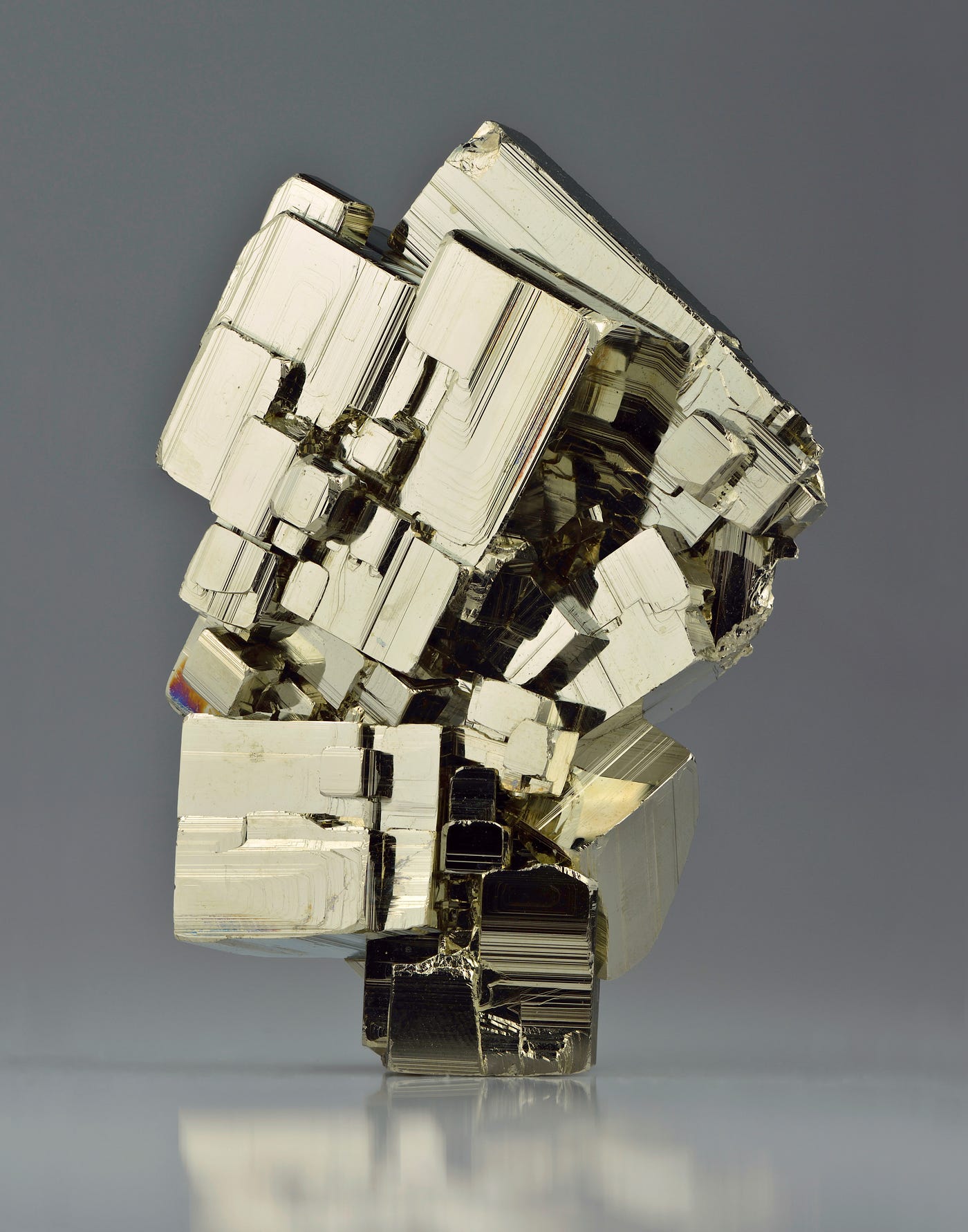
By Ivar Leidus — Own work, CC BY-SA 4.0, https://commons.wikimedia.org/w/index.php?curid=99444453
In Becker-Kerber’s words, the filaments are “consistent with bacteria or algae that existed during that period”. They are not, and never were, the traces of an animal moving through sediment.
Why This Matters
The implication of the 2017 paper, if it had held, was substantial. It would have meant that small symmetrical animals (the ancestors of almost every creature alive today) existed in significant numbers in the late Ediacaran ocean, around 541 million years ago, before the Cambrian explosion. It would have meant that the rise of complex animal life was not a single dramatic event but a slow burn that started millions of years earlier than the rocks elsewhere on Earth seemed to suggest. And it would have meant that Ediacaran oceans held enough dissolved oxygen to sustain mobile animals churning through the seafloor mud; which contradicts most of the chemical evidence we have about that period.
With the burrow interpretation removed, the picture snaps back into focus. The Ediacaran ocean was dominated by microbial life. The mats were doing the work. Thick, intertwined carpets of cyanobacteria and microscopic algae, layered in soft pillows across the seafloor, breathing oxygen out into the water in quantities small enough to be a rumour. They had been there, in one form or another, for at least two and a half billion years. They are the slowest engineers in the history of the world. They built the atmosphere. They built the sky. They will eventually build the conditions under which more complex life can survive, although they will not live to see it.
There were certainly some macroscopic Ediacaran organisms (the famous Ediacaran biota of South Australia, Newfoundland, and the Namibian desert), but the soft seafloor mud was not yet being churned by tiny worms. The atmospheric oxygen levels that would later support the Cambrian explosion had not yet arrived. The world was waiting.
The People Who Corrected Themselves
The most interesting feature of this story is who did the correcting. Becker-Kerber is part of the same Brazilian palaeontological research community that worked on the original 2017 paper. He collaborates regularly with co-authors on that earlier study and on related work. The Corumbá fossils are, to put it mildly, a local resource. Three Brazilian states have made the Tamengo Formation a UNESCO Aspiring Geopark. The fossils are a source of national pride.
It would have been easy, in other words, to let the 2017 interpretation stand. The original paper had been cited hundreds of times. It appeared in textbook discussions of early animal evolution. The data it produced had been folded into broader models of Ediacaran ecology. Walking that back is the kind of professional inconvenience that institutions tend to find ways to avoid.
What happened instead was that one of Brazil’s most ambitious scientific infrastructure projects (Sirius) was used by a Brazilian research team to test the most prominent local fossil claim. They found it did not hold up. They published the correction in a peer-reviewed journal. The press releases went out. The story made the science news cycle. And the field, broadly, accepted the new interpretation within days.
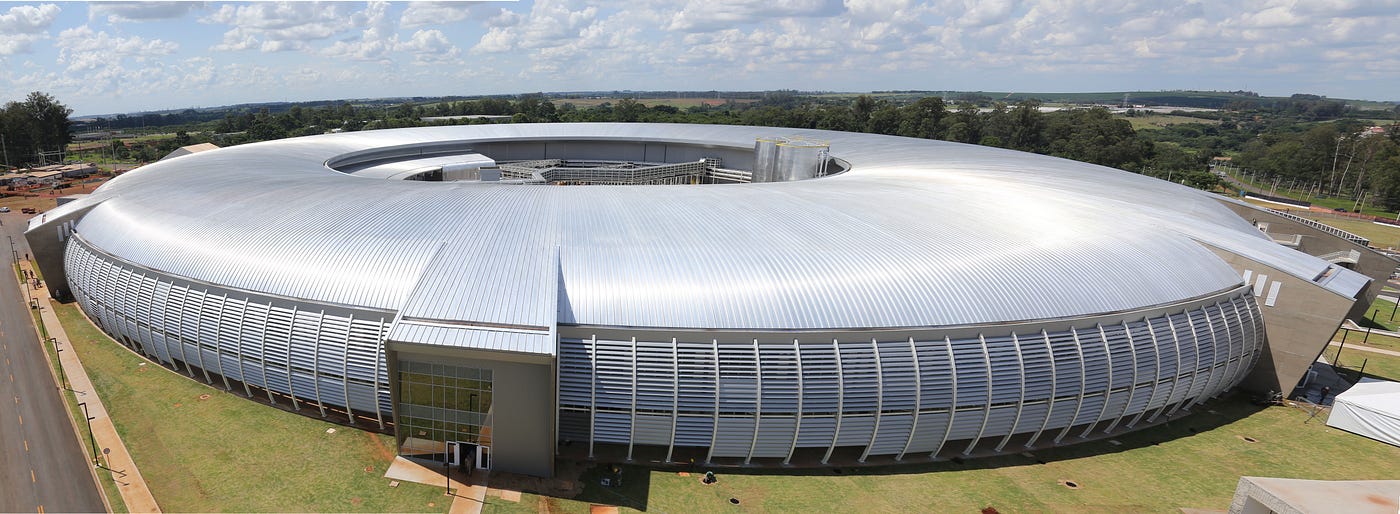
By Ministério da Ciência, Tecnologia, Inovações e Comunicações — Ministro participa da inauguração do acelerador de partículas Sirius., CC BY 2.0, https://commons.wikimedia.org/w/index.php?curid=74450245
There is no scandal here. There is no fraud, no misconduct, no retraction. The 2017 paper was a good-faith interpretation of the best data available at the time. The 2026 paper is a good-faith correction made possible by better data. This is precisely how the system is supposed to work.
It is also how the system rarely works, in fields where the financial or political stakes are higher than the date of the first burrow. Pharmaceutical claims that hold for thirty years on the strength of a single 1970s paper. Nutritional guidelines built on cohort studies nobody has ever managed to replicate. Economic theories that survive their own predictions failing because the people invested in them are the same people writing the textbooks. The reason the Corumbá fossils could be corrected is, in part, that nobody had a career-killing amount of money tied up in the worms being real.
What We Now Think Happened
The current best estimate is that the filaments in the Tamengo Formation were formed by dense mats of cyanobacteria and eukaryotic algae growing on the seafloor in shallow Ediacaran water. When those mats were buried by sediment, the iron and sulphur in the surrounding mud reacted with the organic material to produce pyrite, the mineral that preserved the shape of the filaments in three dimensions. Over hundreds of millions of years, the rest of the rock turned to stone around them.
What looks, in a sliced sample, like the curving track of a tiny worm is in fact the fossilised remains of microbial life that was already old by Ediacaran standards. The first burrowing animals would not appear in the fossil record for another few million years, at the dawn of the Cambrian, when oxygen levels finally caught up with biological possibility.
The Cambrian explosion remains where it was. The worms arrived on time. They did not arrive early.
***
Literary sci-fi and fantasy coming soon at https://medium.com/@rennienovels. Follow if you want the first episode the day it arrives.
Sources: Becker-Kerber, B., et al. Proposed Ediacaran meiofaunal burrows from Brazil are pyritized algal/microbial consortia.Gondwana Research, 2026. DOI: 10.1016/j.gr.2026.01.011/Parry, L. A., et al. Ichnological evidence for meiofaunal bilaterians from the terminal Ediacaran and earliest Cambrian of Brazil. Nature Ecology & Evolution, Vol 1, October 2017, 1455–1464. DOI: 10.1038/s41559–017–0301–9/FAPESP Agency. Microfossils interpreted as animal traces were actually algae and bacteria. May 2026. https://agencia.fapesp.br/microfossils-interpreted-as-animal-traces-were-actually-algae-and-bacteria/58064/Phys.org. Brazilian microfossils interpreted as animal traces are actually algae and bacteria, research reveals. May 2026./ScienceDaily. Stunning fossil discovery challenges the origins of animal life. 12 May 2026./Gizmodo. Lee, G. Study Claims 540-Million-Year-Old ‘Animal’ Fossils Are Something Else Entirely. 13 May 2026./University of Manchester. Half-a-billion year old worm fossils shed new light on animal evolution.Press release, October 2017./Springer Nature Research Communities. Parry, L. When (animal) life got small — meiofauna in the Ediacaran. Behind-the-paper post, 2017./Brazilian Centre for Research in Energy and Materials (CNPEM). Sirius synchrotron and MOGNO beamline documentation.
메타데이터
- post_id
- 2efa0c0221f5
- slug
- the-worms-that-never-were-2efa0c0221f5
- url
- https://medium.com/@missrennie/the-worms-that-never-were-2efa0c0221f5
- canonical_url
- https://medium.com/@missrennie/the-worms-that-never-were-2efa0c0221f5
- author_url
- https://medium.com/@missrennie
- status
- ok
- fetched_at
- 2026-06-09 14:34:10