Sound, History, and Survival Across Political Rupture
by Rama Sinno
Sound, History, and Survival Across Political Rupture
by Rama Sinno
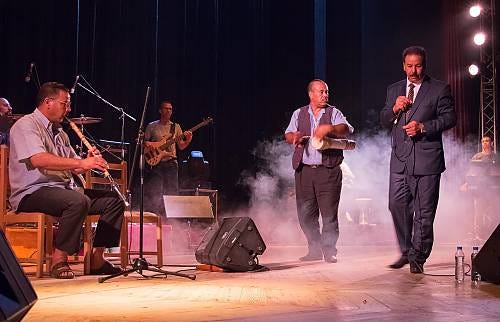
Photo from UNESCO
Raï is not a distinct musical category, but a social phenomenon shaped through gatherings, repetition, and improvisation. In the coastal city of Oran, sound is inseparable from life. Celebrations go on until there is no electricity; cafes function as both social and performance spaces; street corners become spaces for live musical expression rather than archival production. Early Raï’s development through cheikha performers, women rooted in working-class communities (Britannica; UNESCO).
The cheikha tradition established Raï as a form that exists at the margins of social acceptability; it allows women to be creative and expressive about desire, conflict, enjoyment, and experience rather than expressing these themes indirectly. The public presence of cheikha performers was often condemned by male political and social authorities. Nevertheless, they used public spaces to promote their work. Cheikha Rimitti’s significance during that time lay not only in her vocal ability but also in her role in shaping the Raï experience. Social tensions surrounding her performances were exacerbated by the fact that she left public spheres where moral discourse attempted to exclude her; despite all the odds, she flourished through popular circulation (Britannica; H. Noor Al-deen, JSTOR ).
The sonic environment of early Raï cannot be separated from colonial Algeria — the machinery by which the French imposed their rule beginning in 1830, restructuring land tenure; reorganising urban spaces; redistributing authority — embedded structural inequality into the everyday experience. These pressures accumulated through historical events over time. By the mid-twentieth century, anti-colonial consciousness had begun shaping the emotional and historical foundations of cultural forms like Raï.
Following the formation of the FLN in 1954, organised resistance culminated in Algerian independence in 1962 after a liberation struggle, at which point the groundwork was laid for self-determination under DeGaulle (Bougi; Shado Mag; Holslin). Since gaining independence, the Raï music genre has never been understood as either an official national icon or an organisational cultural initiative. Nevertheless, Raï continues to circulate within working-class and migrant communities. Raï frequently plays at weddings, in neighbourhoods shaped by rural-to-urban migration, and at informal places, with music acting as both entertainment and communication.
In the 1960s and the 1970s, the evolution of the cheikha tradition reflected the developing urban environment. Urbanised younger performers were now influenced by electric guitars, saxophones, and rhythmic structures derived from the vast array of global pop cultures. Influenced by youth culture, musicians express frustration and social constraints (Holslin, Afropop; Levitt, Stamp the Wax).
Cheb and Cheba performers represent a definitive generational transition in Raï music. The term cheb (‘young’) referred not only to youth but also to a musical style. The transition from traditional to modern is represented by artists like Cheb Khaled, whose early works fuse traditional Algerian melodic styles with production methods, allowing Raï to move from live performance into recorded circulation across urban Algeria and beyond (Levitt, “Stamp the Wax”).
Furthermore, the Raï genre has a complex relationship with the State of Algeria. Though it has never been completely outlawed, it has always faced scrutiny regarding its often ‘immoral’ lyrical content (e.g., love, alcohol, nightlife, and emotional transparency). Censorship occurs through indirect means, such as broadcast restrictions and limitations on performances in certain venues. Cassette copies allowed Raï to escape such censorship (Hana Noor Al-Deen, JSTOR; ISC Team, Insheepsclothing HiFi).
During the 1980s, Raï began gaining popularity on a global scale. Cheb Khaled’s album Kutché, released in 1988, marked a major milestone. Its production featured many French and international musicians, helping introduce Raï to a broader global audience and secure a place for it within the international recording industry. Ultimately, this increased the visibility of Raï musicians, leading them to increasingly adapt their sound to appeal to global audiences (Levitt, Stamp the Wax; ISC Team, Insheepsclothing HiFi).
Migration has been essential to this transformation. Algerian diasporas residing in France created important sites of cultural circulation where Raï connects communities to both the past and present. Raï now functions as both a form of cultural expression and a genre created for a global market (Karim Meskia, Afropop).
The Algerian Civil War, known as the ‘Black Decade’, was marked by political turmoil following the cancellation of elections in 1992. Many artists were made targets during this time. The assassination of Cheb Hasni (1994), one of the most beloved Raï musicians, was viewed as a large loss within Algerian society, demonstrating how political violence shaped life in Algeria(Bougi, Shado Mag; Holslin, Afropop).
After the civil war, many musicians shifted their focus to the diaspora communities to continue preserving and developing Raï music. Diasporic experience continues to reshape the genre through memory, loss, and longing.
Even as Raï has evolved through colonialism, urbanisation, censorship, migration, and globalisation, it has maintained its role as a form of cultural expression rooted in everyday life. From the Cheikha tradition to diasporic communities, Raï has continually adapted to changing historical conditions while preserving its connection to working-class experience. Its significance lies not in remaining fixed, but in its ability to survive and transform across generations (i.e., Britannica, UNESCO, Levitt, Stamp the Wax).
Resources
- Bougi. Shado Mag. https://shado-mag.com/articles/hear/the-rai-legacy-mapping-algerias-struggles-through-its-most-opinionated-music-genre/
- Holslin, Peter. Afropop Worldwide. https://www.afropop.org/articles/1970s-algerian-folk-and-pop
- Levitt, Aaron. Stamp the Wax. https://www.stampthewax.com/2019/09/30/a-brief-history-of-rai/
- Meskia, Karim. Afropop Worldwide. https://www.afropop.org/articles/when-algerian-music-travels-beyond-its-frontiers
- ISC Team. In Sheep’s Clothing HiFi. https://insheepsclothinghifi.com/maghreb-rai/
- Britannica Editors. https://www.britannica.com/art/rai-musical-style
- UNESCO. https://ich.unesco.org/en/RL/rai-popular-folk-song-of-algeria-01894
- Hana Noor Al-Deen. JSTOR. https://www.jstor.org/stable/40034339
- Afropop Worldwide. https://www.afropop.org/articles/the-story-of-rai-2
메타데이터
- post_id
- 2febd141e27c
- slug
- sound-history-and-survival-across-political-rupture-2febd141e27c
- url
- https://medium.com/ypla/sound-history-and-survival-across-political-rupture-2febd141e27c
- canonical_url
- https://medium.com/ypla/sound-history-and-survival-across-political-rupture-2febd141e27c
- author_url
- https://medium.com/@teresachiran00444
- status
- ok
- fetched_at
- 2026-06-09 21:21:26





