Why the Best Metaverse Development Companies Are Moving to a “Mixed Reality First” Strategy
Breaking hardware limitations — how modern spatial computing apps let VR headset, desktop, and mobile users work inside one shared 3D…
Why the Best Metaverse Development Companies Are Moving to a “Mixed Reality First” Strategy
Breaking hardware limitations — how modern spatial computing apps let VR headset, desktop, and mobile users work inside one shared 3D ecosystem. And why most enterprise deployments still get this completely backwards.

Nobody warned me how many metaverse projects would die in a conference room.
Not from bad code. Not from budget cuts. They died the moment someone on the client side asked a simple question — “wait, does this only work with the headset?” — and the room went quiet.
I’ve watched that happen more times than I’d like to admit. And every single time, the project team had done genuinely impressive technical work. Beautiful environments. Solid latency numbers. Physics that actually behaved. But they’d built the whole thing for hardware that maybe 8% of the company owned. And the remaining 92% — the people who actually needed to use the platform every day — were looking at a login screen that required a device they didn’t have.
That’s not a technology failure. That’s a strategy failure. A fundamental misread of what “enterprise deployment” actually means.
The companies getting this right in 2025 aren’t building metaverse experiences for VR headsets. They’re building spatial platforms where VR headsets are one tier of access — a premium layer sitting on top of something that works for everyone. Desktop. Mobile. Standard browser. No downloads, no drivers, no procurement requisition for 300 Quest 3s.
The industry term is Mixed Reality First. I prefer to just call it building for the real world.
Here’s the thing about enterprise hardware that nobody in a pitch deck will tell you
Walk into most corporate offices — not the tech campus in Austin or the innovation lab in Singapore, I mean the regional sales office, the manufacturing floor, the hospital admin wing — and you’ll see a lot of Dell laptops running Windows 10. Some iPads in supervisor hands. Mobile phones that IT has locked down to half their features.
VR headsets? Maybe two. Locked in a cabinet. Last charged eight months ago for a demo that impressed the board and then got forgotten.
I’m not exaggerating. This is the gap that kills adoption.
The organizations genuinely deploying spatial computing at scale — Toyota’s manufacturing teams, Siemens’ field engineers, Walmart’s training divisions — they didn’t wait until every employee had an XR headset. They built platforms that their existing hardware fleet could actually run. Then they layered in headset experiences for the use cases where full immersion actually earned its cost.
That sequencing matters enormously. Start with universal access, then enhance upward for premium hardware. Not the other way around.
The metaverse development companies that understand this build differently from the start — different asset pipelines, different rendering strategies, different UI logic. The ones that don’t understand it tend to bolt on a “mobile version” at the end of a project, right before launch, under deadline pressure, and it shows.
WebXR changed the math. Most enterprise buyers don’t know it yet.
Three or four years ago, cross-platform spatial computing genuinely required painful trade-offs. You either built natively for headsets and lost the browser audience, or you built a watered-down WebGL experience that felt like a 3D website rather than a spatial environment.
That gap has basically closed.
WebXR — the W3C specification that gives browsers direct access to XR hardware — has matured to the point where a user on a $500 Chromebook and a user strapped into an Apple Vision Pro can occupy the same persistent 3D space simultaneously. They’re not looking at the same image. They’re in the same environment. The Chromebook user gets a rich, interactive 3D scene they navigate with mouse and keyboard. The Vision Pro user gets full spatial presence with hand tracking and depth perception. One platform. One session. Same room.
That’s not a demo trick. It’s a production capability, deployed right now across enterprise showrooms, industrial simulations, and training environments that I’ve seen running in client environments.
OpenXR sits underneath all of this on the hardware abstraction side. Khronos Group built it specifically to stop developers from writing separate SDKs for every headset manufacturer — Meta, Valve, HTC, Microsoft each had their own, and maintaining all of them was a genuinely miserable engineering problem that mostly benefited the hardware vendors, not the developers or the end users. OpenXR means you write the spatial interaction layer once, and it runs across the hardware ecosystem. Not “mostly runs.” Runs.
And then there’s glTF 2.0. If you’ve been in 3D development long enough to remember the FBX wars, you know how important a genuinely open, compact, widely-supported 3D format is. glTF 2.0 is what makes a photorealistic enterprise showroom asset load in three seconds on a 4G mobile connection instead of timing out entirely. It’s the reason a field engineer can pull up a digital twin on a construction site using their phone and see accurate geometry rather than a grey blob.
These three — WebXR, OpenXR, glTF 2.0 — are the actual foundation of every legitimate cross-platform deployment. Not the marketing buzzwords in the pitch. The actual code underneath.
Here’s what loading that foundation looks like in practice:
// Verifying glTF 2.0 asset loading for cross-platform metaverse environments
import { GLTFLoader } from 'three/examples/jsm/loaders/GLTFLoader.js';

const loader = new GLTFLoader();

loader.load(
  '/spatial-assets/enterprise_showroom.gltf',
  (gltf) => {
    // Same asset, injected into persistent scene — renders across all tiers
    scene.add(gltf.scene);
    console.log('Cross-platform environment loaded successfully.');
  },
  (xhr) => {
    // Progress feedback during asset streaming
    console.log((xhr.loaded / xhr.total * 100) + '% loaded');
  },
  (error) => {
    console.error('Asset pipeline error — check LOD configuration', error);
  }
);
That’s a single asset load serving a VR headset, a Chrome browser, and a mobile device from the same file. No separate builds. No stripped-down mobile version that quietly omits half the functionality. The same environment, rendered appropriately for each device’s capabilities.
When I show this to CTOs who’ve been told cross-platform spatial computing requires three separate codebases, they usually go quiet for a second. Then they ask why their current vendor didn’t mention this.
The three deployments actually generating ROI right now
I want to ground this in real use cases, because “the metaverse” as a concept has accumulated so much hot air that it’s hard to separate the actual business applications from the hype.
Here’s what’s working:
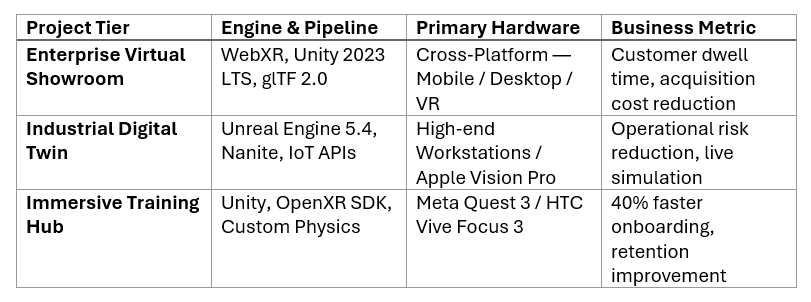
The virtual showroom is the one generating the most immediate commercial interest, and the math is pretty straightforward. Traditional product demos require either shipping physical product to every location or flying buyers to a central facility. A cross-platform virtual showroom eliminates both. A procurement manager in Pune opens a browser tab and walks through a life-size 3D product configuration. A senior buyer in London does the same on a Meta Quest 3 with full spatial presence. Neither experience requires the other to exist — and both connect to the same live inventory and specification data.
The dwell time numbers here are not subtle. WebXR showrooms are consistently showing 4x to 7x longer session duration compared to standard product video. People explore when they can navigate a 3D space. They absorb more, ask better questions, and — most importantly for the business case — they remember more.
The industrial digital twin is where the technical complexity goes up sharply and so does the stakes. Unreal Engine 5.4 with Nanite tessellation can render a refinery or a semiconductor fab at photorealistic fidelity. Layer in live IoT API feeds — sensor data, pressure readings, equipment status — and you have a real-time 3D replica of your physical environment. Engineers can run failure simulations, plan maintenance procedures, and model process changes inside the digital environment before touching anything physical.
This is not science fiction. It is deployed. The operational risk reduction argument is strong enough that conversations about this happening in manufacturing and energy sectors are a matter of record. Unplanned downtime in heavy industry costs real money — six to seven figures per incident in larger facilities — and digital twin simulation has a documented track record of catching failure conditions before they materialize.
When mapping your cross-platform strategy for digital twin deployments, working with an established metaverse development company that has Unreal Engine 5.4 and IoT integration experience isn’t just preferable — it’s the difference between a working simulation and an expensive proof of concept that never leaves the lab.
The training hub is the one I find most personally compelling, and I think it’s underrated in most enterprise conversations about the metaverse.
Here’s the cold truth about compliance training: most of it doesn’t work. Adults don’t learn effectively from slide decks and multiple-choice quizzes. They know this. Their managers know this. The L&D team knows this. Everyone sits through the annual training, clicks through 47 slides about fire safety or data handling protocols, passes the quiz on the third attempt, and forgets 80% of it within a week.
Immersive training in a spatial environment changes the retention curve dramatically. PwC’s research on VR training found that VR-trained employees were up to four times more focused than e-learning peers and 275% more confident applying their skills after training. University of Maryland research on spatial learning showed consistent retention advantages for immersive formats.
The 40% reduction in onboarding time that surfaces in deployment data for immersive training hubs is not because the content is shorter. It’s because people actually learn it the first time.
The cross-platform piece matters here for a specific logistical reason. You cannot mandate that 2,000 new hires complete onboarding on a VR headset — the device procurement alone would take three months and cost more than the training program budget. But you can deploy a WebXR-based training environment that runs in any browser on any device for the core curriculum, and then route high-stakes simulation scenarios — equipment operation, emergency response, surgical procedures, anything where physical presence and muscle memory matter — to shared headset pools at training centers. One platform. Two hardware tiers. Actual results.
Leveraging open standards like OpenXR lets spatial computing developers build these hybrid deployments without maintaining two separate environments. The same training module runs everywhere. The analytics are unified. The L&D team sees one dashboard, not three.
The argument I keep having about “VR-first with a mobile fallback”
Every few months I end up in a conversation with a development team that pushes back on the Mixed Reality First approach. Their argument is basically: build the best possible VR experience, then make a simplified version for other devices. Premium first, scaled down for accessibility.
I understand the logic. I don’t agree with it.
When you build for VR-first, your asset pipeline gets optimized for headset rendering. Polygon counts, texture resolution, physics simulation fidelity — all tuned for a device that’s rendering two high-resolution displays at 90+ frames per second, right in front of someone’s eyes. The assets are heavy. The interaction model is 6DOF spatial. The UI is designed for hand tracking or controller input, not a mouse or a touchscreen.
Now strip that down for desktop. The assets need to be re-optimized for WebGL. The interaction model needs a complete redesign for mouse-and-keyboard navigation. The UI elements that floated naturally in 3D space at arm’s length look bizarre on a flat screen. This isn’t a minor adaptation — it’s rebuilding core systems under deadline pressure, with a fraction of the original budget, after the “real” version is already done.
The output is predictable: a flagship VR experience that’s genuinely impressive and a browser version that feels like something got lost in translation. The users who needed the browser version — remember, the majority of your workforce — notice immediately.
Flip the architecture. Build WebXR-first. Design the interaction model for universal input (mouse, touch, controller, hand tracking — all handled through the same abstraction layer). Optimize the base asset pipeline for efficient streaming and cross-device rendering. Make that experience excellent. Then layer in the headset enhancements: spatial audio, haptic feedback, room-scale movement, the sense of genuine presence that you can only get in a headset. Users on premium hardware get something extraordinary. Users on standard hardware get something genuinely good.
One codebase. Progressive enhancement. QA process that doesn’t require maintaining three separate test environments.
The reason this approach isn’t universal is partly inertia and partly that VR-first demos are more visually impressive in a pitch meeting. A headset demo in a board presentation generates excitement in a way that a browser demo doesn’t, even if the browser demo represents 90% of actual deployment value. Sales incentives and business reality are not always aligned.
What to actually ask when evaluating a development partner
Ten years of watching enterprise spatial projects has given me a pretty reliable set of questions for separating the vendors who understand cross-platform deployment from the ones who will figure it out at your expense.
“Show me a working WebXR demo I can open in this browser right now.” Not a video. Not a headset demo. A URL. If they can’t produce one in the meeting, the cross-platform capability exists only on their website.
“How do you handle LOD management for mobile?” Level of Detail — the technique for rendering lower-complexity geometry at greater distances to preserve performance on limited hardware — is not optional for mobile spatial experiences. If they don’t have a specific answer, mobile is an afterthought.
“What’s your OpenXR test coverage across headset hardware?” A good answer names specific headsets and specific test results. A bad answer says “we support all major platforms” without evidence.
“How does a user on a phone see a user in a headset?” This is the real cross-platform question. Multi-user spatial environments where different device tiers can see and interact with each other require deliberate architecture from the beginning. If they haven’t thought about this, the “cross-platform” claim applies to single-user access, not collaborative use.
“Can I talk to someone from a previous enterprise deployment in my vertical?” Not a case study PDF. An actual person. The answer to this one tells you a lot.
A serious metaverse development company will have documented answers to all five. They’ll probably have additional context you didn’t ask for. Vendors who are filling capability gaps in real time will hedge, redirect, or offer to “follow up with details.”
The phasing question nobody asks but everyone should
Organizations that want to deploy spatial computing often get stuck on scope. The enterprise metaverse vision is large — global collaboration environments, persistent digital twins, immersive training at scale — and the gap between that vision and a working first deployment feels enormous.
It doesn’t have to be sequential. The phasing that works in practice:
First three months: WebXR environment deployed on existing hardware for one specific use case — a product showroom, a training module, a collaboration space for one team. Accessible to executives, stakeholders, and end users without any new device procurement. Metrics baseline established.
Months four through six: Headset tier activated. OpenXR configuration for whatever hardware the client has or wants to pilot. The people who’ve been using the WebXR version for three months now have enough context to actually evaluate what the headset experience adds — which is a much better position than evaluating a headset demo cold.
Months seven through twelve: IoT integration, advanced analytics, AI-assisted spatial features, full multi-user collaboration across device tiers. Platform scaling beyond the pilot cohort.
The reason this phasing works is the first phase. When the CFO can pull up the environment on their laptop and actually experience it — not just watch a video of someone else wearing a headset — the internal advocacy changes completely. The “this is too niche, it only works for the tech team” objection disappears because it’s visibly false.
Get something running on existing hardware first. Prove the use case. Then scale the hardware and the scope together.
A word on timing, because it actually matters
This isn’t a “the metaverse is coming, prepare now” argument. That framing has been used to sell vaporware for three years and everyone is tired of it.
This is something more specific: the companies building operational spatial computing capabilities today are accumulating organizational knowledge that compounds. They’re not just deploying software — they’re learning how their teams use it, what breaks, what works better than expected, where the friction lives. They’re building internal muscle that takes time to develop regardless of how good the technology gets.
The hardware will keep improving. The open standards will keep maturing. WebXR will keep getting faster. None of that changes the fact that institutional capability is a function of time, not just technology access.
The organizations that will be genuinely advanced in spatial computing in 2027 are the ones that started in 2025 with something imperfect but real. Not a pilot that lived in a demo room. Not a proof of concept that got shelved after the vendor engagement ended. Something deployed, used, iterated on.
Mixed Reality First is what makes that possible without requiring a hardware revolution inside your organization first. The infrastructure you already have is enough to start.
Evaluating cross-platform spatial computing for enterprise deployment? Hyperlink InfoSystem’s team specializes in Mixed Reality First architecture — WebXR, OpenXR, Unreal 5.4, Unity 2023 LTS — built for the hardware reality of actual enterprise environments. See the full technical capabilities at their metaverse development company services page.
메타데이터
- post_id
- 302df8792f0a
- slug
- why-the-best-metaverse-development-companies-are-moving-to-a-mixed-reality-first-strategy-302df8792f0a
- url
- https://medium.com/@charleswade1776/why-the-best-metaverse-development-companies-are-moving-to-a-mixed-reality-first-strategy-302df8792f0a
- canonical_url
- https://medium.com/@charleswade1776/why-the-best-metaverse-development-companies-are-moving-to-a-mixed-reality-first-strategy-302df8792f0a
- author_url
- https://medium.com/@charleswade1776
- status
- ok
- fetched_at
- 2026-06-21 19:25:17