The Death of the Traditional DevOps Engineer (And Why That's Good News)
"The biggest threat to DevOps isn't AI. It's the belief that DevOps will continue to look the way it did ten years ago."
The Death of the Traditional DevOps Engineer (And Why That's Good News)
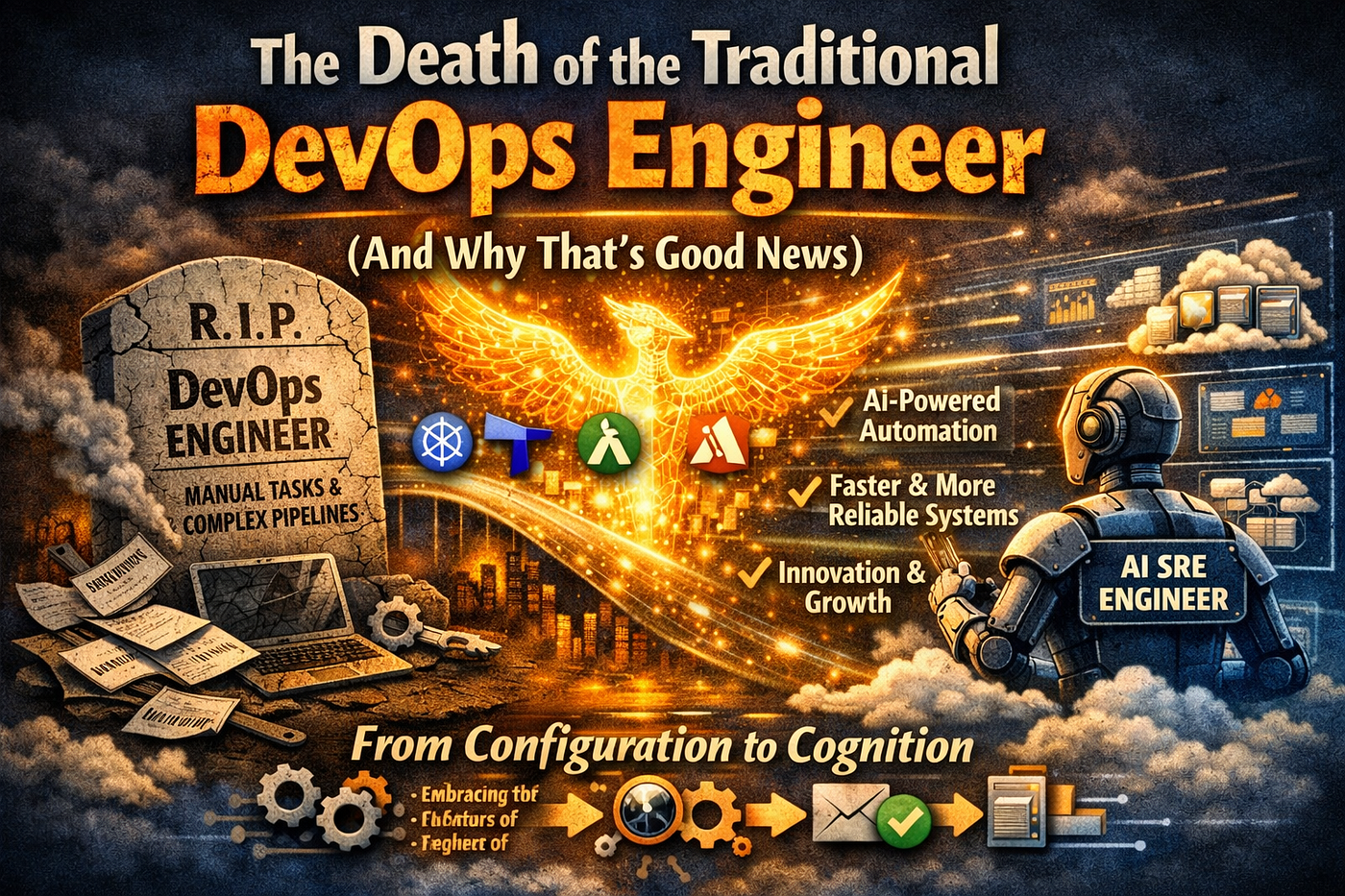
AI Generated Image
"The biggest threat to DevOps isn't AI. It's the belief that DevOps will continue to look the way it did ten years ago."
A few years ago, a typical DevOps engineer spent a large part of the day writing CI/CD pipelines, provisioning cloud infrastructure, debugging Kubernetes deployments, rotating secrets, responding to alerts, and maintaining Infrastructure as Code.
Those responsibilities defined the profession.
Today, many of those same activities are becoming increasingly automated.
Terraform modules generate infrastructure in minutes. GitHub Actions templates eliminate repetitive pipeline work. Managed Kubernetes platforms abstract away cluster management. AI assistants can explain YAML files, troubleshoot deployment failures, and even suggest infrastructure improvements.
It's easy to look at this trend and conclude that DevOps engineers are becoming less important.
I believe the opposite is true.
The traditional DevOps engineer is disappearing—not because the role is dying, but because the expectations are evolving.
The next generation of DevOps professionals won't be measured by how quickly they write YAML. They'll be measured by how effectively they design engineering platforms that thousands of developers can use safely and efficiently.
DevOps Was Never About YAML
One of the biggest misconceptions about DevOps is that it's a collection of tools.
Ask ten people what DevOps means and you'll hear answers like:
Docker
Kubernetes
Jenkins
Terraform
Ansible
Helm
GitHub Actions
Those tools matter, but they were never the destination.
The real objective of DevOps has always been reducing the distance between an idea and production.
Automation, continuous delivery, infrastructure as code, and observability were simply the mechanisms that helped achieve that goal.
Unfortunately, many organizations became so focused on the tools that they lost sight of the outcome.
Engineers spent more time maintaining pipelines than improving developer productivity.
That imbalance is exactly why Platform Engineering has gained so much momentum.
The Rise of Platform Engineering
Imagine two organizations.
The first requires every development team to write its own Kubernetes manifests, Terraform modules, monitoring dashboards, and deployment workflows.
The second provides a self-service internal platform where developers click a button and receive a production-ready environment with security policies, observability, CI/CD, secrets management, and cost controls already configured.
Which organization ships software faster?
The answer is obvious.
Platform Engineering isn't replacing DevOps. It's applying DevOps principles at a higher level of abstraction.
Instead of asking every engineer to become an infrastructure expert, platform teams create paved roads that make the right path the easiest path.
That's a much more scalable operating model.
AI Changes the Daily Workflow
Artificial intelligence introduces another shift.
Until recently, troubleshooting often started with dashboards.
An alert fired.
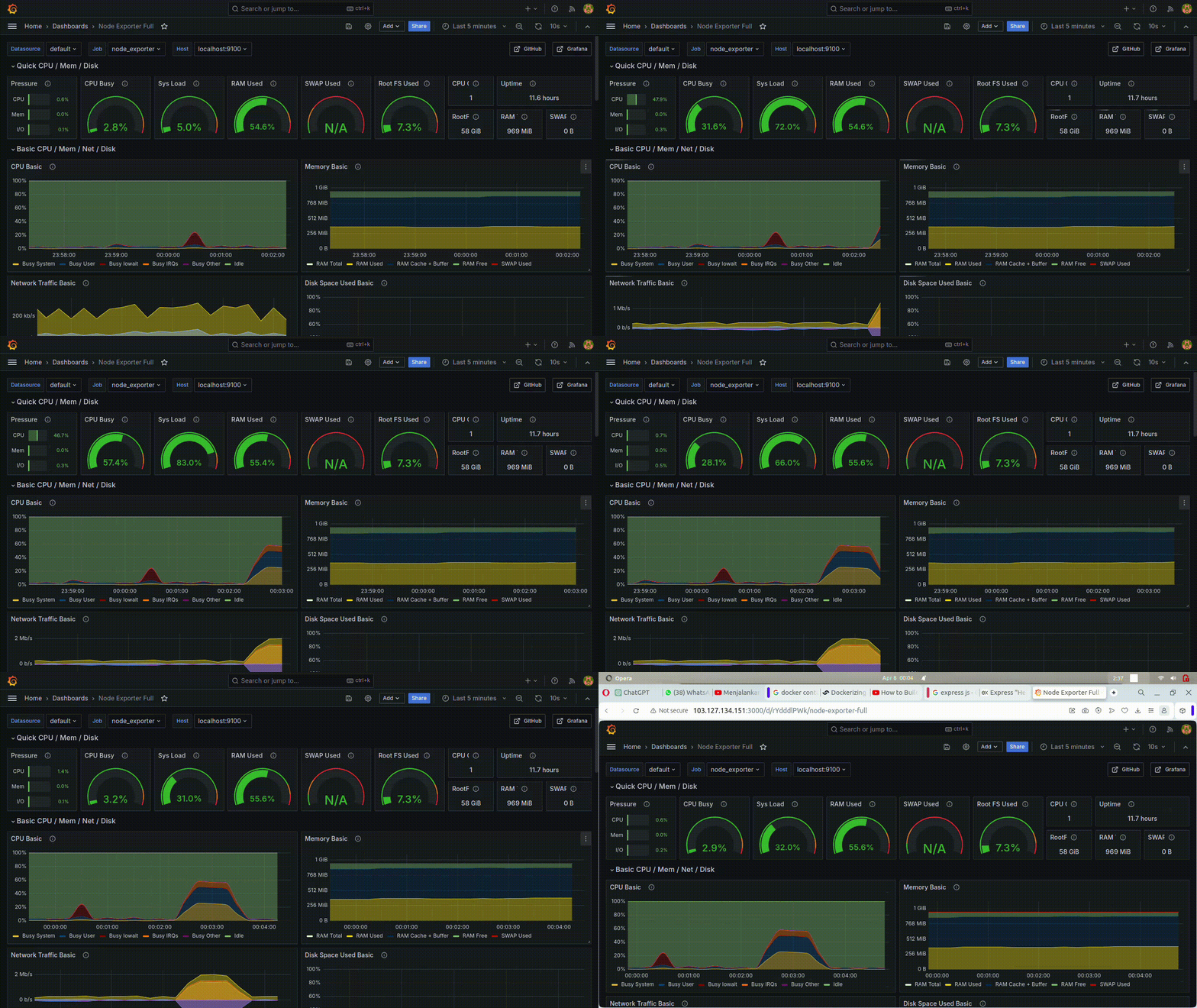
An engineer opened Grafana.
Then Prometheus.
Then logs.
Then GitHub.
Then Kubernetes.
The investigation depended on manually correlating signals across multiple systems.
AI is changing that workflow.
Increasingly, intelligent systems can collect metrics, summarize logs, compare deployments, retrieve previous incidents, and propose likely root causes before an engineer begins investigating.
This doesn't eliminate human expertise.
It removes repetitive cognitive work.
The engineer spends less time gathering evidence and more time validating decisions.
That's a meaningful change in how operations teams create value.
Skills That Will Matter More
As repetitive infrastructure work becomes increasingly automated, several capabilities become more valuable.
System design will matter more than scripting.
Observability strategy will matter more than dashboard creation.
Cloud architecture will matter more than server provisioning.
Platform design will matter more than writing individual deployment files.
Security and governance will become integral to every deployment pipeline rather than separate review stages.
Perhaps most importantly, engineers will need to understand how AI systems themselves operate.
Questions such as:
How do we evaluate AI-generated infrastructure?
How do we govern autonomous deployment agents?
How do we observe AI-assisted operations?
How do we establish trust in automated recommendations?
These are becoming practical engineering questions rather than theoretical discussions.
Building the DevOps Team of the Future
A mature engineering organization in the next few years may include:
Platform Engineers building internal developer platforms.
Site Reliability Engineers focused on resilience and reliability.
AI Platform Engineers managing model infrastructure.
AgentOps Engineers monitoring autonomous engineering agents.
Security Engineers embedding policy into delivery pipelines.
FinOps specialists optimizing cloud spending from the beginning of the software lifecycle.
Notice that none of these roles eliminate DevOps.
They expand it.
DevOps becomes less of a job title and more of an engineering philosophy embedded across multiple disciplines.
Where Should Engineers Invest Their Time?
If I were starting a DevOps career today, I would spend less time memorizing every Kubernetes command and more time understanding how modern engineering systems fit together.
That means learning:
Cloud architecture on AWS or Azure.
Terraform and Infrastructure as Code.
GitOps workflows.
Kubernetes fundamentals.
Observability with Prometheus, Grafana, and OpenTelemetry.
Internal Developer Platforms.
AI-assisted engineering using tools like LangGraph, MCP, and cloud AI services.
The engineers who combine these skills will be well positioned for the next generation of cloud-native systems.
Final Thoughts
Every major technology transition creates anxiety.
The move from physical servers to cloud infrastructure did.
The move from manual deployments to CI/CD did.
Infrastructure as Code did.
Containers did.
Kubernetes did.
Artificial intelligence is simply the next chapter.
The traditional DevOps engineer isn't disappearing because the profession has failed.
It's disappearing because the profession succeeded.
Automation removed yesterday's repetitive work and created space for higher-value engineering.
The future belongs to engineers who don't just automate tasks—they design platforms, orchestrate intelligent systems, and build the foundations that allow entire organizations to innovate safely and quickly.
DevOps isn't ending.
It’s evolving into something even more interesting.
메타데이터
- post_id
- 37e0009704ea
- slug
- the-death-of-the-traditional-devops-engineer-and-why-thats-good-news-37e0009704ea
- url
- https://blog.devops.dev/the-death-of-the-traditional-devops-engineer-and-why-thats-good-news-37e0009704ea
- canonical_url
- https://blog.devops.dev/the-death-of-the-traditional-devops-engineer-and-why-thats-good-news-37e0009704ea
- author_url
- https://medium.com/@pranavprakash4777
- status
- ok
- fetched_at
- 2026-07-17 20:05:51