From Frame to System: Why Visual Storytelling Can No Longer Be Intuitive
How to engineer audiovisual content as a controllable system for global audiences
From Frame to System: Why Visual Storytelling Can No Longer Be Intuitive
How to engineer audiovisual content as a controllable system for global audiences
Topics:
Visual Storytelling Media Engineering Content Strategy Audience Engagement Digital Media
What This Book Is About
By 2026, the volume of audiovisual content in digital environments continues to grow exponentially. Traditional production models based on intuition, individual experience, and situational creative decisions have reached their structural limits.
This book proposes a shift from intuitive, craft-based approaches to engineering-based design of audiovisual content. The focus is no longer on the individual frame or isolated artistic decisions, but on the interconnected processes and parameters that determine stability in digital environments.
“A narrative system is not an autonomous aesthetic object. It is a functional mechanism for transmitting structured information and managing cognitive responses.”
Why Intuition No Longer Works
Modern digital platforms (YouTube, TikTok, Netflix, OTT services) operate on formalized algorithms for recommendations, ranking, and retention. Content designed to perform effectively in these environments must possess a comparable internal architecture.
The intuitive approach cannot guarantee:
· Reproducible results at scale
· Predictable engagement metrics
· Stability across international markets
· Alignment between creative decisions and platform constraints
This book presents an engineering framework that treats visual language as a set of verifiable, controllable parameters.
Key Concepts from the Book
- The Visual Algorithm as Multi-Layer Architecture
The book describes the visual algorithm as a hierarchical technology stack with four layers:
Logic Layer (Semantic Core) — Primary formalization of meaning. Qualitative categories are translated into measurable parameters. Each information block receives a quantifiable priority coefficient.
Structural-Dramaturgical Layer — A dynamic model for distributing cognitive load across time and narrative space. Bifurcation points are calculated where information delivery must change to prevent neural adaptation and loss of attention.
Physical Layer — Materializes the algorithm through precise calibration of frame geometry, composition, lighting, and color. These are not aesthetic categories but tools for directing gaze and redistributing cognitive resources.
Distribution Interface — Ensures integration with platform ranking and recommendation algorithms. Content is designed as platform-agnostic code that retains its internal logic across any playback format.
- Deep Decomposition of the Audiovisual Flow
The audiovisual flow is broken down along multiple analytical axes:
· Spatial decomposition — Each frame is treated as a dynamic map with primary scanning zones, secondary attention areas, and peripheral context. This formalizes gaze trajectories and optimizes stimulus distribution.
· Temporal decomposition — Total duration is broken into functional segments: impulse elements (attention initiation and reactivation) and stabilizing intervals (cognitive fatigue reduction).
· Frequency decomposition — Visual saturation is treated as a controllable parameter. Optimal frequency ranges prevent both cognitive overload and perceptual disengagement.
· Semantic decomposition — Meaning is broken into elementary information blocks evaluated for complexity, novelty, and processing cost.
- Algorithmization of Dramaturgy
In digital environments, classical linear dramaturgy demonstrates limited effectiveness. Users decide whether to continue interaction within very short time windows.
The book proposes adaptive narrative cycles based on fractal organization — each narrative segment, regardless of duration, contains a complete cycle of attention initiation, retention, and redirection.
Cognitive triggers are designed as technical components with measurable impact parameters, functioning to transition the system from passive observation to active interaction.
- Attention Retention Engineering
Attention is treated as a limited resource, competition for which follows reproducible statistical patterns. The central metric is the Retention Index (RI) — an integrated indicator calculated by overlaying the temporhythmic map of content onto platform-generated retention curves.
Any recorded decline in retention is treated not as creative failure but as the result of incorrect cognitive load calculation. Corrections are made through iterative optimization, with each content version treated as a testable hypothesis.
Visual triggers — dynamic, color-based, and semantic — are algorithmically calibrated mechanisms for attention reactivation.
- Production as a Data Conveyor
The production cycle is transformed from a creative laboratory into a data-processing conveyor system:
· Algorithmic previsualization — Generative models create architectural mockups, testing structural viability before investment cycles begin
· Automated quality control — Neural network algorithms detect deviations from architectural parameters in near real time
· Modular asset libraries — Standardized components described by functional role, use conditions, and permissible transformations
- Universal Visual Codes for Global Scaling
Scalability is the ultimate criterion of engineering quality. A system that loses functionality as its audience expands is architecturally unstable.
The book introduces universal visual codes — stable perceptual patterns that remain invariant across cultural, linguistic, and geographic differences. These operate at the level of fundamental cognitive mechanisms: motion perception, spatial orientation, light contrast, and geometric structures.
A two-level architecture separates the invariant visual core from the localizable semantic layer, enabling parametric tuning for specific markets without complete system reconstruction.
- Designing for Extremely Large Audiences (145M+)
When operating at scales exceeding 145 million subscribers, every second of content becomes an object of calculation. The book presents:
· Universal visual attractors — patterns resistant to cultural and contextual differences
· Precision micro-rhythmic structures that prevent desensitization
· Cascading comparative testing before large-scale deployment
· The Minimum Viable Architecture (MVA) — a compact model preserving all key structural dependencies
- From Individual Authorship to System Architecture
The book fundamentally reinterprets creative leadership. The 21st-century director functions not as a source of isolated artistic decisions but as an architect of complex systems.
A multi-level team structure is proposed:
· Strategic layer — Designs visual code, manages metrics, oversees risk
· Production layer — Autonomous modules operating within regulated protocols
· Analytical layer — Provides continuous feedback between audience behavior and system architecture
- Ethical and Legal Engineering
Managing the attention of millions of users requires not only technological precision but also responsibility. The book integrates ethical constraints directly into the architectural parameters — eliminating destructive stimuli, manipulation, and addictive patterns.
The legal model shifts from protecting individual works to protecting the architecture itself — licensing access to a system of guaranteed outcomes rather than selling isolated creative services.
Why This Book Matters
This framework enables:
✅ Predictable audience engagement at global scale
✅ Reproducible results across platforms and formats
✅ Architectural stability under growth and change
✅ Reduced dependence on individual talent
✅ Ethical, responsible management of audience attention
“Scaling ceases to be a secondary effect of success and becomes a function of correctly constructed architecture.”
Who Should Read This Book
· Media engineers and systems architects in creative industries
· Directors, producers, and content strategists working with digital platforms
· Researchers at the intersection of visual arts, applied mathematics, and systems analysis
· Anyone interested in transforming intuitive storytelling into a controlled engineering process
Final Thought
The 21st-century director is not a bearer of unique style but an architect of complex systems. Authorship does not disappear — it shifts to the level of architecture and system operating principles.
When narrative is treated as an algorithm, attention as a resource, and production as a data conveyor, media ceases to be a chaotic sequence of decisions and becomes a managed cycle in which each stage is subject to analysis, validation, and optimization.
“The future of media production is shaped not through opposition between art and technology, but through their integration.”
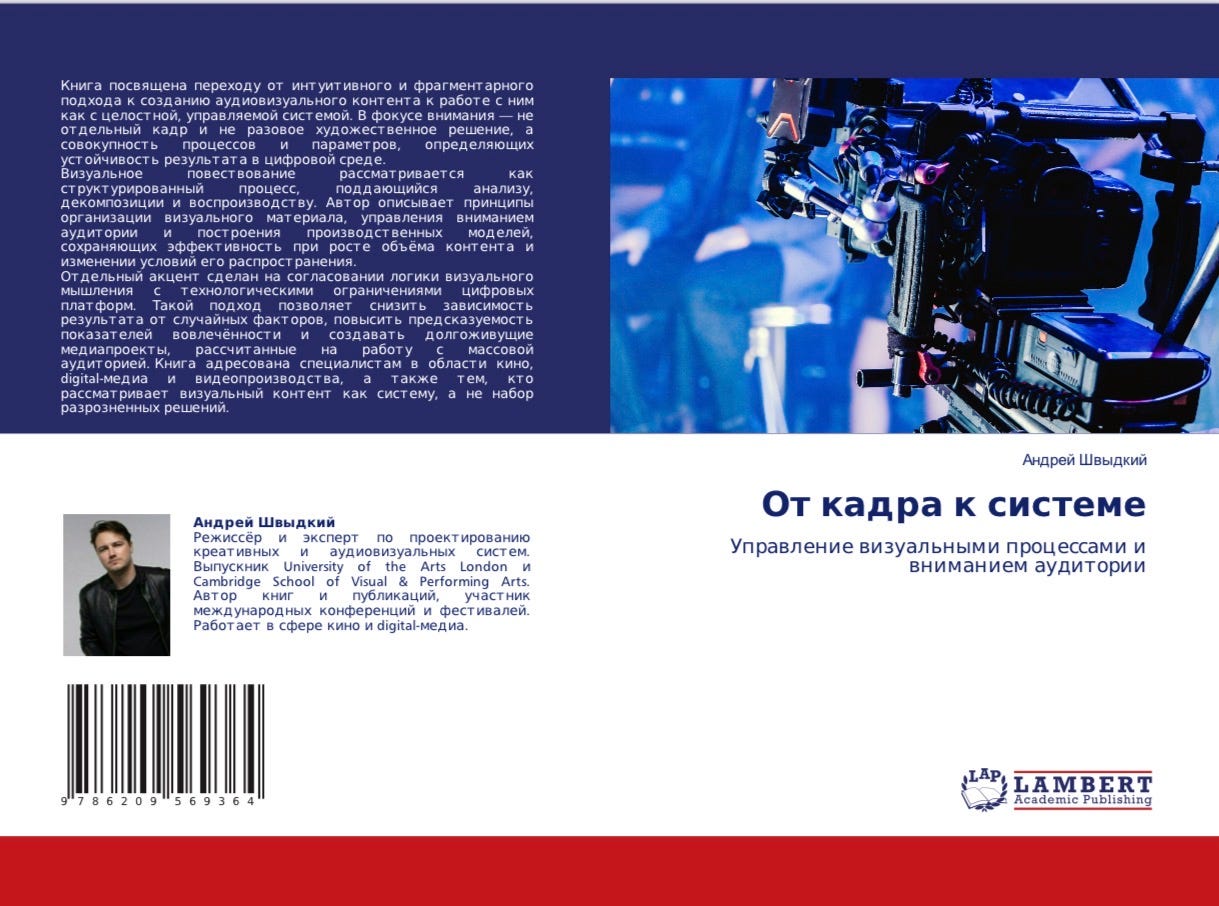
Where to Buy My Books
You can purchase print and digital editions on major international book platforms:
[embed]ShopUi Edit descriptionwww.morebooks.de
Author:
Andriy Shvydkyy
Independent Film Director, Visual Storytelling Researcher, Developer of Structured Narrative Systems
Dania Beach, Florida, USA
메타데이터
- post_id
- 3a5aa1e303d7
- slug
- from-frame-to-system-why-visual-storytelling-can-no-longer-be-intuitive-3a5aa1e303d7
- url
- https://medium.com/@shvydkyyandriy/from-frame-to-system-why-visual-storytelling-can-no-longer-be-intuitive-3a5aa1e303d7
- canonical_url
- https://medium.com/@shvydkyyandriy/from-frame-to-system-why-visual-storytelling-can-no-longer-be-intuitive-3a5aa1e303d7
- author_url
- https://medium.com/@shvydkyyandriy
- status
- ok
- fetched_at
- 2026-06-09 15:37:30