What Can We Know for Certain? Russell and the Limits of Knowledge
We spend a great deal of energy pretending to be certain. We sign our names to opinions we have not examined, defend convictions we…
What Can We Know for Certain? Russell and the Limits of Knowledge
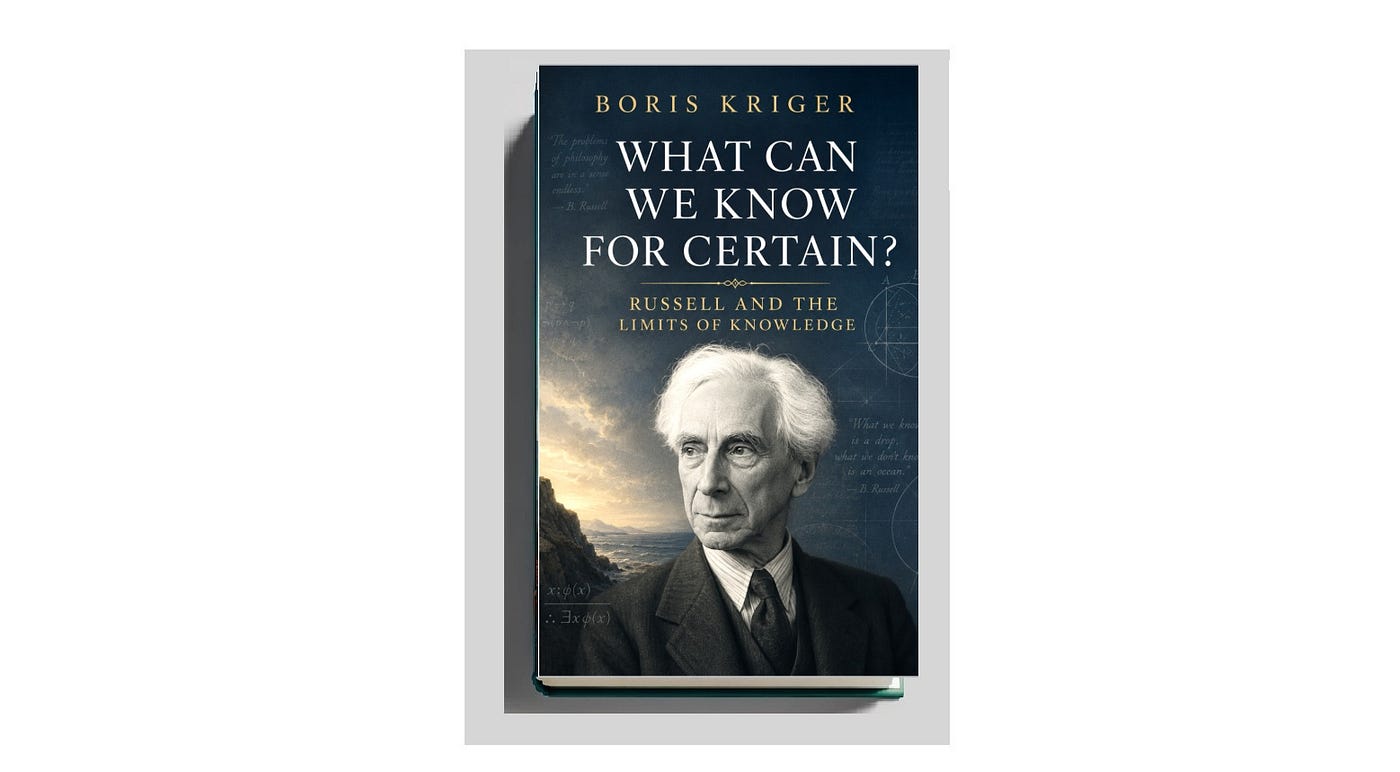
We spend a great deal of energy pretending to be certain. We sign our names to opinions we have not examined, defend convictions we inherited rather than chose, and treat the absence of doubt as though it were the same thing as the presence of truth. Bertrand Russell spent a long, turbulent, and astonishingly productive life insisting that this is exactly backward — that the honest mind is not the one that has stopped asking questions, but the one that has learned to keep asking them without falling apart.
This book is a portrait of that mind. It follows Russell from an aristocratic English childhood into the cathedral of pure logic he tried to build, into the prison cell where his pacifism landed him, and out the far side into a strange and bracing freedom: the recognition that knowledge has edges, that even mathematics rests on foundations it cannot prove, and that living wisely means learning to breathe inside uncertainty rather than fleeing it. Along the way it visits the famous paradox that bears his name, the dream of a perfect language and why that dream could never quite come true, the Vienna thinkers who tried to draw a hard line between sense and nonsense, and the question that animated everything Russell did — what, in the end, can we actually know for certain?
Written without a single equation, in plain and vivid language, it is a book for anyone who has ever suspected that the people shouting their certainties the loudest are the ones who have thought about them the least. It is an argument that doubt, properly understood, is not weakness but courage — and that clarity of thought may be the most underrated form of honesty we have.
Keywords: Bertrand Russell, philosophy, logic, knowledge, skepticism, certainty, critical thinking
[embed]
Contents
Chapter One: The Fog That Cannot Be Lifted. 12
Chapter Two: Learning to Breathe in Open Air 18
Chapter Three: What Can We Know for Certain?. 24
Chapter Four: The Aristocrat Who Would Not Be Silent 30
Chapter Five: The Language More Exacting Than Words. 36
Chapter Six: The Cathedral Built from Logic. 42
Chapter Seven: The Crack in the Foundation. 48
Chapter Eight: The Village Barber 54
Chapter Nine: A Map of Simple Facts. 59
Chapter Ten: Naming the World. 64
Chapter Eleven: The Vienna Gathering. 69
Chapter Twelve: Meaning as a Method of Testing. 74
Chapter Thirteen: The Line Between Sense and Sound. 79
Chapter Fourteen: The Dream of a Perfect Language. 84
Chapter Fifteen: Where Words Outrun the World. 89
Chapter Sixteen: Against Trusting the Inner Voice. 94
Chapter Seventeen: Good, Evil, and the Limits of Proof 99
Chapter Eighteen: God, the Soul, and the Unverifiable. 104
Chapter Nineteen: Doubt as an Instrument, Not a Weakness. 109
Chapter Twenty: The Unprovable Beginnings. 114
Chapter Twenty-One: The Human Measure of Reason. 119
Chapter Twenty-Two: Humility Without Surrender 124
Chapter Twenty-Three: Tolerance Born of Knowing One’s Limits. 129
Chapter Twenty-Four: Truth That Will Not Stand Still 134
Chapter Twenty-Five: Philosophy as the Art of Clarity. 139
Chapter Twenty-Six: The Compass, Not the Verdict 144
Chapter Twenty-Seven: The Prisoner of Conscience. 149
Chapter Twenty-Eight: Why He Was Not a Christian. 154
Chapter Twenty-Nine: A Nobel for the Written Word. 159
Chapter Thirty: The Old Man and the Bomb. 164
Chapter Thirty-One: The Problem of Drawing Lines. 169
Chapter Thirty-Two: Respecting What Escapes Reason. 174
Chapter Thirty-Three: Thinking Clearly, Doubting Honestly. 179
Case Study One: The Sunrise. 193
Case Study Two: The Village Barber 194
Case Study Three: The King of France. 195
Case Study Four: The Invisible Dragon. 196
Case Study Five: The Overturned Theory. 197
Case Study Six: What the Color-Blind Cannot See. 198
Case Study Seven: Cruelty and Taste. 199
Case Study Eight: The Experience and Its Interpretation. 200
Case Study Nine: The Map and the Territory. 201
Case Study Ten: The Fishing Net 202
Case Study Eleven: The Confident Witness. 203
Case Study Twelve: The Expert Who Was Sure. 204
Case Study Thirteen: The Theory That Explains Everything. 205
Case Study Fourteen: Belief and the Body. 206
Case Study Fifteen: When Day Becomes Night 207
Case Study Sixteen: The War of Certainties. 208
Case Study Seventeen: The Gamble of Deterrence. 209
Case Study Eighteen: The Man Who Changed His Mind. 210
Case Study Nineteen: The Dream of a Perfect Language. 211
Case Study Twenty: The Rules of the Game. 212
Preface
There is a particular kind of person who makes everyone else in the room slightly nervous, and it is not the loud one. It is the quiet one who, after the loud one has finished announcing exactly how the world works, leans forward and asks, with no apparent malice whatsoever, “How do you know that?” The question seems innocent. It is not. It is one of the most disruptive instruments human beings have ever devised, and the man this book is about spent the better part of a century wielding it with a precision that alarmed bishops, governments, fellow philosophers, and, on his more honest days, himself.
Bertrand Russell was born in 1872 into the upper reaches of the English aristocracy, the grandson of a former prime minister, and he died in 1970 having outlived the certainties of three or four distinct historical eras. In between he tried to derive all of mathematics from pure logic, discovered a flaw in his own foundations that nearly broke him, helped invent the way philosophers now think about language, went to prison for opposing a war, won the Nobel Prize for Literature, scandalized polite society on several continents, and spent his final years protesting nuclear weapons with the same stubborn clarity he had once brought to the question of whether the number two truly exists. It is a biography that resists summary, and this book does not really try to summarize it. Instead it follows a single thread running through all of it — Russell’s lifelong preoccupation with the limits of what we can know, and his conviction that facing those limits honestly is not a defeat but a kind of liberation.
Most of us are raised to treat certainty as the goal of thinking. We are taught that to know something is to have arrived, to have closed the question, to be able to stop. Doubt, in this picture, is merely the uncomfortable waiting room we sit in until knowledge shows up and lets us through the door. Russell spent his life arguing that this picture is not just wrong but harmful. Certainty, he came to believe, is far more often a psychological comfort than an intellectual achievement. The feeling of being sure and the state of being right are two completely different things, and human beings are spectacularly bad at telling them apart. We confuse the warm glow of conviction with the cold light of evidence, and we have built wars, inquisitions, and a great deal of ordinary unhappiness on the back of that confusion.
What Russell offered instead was something harder and, in the long run, more rewarding. He suggested that we could learn to hold our beliefs the way a good scientist holds a hypothesis — seriously, but provisionally; acting on them where we must, but never forgetting that they are subject to revision the moment better evidence arrives. He believed that a mind trained this way does not collapse into helpless relativism, the lazy notion that since nothing is certain, every opinion is as good as every other. Quite the opposite. A mind that has genuinely accepted the limits of knowledge becomes more rigorous, not less, because it can no longer hide behind the false security of dogma. It has to do the actual work of checking, weighing, and reasoning, over and over, with no final exam to pass and no diploma that lets it stop.
This is, admittedly, an exhausting way to live. Russell knew it. He wrote, more than once, about how unnatural it feels to suspend judgment, how deep the human craving for solid ground runs, how the mind reaches almost instinctively for a firm answer the way a hand reaches for a railing in the dark. He did not pretend that the discipline he recommended was easy or that he himself always managed it. He changed his own mind on enormous questions, sometimes embarrassingly, and he regarded this not as a flaw to be hidden but as evidence that the method was working. A thinker who never revises is not admirably consistent; he has simply stopped thinking and started reciting.
I should say a word about what this book is and is not. It is not a technical introduction to Russell’s logic, and it contains no mathematics at all — not a single symbol, not one equation. This is a deliberate choice, and it would have horrified the young Russell, who believed that ordinary language was a swamp of ambiguity and that real precision lived only in formal notation. But the older Russell understood something the younger one resisted: that the ideas worth having can almost always be carried, with care, into plain words, and that an idea you cannot explain to an intelligent person without resorting to symbols is an idea you may not fully understand yourself. The concepts in this book — the nature of doubt, the structure of meaning, the boundary between sense and nonsense, the strange humility forced on us by the foundations of mathematics — are all approachable through language, metaphor, and story. Where Russell built a staircase of symbols, this book builds a ramp of words. You will arrive at the same landing.
Nor is this a worshipful book. Russell was a great man, but he was also frequently insufferable, occasionally wrong in ways that mattered, and capable of a coldness in his private life that sits uncomfortably beside the warmth of his public concern for humanity. A portrait that left these things out would be a portrait of a statue, not a man, and statues teach us nothing because they have never had to choose. Part of what makes Russell instructive is precisely that he was a flawed and contradictory person who nonetheless held himself to an extraordinarily high standard of intellectual honesty — higher, often, than he held himself to in other domains. The gap between the rigor of his thought and the messiness of his conduct is itself one of the more interesting things about him, and we will not pretend it does not exist.
The chapters that follow move roughly along two tracks at once, weaving between them. One track is the life — the boy in the great lonely house, the student dazzled by mathematics, the young man building his cathedral of logic, the prisoner, the celebrity, the old campaigner. The other track is the thought — the questions Russell asked, the tools he invented to answer them, the walls he ran into, and the hard-won wisdom he extracted from those collisions. The two tracks are not really separable, which is the whole point. For Russell, philosophy was never a profession he practiced between nine and five and left at the office. It was a way of being in the world, a discipline of attention that shaped how he read a newspaper, how he argued with a friend, how he faced the prospect of his own death. He treated thinking clearly as a moral obligation, not just an intellectual one, and he was prepared to pay real costs for it.
If the book has a single argument, it is this: that the honest acknowledgment of our limits is not the end of confident thought but its true beginning. The person who admits they might be wrong is not weaker than the person who cannot, but stronger, because their beliefs have survived a test the dogmatist’s never faced. The question in the title — what can we know for certain? — turns out to have a humbling answer, perhaps even an unsettling one. But the humility is the gift. It is what keeps the mind in motion, what keeps it honest, what keeps it free. Russell spent ninety-seven years demonstrating that you can stare directly at the boundaries of human knowledge without flinching and without despair, and come away not diminished but somehow more awake.
What follows is an invitation to do a little of that staring yourself. You will not need any special training, only a willingness to be slightly less sure of things at the end than you were at the beginning — which, if Russell was right, is one of the few reliable signs that you have actually learned something.
Chapter One: The Fog That Cannot Be Lifted
A ship’s captain in the days before radar knew something that most of us, sitting comfortably on dry land, have managed to forget. He knew that fog was not an interruption of the voyage but a permanent feature of the sea. There would be clear days, certainly, when the horizon stood sharp and the navigation was easy, but the captain who built his seamanship on the assumption of perpetual clarity was the captain who eventually ran his ship onto rocks he was sure could not be there. The good captain learned to sail in the fog. He learned to trust his soundings, to listen for the bell buoys, to proceed at a speed that left room for the unexpected shape looming out of the gray. He did not curse the fog as an insult to his competence. He treated it as the medium in which all real navigation takes place.
Knowledge is like that. We tend to imagine that uncertainty is a temporary nuisance, a patch of bad weather we must endure until the facts arrive and the skies clear. But the uncertainty is not a flaw in the machinery of thought. It is woven into the very nature of knowing. Every act of understanding reaches toward something that is not fully present, that hides part of itself, that offers only a face or an edge or a suggestion of what it might be. The hidden dimensions of reality, the aspects that escape our immediate perception, generate a haze that is thin but unavoidable, and the mind that wants to grasp the elusive essence of things must learn to make its way through that haze rather than waiting for it to lift.
This is a strange thing to say, and it runs against a very deep instinct. We do not like fog. We want the answer, the verdict, the settled fact we can file away and stop worrying about. There is something almost physical about the discomfort of not knowing, a restlessness that the mind tries to resolve as quickly as it can, often by seizing on the first available certainty and clutching it tight. And yet the curious discovery — one that took the man at the center of this book a very long time to fully absorb — is that accepting the relative, provisional, foggy character of all our knowledge does not weaken thought. It makes thought more supple. A mind that knows it is sailing in fog stays alert to many possible explanations and never locks itself prematurely onto a single final conclusion. It keeps its options open not out of indecision but out of accuracy, because the world really is more uncertain than our craving for closure would like it to be.
Consider how differently two people can hold the very same belief. One holds it the way a frightened man holds a rope over a chasm — tightly, desperately, unwilling to consider for even a moment that the rope might not bear his weight, because the alternative is too terrifying to contemplate. The other holds the same belief the way an experienced climber holds a rope: with confidence, yes, but also with a constant quiet attention to its condition, a readiness to test it, an awareness that ropes can fray and that the responsible thing is to keep checking. Both believe. But only one of them is actually thinking. The first has converted a belief into a wall against doubt. The second has kept the belief alive by keeping it open to question.
The deep equilibrium of real understanding lives in that tension between the known and the unknown. It is not a comfortable resting place. It is more like the balance of someone riding a bicycle, who stays upright precisely because they are always making small corrections, always slightly off and recovering, never frozen in a single fixed position. The moment the rider tries to achieve perfect motionless balance, they fall. Understanding works the same way. Its stability comes from movement, from the willingness to adjust, from treating each apparent boundary of knowledge not as a wall to stop at but as a place to push off from toward the next question.
None of this comes naturally, and it would be dishonest to pretend otherwise. The longing for certainty is not a bad habit we can simply decide to drop. It seems to be wired into us at a level far below conscious choice, an ancient instinct that wakes up every time reality refuses to behave in a straight line. A mind accustomed to clear formulas and tidy structures feels genuine distress when it encounters something that will not resolve into a final shape. To accept the fog is therefore not a small adjustment of opinion. It is closer to a remaking of how one perceives the world altogether — not as a system that will eventually yield to a complete and finished explanation, but as a process, endlessly changing, always leaving fresh questions beyond the horizon.
This is the lesson, perhaps, that takes an entire lifetime to learn, with every passing year adding new shades to one’s grasp of this inner instability. The uncertainty does not eventually go away as we grow wiser. It does not retreat into the shadows or dull with familiarity. What changes is its meaning. Early on, the fog feels like a threat, an enemy, a sign that something has gone wrong with our thinking or with the world. Later, if we are fortunate and pay attention, it begins to feel like a field rather than a fence — a space in which movement, searching, and growth are possible precisely because nothing is finally closed off. People learn, slowly, to breathe in this air thick with the unsaid and the not-yet-known, to stop demanding final answers and instead to listen for faint hints, to catch the fragile connections between things without insisting that the world hand over its complete and certain truth.
It may help to think about how knowledge actually grows, because the popular picture of it is badly misleading. We imagine science, for instance, as a steady accumulation of established facts, each one nailed down and added to a growing structure that only ever gets taller and more secure. But anyone who has watched science from the inside knows it does not work this way at all. The history of inquiry is a history of revisions, reversals, and surprises, of confident theories overthrown by inconvenient observations, of the obvious turning out to be false and the absurd turning out to be true. The ground that seemed solid for two hundred years gives way, and a new understanding takes its place — which will itself, in time, give way to something else. This is not a sign that knowledge is failing. It is a sign that knowledge is alive. A field in which nothing was ever revised would be a field that had stopped learning.
And yet none of this means that all views are equally good, or that because we cannot reach final certainty we should give up on getting things right. This is the crucial distinction, and it is one the whole book will keep returning to. The fog does not make all directions identical. A competent navigator in fog is still vastly more likely to reach harbor than an incompetent one, because soundings and bearings and careful attention genuinely track something real, even when visibility is poor. To say that certainty is unavailable is not to say that truth is unavailable, or that the careful thinker has no advantage over the careless one. It is only to say that our grip on truth is always a working grip, firm enough to act on, never so absolute that we are entitled to stop checking.
The deepest reason to make peace with the fog, in the end, is that the alternative is not clarity but self-deception. The person who insists on certainty does not actually possess it; they have merely stopped noticing the fog by refusing to look at it. The haze is still there, surrounding their every confident step, and the only thing they have achieved is to blind themselves to it. This is far more dangerous than honest uncertainty, because the self-deceived navigator sails full speed ahead, convinced the water is clear, straight toward the rocks. Better, far better, to keep one’s eyes open, to admit the gray, and to proceed with the alert humility that the real conditions demand.
Chapter Two: Learning to Breathe in Open Air
Imagine being moved, as a child, from a sealed room into the open air for the first time. The room had walls you could touch, a ceiling you could measure, corners where the boundaries of your world were perfectly defined. You knew exactly how far you could go and where everything stopped. Now you stand outside, and the sky has no ceiling, the horizon keeps retreating as you walk toward it, and the air moves around you without asking permission. For some people this is exhilarating. For most, at least at first, it is faintly terrifying. The very thing that makes open air wonderful — its lack of walls — is the thing that makes it frightening. We are creatures who like to know where the edges are.
Living with uncertainty is the lifelong project of learning to breathe in that open air. We saw in the previous chapter that the fog of not-knowing is permanent, a feature of knowledge rather than a failure of it. The question this chapter takes up is harder and more personal: how does a human being actually live inside that condition, day after day, without either collapsing into anxiety or fleeing back into the false comfort of the sealed room? It is one thing to acknowledge, in a calm philosophical mood, that certainty is mostly an illusion. It is quite another to feel that acknowledgment in your bones at three in the morning, when the mind goes looking for solid ground and finds none.
The first thing to say is that the difficulty is real and should not be minimized. There is a temptation, among people who admire intellectual humility, to talk about embracing uncertainty as though it were a pleasant lifestyle choice, like taking up yoga. But the craving for solid ground is one of the most powerful forces in the human psyche, and pretending it is easy to override does no one any favors. The mind reaches for certainty the way the body reaches to break a fall — automatically, urgently, before any conscious decision has been made. To live well with uncertainty is not to switch off this reflex, which probably cannot be switched off, but to learn to notice it, to recognize the reach for the railing for what it is, and to decide, sometimes, not to grab.
What helps is a shift in what we expect from the world. As long as we believe that the world is the kind of thing that could, in principle, be fully understood and pinned down, every gap in our knowledge feels like a personal failure or an outrage against the natural order. But if we come to see the world as a process rather than a finished object — something always in the middle of happening, never quite complete — then the gaps stop feeling like failures. They become simply the way things are. The unfinished quality of our knowledge mirrors the unfinished quality of the world itself. We are not failing to map a territory that holds still; we are sketching, as best we can, a landscape that keeps shifting under our feet, and there is no shame in a sketch.
Over time, and this is the strange part, the uncertainty stops being merely tolerable and starts being generative. The person who has truly made peace with not-knowing discovers that the open air contains things the sealed room never could. In the room, every possibility was already accounted for; nothing genuinely new could happen, because the walls defined in advance what was possible. In the open air, the future is genuinely open. Surprise becomes possible. Discovery becomes possible. The very absence of final answers is what leaves room for fresh questions, and fresh questions are the engine of every kind of growth, intellectual and personal alike. A mind that had all the answers would have nothing left to do but recite them, and a life with nothing left to discover would be a kind of living death dressed up as security.
There is a particular maturity that comes from this, though it is not the maturity we usually praise. We tend to admire the person who is decisive, who knows their own mind, who never wavers. And there is a place for that. But there is a deeper maturity in the person who can hold a question open without rushing to slam it shut, who can say “I don’t know yet” without feeling diminished, who can act on their best current understanding while remaining genuinely willing to revise it. This is not weakness masquerading as wisdom. It is the hard-won capacity to stay in motion, to keep learning past the point where most people stop, to remain a student of the world rather than declaring oneself its graduate.
The man this book concerns spent his whole life trying to embody this maturity, and his repeated, public changes of mind — which his critics loved to mock as inconsistency — were in fact its clearest evidence. He revised his views on logic, on politics, on ethics, on the prospects for peace, sometimes reversing positions he had defended with great force. To a certain kind of observer this looked like a man who did not know what he believed. To anyone who understood what he was actually doing, it looked like a man who refused to let his beliefs harden past the point of honesty. He was breathing the open air, and breathing means taking in something new with every breath rather than recycling the same stale lungful forever.
Learning to breathe in open air is, finally, less a single achievement than a continuous practice, more like staying in shape than like passing an exam. There is no day on which you finish and can stop. The instinct to retreat into the sealed room never entirely disappears; it simply becomes something you recognize and can choose, more often than not, to resist. And the reward for this practice is not the arrival at some final serenity but the ongoing experience of being awake — alert, curious, unsettled in the productive way, and free in a manner that the inhabitants of sealed rooms, for all their comfort, can never quite be.
It is worth noticing how much of human culture is built precisely to spare us this discomfort. We construct institutions, traditions, and ideologies whose deepest function is not to help us understand the world but to relieve us of the burden of uncertainty about it. They hand us ready-made answers, complete and pre-packaged, so that we never have to sit with an open question long enough to feel the vertigo. There is something genuinely kind in this — the human need for reassurance is real, and not everyone has the temperament or the leisure to live in perpetual inquiry. But there is also a cost, and the cost is paid in freedom and in truth. Every answer we accept simply because it spares us discomfort is an answer we have not actually earned, and a mind furnished entirely with such answers is a comfortable room with the curtains permanently drawn.
The person learning to breathe in open air must therefore develop a certain tolerance for a feeling that most of us are taught to avoid: the feeling of a question left open. We are trained from childhood to close questions, to produce the answer, to fill in the blank. Open questions feel like unfinished business, like an itch, like a task we have failed to complete. Re-learning to leave a question open without anxiety — to hold it lightly, to let it stay unresolved while we gather more, to resist the urge to force a premature conclusion just to be done with it — is one of the central disciplines of the examined life. It is also, not coincidentally, the central discipline of every serious form of inquiry, from science to detective work to honest self-knowledge.
What makes this bearable, even joyful, is the recognition that an open question is not an empty one. It is full — full of possibility, of things not yet ruled out, of directions the mind might still travel. The sealed room offered certainty at the price of possibility; everything in it was already known and therefore already finished. The open air offers possibility at the price of certainty, and once you have truly tasted the difference, the trade looks increasingly generous. To live among open questions is to live in a world that is still being written, in which your own thinking is part of the writing, rather than in a world that was finished before you arrived and merely waits for you to memorize it.
Chapter Three: What Can We Know for Certain?
There is a question so simple that children ask it and so difficult that it has occupied the finest minds in history without ever being fully answered. A child, told that the stove is hot, might ask, “How do you know?” — and if the adult is honest and the child persistent, the conversation can travel, in a remarkably short time, all the way down to the bedrock of human knowledge and discover that the bedrock is not nearly as solid as anyone expected. What can we know for certain? Not what do we happen to believe, not what feels obvious, not what everyone around us takes for granted, but what can we actually be sure of, in a way that would survive the most determined skeptic’s attack?
When the man at the center of this book posed that question, he was not playing a game. He was reaching into the very heart of philosophical inquiry and pulling out its central nerve. The question is dangerous precisely because it does not ask for a new fact. It asks about the status of all our facts. It does not add to the pile of things we believe; it interrogates the pile, asking on what grounds any of it stands. And the unsettling thing that happens when you take the question seriously is that the things you were most confident about begin to lose their apparent solidity. Each statement that seemed self-evident, examined closely, turns out to rest not on bare certainty but on a web of assumptions, habits, and inherited ways of thinking that we had never noticed because we had never had occasion to look.
Take something as ordinary as your confidence that the sun will rise tomorrow. You are about as sure of this as you are of anything. But why? Not because you have proved it, in the strict sense, and not because there is any logical contradiction in imagining the sun failing to rise. You believe it because it has happened every morning of your life and every morning of recorded history. That is an excellent reason to expect it — but notice that it is a reason drawn entirely from the past, and the question is about the future. The assumption that the future will resemble the past is one we cannot do without and also cannot prove. It is a faith, an extraordinarily well-supported faith, but a faith all the same. And once you notice this about the sunrise, you start to notice it everywhere.
This is not an argument for despair, and it is crucial to be clear about that from the start, because the question “what can we know for certain?” is often mistaken for a trapdoor into nihilism. If we cannot be certain of anything, the worried response goes, then surely all knowledge collapses, and we may as well believe whatever we like. But this gets the matter exactly wrong. The skepticism on offer here is not a wrecking ball. It is closer to a cleaning solvent. It does not destroy knowledge; it strips away the false varnish of unearned certainty so that we can see the actual structure underneath. And the actual structure, it turns out, is perfectly capable of bearing weight — just not the infinite, absolute, unquestionable weight we had naively assumed it could bear.
The doubt being recommended here is a tool, not a posture. Its purpose is to push us to look for our footing not in external authorities or unquestionable formulas, but in internal consistency, logical care, and a willingness to test even the things that seem beyond question. A belief that has been examined, found coherent, checked against experience, and held open to revision is worth far more than a belief that has merely never been challenged. The unexamined certainty is brittle; it shatters at the first serious blow because it was never built to withstand one. The examined belief, which knows its own grounds and its own limits, is flexible and therefore durable. It bends rather than breaks.
It is worth dwelling on how rare and difficult this kind of honesty is. Most of what passes for confident knowledge in ordinary life — and a great deal of what passes for it in supposedly serious settings — is simply belief that has never been asked the awkward question. We absorb opinions from our families, our cultures, our times, and we mistake the depth of our familiarity with them for the strength of their justification. The fact that we have believed something for a very long time, or that everyone around us believes it too, feels like evidence, but it is not. A thousand people confidently believing a falsehood does not move it one inch closer to being true. The question “how do you know?” cuts straight through all of this, which is exactly why it makes people so uncomfortable and why it is so valuable.
What the question ultimately reveals is that certainty, in the absolute sense, is not really available to creatures like us. We are finite beings, perceiving a vast world through narrow channels, reasoning with minds that evolved for survival rather than for grasping ultimate truth, using languages that were built for getting through the day rather than for perfect precision. The wonder is not that our certainty has limits. The wonder is that we know anything at all, that our fumbling, fog-bound, assumption-laden efforts manage to track reality as well as they do. To ask what we can know for certain and to receive the humbling answer is not to be cheated of knowledge. It is to understand, at last, what kind of thing our knowledge actually is — and to hold it accordingly, with respect for its power and clear eyes about its edges.
There is a further subtlety worth drawing out, because it rescues the whole enterprise from seeming merely negative. To discover the limits of certainty is itself a piece of knowledge — and a remarkably secure one. We may not be able to be certain that the sun will rise tomorrow, but we can be quite certain about why we cannot be certain, about the exact character of the assumption involved, about where the gap in the reasoning lies. In other words, the inquiry into the limits of knowledge produces real findings. It maps the boundary precisely. This is why the careful skeptic ends up understanding the structure of human knowledge far better than the confident dogmatist, who has never bothered to examine the boundary because he refuses to admit there is one. Knowing the shape of your ignorance is a sophisticated form of knowing.
It also changes how one argues, and changes it for the better. A person who believes they possess certainty has no real reason to listen to opposing views; from their standpoint, disagreement can only be error or bad faith, and the appropriate response is correction or contempt. But a person who knows their own beliefs rest on assumptions that could conceivably be wrong has every reason to listen, because the other person might be seeing something they have missed. Intellectual humility, far from making conversation pointless, is the very thing that makes genuine conversation possible. Where there is no humility, there is only the clash of certainties, each side trying to overpower the other; where there is humility on both sides, there is the rarer and more valuable thing — two minds actually trying to find out together what is true.
So the answer to the question “what can we know for certain?” turns out to be both more modest and more interesting than we might have hoped. We can know very little with absolute, unrevisable certainty — perhaps almost nothing about the world beyond the immediate fact of our own present experience. But we can know a great deal provisionally, carefully, with well-mapped confidence and well-understood limits, and that kind of knowledge is the only kind a finite creature was ever going to have. The dream of absolute certainty was always a child’s dream, the wish for a parent who knows everything and can never be wrong. To give up that dream is to grow up. And growing up, here as elsewhere, turns out to be less a loss than a liberation — the exchange of a comforting fantasy for a more demanding and more honest relationship with what is real.
Chapter Four: The Aristocrat Who Would Not Be Silent
When a child is orphaned young and raised by a grandmother in an enormous, echoing house, two things tend to happen. The child becomes intimate with loneliness, and the child becomes intimate with books, which are loneliness’s most faithful companions. Both of these things happened to the boy who would grow up to ask the world how it could be so sure of itself. He was born in 1872, lost both parents before he was old enough to remember them clearly, and was brought up in the severe, high-minded atmosphere of a family that took its public duties with deadly seriousness. The house was grand. It was also, by his own later account, a place where a sensitive and intensely curious child often felt profoundly alone.
The family name carried weight. His grandfather had twice served as prime minister, and the household breathed an air of political consequence, of the assumption that the people who lived there were responsible, in some direct way, for the conduct of the nation and even the world. This sense of responsibility was not merely vanity. It was a genuine inheritance, a conviction passed down with the silver and the portraits that one had an obligation to speak and to act on matters of public importance. The boy absorbed it completely, and it never left him. Throughout a long life it would surface again and again — in his pacifism, in his criticism of those in power, in his flat refusal to keep quiet when the world seemed to him to be marching toward catastrophe.
But there was a tension built into this inheritance from the very beginning, and that tension is the key to understanding the man. He was raised to be a member of the establishment, and he became one of its most penetrating critics. He was given a position of immense privilege, and he used it again and again to challenge the very arrangements that had granted him that privilege. The aristocratic confidence that he could and should speak his mind on great questions never deserted him; what changed was the content of what he chose to say. He turned the establishment’s own gift — the assumption that his voice mattered and that silence in the face of wrong was a kind of complicity — against many of the establishment’s most cherished beliefs.
It is tempting to romanticize this, and we should resist the temptation, because the same upbringing that produced his moral courage also produced its share of coldness and difficulty. A childhood short on warmth often yields an adult who is more comfortable with ideas than with people, and there was a good deal of that in him. He could be magnificent on the subject of human welfare in the abstract while being careless of the feelings of the particular humans nearest to him. This is not a minor footnote. It is part of the genuine portrait, and it complicates the easy story of the heroic dissenter. The man who would not be silent about the suffering of distant millions was not always so attentive to the suffering he caused close at hand. We will not pretend otherwise; the contradiction is real, and it is human.
What the lonely childhood did give him, unambiguously, was an early and passionate relationship with the life of the mind. In a house where emotional comfort was scarce, the orderly worlds of books and ideas offered something reliable. And among all the worlds available to him, one stood out as supremely beautiful: the world of mathematics, which he encountered as an adolescent and which struck him with the force of a religious conversion. Here, at last, was a realm where things could be known with what looked like perfect certainty, where conclusions followed from premises with an inevitability that nothing in the messy human world could match. For a boy hungry for solid ground, mathematics looked like the firmest ground there was. It is one of the great ironies of his life that this very pursuit of certainty would eventually teach him, more deeply than anything else, where certainty runs out.
The sense of political responsibility and the love of intellectual rigor did not stay in separate compartments. They fused, over time, into a single characteristic stance: the conviction that clear thinking was itself a public duty, that muddle and dishonesty in thought were not merely intellectual failings but moral ones, with real consequences in the world. When he later opposed a war, or criticized a religion, or protested a weapon, he did so not in spite of his philosophical training but because of it. He brought to questions of life and death the same demand for clarity, the same refusal to accept comfortable confusion, that he brought to questions of logic. The aristocrat’s sense that he must speak and the logician’s sense that he must speak truly combined into the figure the world would come to know — brilliant, infuriating, occasionally insufferable, and constitutionally incapable of holding his tongue when he believed something important was at stake.
There is a kind of person who inherits a great deal and spends their life defending it, and another kind who inherits a great deal and spends their life questioning whether they deserved it and what it obliges them to do. He was emphatically the second kind. The privilege was real and he never quite escaped it; he remained, to the end, recognizably a product of his class, with its confidence and its blind spots both. But he turned that privilege outward, into a lifelong argument with his own society, conducted in the firm belief that the worst thing a thinking person could do was to go quietly along. Whatever else he was, he was never quiet. And the questions he refused to stop asking would lead him, before long, into the most ambitious intellectual project of his life.
It is worth pausing on what it means to be raised inside a tradition of dissent, because his was a peculiar inheritance. The family was Whiggish, reformist, accustomed to standing somewhat against the grain of the establishment even while belonging to it. His grandfather had been associated with the great reforms that widened the vote and loosened old restrictions. So the boy did not have to invent the posture of the principled critic from nothing; it was, in a sense, the family business. What he added was a thoroughness and a fearlessness that took the inherited habit of reform far beyond anything his ancestors would have recognized or approved. They had reformed within the system; he would come to question the system’s deepest assumptions, including the religious and moral ones his family held dear.
The loneliness of his early years also left him with a lifelong sense of being, in some fundamental way, an outsider looking in — even at the very heart of the society to which he belonged. This double position, inside and outside at once, is one of the most productive vantage points a thinker can occupy. The pure outsider may rage at a society but rarely understands it from within; the pure insider understands it but cannot see it clearly, being too thoroughly inside to notice the assumptions everyone shares. He had both perspectives at once, the insider’s intimate knowledge and the outsider’s clarifying distance, and much of his power as a critic came from this. He could see the establishment’s blind spots precisely because he had been raised among them and had then learned to step back and look.
All of this was still latent in the young man, of course, a set of tendencies and inheritances waiting for the encounter that would give them shape. That encounter came when he discovered, with the force of a revelation, the world of rigorous thought. The lonely, dutiful, intensely serious boy was about to find the instrument that would let him turn his inherited sense of responsibility into something formidable. The aristocrat who would not be silent was about to learn to speak in the most exacting language human beings had ever devised.
Chapter Five: The Language More Exacting Than Words
Every serious discipline eventually discovers that ordinary language is not quite good enough for its purposes. The lawyer retreats into the careful, hedged, maddening precision of legal drafting because everyday speech is too loose to pin down exactly who owes what to whom. The musician abandons words almost entirely and writes in a notation of dots and lines that captures things no sentence could. And the mathematician, our subject discovered with delight, works in a language so exact that it leaves no room at all for the slippages and ambiguities that haunt every conversation we have ever had. When he arrived at Cambridge, this exacting language opened before him like a country he had been homesick for without knowing it existed.
He had come to the university already in love with mathematics, but at Cambridge that love deepened and sharpened into something like a vocation. He encountered the work of thinkers who had begun to treat logic itself — the bare structure of valid reasoning — with the same rigor mathematicians brought to numbers. One of them had shown that the laws of thought could be written almost like algebra, that the operations of reasoning could be captured in a symbolic system as clean and mechanical as arithmetic. Another had developed a precise notation for the foundations of mathematics, a way of writing down with absolute exactness things that ordinary mathematical language left vague. To the young man these discoveries were intoxicating. They suggested that the dream of perfect clarity might actually be achievable, that the fog of ordinary language could be burned away by a sufficiently rigorous symbolism.
It is hard to overstate what this hope meant to him, and to understand the book ahead it is worth pausing on it. Ordinary language, he had come to feel, was a swamp. The same word meant different things in different mouths; sentences that looked grammatically identical turned out to have completely different logical structures; arguments that sounded persuasive collapsed the moment you tried to state them precisely. Worse, this looseness was not innocent. It was the medium in which bad reasoning hid, in which falsehoods dressed themselves up as truths, in which confusion masqueraded as profundity. If one could only build a language exact enough, a language in which every term had a single fixed meaning and every step of reasoning was explicit and checkable, then this whole class of errors might be eliminated. One could finally say exactly what one meant and reason without the risk of being fooled by the words themselves.
There is something almost touching about the purity of this ambition, and also something we can already see, from our vantage point, was bound to run into trouble. The hope that language could be made perfectly exact, that meaning could be nailed down once and for all, would turn out to be far harder to realize than it seemed in those exhilarating early years — and the man himself would eventually be among those who discovered why. But that disillusionment lay in the future. For now, the prospect was glorious. He had found a language more exacting than words, and he believed it could carry him all the way down to the bedrock of certain knowledge, the very thing he had wanted since he first fell in love with mathematics as a lonely boy.
What makes this period so important is not just the technical work but the spirit behind it, a spirit that would animate everything he did thereafter. It was the conviction that precision is a form of honesty, and vagueness a form of evasion. When someone refuses to say exactly what they mean, he came to believe, it is often because saying it exactly would expose its weakness. Vagueness gives a claim room to dodge; you can never quite catch it, never quite prove it wrong, because it never quite commits to anything. Precision, by contrast, is brave. It stakes out a definite position that can be examined, tested, and if necessary refuted. To insist on precision, then, was not pedantry. It was a demand that ideas show their faces, declare themselves clearly, and accept the risk of being found wanting. This demand he would make for the rest of his life, of others and, to his credit, of himself.
The exacting language also gave him a new way of seeing old problems. Questions that had seemed hopelessly murky when posed in ordinary words sometimes became tractable, even soluble, when translated into a rigorous symbolic form. The translation itself did much of the work, because forcing a vague question into precise language often revealed that it was not one question but several tangled together, or that it rested on a hidden assumption, or that it was not really a meaningful question at all. This was a powerful discovery, and it pointed toward a whole new way of doing philosophy — not as the construction of grand systems, but as the patient clarification of what we are actually saying when we speak. That method would become his lasting contribution, more durable than any particular doctrine.
And so the young man set out, armed with the most exacting language humanity had yet devised, to attempt something that had never been done. He would take the entire edifice of mathematics — that proudest and most certain of all human achievements — and show that it rested, every last theorem of it, on the bare bones of pure logic. If he could do this, he would have demonstrated that at least one vast region of human knowledge stood on absolutely secure foundations, derived by unbreakable logical steps from premises no rational person could doubt. It was an enormous gamble, and it would consume years of his life. The cathedral he set out to build would be one of the most remarkable structures in the history of thought — and the discovery of the crack in its foundation would be one of the most instructive failures.
Consider, as an illustration of why he found ordinary language so treacherous, how a single small word can hide enormous complexity. The word “is” seems perfectly innocent. Yet it does at least several quite different jobs that ordinary speech cheerfully runs together. Sometimes it asserts that something exists. Sometimes it identifies one thing with another. Sometimes it attributes a quality. Sometimes it places a thing in a category. These are logically distinct operations, and confusing them has generated centuries of philosophical muddle, arguments in which people talked past each other because the same little word was quietly meaning different things in different mouths. The exacting language he had fallen in love with could pull these tangled threads apart and assign each its own clear symbol, so that the confusion simply could not arise. To a mind that craved clarity, this was nothing short of thrilling.
This is also why he came to believe that a great many traditional philosophical problems were not deep truths waiting to be discovered but knots in language waiting to be untied. When a question had tormented the finest minds for two thousand years without resolution, he suspected the trouble might lie not in the difficulty of the answer but in the muddledness of the question — that the question, precisely formulated, might dissolve or split into several clearer questions that could actually be addressed. This was a genuinely new way of thinking about what philosophy was for. It suggested that the philosopher’s first job was not to answer the great questions but to figure out what, if anything, they were really asking. The exacting language was the tool that made this kind of analysis possible.
There is a personal dimension to all of this that should not be missed. For a man who had grown up starved of certainty and emotional security, the discovery of a domain where things could be made perfectly clear was not merely an intellectual pleasure. It answered a deep need. Here was a world that would not betray him, would not shift under his feet, would not dissolve into ambiguity the moment he leaned on it. Or so it seemed. The tragedy and the triumph of his life is that he pursued this need for absolute clarity with such relentless honesty that he eventually used the exacting language to demonstrate the limits of exactness itself — to show, from the inside, where even the most precise reasoning runs out of ground. But that reckoning was still ahead. First came the cathedral.
Chapter Six: The Cathedral Built from Logic
Cathedrals take decades to build, swallow fortunes, and break the health of the people who raise them, and they are built by individuals who will never see them finished and who labor anyway because the vision is too magnificent to abandon. The great work of logic that our subject undertook, together with a former teacher who became his collaborator, was a cathedral of exactly this kind. It consumed roughly a decade of intense labor. It ruined, by his own account, something of his mind’s freshness and his health. And it was undertaken in the grip of a vision so compelling that the sheer cost of it seemed, at the time, beside the point.
The vision was this: to derive the whole of mathematics from logic alone. To take the most basic, undeniable principles of reasoning — principles so fundamental that to deny them would be to abandon rational thought altogether — and to show, step by painstaking step, that all of arithmetic, all of the theory of numbers, all the vast structure of mathematics, followed from them by pure logical necessity. If this could be done, it would settle the deepest question about the nature of mathematical truth. Mathematics would be revealed not as a set of mysterious facts about some abstract realm, nor as a mere human invention, but as the unfolding of logic itself, as certain as the principle that a thing cannot both be and not be at the same time.
The labor this required is almost impossible to convey to anyone who has not seen the pages. To prove, with complete logical rigor, things that every schoolchild takes for granted — that one and one make two, for instance — required hundreds of pages of dense, intricate, symbolic reasoning, every link in the chain made explicit, nothing assumed that had not first been established. The collaborators were attempting to leave no gap anywhere, no step that rested on intuition or on the mere appearance of obviousness. Everything had to be earned, derived, demonstrated. It was an act of almost superhuman patience, a refusal to accept anything on faith, carried out across thousands of pages over many years. The two men worked until they were exhausted, and then they worked more.
Why would anyone do this? Why pour a decade of one’s finite life into proving, with elaborate ceremony, things that no one actually doubts? The answer takes us back to the hunger that had driven him since boyhood. He was not really trying to convince anyone that one and one make two. He was trying to discover whether the certainty we feel about such things could be given a perfectly secure foundation, whether the apparent solidity of mathematics was real solidity or merely the comfortable familiarity of things we have never questioned. He wanted to reach the bedrock and touch it with his own hands, to know that beneath the soaring structure of mathematics lay foundations that could bear any weight. The cathedral was, at heart, a search for absolutely firm ground.
And for a time the work seemed to be succeeding magnificently. The system grew, the derivations multiplied, the structure rose. It looked as though the dream might actually be realized, as though mathematics might indeed be shown to rest on the unshakable foundation of pure logic. The achievement, even judged by what it did accomplish, was monumental; it transformed the field and inspired a whole generation of thinkers who wanted to bring the same rigor to every corner of human reasoning. For decades afterward it stood as a landmark, a demonstration of just how far the demand for explicit, gap-free reasoning could be pushed. In the cathedral of logic, it seemed, humanity had built something that would stand forever.
But cathedrals, however glorious, are built by human hands, and human hands make mistakes — and sometimes the mistakes are not in the workmanship but in the very conception of what is being built. Even as the great structure rose, its principal architect had already glimpsed something deeply troubling in its foundations, a problem that would not go away no matter how he attacked it, a crack that seemed to run not through any particular stone but through the bedrock itself. He had set out to banish all uncertainty from at least this one domain of knowledge, to build a place where doubt could never enter. What he found, instead, was that doubt had been waiting for him at the very bottom, in the deepest foundation of all, in the basic notions he had assumed were beyond question. The discovery of that crack — and what it did to the man and to his dream — is the subject of the chapter that follows.
To appreciate the boldness of the project, it helps to understand what most people, including most mathematicians, had assumed before. Mathematics was generally treated as a collection of truths about quantity and space, truths that were simply given, that we discovered the way explorers discover continents. The numbers were just there, with their properties, and mathematicians charted them. What the cathedral-builders proposed was radically different and far more ambitious. They proposed that the numbers and their properties were not brute given facts at all, but consequences — that everything about them could be generated from logic alone, the way an entire chess game’s possibilities are generated from a handful of simple rules. If true, this would mean that mathematics had no independent existence to discover; it would be logic, elaborated, all the way down.
The patience required for such work is difficult for most of us even to imagine, and it is worth dwelling on as a kind of moral example quite apart from its results. We live in an age that prizes speed, that wants the answer now, that grows restless after a few minutes of difficulty. The builders of the cathedral worked for years on problems that yielded nothing visible for months at a stretch, refusing to take shortcuts, refusing to assume what they could prove, refusing to declare victory until every last gap was closed. This is a kind of intellectual virtue that has nothing to do with cleverness and everything to do with character — the willingness to keep faith with a difficult task long after the initial excitement has faded, simply because the task is worth doing and worth doing right.
And yet — and here is where the whole story turns — all this patience and rigor, all this refusal to assume anything, was in pursuit of a goal that would prove, in a deep sense, unreachable. Not because the builders were careless, but because the very thing they were trying to do contained a hidden impossibility, one that no amount of care could have avoided. The crack they would discover was not a flaw they had introduced through some oversight. It was waiting in the nature of the enterprise itself, a limit built into the foundations of logic and mathematics that no human effort could remove. The cathedral was magnificent, and it was, in its original conception, impossible. Understanding why is the next step in our story, and it is one of the most profound things human beings have ever learned about the limits of their own reasoning.
There is a lesson in the building of the cathedral that does not depend on what happened to it afterward, and it is worth stating plainly before we turn to the crack. The lesson is that rigor is expensive and worth the expense. The willingness to make every assumption explicit, to prove rather than assume, to refuse the easy comfort of the self-evident — this is hard, slow, sometimes maddening work, and most people are not willing to do it. They would rather take the foundations for granted and get on with decorating the upper floors. But it is precisely this willingness to dig all the way down, to question even what no one questions, that separates genuine inquiry from mere elaboration of received opinion. The cathedral may have had a crack in its foundation. But it took builders of extraordinary honesty and persistence even to dig deep enough to find it — and finding it, as we will see, turned out to be a greater achievement than the cathedral itself would have been.
Chapter Seven: The Crack in the Foundation
A man spends ten years building a tower meant to reach unshakable ground, and then one morning, while inspecting the deepest level, he notices a hairline crack — not in the upper stories, where flaws would be expected and easily repaired, but in the foundation stone itself, the one stone on which everything else rests. He tells himself it is nothing. He looks again. The crack is still there. He tries to seal it, and the sealing opens a second crack beside the first. Slowly, with a sinking feeling that no amount of professional composure can disguise, he realizes that the flaw is not in his workmanship. It is in the very idea of building a foundation of this kind at all.
Something very much like this happened to the architect of our cathedral of logic, and it happened, by a particularly cruel irony, through his own discovery rather than an enemy’s attack. As he worked to place the whole of mathematics on the secure footing of logic, he came upon a contradiction lurking in the most basic notions he was using — a contradiction that seemed to arise not from any mistake he had made but from the fundamental concepts themselves. The trouble had to do with collections, with the apparently innocent idea of grouping things together into a set, which was one of the bedrock notions on which the entire structure depended. And the contradiction he found there was not a small technical glitch. It threatened to bring the whole edifice down.
We will look closely at the paradox itself in the next chapter, because it deserves careful unfolding and can be grasped by anyone willing to follow a simple story. What matters here is what the discovery meant, and what it did to the man who made it. He had set out, more than anything, to escape uncertainty — to find at least one domain where knowledge stood on absolutely secure ground. He had chosen mathematics precisely because it seemed the most certain thing there was. And now, digging down to its very foundations, he had found not bedrock but a fault line, a place where the basic concepts contradicted themselves, where the ground that was supposed to be firmest of all turned out to be cracked.
Here is the moment that reveals his greatness, and it is worth lingering on, because it would have been so easy to do otherwise. Faced with a contradiction in his own life’s work, a flaw that undermined the project into which he had poured a decade, he did not hide it. He did not paper over it, or quietly drop the troublesome cases, or pretend he had not seen what he had seen. He brought the contradiction into the open, examined it without flinching, and made it a central object of study. This is the opposite of what most people do when their cherished projects develop fatal flaws. The natural instinct is to protect the project, to look away from the problem, to defend what one has built. He did the harder and rarer thing: he followed the truth even though it wounded him, because he cared more about getting things right than about being right.
The discovery did real damage, and not only to the abstract project. By his own later testimony, the years of grappling with these foundational problems cost him something he never fully recovered — a kind of intellectual freshness, an ease of thought that the relentless strain of the work wore away. There is a heroism in this that is rarely acknowledged, the heroism of the person who keeps pushing on a problem that is breaking them, because they cannot in good conscience leave it alone. He could have walked away. He could have declared the cathedral finished and enjoyed the acclaim. Instead he kept digging at the crack, because the crack was real and pretending otherwise would have been a lie.
What the crack taught, in the end, was something far more valuable than the secure foundation he had been seeking, though it was not what he wanted to learn. It taught that the dream of absolute certainty, even in mathematics, even in logic itself, the very citadel of exactness, could not be fully realized. There would always be, it seemed, a point at which the foundations rested on choices, on assumptions, on starting points that could not themselves be proven within the system they supported. The bedrock he had hoped to touch did not exist in the form he had imagined. Beneath every foundation lay another question, and beneath that another, with no final stone on which everything could rest in perfect security.
This is a desolating discovery if you approach it the way the young man would have, as the failure of a beloved dream. But there is another way to receive it, the way the older and wiser man eventually did, and it makes all the difference. The lesson of the crack is not that knowledge is worthless or that nothing can be relied upon. Mathematics did not stop working the day the contradiction was found; bridges did not fall down; the theorems remained as useful and as beautiful as ever. What changed was only the fantasy that had surrounded them, the fantasy of an absolute, self-supporting, perfectly secure foundation. Losing that fantasy was painful, but it brought one closer to the truth about what human knowledge actually is — a magnificent, powerful, indispensable structure that nonetheless rests, at the very bottom, on ground we have chosen rather than ground we have proven.
The man who found the crack would spend much of the rest of his intellectual life absorbing its implications, and they reached far beyond mathematics. If even logic could not provide an absolutely secure foundation, then the whole project of grounding human knowledge on unshakable certainties was in question. The search would have to be reconceived. Instead of looking for bedrock that did not exist, one would have to learn to build well on ground that was always, to some degree, provisional — to construct knowledge that was reliable without being absolute, trustworthy without being beyond all possible question. This is a humbler ambition than the one he started with. It is also a wiser and more honest one, and arriving at it, through the painful route of his own discovery, was perhaps the most important thing he ever did.
Before we turn to the paradox that opened the crack, it is worth marking how unusual this whole episode is in the history of human thought. We are used to flaws in great works being discovered by rivals, by later generations, by critics with an interest in tearing down. It is rare for the builder himself to find the fatal flaw in his own foundation and to announce it to the world. That he did so tells us almost everything we need to know about the kind of thinker he was. His loyalty was not to his system, not to his reputation, not to the magnificent thing he had built. His loyalty was to the truth, even when the truth came as an unwelcome visitor and refused to leave. The crack in the foundation was a catastrophe for his dream. It was a triumph for his honesty. And it is that honesty, more than any particular doctrine, that makes him worth our attention all these years later.
Chapter Eight: The Village Barber
Let us leave the rarefied heights of mathematical logic for a moment and walk down into an ordinary village, because the deepest problem in the foundations of mathematics can be told as a story about a barber, and the story requires no symbols, no equations, nothing but a little patience and a willingness to follow a thought to its uncomfortable conclusion. Imagine a small village with a single barber. This barber follows one simple rule, posted proudly in his window: he shaves all the men in the village who do not shave themselves, and only those men. He does not shave the men who shave themselves; he shaves everyone else. It seems a perfectly sensible rule, the kind of tidy arrangement a sensible village might adopt.
Now ask one innocent question: does the barber shave himself? Take it slowly, because the trouble appears only when you do. Suppose he does shave himself. But the rule says he shaves only those men who do not shave themselves. So if he shaves himself, he is shaving a man who shaves himself, which the rule forbids. Therefore he must not shave himself. But wait — suppose, then, that he does not shave himself. The rule says he shaves all the men who do not shave themselves. He is, in that case, a man who does not shave himself. So the rule requires that he shave himself after all. Whichever way we turn, we arrive at a contradiction. If he shaves himself, he must not; if he does not, he must. The poor barber is trapped in a logical box from which there is no escape.
This is not a trick of careless wording, though it may feel like one at first, and the natural response is to suspect that some sleight of hand has been pulled. It has not. The rule seemed perfectly coherent. Each part of it made sense on its own. The trouble arose only when the rule was turned back upon the person who was supposed to follow it — when the barber himself became one of the cases the rule had to decide. The moment the rule had to apply to its own author, it tied itself in a knot. And this knot, our subject discovered, was not confined to whimsical stories about barbers. The very same structure appeared at the heart of the foundations of mathematics, in the apparently harmless idea of a collection that is defined in terms of itself.
Here is how the same knot shows up in the mathematical case, told as plainly as it can be. Mathematicians work constantly with collections — groupings of things lumped together and treated as a single object. There are collections of numbers, collections of points, collections of collections. Now, most collections are not members of themselves. The collection of all teacups is not itself a teacup, so it is not a member of itself. But you can imagine collections that do contain themselves: the collection of all things that are not teacups is itself not a teacup, so it would seem to belong to itself. So far so harmless. But now consider the collection of all collections that do not contain themselves. Does that collection contain itself? If it does, then by its own definition it should not. If it does not, then by its own definition it should. It is the barber all over again, dressed in mathematical clothing, and it sits at the very bottom of the structure mathematicians had assumed was solid.
The discovery that this contradiction lurked in the foundations was genuinely shocking, and it is hard to recapture now just how shocking it was. Mathematics was the one place where everything was supposed to be clean, where contradictions simply did not happen, where you could reason with perfect confidence that you would never be led into nonsense. And here was a contradiction sitting in the basement, generated by nothing more exotic than the everyday idea of a collection. It was as if a master engineer, examining the most reliable bridge ever built, had found that the laws of physics themselves produced a contradiction when applied to one of the bridge’s supporting members. The problem was not in the construction. It was in the rules the construction depended on.
What can be done about such a thing? One cannot simply ignore a contradiction in the foundations, because in logic a single contradiction is uniquely poisonous; from a contradiction, it can be shown, absolutely anything follows, and a system that proves everything proves nothing. The contradiction had to be dealt with, and the way it was eventually handled tells us something important about how human beings cope with the limits of their own reasoning. The solution that emerged was, in essence, to make a rule forbidding the dangerous kind of self-reference — to declare that collections may not be defined in terms of whether they contain themselves, that there are levels or types of collections and that a collection of one level may only contain things of a lower level. The barber, in other words, is simply not allowed to exist; the rule that creates him is ruled out of bounds.
Notice what kind of solution this is, because it is deeply revealing. It is not a discovery that the contradiction was an illusion all along. The contradiction was perfectly real. The solution was a decision — a deliberate restriction imposed on the system to keep the trouble from arising, a fence built around the dangerous ground. This worked, in the sense that it kept the contradictions out and let mathematics proceed. But it was not handed down by logic itself; it was chosen by human beings who needed the system to function and were willing to accept a restriction in order to get it. The foundations of mathematics, it turned out, included not just self-evident truths but also pragmatic decisions, rules adopted because they worked rather than because they could be proven. The bedrock contained a layer of human choice.
And this is the real lesson of the village barber, the one that reaches far beyond mathematics into every corner of thought. Even in the most rigorous domain human beings have ever constructed, the place where certainty seemed most secure, we find that the foundations rest partly on decisions we have made rather than on truths we have discovered. This does not make mathematics arbitrary or unreliable; the decisions are constrained, sensible, and astonishingly fruitful. But it does mean that the dream of a knowledge resting on nothing but self-evident, undeniable, choice-free certainty is a dream that even mathematics cannot fulfill. The barber stands at the gate of the citadel of certainty, asking his unanswerable question, and his presence there tells us that the citadel, however magnificent, was built by human hands on human ground.
Chapter Nine: A Map of Simple Facts
A good map does something almost magical: it represents a vast and complicated reality by means of a small, flat, simplified arrangement of marks. The map is not the territory — it leaves out almost everything, the smell of the streets, the warmth of the afternoon, the particular blue of a door — and yet, by capturing certain structural relationships accurately, it lets us find our way through a city we have never visited. A great deal of human thought works on this principle. We build simplified representations that mirror the structure of reality closely enough to be useful, and we navigate the world by means of our maps. The question our subject asked, in one of his most ambitious philosophical phases, was whether the whole of reality might be mapped in this way by language — whether the world might be, at bottom, a collection of simple facts that a sufficiently precise language could represent with perfect accuracy.
This idea, which he developed into a full philosophical picture, began from a natural thought. When we say something true, what makes it true? The obvious answer is that it corresponds to how things actually are. The statement that the cat is on the mat is true if, in fact, the cat is on the mat. There is a sentence, and there is a fact, and truth is a kind of matching between them. Pursuing this thought rigorously, he arrived at a striking vision. Perhaps the world is ultimately composed of a great many simple, atomic facts — the cat being on the mat, this particular thing having that particular quality, this standing in that relation to that. And perhaps language, properly analyzed, breaks down into simple statements that each picture one of these atomic facts. Complex truths would then be built up out of simple ones, just as complex sentences are built up out of simple ones, and the structure of language would mirror the structure of the world.
It is a beautiful vision, clean and orderly, and you can feel in it the same hunger for clarity that drove the cathedral of logic. The world, on this picture, is not an undifferentiated mystery but an arrangement of definite facts, each one capable of being stated precisely. There is no irreducible fog, no essential vagueness; there is only complexity, which careful analysis can break down into simple components. If this were right, then the task of acquiring knowledge would be, in principle, the task of correctly identifying the simple facts and stating them in clear language. Confusion and error would arise only from failures of analysis, from letting complex statements remain tangled instead of breaking them down into their simple, picture-able parts.
The picture had a powerful consequence for what counts as meaningful speech, and this consequence would echo through much of the philosophy that followed. If meaningful statements are those that picture possible facts, then a statement that does not picture any possible fact is not really saying anything at all, however grammatical and impressive it may sound. It is a string of words masquerading as a claim. This gave a precise and ruthless criterion for sorting genuine assertions from empty noise: a real assertion is one for which you could, at least in principle, say what the world would have to be like for it to be true. A pseudo-assertion is one for which no such specification is possible — words arranged to look meaningful that, on examination, picture nothing.
Applied with vigor, this criterion turned out to be enormously destructive of traditional philosophy, and that destruction was very much part of the appeal. Vast stretches of metaphysics — grand claims about the Absolute, the ultimate nature of being, the underlying unity of all things — suddenly looked suspect. Not false, exactly, but worse than false: meaningless, failing even to make a claim that could be true or false. If a statement does not picture any possible arrangement of simple facts, then asking whether it is true is like asking whether the color green is heavier than the note middle C. The question has the grammatical form of a question, but there is nothing there to answer. Much of what philosophers had solemnly debated for centuries, on this view, was of exactly this kind.
But the map of simple facts, for all its elegance and power, ran into difficulties that its author was honest enough to acknowledge, and these difficulties are as instructive as the picture itself. What, precisely, is a simple fact? Can we ever actually point to one, fully analyzed, with no remaining complexity? When we try to specify the truly atomic facts, the absolutely simple components out of which everything else is built, they prove maddeningly elusive. Every candidate, examined closely, seems to break down further or to depend on context or to resist the clean isolation the theory required. The simple facts were supposed to be the fixed points, the bedrock on which the whole structure rested — and like the foundations of mathematics, they showed a disconcerting tendency to dissolve under scrutiny just when one needed them to be solid.
There was a deeper problem too, one that strikes at the relationship between the map and the territory. A map, to be useful, must share some structure with what it maps. But how can we ever check the match between language and the world, when the only access we have to the world is already through language and perception? We cannot step outside both our words and our experience to compare them directly, to hold the map up against the territory from some neutral vantage point. We are always inside the representation, never able to get behind it to the raw, uninterpreted facts themselves. This does not necessarily destroy the picture, but it complicates it profoundly, and it suggests that the relationship between language and reality is far more entangled than the clean image of a map laid over a territory would imply.
The map of simple facts, then, was not a final answer but a brilliant and revealing attempt, and its very failures taught important lessons. It pushed the demand for clarity about as far as it could go, and in doing so it discovered where that demand meets its limits. The world may not, after all, be a neat collection of simple facts waiting to be pictured; or if it is, the simple facts may lie forever beyond our power to isolate them cleanly. What survived from the attempt was not the grand metaphysical picture but the method — the practice of asking, of any statement, what it would actually mean for it to be true, and of treating statements that fail this test with appropriate suspicion. That method, more modest than the original vision but far more durable, would become one of the lasting tools of clear thinking, and it leads us directly to one of his most celebrated achievements: a new understanding of how language manages to hook onto the world at all.
Chapter Ten: Naming the World
Consider a sentence that has puzzled philosophers far more than its innocent appearance would suggest: “The present king of France is bald.” There is, at the moment, no king of France. So is the sentence true? It hardly seems true, since there is no such person to be bald. But is it false? If we call it false, we seem to imply that the present king of France is not bald — which suggests there is a king of France who happens to have hair, and that is no better. The sentence appears to trap us. It refers to someone who does not exist, and our ordinary categories of true and false do not seem to know what to do with it. This little puzzle, trivial as it looks, opened onto one of our subject’s most influential discoveries, and it changed the way philosophers thought about language forever after.
The puzzle matters because it reveals that the grammatical form of a sentence can disguise its real logical structure, and that the disguise can lead us badly astray. On the surface, “the present king of France is bald” looks just like “the current president of France is married” — both seem to pick out a person and attribute a quality to him. But the first picks out no one, and that difference, hidden by the identical grammar, is exactly what generates the trouble. Our subject’s insight was to see that the phrase “the present king of France” does not actually work the way a name works. A name simply labels a thing. But a phrase like this one does something more complicated, and untangling that complication dissolved the puzzle.
His analysis went roughly like this, and it can be followed without any symbols at all. To say “the present king of France is bald” is really to make a bundle of claims at once: that there exists a king of France, that there is only one such king, and that he is bald. Spelled out this way, the sentence is not referring to a mysterious nonexistent person at all. It is asserting, among other things, that a certain person exists. And since no such person exists, that assertion is simply false — straightforwardly, unproblematically false, with no paradox at all. The sentence is false not because the king of France has hair, but because there is no king of France for the sentence’s existence-claim to be true of. The puzzle vanishes the moment we see the real structure beneath the misleading grammar.
This may seem like a small technical victory over an artificial puzzle, but its implications were enormous, and they radiated out across the whole of philosophy. What the analysis showed was that the surface form of our language is an unreliable guide to what we are really saying. Sentences that look logically simple may be logically complex; phrases that look like names may not name anything; the grammar that we use to communicate efficiently can systematically mislead us about the structure of our own thoughts. And if grammar can mislead us in a case as simple as the bald king, how often must it be misleading us in the far more tangled cases that philosophy actually cares about — questions about existence, about the self, about God, about goodness?
Here was a powerful new tool, and it had a name: the analysis of language to reveal its hidden logical form. The philosopher’s task, on this view, was not merely to take sentences at face value and argue about whether they were true, but first to dig beneath the surface and uncover what the sentences were actually claiming. Many traditional problems, our subject suspected, arose precisely because thinkers had been fooled by surface grammar into treating logically complex or even empty statements as if they were simple, meaningful assertions. Clear away the grammatical disguise, lay bare the real logical structure, and many an ancient puzzle would either be solved or revealed as no genuine puzzle at all but a confusion bred by language.
The discovery also bore directly on the deep question of how language manages to connect to the world in the first place. We use words to talk about things, and most of the time it works seamlessly, so seamlessly that we never wonder how. But the bald king shows that the connection is not as simple as words being labels stuck onto objects. Much of our talk about the world does not work by naming things at all, but by describing them — by specifying conditions that some object may or may not satisfy. “The tallest mountain” does not name a particular mountain the way a proper name does; it describes a condition, and whichever mountain happens to satisfy it is the one we are talking about. This distinction between naming and describing turned out to be fundamental, and grasping it cleared away a remarkable amount of confusion.
There is a beautiful economy in all this that is worth appreciating. By attending carefully to the actual workings of a single odd sentence, our subject illuminated something general about the relationship between thought, language, and reality. He did not propose a grand new theory of everything. He performed a precise analysis of a particular case and let the general lesson emerge from it. This was the method that would define his most lasting contribution to philosophy — not the building of systems, but the patient, exact untangling of what we are really saying when we speak. It is unglamorous work compared to the construction of metaphysical cathedrals, but it is far more reliable, and far more honest about its own limits.
What makes the analysis of descriptions so emblematic of his whole approach is the spirit it embodies. It takes a problem that had seemed to demand some deep metaphysical answer — what is the strange status of nonexistent objects? — and shows that the problem was an illusion generated by a misreading of our own language. The way forward was not to postulate shadowy realms of nonexistent beings, as some philosophers had been tempted to do, but to clarify what we meant in the first place. Again and again, this would be his move: when faced with a tangle, do not add new entities or grand hypotheses; instead, get clear about the language, and watch the tangle dissolve. It is a deflationary method, and it has saved generations of thinkers from chasing problems that were never really there.
Of course, language is not infinitely tractable, and we will see in later chapters that the dream of making it perfectly transparent ran into its own limits, just as the dream of a secure mathematical foundation did. But the analysis of how we name and describe the world stands as one of the genuine and lasting achievements of clear thinking. It gave philosophers a precise way to ask what a sentence really claims, and that question, simple as it sounds, has dissolved more false problems and exposed more hidden confusions than almost any other tool in the philosophical kit. From a puzzle about a bald king who never was, a whole new way of doing philosophy was born — and from here the demand for clarity would spread outward to an entire movement determined to draw a hard line between sense and nonsense.
Chapter Eleven: The Vienna Gathering
In a city famous for its coffee houses, its music, and its peculiar combination of imperial grandeur and intellectual ferment, a group of philosophers, scientists, and logicians began meeting in the years between the great wars to pursue a shared and radical ambition. They wanted nothing less than to put philosophy on a new footing entirely — to sweep away centuries of what they regarded as empty speculation and to rebuild thought on the firm ground of logic and observable fact. They were inspired, in no small part, by the work our subject had done on logic and language, and though he was not himself a member of their circle, his ideas ran through their discussions like a current through water. The gathering would come to be known by the name of the city in which it met, and its influence on the next several decades of thought would be immense.
What drew these thinkers together was a deep dissatisfaction with the state of philosophy as they found it. For centuries, they felt, philosophers had been producing vast systems full of grand-sounding claims about the ultimate nature of reality, the absolute, the world-spirit, the ground of being — claims that could never be tested, never be checked against anything, never be shown to be either true or false. Meanwhile, the sciences had been making spectacular, undeniable progress precisely by doing the opposite: by tying their claims tightly to observation and experiment, by insisting that ideas prove themselves against the evidence. The Vienna thinkers looked at this contrast and drew a bold conclusion. Philosophy should stop imitating theology and start imitating science. It should abandon the unanswerable questions and devote itself to clarity.
At the heart of their program lay a single, sharp idea, one they wielded like a blade against the whole tradition of speculative metaphysics. The idea was that the meaning of a statement is bound up with the way it can be tested. If you want to know what a claim means, ask what observations would confirm it or count against it. A statement that no possible observation could ever bear on, one that would look exactly the same to us whether it were true or false, is not really saying anything about the world at all. It may stir feelings, it may sound profound, but it carries no genuine information. This criterion gave them a way to separate the statements worth taking seriously — the ones connected to possible experience — from the ones that merely sounded meaningful while saying nothing testable whatsoever.
Armed with this criterion, the Vienna thinkers went to war against metaphysics, and the campaign was conducted with a zeal that could be exhilarating or alarming depending on where one stood. Claims about the absolute, about the soul, about a transcendent God, about the ultimate purpose of the universe — all of these, they argued, failed the test. Not because they had been shown false, but because no observation could ever bear on them one way or another, which meant they were not genuine claims about reality at all but something else: expressions of feeling, perhaps, or grammatical illusions, or poetry mistaken for fact. The traditional grand questions of philosophy were, on this view, not hard problems awaiting solution but pseudo-problems that dissolved the moment one demanded to know how they could be tested.
It is easy, from a comfortable distance, to find this program either thrilling or arrogant, and it was in truth a little of both. There was something bracing and honest in the refusal to be impressed by impressive-sounding nonsense, in the demand that words connect to something checkable before being granted the dignity of meaning. The Vienna thinkers were trying to hold thought to a high standard of intellectual responsibility, to refuse the comfort of claims that could never be wrong because they could never be tested. But there was also something hasty in their confidence, a tendency to wield their criterion as a club, to declare whole regions of human concern meaningless without quite noticing that the criterion itself raised hard questions about its own status and its own limits.
For the criterion, examined closely, turned out to be far less straightforward than it first appeared, and the difficulties that emerged would eventually unravel the movement from within. What exactly counts as a possible observation? How do we handle the general laws of science, which seem to reach beyond any finite set of observations we could ever make? What about statements concerning the distant past, or the very small, or the far future, none of which we can observe directly? And — most awkwardly of all — what about the criterion itself? Is the claim that meaning consists in testability a claim that can be tested? It does not seem to be. By its own standard, the principle that defined the whole movement appeared to be meaningless, which was an embarrassment its defenders never fully resolved.
Yet it would be a mistake to dismiss the Vienna gathering as merely a failed experiment, and the wiser members of the movement came to see this themselves. Even as the strict criterion ran into trouble and had to be softened, qualified, and eventually largely abandoned, the spirit behind it left a permanent mark on how careful people think. The demand for clarity, the suspicion of grand claims that float free of all evidence, the insistence that the burden of proof lies with the person making an assertion, the conviction that philosophy should help us think more clearly rather than spin ever more elaborate systems — all of this survived the collapse of the specific doctrine and became part of the intellectual atmosphere we still breathe. The movement failed in its boldest ambition and succeeded in something quieter and more durable.
Our subject’s relationship to all this was complex and revealing. His work had helped inspire the Vienna thinkers, and he shared much of their suspicion of metaphysics and their love of clarity. But he was too careful, and too honest about difficulty, to embrace their program in its most aggressive form. He understood, perhaps better than they did at first, that the criterion of testability raised problems for itself, that the line between sense and nonsense was harder to draw than it looked, and that some of the things being dismissed as meaningless — claims about ethics, for instance — might be doing something real even if they were not testable assertions of fact. He was sympathetic to the project of cleaning up thought, but wary of any criterion applied too confidently, having learned from his own experience how the firmest-seeming foundations can crack. That wariness, born of the cathedral and its fault line, kept him from the overconfidence that eventually undid the movement he had helped to inspire.
Chapter Twelve: Meaning as a Method of Testing
Suppose a friend tells you, with great seriousness, that there is an invisible, intangible, undetectable dragon living in their garage. You ask to see it; it is invisible. You suggest spreading flour on the floor to catch its footprints; it floats. You propose a heat sensor to detect its fiery breath; the fire, it turns out, gives off no heat. For every test you devise, your friend has a ready explanation of why that particular test will not work. After a while, a question begins to nag at you, and it is a deeper question than it first appears. What is the actual difference between a dragon that cannot be detected by any possible means and no dragon at all? If nothing whatsoever could ever count as evidence for or against the dragon, in what sense is your friend really claiming anything?
This puzzle is the doorway into one of the most influential ideas of the last century, the idea that the meaning of a claim is tied to how it could be tested. The thought, which animated the Vienna thinkers and drew on currents our subject had helped set in motion, is deceptively simple. To understand what a statement means, the idea goes, is to understand what would have to be the case for it to be true — and that, in turn, means understanding what we could observe that would confirm or disconfirm it. A statement whose truth or falsity would make no observable difference whatsoever, like the claim about the undetectable dragon, is not really telling us anything about the world. It has the form of a claim but not the substance.
There is genuine power in this idea, and it is worth feeling that power before we examine its limits. It gives us a way to deflate a great deal of impressive-sounding nonsense. Whenever someone makes a grand pronouncement, you can ask: what would the world look like if this were true, and what would it look like if it were false? If the answer is that the world would look exactly the same either way, then the pronouncement, however solemn, is not actually informing you about anything. This is a marvelous instrument for cutting through fog, for exposing claims that survive only because they have been carefully insulated from any possible test. It demands that assertions about reality earn their keep by making some difference to what we might expect to find.
The idea also clarifies something important about the difference between real disputes and merely verbal ones. Two people may argue endlessly, with great passion, and yet if there is no possible observation that would settle the matter between them, one begins to suspect they are not really disagreeing about a fact at all but about something else — about words, or feelings, or values, dressed up in the language of factual dispute. Asking what observable difference a disagreement makes is a wonderfully clarifying move. It separates the questions that have factual answers, even if we cannot currently determine them, from the questions that only look factual while actually being something quite different. Much human conflict, examined this way, turns out to be confusion about what is even being claimed.
But the idea, for all its usefulness, cannot quite bear the weight its champions wanted to place on it, and the cracks appear as soon as it is pressed. Consider the general laws of science — that every piece of matter attracts every other, say. No finite number of observations could ever fully confirm such a law, since it makes a claim about every case everywhere and always, including the infinitely many we will never observe. Yet such laws are the very crown of scientific knowledge, the opposite of meaningless. If the testability criterion implies that universal laws are meaningless because they cannot be conclusively verified, then the criterion has refuted itself, since it has just declared the most important parts of science to be nonsense. Clearly something in the simple version of the idea needs fixing.
The attempts to fix it were ingenious and instructive, and they reveal how a good idea matures under pressure. Perhaps, some suggested, a statement is meaningful not if it can be conclusively verified but if observations can count toward it or against it, raising or lowering its probability without ever finally settling it. This is gentler and more realistic, closer to how science actually works, where evidence accumulates and theories grow more or less credible without ever achieving absolute proof. Others shifted the emphasis from confirmation to refutation, proposing that what makes a claim scientific is not that it can be proven true but that it could in principle be proven false — that it sticks its neck out and risks being contradicted by experience. A claim that forbids nothing, that is compatible with every possible observation, tells us nothing; a claim that rules certain things out, and survives the test, has earned a measure of trust.
This last refinement deserves emphasis, because it captures something deep about the difference between knowledge that means something and pronouncements that merely sound impressive. The claims worth taking seriously are the ones that take a risk. They say: the world is this way and not that way; and if you look and find it the other way, I am wrong. The undetectable dragon takes no such risk. It is carefully constructed to be compatible with everything, and that is precisely why it tells us nothing. Real knowledge has the courage to be wrong, to make predictions that could fail, to expose itself to the world’s correction. The willingness to be tested, to be possibly refuted, is not a weakness of a claim but the very source of its dignity as a claim about reality.
What survives, then, from the idea that meaning is tied to testing is not the rigid original formula but a lasting disposition, a habit of mind. When you encounter an assertion about the world, ask what difference it makes, what it rules out, what would show it wrong. This question does not resolve every difficulty — we have seen that the criterion struggles with its own status and with the universal claims of science — but as a working tool it is invaluable. It is the intellectual equivalent of asking someone to put their money where their mouth is. And it connects directly to the larger theme of this book, for it is one more expression of the conviction that ran through our subject’s whole life: that real knowledge is knowledge that can be checked, that exposes itself to correction, that earns its standing by surviving the test rather than by being shielded from it. The next question, naturally, is where exactly to draw the line — and that question proves harder than anyone expected.
Chapter Thirteen: The Line Between Sense and Sound
A skilled counterfeiter does not produce something that looks nothing like real money; that would fool no one. The whole art of the counterfeit lies in producing something that looks exactly like the real thing while being, in fact, worthless. And this is precisely what makes counterfeit so dangerous and so hard to detect: it borrows the entire appearance of value while possessing none of the substance. Certain kinds of statement, our subject and his intellectual descendants came to believe, are counterfeits of exactly this sort. They have the full appearance of meaningful claims — they are grammatical, they sound serious, they are uttered with conviction by intelligent people — and yet, on examination, they turn out to assert nothing that could be true or false at all. The problem of telling the genuine article from the counterfeit, of drawing the line between sense and mere impressive sound, became one of the central problems of modern thought.
The motivation behind this concern was not mere fastidiousness. If we cannot distinguish meaningful claims from meaningless ones that merely sound meaningful, then we are perpetually at risk of being deceived — of arguing passionately about questions that have no answers because they were never real questions, of being moved by pronouncements that move us only because we have not noticed they say nothing, of building whole systems of belief on foundations of grammatical sand. The ability to tell sense from sound is, in this light, a kind of intellectual self-defense, a way of protecting the mind from the counterfeit currency of pseudo-meaning that circulates so freely in human discourse and so often passes for wisdom.
The proposed test for genuine meaning, as we have seen, was connection to possible experience. A statement counts as a real claim about the world if there is something we could observe that would bear on its truth. A statement that floats entirely free of all possible observation, that would look the same to us whatever the world were like, fails the test and is exposed as counterfeit, however grand it sounds. This was the great dividing line, the demarcation between the statements that belong to the realm of genuine knowledge and the statements that, whatever else they may be doing, are not making checkable claims about reality. On one side stood science and ordinary factual talk; on the other, vast tracts of traditional metaphysics.
When the line was drawn, the casualties were striking, and the boldness of the cull is part of what made the program so controversial. Claims about the ultimate nature of being, about a reality lying behind all appearances, about the absolute ground of everything — these were ruled to be on the wrong side of the line. Not false, which would at least grant them the status of genuine claims, but meaningless, mere arrangements of words that mimic the form of assertions without the substance. To the metaphysicians whose life’s work was thereby dismissed, this was an outrage. To the line-drawers, it was a long-overdue housecleaning, the sweeping away of centuries of accumulated verbal rubbish that had cluttered the rooms of thought and impeded the entry of light.
But drawing the line proved far harder than declaring that it existed, and the difficulty is deeply instructive. The trouble is that the boundary between the testable and the untestable is not sharp. Consider a claim about the very distant past, before any observers existed, or a claim about the interior of a distant star, or a claim about what would have happened under circumstances that never arose. These are not directly observable, yet we do not want to call them meaningless; they seem to be genuine claims that connect to observation only indirectly, through chains of inference and theory. Once we allow indirect connection to count, though, the line begins to blur, because almost any statement can be connected to observation through a long enough chain of assumptions, and the metaphysician will gladly supply the chain.
There is a further and subtler difficulty, one that cuts to the heart of the whole enterprise. The proposed line is itself a philosophical claim — the claim that meaning consists in testability. And that claim does not appear to be testable. What observation could confirm or refute the principle that genuine statements must be connected to observation? None, it seems. So by its own criterion, the criterion is meaningless, a counterfeit by its own definition of counterfeit. This is not a cheap debating point but a genuine and serious problem, and the inability to resolve it cleanly was one of the things that eventually led thoughtful people to abandon the strict version of the demarcation. The blade, swung hard enough, cut off its own handle.
What should we conclude from this? Not, surely, that there is no difference at all between sense and sound, between genuine claims and impressive nonsense — anyone who has sat through a sufficiently pretentious lecture knows that the difference is real. The conclusion is rather that the difference, though real, is not captured by a single sharp rule applied mechanically. It is a matter of judgment, of attention, of asking in each particular case what is actually being claimed and how it connects, however indirectly, to anything we could check. The line between sense and sound is better thought of as a skill to be cultivated than as a boundary to be drawn once and for all and then policed by formula. We learn to detect counterfeit not by memorizing a single rule but by developing a feel for the genuine article.
This more modest conclusion fits the deepest tendency of our subject’s thought, the tendency that distinguished him from the more dogmatic of his intellectual heirs. He was always more interested in the activity of clarifying than in any fixed doctrine about the results of clarification. The point was not to possess a magic criterion that sorted all statements automatically into the meaningful and the meaningless, but to practice, continually and case by case, the discipline of asking what we really mean and whether it connects to anything beyond itself. The line between sense and sound is drawn anew with each careful examination, and the drawing of it is never finished — which is exactly what we should expect, by now, of every attempt to fix the boundaries of human knowledge once and for all.
Chapter Fourteen: The Dream of a Perfect Language
There is an old story, found in various forms across many cultures, of a time before the confusion of tongues, when all people spoke a single perfect language in which the name of each thing captured its true essence, so that to know the word was to know the thing itself. It is a powerful and recurring human fantasy: the dream of a language without ambiguity, without slippage, without the maddening gap between what we say and what we mean — a language in which thought could be expressed with perfect precision and misunderstanding would simply be impossible. In the modern era, this ancient dream took on a new and rigorous form, and our subject was among those most powerfully drawn to it.
The modern version of the dream was not about the names of things capturing magical essences, but about constructing a language so logically transparent that every statement would have one and only one clear meaning, and the logical relationships between statements would be visible on their surface. The maddening features of ordinary language — the way a single word carries many meanings, the way grammar disguises logical structure, the way sentences can be vague or ambiguous or subtly incoherent — all of this would be engineered away. In the perfect language, each term would be precisely defined, each statement would wear its logical form openly, and reasoning could proceed with the mechanical certainty of calculation, free from the errors and confusions that ordinary words invite.
The appeal of this dream, for someone who had spent his life battling the fog of imprecise thought, is easy to understand and hard to overstate. So much human error, our subject believed, springs from the defects of ordinary language. We are misled by words into thinking we have made a claim when we have not, into treating different things as the same because we use the same word for them, into mistaking grammatical form for logical substance. A perfect language would close all these traps. It would make it impossible to talk nonsense without the nonsense showing, impossible to reason badly without the bad reasoning being exposed. It would be, in effect, a machine for thinking clearly, a device that would protect us from our own tendency to be deceived by the very instrument we think with.
And real progress was made toward this dream, which is what made it seem, for a time, genuinely achievable rather than merely utopian. The development of rigorous logical notation showed that at least some reasoning could be made completely explicit and mechanical, that the logical skeleton of an argument could be laid bare and checked step by step with no reliance on intuition or on the persuasive music of well-chosen words. In the construction of formal systems, thinkers built small, artificial languages in which every symbol had a fixed meaning and every permissible move was specified by exact rules. Within these systems, the dream seemed close to realization: here, at last, was reasoning purified of ambiguity, thought made transparent to itself, a region of perfect clarity carved out of the fog.
But as these artificial languages were developed and explored, something unexpected and humbling emerged, a lesson that echoes the crack in the foundation we examined earlier. The perfect languages turned out to have limits of their own, limits that could be demonstrated with the same rigor that had built them. There were truths that could be seen to hold but could not be proven within the system; there were questions the system could pose but not answer; there were boundaries to what any such formal language could capture, boundaries that no amount of clever engineering could remove. The dream of a language that could express and settle everything ran into a wall built into the very nature of formal systems — a wall that the most rigorous thinking, applied to the systems themselves, revealed to be unavoidable.
Even setting aside these deep formal limits, the perfect language faced a more homely difficulty whenever anyone tried to use it for actual human purposes. The artificial languages worked beautifully for the narrow, precise domains they were built for, but the moment one tried to extend them to the rich, messy, open-ended business of talking about the real world — about people, about feelings, about history, about value — they became unwieldy or simply broke down. The very features of ordinary language that made it imprecise also made it flexible, capable of capturing nuance, able to say new things and stretch to fit unforeseen situations. The perfect language, purchased at the price of this flexibility, turned out to be perfect only for a small range of tasks and clumsy or useless for most of what we actually need language to do.
This is a profound and somewhat ironic lesson, and our subject was honest enough to absorb it even though it cut against his deepest inclinations. The imprecision of ordinary language, which he had regarded as a mere defect to be engineered away, turned out to be inseparable from its power. A language precise enough to eliminate all ambiguity would be a language too rigid to handle the genuine open-endedness of human life and thought. The fog in language is not simply a flaw; it is the other side of language’s flexibility, its capacity for growth, its ability to reach toward things that have never been said before. To drain the fog completely would be to drain the life along with it, leaving behind a perfectly clear language in which almost nothing worth saying could be said.
The dream of a perfect language, then, takes its place beside the dream of a secure mathematical foundation as one of the great instructive failures of the modern mind. Both dreams were noble, both were pursued with extraordinary rigor, and both ran into limits that turned out to be not accidental but essential, built into the nature of the enterprise itself. And both teach the same humbling lesson that runs through this entire book. There is no escape, even in the most rigorous undertakings, from a certain irreducible openness, a certain refusal of the world and of our thought about it to be finally pinned down. The dream of perfect clarity is, in the end, a dream of being something other than the finite, situated, fog-bound creatures we actually are. We may approach perfect clarity in small, artificial domains, but the moment we try to capture the whole of what we mean, the words outrun the world, and the world outruns the words.
Chapter Fifteen: Where Words Outrun the World
A net is a wonderful tool for catching fish, but it has a curious property: it can only catch fish larger than its holes. Everything smaller slips through. The marine biologist who concludes, from examining the contents of the net, that there are no fish in the sea smaller than the net’s mesh has made an elementary error — confusing the limits of the instrument with the limits of reality. The net’s mesh is a feature of the net, not of the ocean. And yet this very error, in subtler forms, is one of the most persistent traps in human thought, and it lies at the heart of why even a perfect language could never quite do what its dreamers hoped.
Language is a kind of net we throw over the world, and like every net it has a mesh. It catches certain things beautifully — physical objects, observable events, the ordinary furniture of daily life — and it lets other things slip through. The question that haunted the dream of a perfect language was whether the mesh could be made fine enough to catch everything, whether language could be refined to the point where nothing of significance escaped it. And the hard-won answer, glimpsed from several directions at once, was no. There seem to be aspects of reality, or at least of our experience of reality, that the net of language cannot quite hold, that slip through no matter how fine we make the mesh.
Consider the simple matter of what it is like to see the color red. You can describe the wavelength of red light with perfect precision. You can specify exactly which objects reflect it and which absorb it. You can map the entire physics and physiology of color vision down to the last detail. And yet none of this captures the actual experience, the redness of red as it appears to a seeing eye. A person blind from birth could learn every fact about the physics of color and still not know what it is like to see red. There is something here that the net of factual language does not catch, something that slips through the mesh, however fine we make it. The words describe everything around the experience and somehow miss the experience itself.
This points to a general phenomenon that our subject, for all his devotion to clarity, came to acknowledge: words and the world do not match up perfectly, and the mismatch runs in both directions. Sometimes words outrun the world, as when we construct grammatically perfect sentences that turn out, on examination, to assert nothing real — the impressive-sounding counterfeits we examined in earlier chapters. But sometimes the world outruns words, as when we encounter something — an experience, a quality, a felt significance — that we cannot quite say, that language gestures toward but never fully captures. Both directions of mismatch are real, and both set limits on the dream of a language that would mirror reality exactly.
It is tempting to respond to this in one of two opposite and equally mistaken ways. One response is to deny that anything escapes language at all, to insist that whatever cannot be said clearly does not really exist, that the net catches everything and what slips through was never there. This is the error of the marine biologist, mistaking the limits of the instrument for the limits of reality. The opposite response is to wallow in the inexpressible, to treat the things that slip through the net as more real and more important than anything language can capture, to use the genuine limits of language as an excuse for vagueness, mysticism, and intellectual laziness. Both responses fail. The first denies a real feature of our situation; the second exploits it irresponsibly.
The mature attitude, the one our subject worked his way toward, threads between these errors with characteristic care. It acknowledges, honestly, that language has limits, that there are things which slip through the mesh, that the net does not catch everything. But it refuses to treat this acknowledgment as a license for sloppy thinking. The right response to the limits of language is not to abandon clarity but to be clear, including being clear about where clarity runs out. We can say, precisely, that there are things we cannot say precisely. We can map the boundary of the sayable from the inside, marking exactly where the words give out, without pretending either that the boundary is not there or that the territory beyond it is open to careless trespass.
This is a delicate and demanding discipline, and it is easy to see why the young dreamer of a perfect language resisted it for so long. It would have been so much tidier if everything real could be captured in clear words, if the net could be made fine enough to catch every fish. The recognition that some things slip through is a concession, an admission that the program of total clarity cannot fully succeed. But it is a concession made in the name of a higher honesty. To insist that the net catches everything, when it plainly does not, would be to sacrifice truth to tidiness — and that sacrifice, our subject came to see, is one no genuine lover of clarity should be willing to make.
Where words outrun the world, we get counterfeit meaning, statements that sound like claims but assert nothing. Where the world outruns words, we get genuine experience that language can only gesture toward. The space between these two mismatches is the space in which all our actual thinking and speaking takes place — a space of imperfect fit, of approximation, of nets that catch much but never all. Learning to work skillfully within this space, neither overestimating language’s reach nor despairing of its power, is one of the great practical arts of the examined life. And it requires, above all, a clear-eyed honesty about the instrument we are using — the same honesty that, turned upon another favorite source of supposed certainty, would lead our subject to one of his most bracing and controversial positions: a deep distrust of the inner voice we call intuition.
Chapter Sixteen: Against Trusting the Inner Voice
There is a moment, familiar to anyone who has ever made a serious decision, when a quiet inner voice speaks up and says, with complete conviction, this is right — or this is wrong, or this is true. The voice does not argue. It does not present evidence. It simply knows, or seems to, with an immediacy and certainty that no laborious chain of reasoning can match. We call this voice intuition, and across history a great many thinkers have treated it as a special faculty, a direct line to truths that reason cannot reach. Our subject, with characteristic stubbornness, refused to grant it that authority. He distrusted the inner voice precisely because of its greatest apparent strength: its unearned certainty.
His worry was not that intuition is always wrong. Often it is right, sometimes spectacularly so; the experienced doctor who senses something is amiss before any test confirms it, the mathematician who glimpses a result before proving it, the person who feels at once that a stranger cannot be trusted. The worry was that intuition gives us no way to tell, from the inside, when it is right and when it is wrong. The feeling of certainty is exactly the same in both cases. The inner voice that correctly warns us of danger sounds identical to the inner voice that fills us with confident prejudice, that assures us of things that are simply false, that mistakes familiarity for truth and comfort for knowledge. If we cannot distinguish the reliable intuitions from the unreliable ones by the feeling alone, then the feeling alone cannot be trusted as a guide.
This is a deep point, and it generalizes far beyond the obvious cases. The strength of intuition is that it does not need to justify itself; the conviction simply arrives, whole and certain. But this is also its fatal weakness as a source of knowledge. A belief that cannot be examined, that offers no reasons, that simply presents itself as obviously true, is a belief we cannot check. And a belief we cannot check is a belief we cannot correct. The whole engine of inquiry — the testing, the weighing of evidence, the willingness to revise — depends on beliefs that can be brought into the open and examined. Intuition, by its nature, resists this. It says: do not question me, I simply know. And that is precisely the demand that our subject, devoted to the discipline of doubt, could not accept.
Where the older philosophical tradition often relied on inner evidence, on the self-evident, on truths supposedly grasped directly by the light of reason or the witness of conscience, our subject proposed a different and more demanding method: the patient analysis of what is actually being claimed and how it connects to the observable world. Instead of asking whether something feels true, he asked what it would mean for it to be true and what could be observed that would bear on it. This shifts the ground entirely. It refuses to let the strength of a conviction count as evidence for its truth, and it insists that even the most overwhelming inner certainty must submit to examination if it is to count as knowledge rather than mere feeling.
Language plays a treacherous role here, as it so often does, and part of intuition’s power comes from the way it hides inside our words. Many of our intuitions are not really direct perceptions of truth at all but inherited habits of thought, dressed up in the feeling of obviousness. We feel certain that something is true when really we have simply heard it many times, absorbed it from our surroundings, never had occasion to question it. The inner voice that seems to speak with the authority of insight is often only the echo of our upbringing, our culture, our unexamined assumptions, speaking back to us in the first person. Careful analysis of what we are actually claiming, and why, can reveal how much of our supposed intuition is really just the sediment of habit mistaken for the bedrock of truth.
It would be easy to misread all this as a cold rejection of feeling, a demand that we become reasoning machines indifferent to the promptings of the heart, and it is important to correct that misreading. Our subject did not deny that intuitions exist, that they often matter, or even that they sometimes track truths we cannot yet articulate. What he denied was their authority as a final court of appeal. An intuition, on his view, is a hypothesis, not a verdict. It is a place to start, a suggestion worth examining, a flag planted by some part of the mind that has noticed something. But it must then be tested, justified, brought into the light, and held open to correction like any other belief. The inner voice may speak first, but it does not get to speak last.
There is real courage in this position, and also real cost, and our subject paid the cost willingly. It is comforting to believe that we have a faculty that delivers truth directly, that some of our convictions are simply beyond question, that on the deepest matters we can trust the inner voice absolutely. To give this up is to accept that even our most powerful certainties might be wrong, that there is no inner oracle exempt from the general fallibility of human thought. This is unsettling. But it is also liberating, in the way that all of his hard truths turn out to be liberating. For if even intuition can be questioned, then no belief is so sacred that it cannot be examined — and a mind willing to examine everything is a mind that can never be permanently trapped in error.
The distrust of the inner voice connects directly to the largest theme of this book. Again and again we have found that the sources we most want to treat as foundations — the certainties of mathematics, the precision of language, the immediate deliverances of intuition — turn out, on examination, to rest on ground that is shiftier than we hoped. And again and again the lesson has been the same: not to despair at the absence of an unshakable foundation, but to give up the search for one and learn instead to build well on ground that is always provisional, testing as we go. The inner voice is one more candidate foundation that fails the test. What replaces it is not a different and better oracle but a method — the slow, honest, never-finished work of examining our beliefs in the open, where they can be checked and, if necessary, corrected. And nowhere does this method meet a harder test than in the realm of value, where the inner voice speaks loudest of all.
Chapter Seventeen: Good, Evil, and the Limits of Proof
Two people stand before a painting. One is moved to tears by its beauty; the other shrugs and finds it dull. They argue, but the argument goes nowhere, because there seems to be no fact about the painting that would settle the matter, no measurement that could prove one of them right and the other wrong. Now imagine the same two people watching an act of cruelty. One is filled with moral outrage; the other, let us suppose, is indifferent. Here too they argue. But is this second argument like the first? Is the wrongness of cruelty a matter of taste, like the beauty of a painting, on which people simply differ with no fact of the matter to appeal to? Or is it something more, something that the indifferent person is genuinely failing to see? This question troubled our subject deeply, and his answer to it was both bracing and, to many, deeply unsatisfying.
His position, which he held with some discomfort and revised more than once over his long life, grew out of the same demand for testability that ran through all his thought. A genuine factual claim, he held, is one that can be checked against observation. The statement that this substance is poisonous can be tested; the statement that this object weighs more than that one can be verified. But the statement that cruelty is evil — what observation could confirm or refute it? We can observe the cruelty, the suffering, the consequences. But the wrongness itself, the moral quality of evil, does not seem to be among the observable facts. We do not detect it with any instrument. And so, by the criterion of testability, claims about good and evil began to look as though they were not factual claims at all.
If moral statements are not factual claims, then what are they? One influential answer, congenial to the demand for testability, is that they are expressions of feeling or attitude rather than descriptions of fact. When I say that cruelty is evil, on this view, I am not reporting a feature of the world the way I report that grass is green; I am expressing my horror and disapproval, and perhaps trying to move you to share it. The moral statement is more like a cry of pain or a cheer of approval than like a measurement. This view has a certain clarifying power. It explains why moral disagreements can be so intractable: if they are clashes of attitude rather than disputes about fact, then no appeal to evidence could ever settle them, because there is no fact at issue to which evidence could speak.
And yet this conclusion sat uneasily with our subject, as it sits uneasily with most of us when we really confront it, and his discomfort is itself instructive. For he did not actually believe that cruelty and kindness were on a par, that the difference between them was merely a matter of taste like a preference for one color over another. He spent his life as a passionate moral campaigner, denouncing war and injustice and cruelty with every appearance of believing, deeply, that he was right and his opponents wrong — not merely that he felt differently from them, but that they were failing to see something real. There was a tension, never fully resolved, between his philosophical theory, which seemed to deny that moral claims could be true or false, and his moral practice, which was that of a man utterly convinced of the rightness of his causes.
This tension is worth dwelling on rather than papering over, because it is honest, and because most of us live inside some version of it. We talk as though some things are simply, objectively wrong — the torture of children, say — and we mean it with our whole being; we do not feel that we are merely expressing a preference. And yet when pressed to say what kind of fact the wrongness is, where it lives in the observable world, how it could be detected or proven, we find ourselves at a loss. The wrongness seems undeniable and yet unprovable, real and yet not a fact like other facts. Our subject felt this tension acutely and never claimed to have resolved it cleanly. His honesty in leaving it unresolved is more admirable than a false tidiness would have been.
What he would not do, however, was use the unprovability of moral claims as an excuse for moral indifference or relativism, and this is the crucial point. That ethics cannot be put on the same footing as physics does not mean that anything goes, that all moral views are equally good, that we may as well do whatever we like. The fact that we cannot prove the wrongness of cruelty the way we prove a theorem does not make cruelty any less horrifying or our opposition to it any less urgent. There are matters that resist proof and yet command our deepest commitment, and the inability to demonstrate them in the manner of science is a fact about the limits of proof, not a license to abandon them. The limits of proof are not the limits of what matters.
Indeed, there is something almost clarifying in recognizing that our deepest values do not depend on proof, that they are not the kind of thing that could be established by argument or measurement. The person who would only oppose cruelty if cruelty could be proven wrong by some decisive demonstration has a strange and impoverished relationship to morality. Our commitment to kindness, justice, and the relief of suffering does not wait upon philosophical proof and would not be shaken by the discovery that no such proof is possible. It rests on something else — on sympathy, on imagination, on the direct response of one human being to the suffering of another — and that foundation, while it is not the foundation of a science, is not for that reason weak. It may even be stronger for not pretending to be what it is not.
So the realm of value sits in a peculiar relationship to the realm of provable fact, and our subject’s great contribution here was less a solution than a clarification of the problem. He showed, with uncomfortable precision, that moral and aesthetic claims do not behave like factual ones, that they cannot be tested and proven in the same way, that the inner certainty we feel about them cannot by itself establish their truth. But he also showed, in the conduct of his own passionate moral life, that this does not drain them of importance or release us from our commitments. The good and the beautiful may lie beyond the reach of proof. They do not lie beyond the reach of our care. And learning to hold them firmly while acknowledging that we cannot prove them is one more instance of the central art this whole book describes: living well, and even acting with conviction, in the absence of the certainty we wish we had.
Chapter Eighteen: God, the Soul, and the Unverifiable
A man is asked whether he believes the universe was created by a divine intelligence, and he replies, carefully, that he does not know — that he can neither prove it true nor prove it false, and that he is therefore unable to assert it as knowledge. This answer satisfies almost no one. The believers hear it as evasion or hostility; the confident atheists hear it as cowardice or fence-sitting. But the answer, in its careful refusal to claim more than can be claimed, is in fact the most honest response available to a certain kind of rigorous mind, and it was very close to the position our subject occupied on the largest questions of religion and metaphysics — questions he approached with the same demand for testability he brought to everything else.
The claims at the heart of traditional religion and metaphysics — that God exists, that the soul is immortal, that the universe has an ultimate purpose, that there is a meaning written into the fabric of history — share a striking feature when examined through the lens of testability. They do not appear to connect, in any clear way, to possible observation. Whatever the world looks like, the believer can maintain that God exists; whatever happens, the doctrine of an immortal soul remains compatible with it. These claims seem carefully insulated from any possible evidence, neither confirmable nor refutable by anything we could observe. And so, by the criterion that real factual claims must connect to possible experience, they fall into the same uneasy category as moral claims: not obviously false, but not functioning as testable assertions of fact either.
It is crucial to understand what this does and does not imply, because the point is easily and often misunderstood in both directions. To say that the claim God exists is not testable is not to say that it is false. That would be to claim knowledge of exactly the kind that has just been declared unavailable. Nor is it to say that the claim is unimportant, or that those who hold it are foolish, or that the religious life is empty. It is only to say something quite specific and limited: that such claims do not have the status of verifiable knowledge about the world, that they cannot be established or refuted by the methods that establish ordinary facts, and that to assert them as known facts is to claim more than the evidence permits. This is a statement about the kind of claim being made, not a verdict on its truth.
Our subject’s own attitude here was more subtle than his reputation as a critic of religion sometimes suggests, and it repays careful attention. He was indeed a sharp critic of organized religion, particularly of its historical record of cruelty, intolerance, and obstruction of free inquiry, and he did not hide his hostility to dogma of every kind. But on the bare metaphysical question — whether some kind of divine reality exists — his considered position was not flat denial but a careful suspension of judgment. He held that the question could not be settled by evidence or argument, that confident assertions on either side claimed a certainty no one actually possessed, and that the honest response was to acknowledge that we do not and perhaps cannot know. This is a harder and more disciplined position than either confident belief or confident denial, and it is characteristic of the man.
What he insisted upon, above all, was the distinction between the experience and its interpretation, and this distinction does a great deal of work. He fully acknowledged that human beings have profound inner experiences — of awe, of transcendence, of a reality that seems to exceed the ordinary world, of moral demand and spiritual longing. These experiences are real as experiences; no one can deny that people have them or that they matter enormously in human life. But the interpretations placed upon these experiences — that they are encounters with a particular God, that they reveal an immortal soul, that they prove a cosmic purpose — these go far beyond the experience itself and import claims that the experience alone cannot establish. One can respect the reality and depth of the experience while remaining skeptical of the elaborate metaphysical structures built upon it. The feeling is genuine; the doctrine derived from it is a further and questionable step.
This careful separation allowed our subject to avoid two errors that he regarded as equally crude. One error is the dogmatic religious claim to certain knowledge of things that cannot be known — the confident assertion of detailed metaphysical doctrines as though they were established facts. The other error, less often noticed but just as real, is the dogmatic denial that claims the same illegitimate certainty in the opposite direction — the confident assertion that there is definitely nothing beyond the observable world, which is itself a claim reaching beyond the evidence. The disciplined position threads between them. It neither affirms nor denies what cannot be tested, but acknowledges, with what he regarded as basic intellectual honesty, the limits of what we are in a position to know.
There is a kind of person who finds this suspension of judgment intolerable, who feels that one must come down firmly on one side or the other of the great questions, that the refusal to do so is a failure of nerve. But this impatience is itself a symptom of the craving for certainty that this whole book has been examining. The demand that every great question receive a confident answer, that we declare ourselves for or against, that we resolve the irresolvable rather than living honestly with open questions — this is the very demand that our subject spent his life teaching us to resist. On the largest questions of all, where the evidence runs out and proof is unavailable, the mature response is not to manufacture a certainty we do not have but to acknowledge, calmly, that here we reach the edge of what we can know.
And so the questions of God, the soul, and the ultimate meaning of things take their place at the far boundary of the territory this book has been mapping. They are the questions where the unverifiable shows itself most clearly, where the limits of testable knowledge are most starkly drawn. To approach them honestly is not to dismiss them — they may be the most important questions human beings can ask — but to be clear about the kind of question they are and the kind of answer that is and is not available. We may live with them, wrestle with them, be moved and shaped by them. What we cannot do, if we are honest, is pretend to a certainty about them that no one possesses. Here, at the edge of the knowable, the discipline of doubt finds its sternest application — and, perhaps, its deepest dignity. For it is one thing to doubt about small matters, and quite another to maintain that same honesty about the questions we most long to have answered.
Chapter Nineteen: Doubt as an Instrument, Not a Weakness
A craftsman’s workshop contains tools that look, to the untrained eye, almost like weapons — chisels with cruel edges, mallets, blades, instruments that could do real damage in careless hands. But in the hands of someone who knows their use, these are not weapons at all. They are the means by which raw material is shaped into something fine. The same chisel that could gouge and destroy is the instrument that releases the form hidden in the block of wood. Doubt is a tool of exactly this kind, and one of the great confusions of ordinary life is the failure to recognize it as such — the tendency to treat doubt as a weapon turned against knowledge, or as a symptom of weakness and indecision, rather than as the precise instrument by which crude belief is shaped into something worthy of the name knowledge.
We are taught, mostly without anyone saying so directly, to regard doubt with suspicion. The doubter is the one who cannot commit, who lacks faith, who undermines, who weakens resolve. Certainty is associated with strength, conviction, leadership; doubt with hesitation, vacillation, feebleness of will. This association runs deep in our culture and our language, and it is almost entirely backward. The person who cannot doubt is not strong; they are trapped. They are at the mercy of whatever beliefs happened to lodge in their mind, unable to examine them, unable to correct them, condemned to defend whatever they first absorbed. It is the capacity to doubt — to step back, to question, to hold a belief up to the light and ask whether it deserves to be held — that makes a mind free.
Our subject understood doubt as the central instrument of clear thinking, and he wielded it with a precision that unsettled people. To doubt a claim, in his hands, was not to reject it but to examine it — to refuse to accept it merely because it was familiar, or authoritative, or comfortable, or widely believed, and to ask instead what could actually be said in its favor. This is a discipline, and like all disciplines it must be learned and practiced. The natural tendency of the mind is to accept, to settle, to stop questioning as soon as it has found an answer it can live with. Doubt, deliberately applied, resists this premature closure. It keeps the question open long enough for the mind to do its proper work of weighing and testing.
It is essential to distinguish this productive doubt from its corrupt cousins, because the word covers several quite different things and the confusion among them does real harm. There is a lazy doubt that doubts everything equally and therefore examines nothing — the shrug of the person who says that since nothing can be known for certain, no belief is any better than any other, and who uses this as an excuse to avoid the labor of thought altogether. This is not the instrument our subject prized; it is the abandonment of the instrument. There is also a corrosive doubt, a doubt deployed selectively and in bad faith, used to undermine inconvenient truths while sparing comfortable ones. Genuine doubt is different from both. It is even-handed, it is laborious, and its purpose is not to destroy belief but to improve it.
The proper use of doubt requires a kind of internal honesty that is surprisingly rare and surprisingly demanding. It means being willing to turn the instrument on one’s own most cherished convictions, not just on the beliefs of one’s opponents. It is easy to doubt the views one already disagrees with; that is not doubt at all but merely the expression of existing disagreement dressed up as inquiry. The hard thing, the genuinely honest thing, is to doubt the views one wants to be true, to subject one’s own deepest commitments to the same scrutiny one applies to everyone else’s. This is uncomfortable. It risks unsettling the beliefs we have built our lives around. And it is precisely the willingness to take that risk that separates the honest thinker from the partisan.
There is a beautiful paradox at the heart of all this, one that our subject’s life illustrated again and again. The beliefs that survive serious doubt are stronger than the beliefs that have never been doubted, in exactly the way that a bridge that has been stress-tested is more trustworthy than one that has merely been declared sound. The unexamined belief may happen to be true, but we have no way of knowing whether it is, and it is brittle, liable to shatter at the first serious challenge because it was never built to withstand one. The belief that has passed through doubt — that has been questioned, tested, weighed against the alternatives, and found to hold up — is something we can rely on with our eyes open. Doubt does not weaken such a belief; it is what earns the belief its standing.
This reframing of doubt, from weakness to instrument, has consequences that reach far beyond philosophy into the conduct of ordinary life. The person who has learned to use doubt well is harder to fool, less likely to be swept up in collective delusions, more able to change course when the evidence demands it, more honest in argument because they are genuinely trying to find out rather than merely to win. They are also, it must be said, sometimes harder to live with, because they will not simply accept comfortable falsehoods for the sake of social ease. But the trade is worth it. A society of people who could use doubt well — who could question their own assumptions, examine the claims pressed upon them, and revise their beliefs in the light of evidence — would be far less vulnerable to the catastrophes that confident, unexamined certainty has so often produced.
Doubt, properly understood, is therefore not the enemy of knowledge but its closest ally and most faithful servant. It is the chisel that shapes raw belief into knowledge, the instrument by which the mind does its finest work. To fear doubt, to flee from it into the false comfort of unexamined certainty, is to throw away the very tool that makes genuine understanding possible. Our subject spent his life demonstrating that one can doubt deeply and still believe firmly, that the two are not opposites but partners, that the firmest beliefs are precisely the ones that have been most thoroughly doubted. This is perhaps his most practical and most transferable lesson, and it leads directly into the strange discovery that even the most certain knowledge we possess rests, at the very bottom, on foundations that cannot themselves be proven.
Chapter Twenty: The Unprovable Beginnings
Every game has rules that are not themselves part of the game. You cannot, while playing chess, use a chess move to establish that the bishop moves diagonally; that rule is laid down before play begins, presupposed by every move, not provable by any of them. If you ask why the bishop moves diagonally, the only honest answer is that this is how the game is set up — the rule is a starting point, accepted so that play can proceed, not a conclusion reached within the play itself. Something remarkably similar, our subject discovered to his initial dismay and eventual enlightenment, is true of the most rigorous knowledge human beings possess. Even mathematics, the very model of proven certainty, rests at bottom on starting points that cannot be proven within mathematics itself.
This discovery cut deep, because mathematics had always seemed the one place where everything could be proven, where nothing had to be taken on trust, where the chain of reasoning could be followed all the way down to absolute bedrock. But when our subject and others examined the foundations with sufficient rigor, they found that the chain of proof does not, in fact, descend forever. It has to start somewhere. There must be some initial statements — call them the starting assumptions — that are not proven but simply accepted, and from which everything else is then derived. These starting points cannot themselves be proven, because there is nothing more basic from which to prove them; they are the most basic things, the bedrock on which all the proving stands. And bedrock, by definition, is not itself resting on anything.
Why are these starting points accepted, if they cannot be proven? Not because they are self-evidently true in some way that puts them beyond all possible question — that comforting idea turned out, on examination, not to survive. They are accepted because they are needed: without some starting points, no reasoning could begin at all, just as without rules no game could be played. They are chosen, in part, because they seem evident, because they yield results that work, because the structure built on them is fruitful and coherent. But this is a pragmatic justification, a justification in terms of what the assumptions allow us to do, not a proof of their truth. The foundations of mathematics, it turns out, include an element of decision, of choice, of acceptance-without-proof, right at the very bottom.
It is worth pausing to feel the full strangeness of this, because it overturns one of our deepest assumptions about knowledge. We tend to imagine that the ideal form of knowledge is one in which everything is proven, in which nothing is taken on faith, in which the whole structure rests on absolutely secure, self-justifying foundations. And we tend to imagine that mathematics, at least, approaches this ideal. But the closer one looks, the clearer it becomes that this ideal is unreachable in principle, not just in practice. Any system of reasoning must start somewhere, and the starting points cannot be justified by the very reasoning they make possible. The dream of a knowledge that proves itself all the way down, that rests on nothing but its own self-evident truth, is a dream that even mathematics cannot fulfill.
This realization does not destroy mathematics, and it is important to be clear about that, because the discovery can sound more devastating than it is. Mathematics works; its theorems are reliable; the structures built on the unprovable starting points are among the most magnificent and useful achievements of the human mind. The discovery that the foundations rest on unprovable assumptions does not change any of this. What it changes is only our understanding of what mathematics is and what its certainty amounts to. Mathematical certainty turns out to be conditional certainty: given these starting points, these conclusions follow with absolute rigor. The conclusions are certain relative to the assumptions. But the assumptions themselves are not certain in that absolute, self-justifying way; they are accepted, chosen, taken as the place to begin.
And here is the liberating turn, the thing our subject came to see and that transforms the whole discovery from a defeat into a kind of wisdom. If even mathematics — the gold standard of certain knowledge — rests on unprovable beginnings, then we should stop demanding of any knowledge that it rest on absolutely secure, self-justifying foundations. That demand was always a fantasy. No knowledge meets it; no knowledge could. The appropriate response is not despair at the absence of perfect foundations but a recalibration of what we expect from knowledge in the first place. We should expect knowledge to be well-founded in the only sense actually available: built carefully on starting points that are reasonable, fruitful, and held open to revision, with the structure above them rigorously derived and reliably useful.
This recalibration is one of the central movements of mature thought, and it echoes everything we have seen in earlier chapters. The crack in the foundation of the cathedral, the limits of the perfect language, the fish that slip through the net of words, the unprovable status of moral and religious claims — and now the unprovable beginnings of mathematics itself. Again and again, the search for absolutely secure foundations comes up empty, and again and again the lesson is the same: give up the search for the impossible foundation and learn instead to build well on the provisional ground that is all we have. This is not a counsel of despair. It is a counsel of maturity, of accepting the actual conditions of human knowledge rather than pining for conditions that never obtained.
The unprovable beginnings, then, are not a scandal to be hidden but a fundamental feature of knowledge to be understood and accepted. Every structure of reasoning, however rigorous, rests finally on starting points it cannot itself justify. This is true of mathematics, and it is true, even more obviously, of every other domain of human thought. The recognition of this fact, far from undermining knowledge, allows us to understand it correctly for the first time — to see it as a human achievement, built by human beings on foundations they have chosen, magnificent and reliable and yet never absolute, never resting on anything firmer than the ground we have agreed to stand on. To know this is to know something deep about the human measure of all our reasoning, and it is to that human measure that we turn next.
Chapter Twenty-One: The Human Measure of Reason
When the ancient philosopher declared that man is the measure of all things, he was widely understood to be saying something disreputable — that truth is whatever any individual happens to think it is, that there is no reality beyond our opinions, that everything is relative to the perceiver. So understood, the saying is easy to refute and has been refuted countless times. But there is another sense in which the human measure of things is not a doctrine to be refuted but a fact to be acknowledged, and it is this sense that our subject’s life work, perhaps against his own early intentions, helps us to see. Whatever the world is in itself, our knowledge of it is unavoidably human knowledge, shaped at every point by the kind of creatures we are, and there is no stepping outside our humanity to check our knowledge against reality directly.
We have seen this human measure appearing at every level of the inquiry. Mathematics rests on starting points we choose; language catches some things and lets others slip through its humanly-shaped mesh; the criterion of meaning turns out to require human judgment rather than mechanical application; even our most powerful intuitions are partly the sediment of human habit and culture. At each level, the dream of a purely objective knowledge, a knowledge cleansed of all human contribution, a view of the world as it is in itself with no perspective and no perceiver, turns out to be unreachable. We cannot get behind our own faculties to compare them with reality. We are always inside the human point of view, always seeing the world through human eyes and thinking about it with human minds.
This could sound like a prison, and there is a long tradition of treating it that way, lamenting our confinement within the human perspective as a tragic limitation that forever separates us from things as they really are. But this lament rests on a confusion, and seeing through the confusion is one of the quiet liberations of mature thought. To say that our knowledge is human knowledge is not to say that it fails to reach reality. A human perspective is still a perspective on reality, a genuine if partial grasp of how things actually are. The fact that we see the world through human eyes does not mean we see only our own eyes; we see the world, really if imperfectly. The human measure is a measure of something real, not a wall sealing us off from the real.
What the human measure does require is a certain humility about the completeness and finality of our knowledge, and this humility is the proper fruit of everything we have examined. Because our knowledge is shaped by the kind of creatures we are, we must allow that creatures of a different kind, with different faculties, might grasp aspects of reality that escape us entirely, as the colors escape the colorblind or as sounds beyond our range escape our ears. We must allow that our deepest categories of thought, which feel to us like the very structure of reality, may be in part the structure of our minds projected onto reality. We cannot rule this out, because we cannot step outside our minds to check. The human measure is the measure we have, and we have no other; this is not a tragedy, but it is a fact that should keep us modest about our claims to final truth.
There is a deep connection here to the discipline of doubt that runs through this whole book. The recognition of the human measure of reason is, in a sense, doubt applied at the largest possible scale — doubt not about this or that particular belief, but about the pretension of human knowledge as a whole to be complete, final, and free of all perspective. And like doubt at smaller scales, this large doubt is not corrosive but clarifying. It does not lead us to abandon knowledge but to hold it correctly, with awareness of its character as human knowledge, neither overvaluing it as the final word nor dismissing it as mere illusion. It places our knowledge where it belongs: as the genuine but partial and perspective-bound achievement of a particular kind of finite creature.
Our subject’s intellectual journey can be read as a long and reluctant education in the human measure of reason. He began, as a young man, in pursuit of a knowledge that would transcend the human entirely — the absolute certainty of mathematics derived from self-evident logic, a perfect language free of all the defects of human speech, a foundation so secure that no human limitation could touch it. One by one, these aspirations to a superhuman knowledge ran into the limits we have traced, and one by one he was forced to acknowledge that the knowledge available to us is human knowledge, with all that this implies. The acknowledgment cost him something; it was the surrender of a dream he had held since boyhood. But it also brought him to a deeper and truer understanding than the dream could ever have provided.
The human measure of reason is not a doctrine of despair or of arrogant relativism, then, but a sober and ultimately freeing recognition of what we are. We are finite creatures, equipped with remarkable but limited faculties, reaching toward a reality that exceeds our grasp, achieving real but partial knowledge through the only means available to us. To know this is to be freed from two opposite errors: the arrogance that mistakes our human knowledge for the final and complete truth about everything, and the despair that, finding our knowledge less than absolute, concludes that it is worthless. Between these errors lies the narrow and honest path that our subject spent his life trying to walk — the path of taking our knowledge seriously precisely as human knowledge, valuing it for what it is, and never pretending it is more.
And from this recognition flows a particular kind of intellectual character, one we will explore more fully in the chapters ahead. The person who has truly grasped the human measure of reason holds their beliefs with a distinctive combination of confidence and humility — confident enough to act, to commit, to build a life on what they have learned, yet humble enough to remember always that they might be wrong, that their perspective is partial, that the reality they grasp exceeds their grasping. This combination, difficult to achieve and easy to lose, is something like wisdom. It is the mature fruit of a long acquaintance with the limits of knowledge, and it transforms those limits from a source of anxiety into the very ground of a free and honest mind.
Chapter Twenty-Two: Humility Without Surrender
There is a kind of humility that is really just defeat wearing a modest expression — the humility of the person who has given up, who no longer tries to know anything because they have decided that knowing is impossible, who mistakes the abandonment of effort for a virtue. And there is another kind of humility entirely, the humility of the mountaineer who knows exactly how dangerous the climb is, who respects the mountain’s power and their own limitations, and who climbs anyway, with care, precisely because they are not deluded about the risks. These two humilities look superficially alike — both involve a frank acknowledgment of limitation — but they could hardly be more different in spirit. Our subject spent his life practicing the second kind, the humility that acknowledges limits without surrendering the effort to know.
It is easy to slide from the recognition that our knowledge is limited into the conclusion that effort is pointless, that since we cannot know anything for certain we may as well not try, that all the careful work of reasoning and testing is just rearranging deck chairs on a ship that is sinking into uncertainty anyway. This slide is one of the most common and most damaging errors a thinking person can make. It takes the genuine insight that absolute certainty is unavailable and twists it into a justification for intellectual laziness, for giving up, for treating all views as equally worthless because none is perfectly certain. This is humility gone rotten, the modest expression on the face of someone who has simply quit.
True intellectual humility is far more demanding than this counterfeit, and far more energetic. It does not say: since I cannot know everything, I will try to know nothing. It says: since my knowledge is limited and fallible, I must work all the harder to make it as good as it can be, testing it, checking it, holding it open to correction, never resting in the comfortable assumption that I have got it right. The humble thinker, in this true sense, is not the one who has stopped trying but the one who tries hardest, precisely because they are under no illusion that the truth will simply hand itself over. Humility, properly understood, is not the opposite of intellectual ambition but its necessary companion.
The distinction comes into sharp focus when we consider how the humble thinker holds their actual beliefs. They do hold beliefs — humility without surrender is not the refusal to believe anything, which would be both impossible and useless. They commit to positions, act on their best understanding, take stands, sometimes passionate ones. What distinguishes them is the manner of their holding. They hold their beliefs as their best current understanding rather than as final truth, as conclusions they are prepared to defend vigorously and also prepared to revise if the evidence demands it. This is a subtle but crucial difference. It is the difference between holding a belief and being held by it, between owning your convictions and being owned by them.
Our subject embodied this combination in a way that confused many of his contemporaries, who could not understand how a man so full of doubt could also be so full of conviction. He would argue a position with tremendous force and then, in the same breath, acknowledge that he might be wrong and that he was prepared to change his mind if shown good reason. To people accustomed to thinking of belief and doubt as opposites, this looked like incoherence or weakness. In fact it was the highest intellectual virtue: the ability to commit fully to one’s best judgment while remaining genuinely open to its revision. He was not paralyzed by his doubts, and he was not blinded by his convictions. He had learned to hold both at once.
There is a deep connection between this kind of humility and the capacity for genuine learning, and it explains why the truly humble are so often the ones who grow most over a lifetime. The person who holds their beliefs as final truth has, in effect, stopped learning; there is nothing left for them to discover, since they already possess the answers. The person who holds their beliefs humbly, as provisional and revisable, remains a student to the end, always able to take in new evidence, always capable of being surprised, always growing. Humility, far from being a limitation on what one can know, is the very condition of continued learning. The mind that has surrendered its claim to final certainty is the mind that remains free to keep discovering.
This humility extends, in the mature thinker, even to humility itself — a final twist that prevents the whole thing from becoming a new form of pride. For there is a danger that humility about one’s knowledge can curdle into a kind of superior modesty, a smugness about one’s own open-mindedness, a pride in being more humble than others. The genuinely humble thinker guards against this too, recognizing that even their humility is a human achievement, imperfect and incomplete, no more exempt from examination than any other belief. This is humility all the way down, not as a pose to be struck but as a continuous practice, a way of holding everything one thinks — including one’s thoughts about humility — with an open hand.
Humility without surrender, then, is the characteristic stance of the mind that has truly absorbed the limits of knowledge without being defeated by them. It is not the false modesty of the person who has given up, nor the false confidence of the person who claims certainty they do not have, but a third thing harder than either: the willingness to keep striving for knowledge while frankly acknowledging that the knowledge one achieves will always be partial, fallible, and open to revision. This is the stance our subject spent his life trying to occupy and to teach, and it is perhaps the deepest practical lesson that the long encounter with the limits of knowledge has to offer. From it flows, naturally, a particular way of relating to those who disagree with us — a tolerance that we will examine next, and that turns out to be not weakness but its own kind of strength.
Chapter Twenty-Three: Tolerance Born of Knowing One’s Limits
Tolerance has a bad reputation in certain quarters, and not without reason, because it is so often confused with something it is not. The caricature of the tolerant person is someone who believes nothing strongly, who regards all opinions as equally valid, who is so afraid of giving offense that they will not commit to any position, who mistakes spinelessness for virtue. If that were what tolerance meant, it would deserve the contempt it sometimes receives. But there is a very different kind of tolerance, one that grows not from indifference or cowardice but from a genuine understanding of the limits of one’s own knowledge, and this tolerance is among the most valuable fruits of the examined life. It was a tolerance our subject prized and practiced, even toward the many people he vigorously disagreed with.
The connection between knowing one’s limits and tolerating disagreement is direct and powerful. If I am certain, absolutely and beyond all possible question, that I am right and you are wrong, then it is hard to see why I should tolerate your error. My certainty seems to license, even to demand, that I correct you, override you, perhaps silence you for your own good and everyone else’s. The most terrible intolerances in human history have been powered precisely by this kind of certainty — the conviction of being so completely right that those who disagree must be either corrected or eliminated. Intolerance feeds on certainty. It is the natural offspring of a mind that cannot imagine itself mistaken.
But if I have genuinely absorbed the lesson of the limits of knowledge — if I understand that my beliefs, however confident, rest on assumptions that could be wrong, that my perspective is partial, that I might be the one in error — then my relationship to those who disagree with me changes fundamentally. I can no longer regard disagreement as simply the other person’s failure to see the obvious. I must allow that they might be seeing something I have missed, that the question might be harder than my confidence suggests, that the very fact of intelligent disagreement is evidence that the matter is not as settled as I would like to think. Tolerance, in this light, is not a favor I grant to those I am sure are wrong. It is the appropriate response to my own fallibility.
It is crucial to see that this tolerance is not relativism, because the two are constantly confused and the confusion does great harm. Relativism says that there is no truth of the matter, that all opinions are equally valid, that your view and mine are both simply true for whoever holds them. The tolerance born of knowing one’s limits says something quite different: that there is a truth of the matter, that it genuinely matters which view is correct, but that none of us has the kind of certain access to that truth which would justify suppressing dissent. The relativist tolerates all views because none is really true; the fallibilist tolerates opposing views because the truth is real and important and none of us can be sure we have fully grasped it. These are profoundly different attitudes that happen to issue in the same practical respect for disagreement.
This distinction has enormous practical consequences, because the two kinds of tolerance behave very differently under pressure. The relativist’s tolerance tends to collapse into indifference; if no view is really true, then disagreement does not much matter, and there is no particular reason to engage seriously with those who think differently. The fallibilist’s tolerance, by contrast, motivates genuine engagement. Precisely because the truth is real and important, and because I might be wrong about it, I have every reason to listen carefully to those who disagree, to take their arguments seriously, to treat the disagreement as a valuable opportunity to test and perhaps correct my own views. Tolerance born of knowing one’s limits is not a retreat from the pursuit of truth but a method for pursuing it more honestly.
Our subject’s life offers a vivid illustration of how this works, and also of how difficult it is to sustain. He held strong views and defended them fiercely; no one could accuse him of the limp neutrality of the caricatured tolerant man. And yet he also defended, throughout his life, the right of others to hold and express views he found deeply mistaken, even repugnant. He understood that the freedom to be wrong is inseparable from the freedom to seek the truth, that a society which suppresses error in the name of certainty will inevitably suppress truth as well, since no one is wise enough to tell them apart with perfect reliability. His tolerance was not indifference to truth but devotion to it — a recognition that truth is best served by free inquiry and open disagreement, not by the enforcement of any authority’s certainties.
There are limits to this tolerance, of course, and a mature account must acknowledge them rather than pretending tolerance is unconditional. Tolerance of disagreement does not require tolerance of everything; the tolerant person need not tolerate those who would use their tolerance to destroy the very freedom that makes tolerance possible. But within the broad space of genuine inquiry, where reasonable people grapple in good faith with hard questions, the tolerance born of knowing one’s limits is precisely the attitude that allows that inquiry to flourish. It keeps the conversation open, the questions alive, the possibility of correction always available. It is the social and political expression of intellectual humility, and like that humility, it is a strength masquerading, to careless eyes, as weakness.
In the end, the tolerance our subject prized is inseparable from the whole vision of knowledge this book has been tracing. If we could achieve absolute certainty, tolerance might indeed be a weakness, a needless coddling of error. But since absolute certainty is not available to us, since our knowledge is always partial and fallible and human, tolerance becomes not a weakness but a necessity, the only honest response to our actual epistemic situation. To know one’s limits is to know that one might be wrong, and to know that one might be wrong is to have every reason to listen to those who think one is. Tolerance, properly understood, is simply what intellectual honesty looks like when it meets disagreement — and it rests, like everything else in this book, on a clear-eyed acceptance of how little we can finally be sure of.
Chapter Twenty-Four: Truth That Will Not Stand Still
Imagine trying to photograph a river. You can capture an image of it, sharp and clear, and the image will be accurate — but only of that instant. By the time you look at the photograph, the river has moved on; the water you captured is far downstream, replaced by new water, and the river in front of you is both the same river and entirely different. The photograph was true when it was taken and remains true of that moment, yet the river it depicts no longer exists in quite that form. Truth about a river is like this: real, accurate, and yet always slightly behind a reality that will not stand still. And much of the truth we care about, our subject came to understand, is truth of exactly this kind — truth about a world and a body of knowledge that are themselves perpetually in motion.
This presents a puzzle for any simple picture of truth as a fixed correspondence between a statement and a fact. We naturally think of truth as something stable: a statement is true if it matches the facts, and once it matches, it stays matched, fixed forever. And for some statements this works well enough — that a particular event happened on a particular day remains true for all time. But a great deal of our knowledge is not like this. It is knowledge of a changing world, held by a changing understanding, expressed in a language whose meanings shift, embedded in theories that are always being revised. The truth we possess is less like a photograph hung permanently on a wall and more like a series of photographs of a river, each accurate to its moment, none capturing the river once and for all.
Our subject’s relationship to the idea of truth was, fittingly, one that itself would not stand still; he revised his views on the matter repeatedly over his long life. But through all the revisions ran a consistent refusal of two opposite temptations. On one side lay the temptation to absolutism — the idea that truth is fixed, final, and fully accessible, that we can possess truths that will never need revision and that admit of no further qualification. On the other side lay the temptation to a corrosive skepticism — the idea that since our truths keep changing, there is no real truth at all, that truth is merely a word we attach to whatever we currently believe. He rejected both, and the position he occupied between them is subtle and worth grasping carefully.
The key is to distinguish between truth itself and our grasp of it. That a statement is true means, on the correspondence view our subject largely held, that it matches how things actually are. This relationship, when it holds, is perfectly real; the statement that the cat is on the mat is true if the cat is on the mat, full stop. What changes and will not stand still is not this relationship of truth itself, but our knowledge of which statements bear it — our always-partial, always-revisable grasp of what is actually the case. The river of our knowledge flows and changes, but it flows toward a reality that gives our statements their truth or falsity. Truth is the fixed star we navigate by; it is our position relative to it that keeps shifting as we learn.
This distinction rescues us from the corrosive skepticism without delivering us into false absolutism. We can say, with full seriousness, that there is a truth of the matter — that the world is some definite way, whether or not we know it — while also acknowledging, with full honesty, that our knowledge of that truth is provisional, partial, and subject to revision. The two claims are perfectly compatible, and holding them together is one of the marks of mature thought. The skeptic errs by inferring, from the changeability of our knowledge, the unreality of truth. The absolutist errs by inferring, from the reality of truth, the finality of our knowledge. The truth stands; our grasp of it does not stand still; and there is no contradiction in saying both.
There is a practical wisdom in this that bears directly on how we should hold our beliefs, and it gathers up the themes of the preceding chapters. Because truth is real, it is worth pursuing, worth caring about, worth the hard labor of inquiry; we are not merely spinning webs of opinion with no reality to answer to. And because our grasp of truth will not stand still, we must hold our current beliefs as the best available photographs of a moving river rather than as final and unrevisable possessions. We commit to them, act on them, defend them — and we remain ready to take a new photograph when the river has moved, to revise our understanding as our knowledge grows. This is neither the rigidity of the absolutist nor the slackness of the skeptic, but the alert, mobile, honest relationship to truth that the limits of knowledge actually call for.
It is worth noticing how this picture dignifies the activity of inquiry rather than diminishing it. If truth were fixed and fully possessed, inquiry would be merely the recitation of what we already know, and intellectual life would be essentially finished. If there were no truth at all, inquiry would be pointless, a chasing of shadows. It is precisely because truth is real but our grasp of it is always incomplete and in motion that inquiry is both possible and worthwhile — that there is always something more to learn, always a more accurate photograph to be taken, always the possibility of getting closer to a reality that exceeds our current understanding. The truth that will not stand still is the truth that keeps inquiry alive, that gives us something to reach toward without ever fully grasping.
And so the changing, provisional character of our knowledge, which might at first seem a defect, turns out to be inseparable from the very possibility of intellectual life. A truth fully and finally possessed would be a truth we could only repeat; a truth perpetually pursued is a truth we can keep discovering. Our subject’s lifelong willingness to revise his views, to take new photographs of the moving river, was not the inconsistency his critics mocked but the natural expression of this understanding. He held his truths firmly enough to act on them and loosely enough to revise them, navigating by the fixed star of a reality he never claimed to grasp completely. This is how a free and honest mind relates to truth — and it is, in the end, the only relationship to truth that the actual conditions of human knowledge permit.
Chapter Twenty-Five: Philosophy as the Art of Clarity
Ask most people what philosophy is for, and you will get answers about the meaning of life, the nature of reality, the great unanswerable questions that have haunted humanity since it first looked up at the stars. Philosophy, in the popular imagination, is in the business of providing deep answers to deep questions — answers about God, the soul, the purpose of existence, the ultimate nature of things. Our subject came to hold a strikingly different and more modest view of what philosophy could actually accomplish, and this modesty was not a retreat but a discovery about where the real work lay. Philosophy, he came to believe, is less in the business of providing answers than in the business of achieving clarity — of figuring out what the questions actually mean before rushing to answer them.
This shift in the understanding of philosophy’s task was one of the most consequential developments in modern thought, and our subject was among its principal architects. The traditional philosopher had treated the great questions as straightforwardly meaningful and had set about trying to answer them, producing system after system, each claiming to have grasped the ultimate truth. But the recurring failure of these systems — the way they multiplied and contradicted one another without ever reaching agreement — suggested that something had gone wrong at a more basic level. Perhaps the trouble was not that the questions were too hard to answer, but that the questions themselves were unclear, tangled, in some cases not really meaningful at all. And if that was so, then the philosopher’s first job was not to answer the questions but to clarify them.
Clarification, in this sense, is far more difficult and far more valuable than it sounds. To clarify a question is to figure out exactly what is being asked — to untangle the different things that might be meant, to expose the hidden assumptions, to distinguish the genuine issue from the verbal confusion, to determine whether there is really a single question here or several, or perhaps none at all. We have seen this method at work throughout the book: in the analysis that dissolved the puzzle of the bald king, in the demand to know what observable difference a claim makes, in the patient untangling of what we are really saying when we speak. In each case, the philosophical work was not the provision of a grand answer but the achievement of clarity about what was actually at stake.
The results of this kind of philosophy are often surprising and sometimes deflating, which is part of why it never captured the popular imagination the way grand system-building did. Frequently, when a traditional philosophical question is clarified, it does not receive a deep answer; instead it dissolves, revealed as a confusion that arose from a misuse of language or a hidden false assumption. The great question, clarified, turns out not to be a great question at all but a knot in our thinking. This can feel like a cheat, like the philosopher has dodged the question rather than answered it. But our subject would insist that dissolving a false problem is a genuine achievement, perhaps a greater one than answering a real question, because it frees us from chasing something that was never there to be caught.
There is a profound honesty in this conception of philosophy, and it connects directly to everything this book has explored about the limits of knowledge. If our knowledge is limited, if there are questions we cannot answer and perhaps questions that are not really meaningful, then a philosophy that claims to deliver deep answers to all the great questions is promising more than it can possibly provide. A philosophy devoted to clarity, by contrast, works within the actual limits of what we can know. It does not pretend to answer the unanswerable; it helps us understand which questions can be addressed and which cannot, what we are really asking and whether it makes sense to ask it. This is philosophy adapted to the human measure, philosophy that has absorbed the lesson of its own limits.
The art of clarity is genuinely an art, requiring skill, patience, and a certain temperament, and not everyone is suited to it. It demands the willingness to slow down, to resist the rush to answers, to dwell on the question until its real structure becomes visible. It demands a sensitivity to the ways language can mislead, an ear for the difference between a genuine claim and an impressive-sounding pseudo-claim. It demands the discipline to follow a thought precisely rather than letting it blur into vague profundity. And it demands a certain humility, a willingness to conclude that a cherished question was confused, that a beloved problem was no problem at all. These are not the flashy virtues of the system-builder, but they are the real virtues of clear thinking, and they are harder to cultivate than the appetite for grand answers.
It would be a mistake, though, to think that philosophy as the art of clarity is merely negative, merely a matter of dissolving confusions and exposing pseudo-problems. The achievement of clarity is itself a positive good, perhaps the central good that philosophy has to offer. To see clearly what we are asking, to understand the real structure of a problem, to distinguish the meaningful from the meaningless and the answerable from the unanswerable — this is not nothing. It is a great deal. It is, in fact, the precondition for all the other goods that thinking can provide, since we cannot hope to answer a question well until we are clear about what the question is. Clarity is not a consolation prize awarded when answers prove unavailable; it is the foundation on which any real answer must rest.
Our subject’s vision of philosophy as the art of clarity is, finally, of a piece with his whole approach to the life of the mind. It refuses the false comfort of grand systems that promise more than they can deliver. It works honestly within the limits of human knowledge. It values precision over impressiveness, clarity over depth-for-its-own-sake, the honest dissolution of a false problem over the pretended solution of an unanswerable one. And it offers, in place of the answers it cannot honestly provide, something more reliable and more useful: the steady improvement of our ability to think clearly about whatever we turn our attention to. This is a humbler vision of philosophy than the traditional one, but it is also a truer one — and it points toward a way of understanding philosophy’s role that we will explore further in the chapter to come.
Chapter Twenty-Six: The Compass, Not the Verdict
A compass does not tell you where to go. It will not choose your destination, plan your route, or guarantee your arrival. What it does is far more modest and far more useful: it tells you which way is north, and from that single piece of orientation, everything else becomes possible. You still have to decide where you want to go and how to get there; the compass simply ensures that you are not wandering blind, that your movements have a reliable relationship to the actual layout of the world. Philosophy, our subject came to think, functions much more like a compass than like a verdict. It does not hand down final judgments about how to live or what to believe; it orients us, helps us find our bearings, keeps us from wandering blind through the territory of thought.
This is a significant departure from how philosophy has often been understood, and it follows naturally from the conception of philosophy as the art of clarity that we examined in the previous chapter. If philosophy cannot deliver final answers to the great questions — if its proper work is clarification rather than the provision of grand verdicts — then we need a different account of what good it does. The account our subject offers is the account of orientation. Philosophy helps us see where we are, what the options are, what follows from what, where the genuine questions lie and where the confusions. It does not make our decisions for us, but it equips us to make them with our eyes open, oriented to the real structure of the problems we face.
The difference between a compass and a verdict matters enormously for how we relate to philosophical thinking. A verdict is final; once it is handed down, the matter is closed, and our job is simply to accept and obey. A compass is a tool for ongoing navigation; it must be consulted again and again, at every turning, as conditions change and new terrain appears. To treat philosophy as a source of verdicts is to look for final answers that will settle our questions once and for all and free us from the labor of further thought. To treat philosophy as a compass is to accept that the thinking is never finished, that orientation must be continually renewed, that the tool helps us find our way but never relieves us of the journey. The latter is the honest view, given the limits of what we can know.
This reorientation has liberating consequences for how we engage with the great thinkers of the past, our subject included. If philosophy delivered verdicts, then the history of philosophy would be a graveyard of failed verdicts, each great system superseded by the next, and studying it would be a melancholy exercise in cataloguing errors. But if philosophy offers compasses — tools for orientation — then the history of philosophy becomes something quite different: a treasury of instruments, each helping us find our bearings in some region of thought, none final but many still useful. We do not read the great philosophers to receive their verdicts and obey them. We read them to acquire their compasses, to learn the ways of orienting ourselves that they discovered, and then to navigate for ourselves.
There is a deep respect for the individual thinker built into this view, a respect that the verdict model lacks. If philosophy handed down verdicts, then the philosopher would be a kind of authority whose conclusions we must accept, and the rest of us would be in the position of students receiving doctrine. But if philosophy offers compasses, then the philosopher is more like a guide who helps us learn to navigate, and the goal is not for us to accept their conclusions but to become capable navigators ourselves. The point of reading and thinking is not to be told what to believe but to become better at finding out for ourselves — to internalize the tools of orientation so thoroughly that we can use them on new terrain the original thinker never saw. This is education in the truest sense, the cultivation of capacity rather than the transmission of conclusions.
Our subject’s own work exemplifies the compass rather than the verdict, and he would have wanted it received that way. His specific conclusions were often revised, by himself and by others; many of his particular doctrines did not survive. But the tools he developed — the methods of analysis, the demand for clarity, the discipline of asking what a claim really means and how it connects to evidence, the whole orientation toward honest, testable, revisable thought — these have proven durable in a way his specific conclusions did not. He gave the world compasses, and the compasses have outlasted the particular destinations he used them to reach. To honor him is not to accept his verdicts, which he himself would have been the first to revise, but to take up his compasses and navigate honestly with them.
The compass model also illuminates why the limits of knowledge, far from making philosophy pointless, are precisely what give it its proper work. If we could attain final verdicts, philosophy would eventually complete itself and become unnecessary, like a map of fully explored territory. But because our knowledge is always partial and the terrain of thought is always shifting, we are always in need of orientation, always navigating in conditions of incomplete information toward destinations we choose for ourselves. The compass is needed precisely because the journey is never finished and the verdict never final. Philosophy as orientation is philosophy fitted to creatures like us, who must keep moving through a world we can never fully map, and who need, above all, to know which way is north.
To understand philosophy as the compass rather than the verdict is, in the end, to understand it as a permanent companion to the examined life rather than a destination at which that life arrives. It does not promise to end our questions, to settle our uncertainties, to relieve us of the burden of thinking for ourselves. It promises something more honest and more valuable: to help us think well, to keep us oriented, to ensure that our movements through the world of ideas bear a reliable relationship to what is actually there. This is the proper and the achievable role of philosophy, scaled to the human measure of knowledge — and it was the role our subject, in his clearest moments, understood himself to be playing. But a compass, however fine, is useless to one who will not set out; and our subject was, above all, a man who set out, who took his thinking into the dangerous open country of public life, and who paid for it.
Chapter Twenty-Seven: The Prisoner of Conscience
There is a particular test that separates those who merely hold opinions from those who hold convictions, and it is administered not in the seminar room but in the world, when believing the wrong thing begins to carry a real cost. Many people can maintain a position as long as it is comfortable, fashionable, or at least safe. Far fewer can maintain it when it brings the loss of reputation, of livelihood, of liberty itself. Our subject faced this test directly during the first great war of the twentieth century, when his opposition to the slaughter put him at odds with nearly everyone around him, cost him his position, and eventually landed him in prison. How a man behaves under such a test reveals more about him than a library of his writings, and what it revealed about our subject was that his devotion to honest thought was not merely intellectual but went all the way down into his conduct.
His opposition to the war grew directly out of the habits of mind this book has been describing, which is what makes it more than a mere biographical episode. He looked at the case for the war with the same demand for clarity and evidence that he brought to every question, and he found it wanting. The grand justifications, the appeals to national honor and sacred duty, the confident certainties on every side that God and right were with one’s own nation — all of this struck him as exactly the kind of impressive-sounding nonsense that careful thought exposes. He could not see that the immense suffering the war demanded was justified by the muddled and unexamined reasons offered for it. And having reached this conclusion honestly, he refused to keep quiet about it, whatever the cost.
The cost was considerable. He was stripped of his academic position, ostracized by much of respectable society, denounced as a traitor and a coward, and finally imprisoned. It is worth pausing on the irony that a man who opposed war out of moral conviction was branded a coward, when in fact his stand required far more courage than going along with the patriotic tide would have. It is easy to be brave in the company of the brave, to risk one’s life when everyone around you is risking theirs and calling it glory. It is much harder to stand alone against the overwhelming consensus of one’s society, to be reviled by people one respects, to accept punishment for a conviction that nearly everyone insists is wrong. This is a lonelier and less celebrated form of courage, and it was the form our subject displayed.
Prison, by his own account, was not entirely without its compensations, and there is something characteristic in the way he met it. Removed from the demands of ordinary life, he found time to write, to think, to produce work he might not otherwise have completed. He approached even imprisonment with a certain wry detachment, refusing to play the martyr, declining to be either crushed or ennobled by the experience, treating it as one more circumstance to be met with clarity and a measure of humor. This refusal of melodrama is itself revealing. He did not see himself as a saint suffering for the truth; he saw himself as a man who had reached a conclusion honestly and was paying the predictable price for acting on it, which seemed to him simply what a thinking person ought to do.
What makes his stand instructive, beyond the courage it required, is the way it connects conviction to the discipline of thought, demonstrating that the two need not be opposed. There is a common assumption that the doubter, the person who questions everything and claims no final certainty, must be incapable of firm action — that to see all sides of a question is to be paralyzed, unable to commit, forever weighing and never acting. Our subject’s life refutes this assumption decisively. Here was a man who doubted as deeply as anyone, who insisted on the limits of knowledge, who refused easy certainties — and who nonetheless took a stand of the most uncompromising kind, accepting prison rather than betray a conviction he had reached through honest thought. Doubt did not weaken his resolve; it grounded it.
For his opposition to the war was not the product of mere stubbornness or contrarianism but of careful thinking, and that is precisely what made it unshakable. Because he had examined the case for the war and found it genuinely wanting, because his opposition rested on reasons he had tested rather than on impulse or fashion, he could maintain it under pressure that would have broken a more arbitrary commitment. The beliefs that survive serious doubt, as we saw in an earlier chapter, are stronger than those that have never been doubted. His anti-war conviction had survived his own most rigorous scrutiny, and so it could survive the scrutiny and hostility of the world. The discipline of doubt, far from producing paralysis, had produced a conviction strong enough to go to prison for.
There is a lesson here that reaches far beyond the particular circumstances of one war and one man, into the general relationship between honest thought and moral courage. We sometimes imagine that conviction requires certainty, that to act firmly we must first be absolutely sure, and that the honest acknowledgment of our limits must therefore leave us unable to act at all. Our subject’s imprisonment stands as a refutation of this imagining. One can act firmly, even heroically, on the basis of beliefs one holds as fallible and revisable, provided one has held them honestly and tested them seriously. The alternative — refusing to act until one achieves a certainty that is never available — is not a higher standard but a recipe for moral paralysis, a way of using the limits of knowledge as an excuse to avoid the costs of conviction.
The prisoner of conscience, then, embodies the practical upshot of everything this book has been tracing about the relationship between doubt and commitment. He shows that the examined life is not a life of endless hesitation but can be a life of the firmest action, that honest doubt and courageous conviction are not enemies but allies, that the person who has truly absorbed the limits of knowledge may be better equipped for moral courage than the person who clings to false certainties. Our subject went to prison not in spite of his philosophy but because of it — because the same honesty that led him to doubt led him also to refuse complicity in what he had concluded was wrong. In that prison cell, the abstract discipline of clear thinking met the hard reality of moral choice, and it did not flinch. And the same uncompromising honesty would, in the years that followed, turn his attention to the institution he regarded as the greatest enemy of free thought: organized religion.
Chapter Twenty-Eight: Why He Was Not a Christian
At a certain point in his life our subject delivered a public account of why he did not hold the religion of his society, and the very fact that such an account was thought necessary, even scandalous, tells us a great deal about the world he lived in. To explain why one does not believe something is an unusual demand; we do not generally ask people to justify their failure to believe in things for which they see no evidence. But religious belief occupied, and in many places still occupies, a privileged position in which disbelief is the thing that must be defended while belief is simply assumed. Our subject’s willingness to state plainly and publicly why he stood outside the faith of his culture was an act of intellectual honesty that connected directly to everything this book has explored about evidence, testability, and the courage to follow one’s reasoning wherever it leads.
His reasons were not, at bottom, mysterious or original; they were the straightforward application of his general approach to knowledge to the particular claims of religion. The arguments traditionally offered for the existence of a divine creator, he found, did not hold up under scrutiny. The claim that everything must have a cause, and that this cause must be God, founders on the obvious question of what then caused God — and if God can exist without a cause, then the original principle that everything must have a cause has already been abandoned. The claim that the order of the natural world proves a designer dissolves once we understand how order can arise without conscious design. One by one, he examined the classic arguments and found them wanting, not because he wished them to fail, but because they genuinely did not establish what they claimed.
It is important to be precise about what his disbelief amounted to, because it is easily caricatured in both directions. He did not claim to have proven that no divine reality exists; as we saw in an earlier chapter, he regarded the bare metaphysical question as one that could not be settled by evidence either way, and confident denial seemed to him as unjustified as confident affirmation. His point was narrower and more defensible: that the specific arguments offered for religious belief failed, that the detailed doctrines of particular religions claimed a certainty they could not support, and that he therefore saw no good reason to accept them. This is the position not of the dogmatic atheist who knows there is no God, but of the person who, finding the case for belief unpersuasive, declines to believe — while remaining honest about the limits of what can be known.
But his critique went beyond the failure of the arguments to something he regarded as more serious: the moral and social record of organized religion. Here his tone sharpened, and his characteristic detachment gave way to real indignation. He looked at the history of religious institutions and saw, alongside whatever good they had done, a long record of cruelty, persecution, and the suppression of free thought — the punishment of those who questioned, the resistance to inconvenient discoveries, the alliance of religious authority with worldly power against the freedom of the individual mind. Whatever the truth of religion’s metaphysical claims, he argued, its institutions had too often been enemies of the very things he valued most: honest inquiry, intellectual freedom, the right to question and to doubt.
This is a place where a careful reader should pause and weigh, because the critique is partial and our subject’s own approach demands that we say so. The historical record of religion is not only a record of cruelty and suppression; it is also a record of charity, of consolation, of moral teaching, of the preservation of learning, of art and music and architecture of surpassing beauty, of countless lives oriented toward compassion and meaning. A full accounting would have to weigh all of this, and our subject, in his polemical moments, did not always weigh it fairly. His critique of religion’s record was powerful but one-sided, and intellectual honesty requires acknowledging the one-sidedness even while taking the critique seriously. He saw real evils clearly; he did not always see the goods that stood beside them.
What is most valuable in his stand, then, is not the specific verdict on religion but the principle underlying it: that no belief, however venerable, however widely held, however deeply woven into the fabric of society, is exempt from honest examination. The religion of his culture demanded to be exempted from the scrutiny applied to other claims, to be accepted on faith and authority rather than tested against evidence and argument. Our subject refused this exemption. He insisted on applying to religious claims the same standards he applied to every other claim, and he reported honestly what he found. One may disagree with his conclusions, may find his account of religion’s value unfairly negative, and still recognize the integrity of his refusal to make any belief immune from questioning.
There is a connection here to the freedom of thought that was, perhaps, his deepest value, the thing beneath all his particular positions. He opposed organized religion most fundamentally not because of its metaphysics but because he saw it, in its institutional forms, as an enemy of the free mind — as a system that demanded belief without evidence, that punished doubt, that placed certain questions beyond the reach of inquiry. For a man whose whole life was devoted to the proposition that everything may be questioned, that no authority is beyond challenge, that honest doubt is the engine of understanding, this was the cardinal sin. His quarrel with religion was, at its root, a quarrel with any institution that would tell the human mind there are things it must not examine.
Whether or not one shares his conclusions, his stand on religion illustrates the cost and the dignity of intellectual honesty applied without exception. It would have been far easier, and far safer, to make a quiet exception for the beliefs of his society, to apply his rigorous standards everywhere except where applying them caused trouble. He refused the exception. He examined the most protected beliefs of his culture with the same honesty he brought to everything, reported what he found, and accepted the resulting hostility. In doing so he demonstrated, once again, that the discipline of doubt is not selective, that it does not spare our most cherished convictions, and that the price of honest thought is sometimes the loss of comfortable belonging. It was a price he was willing to pay — and a willingness that the world, in time, would come to honor in a most unexpected way.
Chapter Twenty-Nine: A Nobel for the Written Word
There is a pleasing irony in the fact that a man who began his career trying to reduce all of mathematics to logic, who distrusted the imprecision of ordinary language and dreamed of a perfect symbolic notation, should be honored, late in his life, not for his logic or his philosophy but for his writing — for his mastery of exactly the ordinary, imperfect, humane language he had once hoped to transcend. When the committee awarded him its great prize for literature, they were recognizing something that the young architect of the cathedral of logic might have found almost embarrassing: that his most lasting gift to the world might lie not in the symbols but in the words, not in the technical achievements but in his extraordinary ability to think clearly in plain language about things that matter to ordinary human beings.
The recognition was, in a sense, a vindication of the older man over the younger. The young man had believed that real precision lived only in formal notation and that ordinary language was a swamp to be drained. The older man had learned that the ideas worth having can almost always be carried into plain words, and that the ability to do so is itself a high achievement, perhaps a higher one than the construction of formal systems. His prose became a model of how to write about difficult things clearly — how to take a complex idea and express it in language an intelligent general reader could follow, without distortion and without condescension. This is far harder than it looks, and far rarer, and it was for this, in large part, that he was honored.
What made his writing distinctive was not ornamental beauty but a particular kind of clarity married to a particular kind of wit. He wrote about serious matters with a lightness of touch that never trivialized them, deploying irony, humor, and a gift for the memorable phrase in the service of perfectly serious thought. He understood that clarity and liveliness are not opposed to depth but allied with it, that the writer who can make a difficult idea both clear and entertaining has done more to advance understanding than the writer who makes it obscure and ponderous in the mistaken belief that difficulty is the mark of profundity. His humor was not a distraction from his thought but a vehicle for it, a way of disarming the reader’s defenses and slipping a serious point past them.
There is a deep connection between his prose style and his philosophy, between how he wrote and what he believed about knowledge. The commitment to clarity that made him a great writer was the same commitment that animated his whole approach to thought — the conviction that obscurity is usually a sign of confusion or evasion, that anything truly understood can be expressed clearly, that the writer who hides behind difficult language is often hiding the weakness of the underlying idea. His clear prose was the natural expression of his clear thinking, and his refusal to dress up his ideas in impressive obscurity was of a piece with his lifelong war against the impressive-sounding nonsense that careful thought exposes. To write clearly was, for him, a form of honesty.
The wit, too, was more than a stylistic flourish; it was connected to his whole stance toward the limits of knowledge. A certain kind of humor — the wry, self-aware, faintly ironic humor that pervades his writing — is the natural voice of a mind that takes ideas seriously without taking itself too seriously, that holds its convictions firmly while remembering they might be wrong, that can see the comedy in the human predicament of creatures who long for certainty in a world that offers none. The pompous certainty of the dogmatist has no room for humor; it is too busy being right. The humble confidence of the fallibilist, by contrast, leaves ample room for laughter, including laughter at oneself. His wit was the sound of a mind that had made peace with the limits of knowledge and could afford to smile at them.
It is worth reflecting on what it means that the world chose to honor him in this particular way, with a prize for literature rather than for science or philosophy. It suggests a recognition that his greatest contribution was not any particular doctrine — many of his doctrines had already been revised or abandoned — but something more diffuse and more durable: a way of writing and thinking, a model of how to bring clarity and honesty and a certain humane wit to bear on the largest questions. He had shown that one could write about philosophy, science, ethics, and politics for ordinary readers without either dumbing down the ideas or hiding behind jargon, and in doing so he had enlarged the conversation, bringing serious thought within reach of anyone willing to follow a clear sentence. That is a literary achievement of the first order.
The prize also marked his transformation, over a long life, from a technical philosopher into something rarer and more valuable: a public intellectual in the fullest sense, a thinker who brought the discipline of careful thought to bear on the questions that ordinary people actually care about. He wrote about happiness, about marriage, about education, about politics and war and the conduct of life, always with the same commitment to clarity and the same refusal of easy certainties. He took the tools he had developed in the rarefied air of logical analysis and used them in the open country of human concern, and he did so in language that anyone could understand. This was not a descent from his early heights but an ascent to a different and arguably greater achievement.
A prize for the written word, given to a man who had once dreamed of escaping ordinary words altogether, is thus a fitting emblem of the whole arc of his development. He had set out in pursuit of a superhuman precision and had arrived, by way of many instructive failures, at a profoundly human wisdom, expressed in the most human of instruments: clear, witty, honest prose. The cathedral of logic had cracked; the perfect language had proven impossible; the dream of absolute certainty had dissolved. And in their place he had found something better suited to the creatures we actually are — the art of thinking clearly and writing honestly about a world we can never fully know. The honor he received was, in the deepest sense, an honor for that achievement. Yet even crowned with the world’s recognition, he was not finished; the last act of his long life would be his most urgent, as he turned his clarity upon the gravest danger his species had ever devised.
Chapter Thirty: The Old Man and the Bomb
In the final stretch of a very long life, when most people who have achieved a fraction of his fame would have settled into comfortable retirement and the gentle dispensing of wisdom, our subject did something rather different. He became, in his eighties and nineties, one of the most determined and visible opponents of nuclear weapons in the world, throwing himself into protest with an energy that put much younger people to shame, courting arrest, and dedicating his remaining years to the cause of preventing the destruction of the human species. The spectacle of a very old man, one of the most honored intellectuals alive, sitting down in the road to be carried off by police, is one of the more remarkable images of the twentieth century, and it repays understanding.
The new weapons confronted him with a danger of a kind humanity had never faced before, and he grasped its novelty more clearly than most. Earlier wars, however terrible, had not threatened the existence of the species itself; there had always been the assurance that whatever horrors humanity inflicted on itself, some would survive and the story would continue. The new weapons removed that assurance. For the first time, human beings possessed the means of their own total destruction, the capacity to end not just lives but life, not just a civilization but the whole human experiment. This was a genuinely new situation, and our subject saw, with the clarity that had marked his whole life, that it demanded a genuinely new response, that the old habits of thought about war and national interest had become not merely inadequate but suicidal.
His opposition to nuclear weapons was, like his earlier opposition to war, the product of clear thinking rather than mere sentiment, and this is what gave it its force. He looked at the situation with the same demand for honest reasoning he brought to everything, and the conclusion was inescapable: a world in which rival powers possessed the means of mutual annihilation, and in which any miscalculation or accident or moment of madness could trigger that annihilation, was a world living on borrowed time. The confident assurances that deterrence would hold, that the weapons would never be used, that human beings could be trusted indefinitely not to make the fatal error — these struck him as exactly the kind of comfortable certainty, unsupported by the evidence of human history, that careful thought refuses. He could not see why anyone should believe that the luck would hold forever.
There is a striking consistency between this final cause and the convictions of his entire life, a consistency that reveals how deeply his activism flowed from his philosophy. The man who had insisted, since youth, on the limits of human knowledge and the unreliability of confident certainty now applied that insight to the gravest question of all. The advocates of nuclear weapons relied on a confident certainty that the weapons would never be used, that deterrence was stable, that catastrophe could be reliably avoided. Our subject, schooled in the limits of such certainty, found this confidence reckless to the point of madness. When the stakes are the survival of the species, he argued, one cannot responsibly gamble on assurances that the whole history of human fallibility renders doubtful. The discipline of doubt, applied here, became a matter of life and death for everyone.
Some found it undignified that a man of his age and eminence should engage in public protest, should allow himself to be arrested, should descend from the heights of philosophy into the streets. But this judgment misunderstands him profoundly. For our subject, there had never been a separation between thought and action, between the life of the mind and the conduct of the citizen. The same sense of responsibility that he had inherited as a boy in the great house, the same conviction that clear thinking carries moral obligations, drove him into the road in front of the police. Having concluded that the weapons threatened the survival of humanity, he could not in conscience remain a detached commentator. The conclusion demanded action, and he acted, with whatever means an old man had, including the use of his own body and his own liberty.
It is worth dwelling on the courage this required, which was of a piece with the courage that had landed him in prison decades earlier. An old man has every excuse to rest, to let others carry the burden, to enjoy the honors he has accumulated and leave the struggles to the young. He refused the excuse. He spent his final energies, when he might have conserved them, on a cause from which he could expect no personal benefit and whose success he might not live to see. This is a particular form of moral seriousness: the willingness to keep acting on one’s convictions when one could easily and respectably stop, to remain engaged with the world’s gravest dangers when withdrawal would be entirely understandable. It was the same seriousness that had marked his whole life, undimmed by age.
His campaign against the bomb also reveals the ultimate stakes of the whole vision of knowledge this book has traced, the point at which abstract questions about certainty become questions of survival. The habits of mind he had spent his life cultivating and teaching — the suspicion of confident certainty, the demand for honest reasoning, the refusal to gamble everything on unexamined assurances — these were not, in the end, merely academic virtues. In the nuclear age they had become, he believed, conditions of survival. A species that could not learn to doubt its own certainties, that would stake its existence on the confident belief that catastrophe could be indefinitely avoided, was a species in mortal danger. The discipline of doubt, the acceptance of the limits of knowledge, had acquired a new and terrible urgency.
The image of the old man and the bomb is, finally, the image of a life consistent to its very end, a life in which thought and action, doubt and conviction, were never separated. He had spent his youth seeking certainty and his maturity learning its limits; he spent his old age insisting that humanity, too, must learn those limits or perish by its failure to learn them. The same clarity that had cracked the foundations of mathematics, that had exposed the counterfeits of meaning, that had sent him to prison, now sent him into the road against the weapons that could end the world. It was all one piece, all the expression of a single conviction: that honest thought matters, that confident certainty is dangerous, and that the willingness to doubt — even, especially, our most comfortable assurances — may be the most important capacity our endangered species possesses.
Chapter Thirty-One: The Problem of Drawing Lines
A border on a map looks like a simple thing, a clean line separating one territory from another, this side from that. But anyone who has stood at an actual border knows that the line on the map corresponds to something far messier on the ground — a river that shifts its course, a mountain range with no precise summit-line, a zone of mixed population where the neat distinction of the map dissolves into the gradual blending of real life. Drawing a sharp line through a reality that is actually continuous is one of the most useful and most treacherous things human beings do. It is useful because we need distinctions to think and act; it is treacherous because the sharpness of our lines can deceive us about the gradualness of what they divide. This problem of drawing lines runs through the whole of our subject’s thought and through much of the philosophy of science that followed him.
The line that concerned him most deeply was the one we have already encountered in several forms: the line between genuine knowledge and mere opinion, between meaningful claims and impressive-sounding nonsense, between the statements that connect to evidence and those that float free of it. The hope, shared by our subject and the Vienna thinkers and many others, was that this line could be drawn sharply — that there was a clean criterion which would sort all statements definitively into the meaningful and the meaningless, the scientific and the unscientific, the genuine and the counterfeit. Much of the most important philosophy of the last century can be understood as a series of attempts to draw this line, and a series of discoveries about why it is so hard to draw.
The difficulty, as we have seen, is that the line keeps blurring under examination. The criterion of testability, which seemed to promise a sharp boundary, turned out to admit of degrees, to depend on indirect connections that could be extended almost indefinitely, and to have trouble with its own status. The boundary between science and non-science, which seems obvious in clear cases, becomes maddeningly indistinct at the margins, where genuine science shades into speculation and speculation shades into pseudo-science by degrees too gradual to mark with a sharp line. The river shifts its course; the line on the map no longer matches the ground. And yet we cannot do without the distinction, because the difference between knowledge and nonsense, though it lacks a sharp boundary, is absolutely real.
This is the heart of the problem of drawing lines, and it is worth stating precisely because so much confusion springs from getting it wrong. The fact that a line cannot be drawn sharply does not mean there is no real difference between the things it would divide. Day shades into night through a continuous twilight with no sharp boundary, yet noon and midnight are unmistakably different; there is no precise number of grains at which a heap becomes a non-heap, yet a mountain and a single grain are clearly distinct. The absence of a sharp line is perfectly compatible with the presence of a real difference. To conclude, from the impossibility of drawing the line sharply, that the distinction is unreal or arbitrary, is one of the most common and most damaging errors in all of thought.
Our subject’s mature wisdom on this point represents a real advance over the early hope for sharp criteria, and it is characteristic of his intellectual development. He came to understand that many of the most important distinctions we make — between knowledge and opinion, sense and nonsense, science and speculation — are real but not sharp, that they admit of degrees and borderline cases, that they must be applied with judgment rather than mechanically. This does not make them useless or arbitrary; it makes them more like the distinctions we actually live by, which are almost all of this gradual kind. The demand for sharp lines was, in retrospect, another expression of the craving for certainty, the wish for a world that sorts itself neatly into clear categories. The real world, and our knowledge of it, rarely obliges.
There is a temptation, once we recognize that the lines cannot be drawn sharply, to give up on drawing them at all — to conclude that since the boundary between science and pseudo-science is blurry, there is no difference; that since meaningful and meaningless shade into one another, the distinction is worthless; that since knowledge and opinion lack a sharp boundary, all claims are equal. This temptation must be resisted with great firmness, for it is precisely the error of inferring no-difference from no-sharp-line. The blurriness of the boundary is a reason for care and judgment in drawing it, not a reason for abandoning the distinction. The skilled thinker learns to work with distinctions that are real but gradual, applying them thoughtfully to particular cases rather than demanding a mechanical rule that will draw the line automatically.
The problem of drawing lines thus turns out to be a special case of the central theme of this whole book, the theme of living honestly with the limits of knowledge. Just as we must learn to hold beliefs that are reliable without being certain, to pursue a truth we can never fully grasp, to commit firmly to convictions we acknowledge might be wrong, so we must learn to use distinctions that are real without being sharp, to draw lines that are useful and well-grounded while remembering that they simplify a reality more continuous than they suggest. This is a sophisticated intellectual skill, and it is the opposite of both the rigid demand for sharp boundaries and the lazy abandonment of all distinctions. It is the art of thinking carefully about a world that does not come pre-sorted into clean categories.
To master the problem of drawing lines is, in the end, to achieve a certain maturity about the relationship between our concepts and the reality they carve up. Our distinctions are tools, made by us, for our purposes; they are answerable to reality but not simply read off from it. The good thinker uses them with a double awareness — taking them seriously enough to think and act with them, while remembering that they are human instruments imposed on a reality that is often more continuous and more complex than any system of categories can capture. This double awareness, neither rejecting our distinctions nor mistaking them for sharp features of reality itself, is one of the subtler fruits of a long engagement with the limits of knowledge, and it prepares us for the final and most difficult acknowledgment: that some things may escape our concepts and our reasoning altogether.
Chapter Thirty-Two: Respecting What Escapes Reason
A scientist studying music can tell you everything about the physics of sound, the mathematics of harmony, the neurology of auditory perception, the cultural history of a particular composition. And all of this knowledge, valuable as it is, somehow leaves untouched the thing that matters most: the experience of being moved by the music, the shiver down the spine, the sense of meaning that the music conveys and that no analysis of its physical properties can capture. There is something here that escapes reason — not in the sense that reason cannot study it, but in the sense that reason cannot exhaust it, cannot substitute its analysis for the experience itself. One of the marks of a mature thinker, and one of the harder lessons for a mind devoted to clarity, is learning to respect what escapes reason without either dismissing it or surrendering to it.
This was a genuine tension in our subject’s life and thought, and it would be dishonest to pretend he resolved it cleanly. By temperament and conviction he was a champion of reason, clarity, and analysis, suspicious of anything that claimed to lie beyond the reach of careful thought, quick to expose the impressive-sounding nonsense that often shelters under the banner of the ineffable. And yet he was also a man of deep feeling, capable of being moved profoundly by beauty, by love, by the vastness of the universe, by experiences that his own rigorous philosophy struggled to account for. He knew, from the inside, that there were aspects of human experience that mattered enormously and that resisted the kind of analysis he was so good at. The champion of reason was also a witness to reason’s limits.
The challenge is to find the right relationship to what escapes reason, avoiding two opposite mistakes that we have encountered before in other forms. The first mistake is the reductive one: to insist that since these experiences cannot be fully captured by rational analysis, they must be illusions, or merely subjective feelings of no real significance, or nothing but the physical processes that underlie them. This is the error of the scientist who, having analyzed the physics of music, concludes that the experience of beauty is nothing but vibrating air and firing neurons. It mistakes the success of analysis in its own domain for the conclusion that nothing exists beyond what analysis can capture, confusing the reach of the method with the extent of the real.
The opposite mistake is the mystical one: to take the fact that something escapes reason as license for every kind of vague, unfounded, and self-indulgent claim. This is the error of those who, noticing that the deepest experiences resist rational analysis, conclude that reason is therefore worthless, that the way to truth lies through the abandonment of clear thinking, that any feeling of profundity is self-certifying and beyond criticism. Our subject was rightly severe on this error, which uses the genuine limits of reason as an excuse for intellectual irresponsibility, dignifying mere confusion and wishful thinking with the prestige of the ineffable. That something escapes complete rational analysis does not mean that anything goes, that all claims about it are equally valid, that clarity has no role at all.
The mature attitude threads between these errors, and it is genuinely difficult to maintain. It acknowledges, honestly, that there are experiences and realities that reason cannot fully capture — the experience of beauty, the depth of love, the sense of the sublime, the felt significance of being alive. It respects these as real and important, refusing to explain them away. But it also refuses to abandon clarity in their presence, refusing to let the genuine limits of reason become an excuse for nonsense. One can be clear about the fact that something exceeds clarity; one can reason carefully about the limits of reasoning; one can respect what escapes analysis without pretending that this respect licenses any claim one cares to make. This is a delicate balance, and our subject did not always maintain it perfectly, but he understood its necessity.
There is a connection here to the discussion of value in an earlier chapter, to the recognition that our deepest commitments do not rest on proof and are not weakened by their unprovability. Just as the wrongness of cruelty commands our conviction without being a provable fact, so the beauty of music or the meaning of love commands our response without being reducible to rational analysis. In both cases, the inability of reason to capture or prove something does not diminish its reality or importance. The realm of what escapes reason is not a realm of illusion but a realm of genuine human experience that simply does not have the form of testable factual claims. To respect it is not to abandon the standards of clear thought but to recognize, with clear thought, that not everything real takes the form that clear thought is built to handle.
It takes a certain greatness of mind to hold this balance, to be at once a champion of reason and a respecter of its limits, and our subject’s struggle to do so is among the most humanly interesting things about him. A lesser thinker would have chosen one side: either the dogmatic rationalism that dismisses whatever it cannot analyze, or the woolly mysticism that abandons analysis altogether. He refused both, living in the difficult tension between them, devoted to clarity and yet honest about the experiences that clarity could not exhaust. This refusal to resolve the tension by amputating one side of his own nature is itself a kind of integrity, a faithfulness to the full complexity of what it is to be a thinking, feeling human being.
To respect what escapes reason is, in the end, the final humility, the deepest acknowledgment of the limits of knowledge that this book has been exploring. We have seen knowledge reach its limits in mathematics, in language, in the testability of claims, in the realm of value, in the questions of religion and ultimate meaning. Now we reach the limit that is in some ways the most intimate: the recognition that even within our own experience, there are depths that our reasoning cannot plumb, realities we live and feel but cannot fully capture in thought. To acknowledge this without either dismissing it or surrendering to it is the mark of a mind that has truly come to terms with what it is to be human — finite, reasoning, feeling, reaching always toward more than it can grasp. And it brings us, at last, to the question of what all of this finally amounts to: what kind of legacy a life so devoted to honest uncertainty leaves behind.
Chapter Thirty-Three: Thinking Clearly, Doubting Honestly
At the end of a long journey it is natural to ask what we have arrived at, and in the case of a life as long and various as our subject’s, the question is especially pressing. He produced no single system that we can point to as his legacy; many of his specific doctrines were revised or abandoned, by himself and by others. He answered few of the great questions definitively, and on the largest of them he insisted that definitive answers were not available. What, then, did he leave us? The answer, this final chapter suggests, is not a set of conclusions but a way of thinking — a style of mind, a manner of engaging with questions, that may be more valuable and more durable than any conclusion could be. He left us an example of how to think clearly and doubt honestly, and that example is his true legacy.
Consider what this style of mind involves, gathering together the threads of everything we have traced. It begins with the demand for clarity: the refusal to be impressed by grand-sounding language, the insistence on knowing exactly what is being claimed before assessing whether it is true, the patient untangling of confusion and the exposure of pseudo-questions. It proceeds through the discipline of doubt: the willingness to question everything, including one’s own most cherished beliefs, the treatment of doubt as an instrument for improving belief rather than a weapon against it, the refusal of unearned certainty. And it issues in a characteristic way of holding beliefs: firmly enough to act on them, loosely enough to revise them, with confidence and humility held together in a single stance.
This style of mind is, above all, honest, and it is the honesty that gives it its dignity and its difficulty. It refuses the comfortable certainties that most of us rely on to get through life; it insists on facing the limits of our knowledge squarely rather than hiding from them; it accepts the discomfort of open questions rather than forcing premature closure; it follows reasoning to conclusions that may be unwelcome rather than stopping where comfort would prefer. This honesty is demanding. It is far easier to take refuge in certainty, to accept the beliefs of one’s society without examination, to treat one’s intuitions as oracles and one’s convictions as beyond question. The honest mind refuses these comforts, and it pays a price for the refusal — the price of perpetual uncertainty, of standing sometimes alone, of never enjoying the deep ease of those who are sure.
But the price purchases something precious, and the whole of this book has been an attempt to show what. The honest mind is free in a way the certain mind can never be. It is not trapped in whatever beliefs it happened to absorb; it can examine them, correct them, grow beyond them. It is not at the mercy of those who would manipulate it through false certainties; it has the tools to see through the manipulation. It is not condemned to defend, against all evidence, the convictions it started with; it can follow the truth wherever it leads. And it is, in a deep sense, more alive than the certain mind — more curious, more open to surprise, more capable of genuine learning, more awake to a world that always exceeds our understanding. The freedom of the honest mind is the reward for the courage of its doubt.
It is important to insist, one final time, that this style of mind is not the corrosive skepticism that doubts everything and believes nothing, that mistakes the abandonment of inquiry for its fulfillment. Our subject doubted in order to know better, not in order to give up on knowing. His doubt was always in the service of truth, a method for getting closer to a reality he never claimed to grasp completely. He held strong convictions, took firm stands, went to prison and into the streets for his beliefs. The honest doubt this book commends is not the enemy of conviction but its truest foundation, for the convictions that survive honest doubt are the only ones we can trust, and the person who has learned to doubt honestly is the person best equipped to believe and to act with integrity.
There is a question this book has carried from its first page, and it is time to return to it: what can we know for certain? The honest answer, the answer our subject’s whole life points toward, is humbling: very little, perhaps almost nothing, with the absolute certainty we once imagined we could have. The foundations of mathematics rest on unprovable beginnings; language cannot capture everything; our intuitions are unreliable; the great metaphysical and moral questions lie beyond the reach of proof; even our own experience holds depths our reasoning cannot plumb. The dream of certain knowledge, which drove the young man into the cathedral of logic, dissolved under the honest examination he himself insisted upon. We cannot know, for certain, nearly as much as we wish.
And yet — this is the final turn, the resolution toward which everything has been moving — this humbling answer is not a defeat but a liberation. The recognition of how little we can know for certain is precisely what frees the mind to keep inquiring, to remain open, to grow. It is what makes tolerance possible, and genuine conversation, and the continual correction of error. It is what keeps us honest, and humble, and awake. The person who has truly absorbed the limits of knowledge does not despair; they are set free — free from the prison of false certainty, free to follow the truth, free to keep thinking past the point where others stop. The question that seemed to threaten all knowledge turns out, answered honestly, to be the doorway to a richer and freer life of the mind.
This, then, is what our subject leaves us: not a set of certainties to hold, but a way of holding our uncertainties; not answers to memorize, but a manner of asking; not a doctrine, but an example. He showed that one can stare directly at the limits of human knowledge without flinching and without despair, and come away not diminished but more awake. He showed that doubt and conviction can live together, that clarity and humility are allies, that the honest acknowledgment of our limits is the beginning rather than the end of confident thought. To think clearly and to doubt honestly — this was his discipline, his gift, and his legacy. It is a discipline available to anyone willing to pay its price, and its reward is the only kind of intellectual freedom there is. We began by asking what we can know for certain. We end by understanding that the question, honestly faced, is itself the answer — for a mind that has learned to live without certainty has learned, at last, to think.
Conclusion
We have followed a long life and a long argument, and it is worth standing back at the end to see what kind of shape they make together. The life ran from an aristocratic Victorian childhood to the age of nuclear weapons, from the certainties of one vanished world through the upheavals of the most violent century in human history. The argument ran from the youthful pursuit of perfect certainty through a series of instructive failures to a mature wisdom about the limits of what we can know. And the remarkable thing is how completely the two run together, how the life and the argument are finally the same thing seen from two sides. This was a man who did not merely think about the limits of knowledge but lived inside them, who turned a philosophical insight into a way of being in the world.
The central insight, around which everything else organizes itself, is deceptively simple and endlessly demanding. It is that certainty, in the absolute sense, is not available to creatures like us, and that the honest acknowledgment of this fact, far from being a counsel of despair, is the beginning of a freer and more rigorous life of the mind. We have watched this insight emerge again and again from different directions: from the crack in the foundations of mathematics, from the limits of even a perfect language, from the unreliability of intuition, from the gap between our words and the world, from the unprovable beginnings on which all reasoning rests. Each path led to the same place, the recognition that our knowledge is human knowledge, partial and fallible and provisional, and that wisdom lies not in denying this but in learning to live and think well within it.
It would be easy to receive this insight as merely negative, a catalogue of the things we cannot know, a lowering of our intellectual ambitions. But that would be to miss the whole point, the turn that transforms the entire picture. The acknowledgment of our limits is not a subtraction from the life of the mind but the condition of its fullest exercise. The mind that has given up the impossible dream of absolute certainty is precisely the mind that is free to keep inquiring, to remain open, to grow, to correct its errors, to follow the truth wherever it leads. The limits of knowledge, honestly accepted, do not close the mind down; they open it up. This is the paradox at the heart of the whole story, and it is a paradox that resolves, on reflection, into a kind of wisdom.
Think of what the discipline of honest doubt actually makes possible, the goods that flow from it once the initial discomfort is overcome. It makes possible genuine learning, for only a mind that can question its current beliefs can move beyond them. It makes possible real tolerance, the tolerance born not of indifference but of the recognition that we might be wrong and that those who disagree might see something we have missed. It makes possible honest conversation, in which people actually try to find out what is true rather than merely defending positions they have already taken. It makes possible the correction of error, the great engine of all human progress in knowledge. And it makes possible a certain kind of intellectual courage, the courage to follow reasoning to unwelcome conclusions, to stand against the confident certainties of one’s society when honest thought demands it.
This last point deserves emphasis, because it corrects a common and damaging misunderstanding about the relationship between doubt and action. We tend to assume that firm action requires firm certainty, that to commit ourselves wholeheartedly we must first be absolutely sure, and that the acknowledgment of doubt must therefore breed hesitation and paralysis. Our subject’s life is the standing refutation of this assumption. Here was a man who doubted as deeply as anyone has ever doubted, who insisted relentlessly on the limits of knowledge — and who took some of the firmest and most courageous stands of his century, who went to prison for his convictions and into the streets in his old age against the gravest dangers facing humanity. His doubt did not undermine his conviction; it grounded it, for the convictions that survive honest doubt are the only ones worth dying for, and he had tested his in the fire of his own most rigorous scrutiny.
There is a temptation, in summing up a thinker, to extract a tidy doctrine, a set of conclusions we can carry away and apply. But the deepest lesson of this particular life resists that kind of extraction, and the resistance is itself instructive. What our subject offers is not a doctrine but a discipline, not a set of answers but a way of asking, not conclusions to memorize but a manner of holding whatever conclusions we reach. To honor him is not to accept his particular views, many of which he himself revised, but to take up his method — the demand for clarity, the discipline of doubt, the honest acknowledgment of limits, the holding of beliefs with both confidence and humility. This is a more demanding inheritance than a doctrine would be, for a doctrine can simply be accepted, while a discipline must be practiced, continually, with no final achievement at which one can rest.
We should not pretend that this discipline is easy or that its rewards come without cost. To live without certainty is genuinely hard; the craving for solid ground runs deep in human nature and does not disappear simply because we have recognized it as a craving. The honest mind pays a real price: the discomfort of open questions, the loss of the deep ease enjoyed by those who are sure, the loneliness of sometimes standing against the confident consensus of one’s society. Our subject paid these prices throughout his life, and he did not pretend they were not prices. But he judged the trade worthwhile, and the whole of his life and work is an argument that he was right to do so — that the freedom and honesty purchased by the discipline of doubt are worth more than the comfort sacrificed for them.
It is worth reflecting, too, on the particular relevance of all this to our own moment, for the dangers our subject identified have not diminished. We live in a time awash in confident certainties, in voices that claim to know with absolute assurance, in the aggressive marketing of conviction unburdened by doubt. We are surrounded by people and forces eager to sell us certainty, to relieve us of the discomfort of open questions by handing us prepackaged answers, to exploit our craving for solid ground. In such a time, the discipline our subject practiced and taught is not a quaint intellectual virtue but an urgent practical necessity. The capacity to doubt the certainties pressed upon us, to ask for evidence, to examine our own assumptions, to resist the manipulation that works through false certainty — this capacity may be among the most important defenses a free mind possesses.
The man was not a saint, and we have not tried to make him one. He was difficult, sometimes cold in his personal relations, occasionally unfair in his polemics, capable of a coldness toward the particular humans nearest him that sat uncomfortably beside his passionate concern for humanity in the abstract. A portrait that omitted these flaws would be a portrait of a statue, and statues teach us nothing because they have never had to struggle. Part of what makes him instructive is precisely that he was a flawed and contradictory human being who nonetheless held himself, in the realm of thought, to an extraordinarily high standard of honesty. The gap between his intellectual integrity and his personal failings is itself a lesson, a reminder that the discipline of honest thought is one achievement among others, not a guarantee of goodness in every domain of life.
But the flaws do not diminish the achievement, and the achievement is real and large. He showed, over the course of one of the longest and most productive intellectual lives on record, that it is possible to stare directly at the limits of human knowledge without flinching and without despair. He showed that the loss of absolute certainty need not be the loss of everything, that a mind can hold its beliefs honestly and act on them firmly even while acknowledging that they might be wrong. He showed that doubt and conviction, clarity and humility, rigor and openness, are not opposites to be chosen between but partners to be held together. And he showed all this not merely in his arguments but in his life, in the prison cell and in the road before the police, in the clear honest prose and in the refusal to keep silent.
We began this book with a question that children ask and philosophers cannot fully answer: what can we know for certain? We have followed that question through the whole of a remarkable life, watching it dissolve the foundations of mathematics, expose the limits of language, humble our intuitions, and finally bring us to the edge of what human reasoning can grasp. And we have arrived at an answer that is humbling and liberating at once. We can know very little with absolute certainty — perhaps almost nothing. But we can know a great deal provisionally, carefully, with well-mapped confidence and clear-eyed acknowledgment of its limits. And that kind of knowledge, the only kind available to finite creatures like us, is enough — enough to build on, enough to act on, enough to live by, enough to keep us inquiring and growing and free.
The fog, we said at the very beginning, cannot be lifted. It is the permanent medium in which all our navigation takes place. But we have learned, in the course of this long voyage, that the fog is not the enemy of seamanship but its very condition, that the navigator who accepts the gray water and learns to sound his way through it will reach harbors the dreamer of perfect visibility never finds. To accept the limits of knowledge is to become, at last, a real navigator — alert, humble, honest, and free, sounding as we go, content to proceed with care toward horizons we know we will never fully reach. This was the wisdom our subject spent ninety-seven years acquiring and teaching. It is available to any of us willing to pay its price. And it begins, as it always has, with the simple, dangerous, liberating courage to ask: how do you know that?
If you put this book down slightly less certain of things than when you picked it up, and slightly more comfortable with that uncertainty, then it will have done its work — and you will have begun, in the only way anyone ever does, to think.
메타데이터
- post_id
- 3efca24b5991
- slug
- what-can-we-know-for-certain-russell-and-the-limits-of-knowledge-3efca24b5991
- url
- https://medium.com/@krigerbruce/what-can-we-know-for-certain-russell-and-the-limits-of-knowledge-3efca24b5991
- canonical_url
- https://medium.com/@krigerbruce/what-can-we-know-for-certain-russell-and-the-limits-of-knowledge-3efca24b5991
- author_url
- https://medium.com/@krigerbruce
- status
- ok
- fetched_at
- 2026-07-11 09:18:55