The Data Desert Choking Physical AI — And Seven Methods That Can End It
Robot training datasets are 100,000× smaller than what trained GPT-4. New methods — from a smartphone app anyone can use to force-sensing…
The Data Desert Choking Physical AI — And Seven Methods That Can End It
Robot training datasets are 100,000× smaller than what trained GPT-4. New methods — from a smartphone app anyone can use to force-sensing motion capture — are about to change that permanently.
We Are at the Pre-Training Moment for Robotics
Something is happening in robotics that feels familiar if you watched the LLM space between 2019 and 2022. The algorithms are ready. The architectures — Vision-Language-Action (VLA) models like Physical Intelligence’s π₀, NVIDIA’s GR00T N1, and OpenVLA — can already produce generalist robot behavior. The hardware is deploying: Figure, Agility, Unitree, and Fourier are shipping their first commercial humanoids in 2025–2026.
What is missing is data. And not by a small margin.
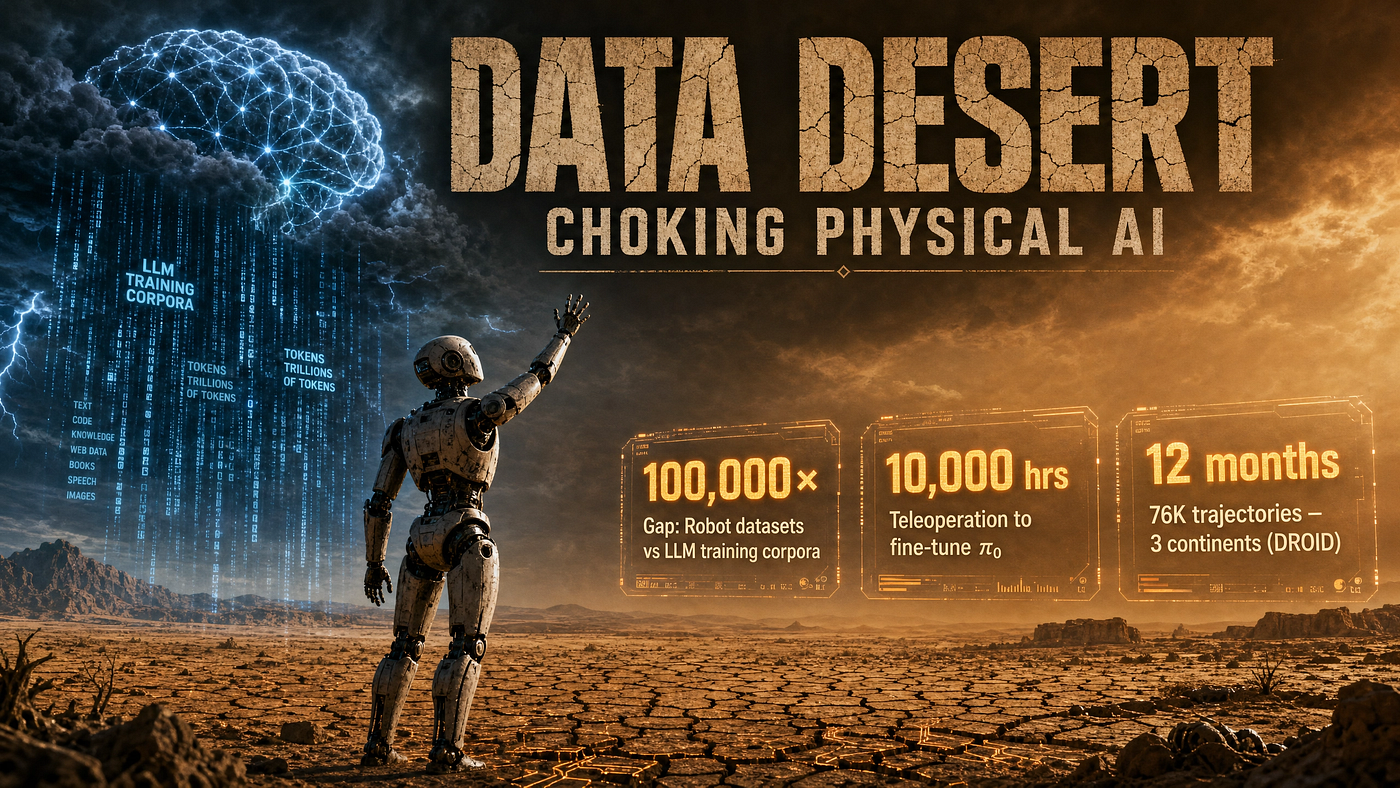
Credit: Nano Banana
This is the “data desert” of Physical AI. Unlike the internet, which gave LLMs essentially unlimited text, every robot trajectory must be physically performed, recorded, labeled, and validated. The result: the biggest open robot dataset in existence (Open X-Embodiment, assembled by 34 labs over years) would be dwarfed by a single week of GPT-4’s pre-training data.
“The ChatGPT moment for robotics is coming.” — Jensen Huang, CES 2025. What he didn’t say: it requires a data infrastructure that doesn’t exist yet.
Why Traditional Teleoperation Is the Wrong Answer at Scale
The dominant paradigm for collecting robot training data today is teleoperation: a human operator remotely controls a robot arm, and the robot records what it did. ALOHA, Mobile ALOHA, DROID — all variations on this theme. It works. It just doesn’t scale.
Five structural failures
- Quality degradation. A May 2026 paper from Siemens researchers (arXiv:2605.26349) studied industrial teleoperation at scale and found that novice operators routinely produce demonstrations that are task-successful but policy-poisoning — inefficient paths, repeated corrections, near-singularity joint configurations. Without automated quality scoring, these silently degrade VLA model performance.
- The scalability math. At $50/hour and 10 demonstrations/hour, collecting one million demonstrations costs $5M in labor alone, before hardware, facilities, or infrastructure. Berkeley’s Real2Render2Real paper (arXiv:2505.09601) puts the gap starkly: robot datasets are over 100,000× smaller than corpora used to train frontier LLMs and VLMs.
- Hardware lock-in. Data collected on a Franka Panda is largely unusable for training a Unitree G1 humanoid. Every new robot platform requires a completely new collection campaign, multiplying costs linearly with platform diversity.
- Geographic constraints. Traditional teleoperation requires proximity to expensive hardware, limiting the operator workforce to specialists near robotics labs. This is a bottleneck on both diversity and throughput.
- Missing modalities. Standard teleoperation captures RGB video and joint states. It almost never captures force and tactile information — which is critical for manipulation of fragile, deformable, or force-sensitive objects. Moreover, it rarely captures wrist-centric egocentric views, which VLA models increasingly need for fine-grained hand-object interaction.

Seven Methods That Crack the Data Bottleneck
The research community has converged on a spectrum of complementary approaches, each solving a different piece of the problem. Here is a high-level summary of the seven most important methods documented in arXiv papers from January 2025 to June 2026.
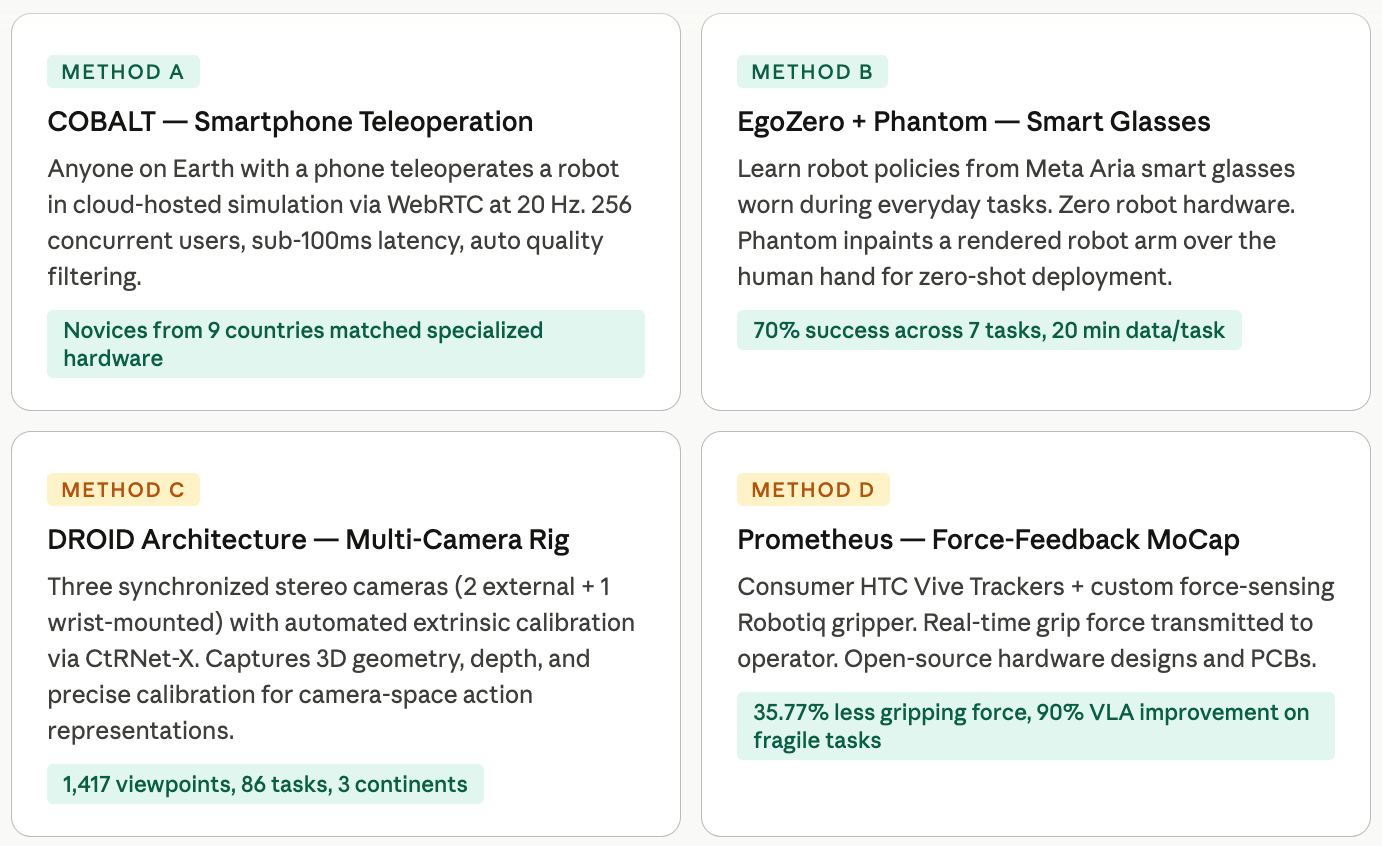
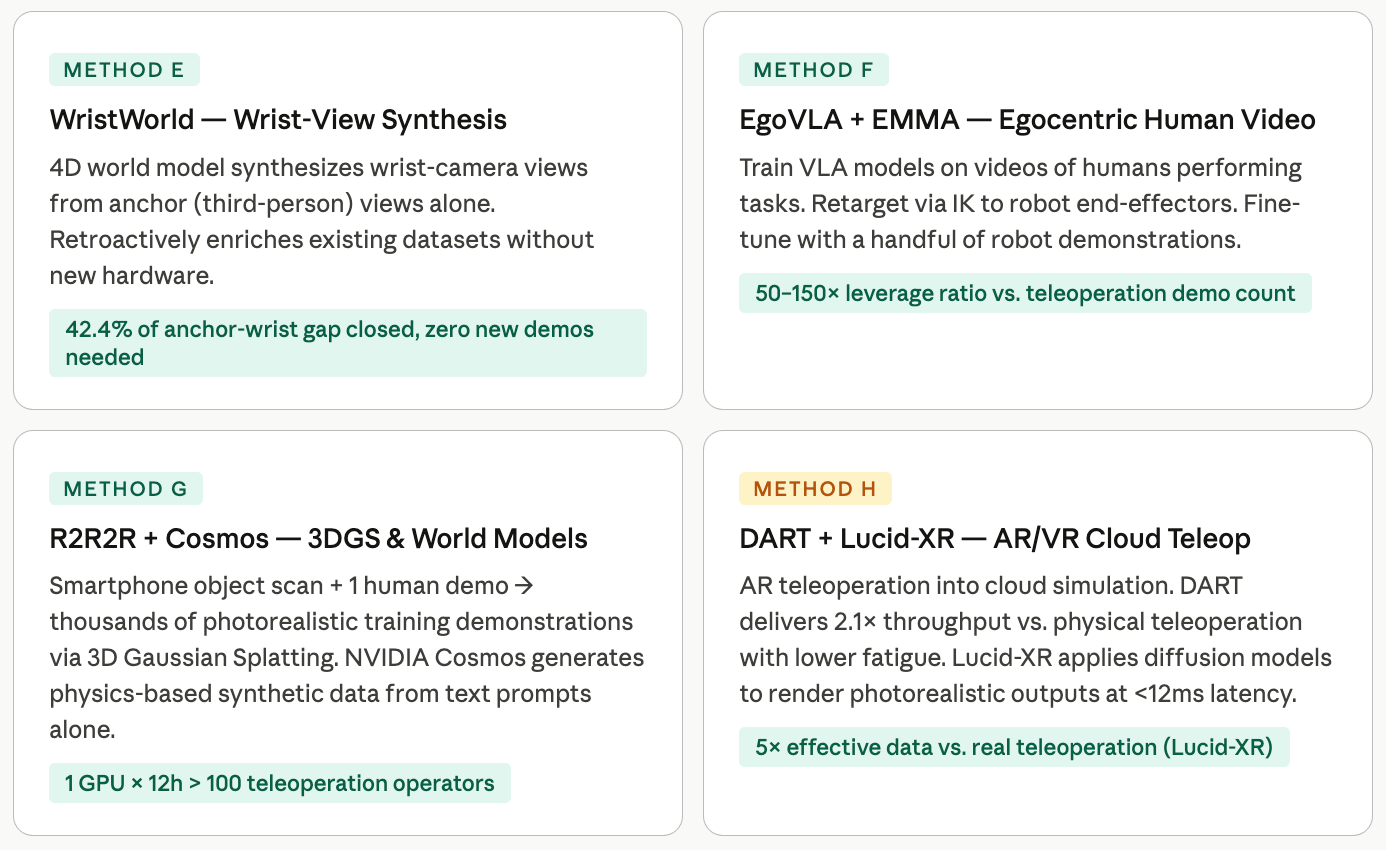
Method Comparison at a Glance
No single method wins everywhere. The table below shows how each approach scores across the five dimensions that matter for a data business.
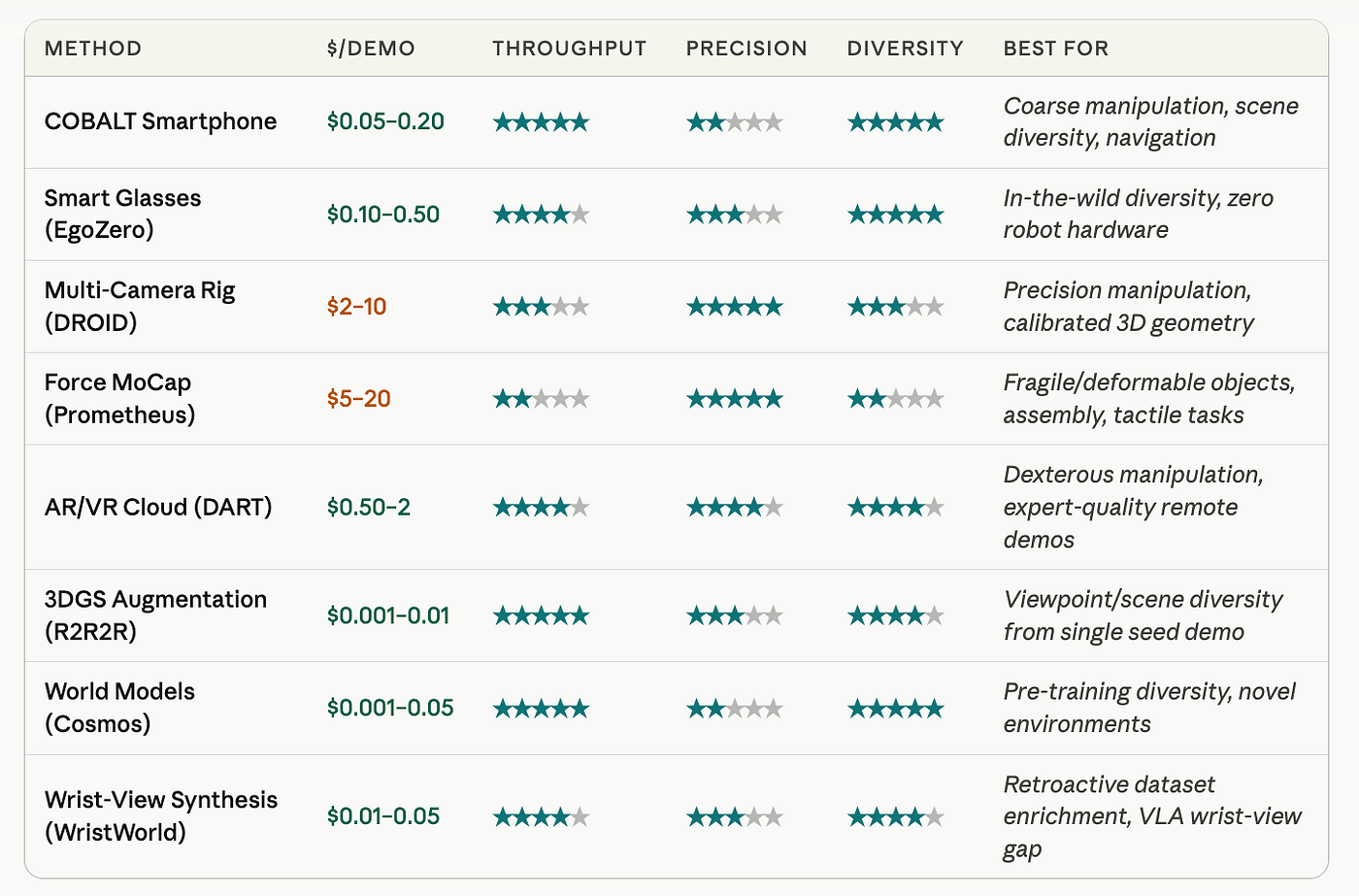
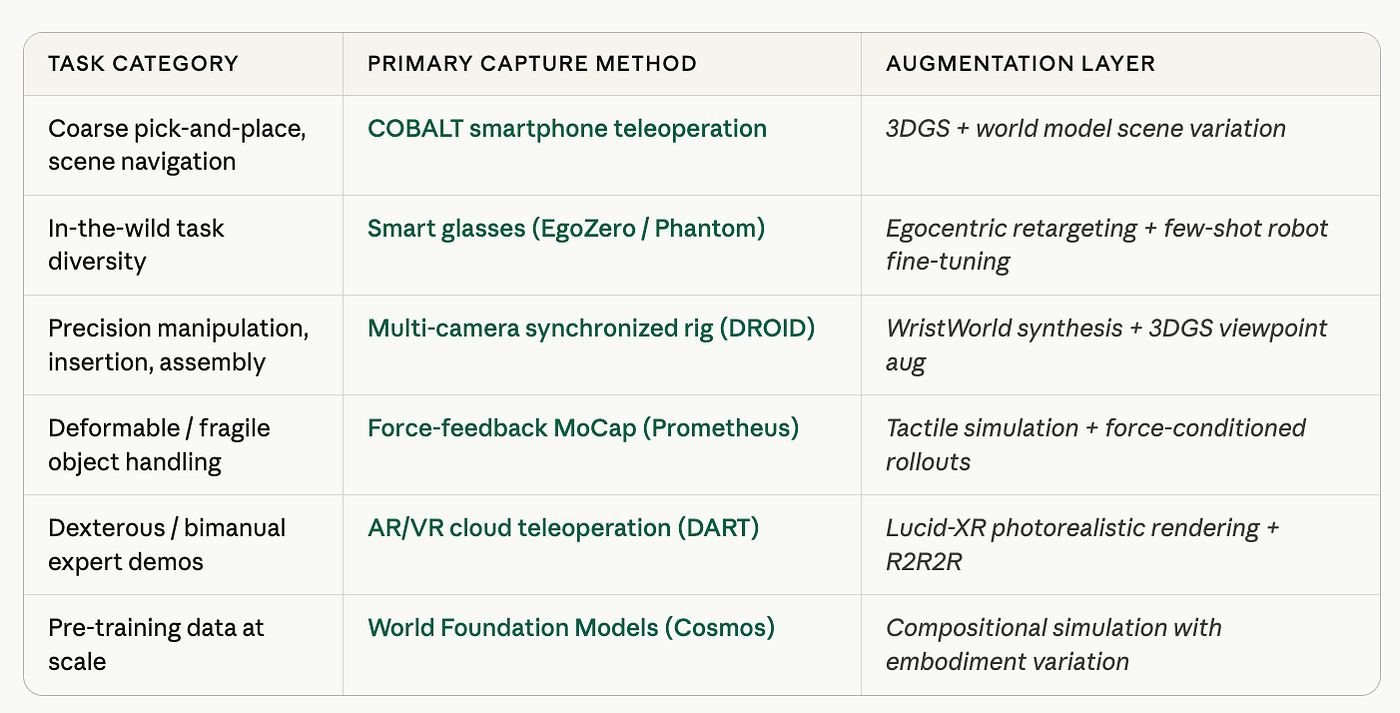
The Method-Routing Engine — Right Tool, Right Task
The core architectural insight for a Physical AI data platform is that the optimal method varies by task type. A platform must intelligently route each customer data request to the appropriate method — or combination of methods — based on the task type, precision requirement, budget, and embodiment target.
Conclusion — and What It Takes to Seize It
Between January 2025 and June 2026, the research community handed the world a complete toolkit for radically more efficient robot data collection.
What it did not deliver was integration, quality assurance, embodiment-agnostic retargeting, or a commercial layer.That is the startup opportunity: build the integrated platform that routes each task to the right capture method, runs automated quality scoring on every demonstration, retargets trajectories across robot embodiments, and delivers policy-ready datasets in standard formats (LeRobot, RLDS, OpenVLA).
The company that does this well captures a defensible position at the center of the Physical AI ecosystem — every robot company training a VLA model becomes a customer. That’s the opportunity waiting.
References — arXiv papers & sources
- arXiv:2605.26349 — Closing the Loop in Teleoperation: DQAF Framework. Narayanan et al., Siemens, May 2026.
- arXiv:2505.09601 — Real2Render2Real: Scaling Robot Data Without Dynamics Simulation or Robot Hardware. Fu et al., UC Berkeley, May 2025.
- arXiv:2505.20290 — EgoZero: Robot Learning from Smart Glasses. Liu, Adeniji et al., NYU / Berkeley, May 2025.
- arXiv:2503.00779 — Phantom: Training Robots Without Robots Using Only Human Videos. Lepert, Fang, Bohg. Stanford CoRL 2025.
- arXiv:2510.07313 — WristWorld: Generating Wrist-Views via 4D World Models for Robotic Manipulation. Qian et al., October 2025.
- arXiv:2510.01023 — Prometheus: Universal, Open-Source MoCap-Based Teleoperation with Force Feedback. Satsevich et al., Skoltech, October 2025.
- arXiv:2504.07939 — Echo: Open-Source Low-Cost Force Feedback Teleoperation System. Bazhenov et al., 2025.
- arXiv:2507.12440 — EgoVLA: Learning Vision-Language-Action Models from Egocentric Human Videos. Yang et al., July 2025.
- arXiv:2511.00153 — EgoMI: Learning Active Vision and Whole-Body Manipulation from Egocentric Human Demonstrations. Yu et al., November 2025.
- arXiv:2509.04443 — EMMA: Scaling Mobile Manipulation via Egocentric Human Data. September 2025.
- arXiv:2602.22461 — EgoAVFlow: Robot Policy Learning with Active Vision from Human Egocentric Videos via 3D Flow. February 2026.
- arXiv:2411.02214 — DexHub and DART: Towards Internet Scale Robot Data Collection. Park et al., MIT.
- arXiv:2604.23001 — Vision-Language-Action: A Survey of Datasets, Benchmarks, and Data Engines. April 2026.
- arXiv:2604.11386 — Building Scalable Real-World Robot Data Generation via Compositional Simulation. April 2026.
- arXiv:2511.16651 — InternData-A1: Pioneering High-Fidelity Synthetic Data for Pre-training Generalist Policy. November 2025.
- arXiv:2403.12945v2 — DROID: A Large-Scale In-The-Wild Robot Manipulation Dataset. Updated April 2025 (automated calibration).
- arXiv:2511.17001 — Stable Offline Hand-Eye Calibration for Any Robot with Just One Mark. 2025.
- arXiv:2602.22818 — LeRobot: An Open-Source Library for End-to-End Robot Learning. March 2026.
- COBALT — Crowdsourcing Robot Learning via Cloud-Based Teleoperation with Smartphones. Georgia Tech PAIR Lab, Agarwal & Garg, 2025/2026. [cobalt-teleop.github.io](https://cobalt-teleop.github.io — https://arxiv.org/abs/2605.19138)
- NVIDIA Cosmos — World Foundation Models for Physical AI. CES January 2025 + GTC March 2025. nvidia.com/cosmos
- Isaac GR00T-Dreams — Synthetic Trajectory Data from World Foundation Models. NVIDIA Developer Blog, December 2025.
- [RoboSplat](https://arxiv.org/abs/2504.13175 — https://yangsizhe.github.io/robosplat/) — 3DGS-Based 6-DoF Data Augmentation. RSS 2025. 87.8% one-shot success from single demonstration.
Acknowledgement: Anshuman Lall, Co-founder ReasonCore
full disclosure: The article was written with the help of Claude to summarize the ArXiv papers on teleoperations, imitation learnings, Physical AI data collections from Jan 2025-Jun 2026
메타데이터
- post_id
- 419bfb1cb313
- slug
- the-data-desert-choking-physical-ai-and-seven-methods-that-can-end-it-419bfb1cb313
- url
- https://medium.com/decisionforce/the-data-desert-choking-physical-ai-and-seven-methods-that-can-end-it-419bfb1cb313
- canonical_url
- https://medium.com/decisionforce/the-data-desert-choking-physical-ai-and-seven-methods-that-can-end-it-419bfb1cb313
- author_url
- https://medium.com/@gs-sriram
- status
- ok
- fetched_at
- 2026-06-14 11:28:49



