I Was Terrified of Heights. Then I Tried Aerial Yoga in Bangalore.
How a fabric hammock and a lot of deep breathing dismantled a fear I had carried for years.
I Was Terrified of Heights. Then I Tried Aerial Yoga in Bangalore.
How a fabric hammock and a lot of deep breathing dismantled a fear I had carried for years.
I want to be clear about something before we go any further: I am not someone who does brave things.
I take the stairs but grip the railing. I avoid window seats on flights. I once spent twenty minutes on a glass-floored bridge in a hill station before a ten-year-old walked past me without breaking stride, at which point I crossed in approximately four seconds out of pure embarrassment.
So when a friend suggested I try aerial yoga at a studio in Kalyan Nagar, I said yes in the cheerful, non-committal way that means no.
Three weeks later, I was standing in a room in HRBR Layout, looking at a hammock suspended from the ceiling, wearing fitted leggings as instructed, trying to remember why I had said yes to this.
What the First Ten Minutes Actually Feel Like
The teacher, Reshma, had us begin on the mat. A warm-up. Normal yoga. I had done yoga before. My nervous system unclenched slightly.
Then she said: sit in the hammock.
The hammock is a wide length of soft, strong fabric. It hangs at hip height. You sit into it like a swing. I did this. It held me. It did not snap. The ceiling did not fall. I was approximately three feet off the ground and nothing terrible happened.
She walked around the room adjusting hammocks, checked that each person felt stable, and moved on. No drama. No ceremony. Just: this is a tool. Trust it.
The hammock doesn’t ask you to be brave. It just asks you to sit down. The bravery, it turns out, is something that happens after.
The Part That Actually Scared Me
Twenty minutes in, we came to the first inversion.
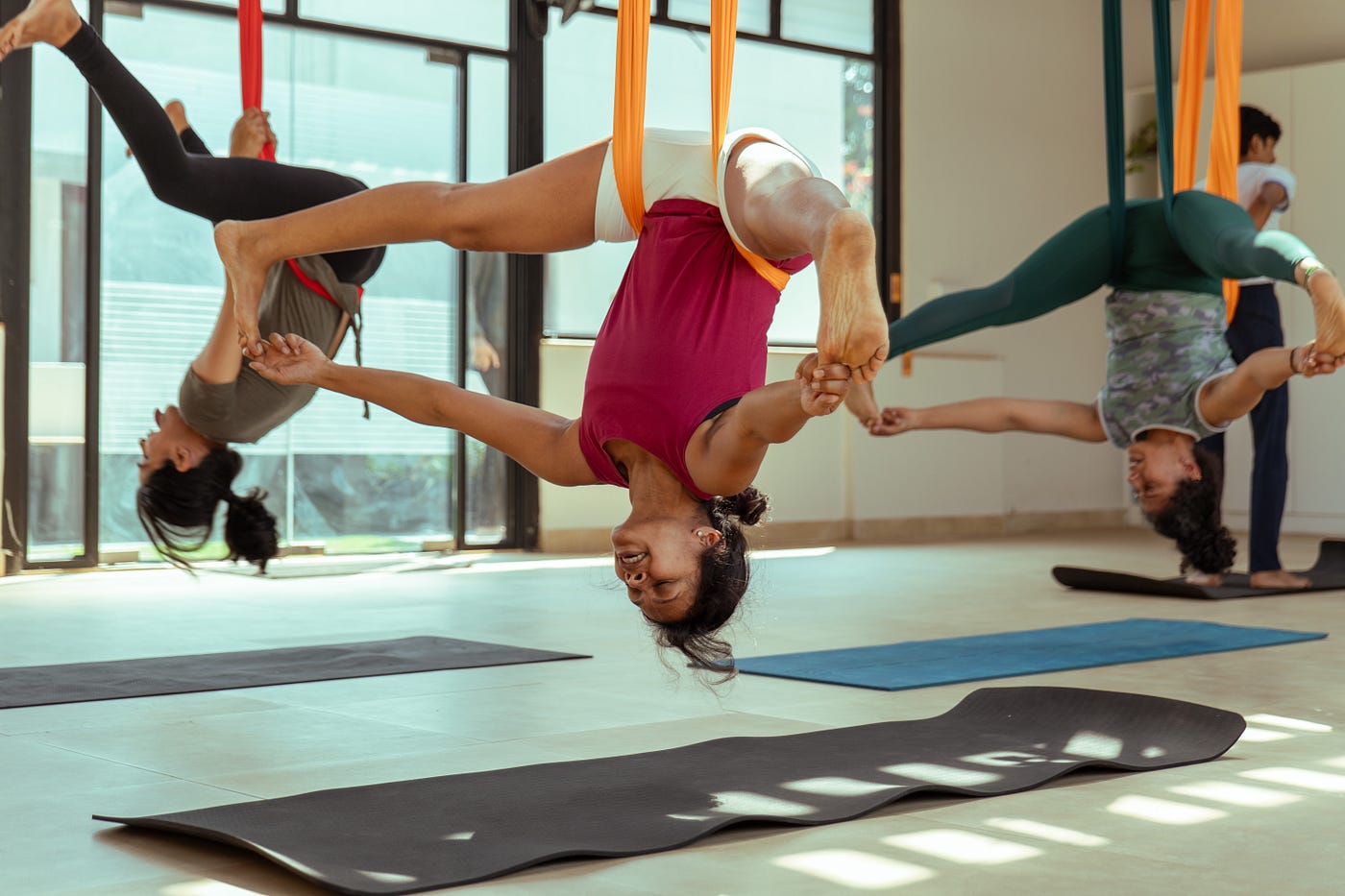
Reshma demonstrated: feet in the hammock, lean back, let your head drop below your heart. The fabric takes your weight. Your spine decompresses. You breathe.
It looked peaceful when she did it. It looked, from where I was standing, like voluntary falling.
I did what I always do when I am frightened: I breathed slowly and did it anyway, faster than I could talk myself out of it.
And then I was upside down. Completely supported. The hammock held every part of me. The blood moved to my head. The tension in my lower back — the kind that had been there for so long I had stopped noticing it — simply… released. Not gradually. Immediately. Like a fist unclenching.
I stayed there for what felt like a long time. It was probably thirty seconds.
What Inversions Actually Do
Later, I read about spinal decompression. The vertebrae in the lower back are compressed throughout the day by the simple fact of being upright — gravity, desk posture, carrying bags, sitting badly. Sustained inversion reverses that load. The discs between the vertebrae get space. Fluid redistribution happens. The muscles along the spine, which have been working to hold you up all day, get to stop.
What I felt in that hammock was not placebo. It was physics.
The fear of heights, I have since come to understand, is at least partly a fear of not being supported. Of falling. The hammock removes that variable completely. You are supported. You are not going to fall. The nervous system, once it receives that information sensorially rather than just intellectually, updates its threat assessment. The fear doesn’t disappear, but it quiets.
The Aerial Savasana
At the end of the class, Reshma had us wrap ourselves entirely in the hammock. Fabric around the body. Head supported. Legs suspended. Eyes closed.
This is called the aerial savasana, or the cocoon. I had read about it in the studio’s description of the practice — students consistently call it their favourite part — and I had assumed this was marketing language.
It is not marketing language.
The gentle compression of the fabric. The sense of being held from all sides. The complete removal of any need to do anything. I have been to a flotation tank. I have tried sensory deprivation. Neither of them produced the quality of stillness that ten minutes in a yoga hammock produced on a Wednesday morning in Kalyan Nagar.
I drove home across north Bangalore with the windows down and did not think about my inbox once.
What I Would Tell the Person I Was Before That Class
The fear is not irrelevant. Bring it. Tell the teacher. A good teacher — and the teachers at this studio are specific, attentive, small-batch good — will meet you exactly where you are and not ask you to go further than your body and nervous system are ready for.
The hammock will hold you. You will be three feet from the ground. Nothing will happen. And then something will happen: the spine will release, the fear will quiet, and the part of you that has been gripping since you can remember will, briefly, let go.
Aerial yoga classes at Absolute Yoga run on Wednesdays and Fridays at the HRBR Layout studio. Members from ₹250 per class. Free trial available: absoluteyoga.in/aerial-yoga-bangalore.php · WhatsApp: wa.link/a15eyp
Trupti Rathi · Founder & Principal Yoga Teacher, Absolute Yoga, Kalyan Nagar, Bangalore
Trupti has taught yoga in Bangalore since 2016. She leads in-studio, live online, and aerial yoga classes, and has guided over a thousand students — from beginners to advanced practitioners — through a practice rooted in alignment, breath, and long-term consistency. She can be reached at absoluteyoga.in or via WhatsApp at wa.link/a15eyp.
메타데이터
- post_id
- 48e5e0d50f82
- slug
- i-was-terrified-of-heights-then-i-tried-aerial-yoga-in-bangalore-48e5e0d50f82
- url
- https://medium.com/@absolute8yoga/i-was-terrified-of-heights-then-i-tried-aerial-yoga-in-bangalore-48e5e0d50f82
- canonical_url
- https://medium.com/@absolute8yoga/i-was-terrified-of-heights-then-i-tried-aerial-yoga-in-bangalore-48e5e0d50f82
- author_url
- https://medium.com/@absolute8yoga
- status
- ok
- fetched_at
- 2026-06-29 01:02:39