How to Structure a Book Like a Professional Writer
Most books don’t fail because of bad writing. They fail because of bad structure. Here’s how to get it right.
How to Structure a Book Like a Professional Writer
Most books don’t fail because of bad writing. They fail because of bad structure. Here’s how to get it right.
You can write beautiful sentences. You can create vivid characters and compelling ideas. But if your book doesn’t have a solid structure underneath all of that, readers will put it down before they reach the middle — and they won’t be quite sure why.
Structure is the invisible architecture of every great book. Readers rarely notice it when it’s working. They absolutely feel it when it isn’t.
Learning to structure a book like a professional writer is one of the most valuable skills you can develop — and unlike raw talent, it’s entirely teachable.
Why Structure Matters More Than Most Writers Think
First-time authors often treat structure as a constraint on creativity. It isn’t. Structure is what gives your creativity somewhere to go.
Think of it this way: a river without banks isn’t a river. It’s a swamp. Structure is what channels your story’s energy in a direction that builds momentum and carries the reader forward. Without it, even the most brilliant ideas get lost in their own sprawl.
Professional writers understand that readers make an unconscious contract with every book they open. They expect rising tension, meaningful turning points, and a satisfying resolution. When a book violates that contract — even if the prose is beautiful — readers feel cheated. Structure is how you honour the contract.
Start With the Three-Act Structure
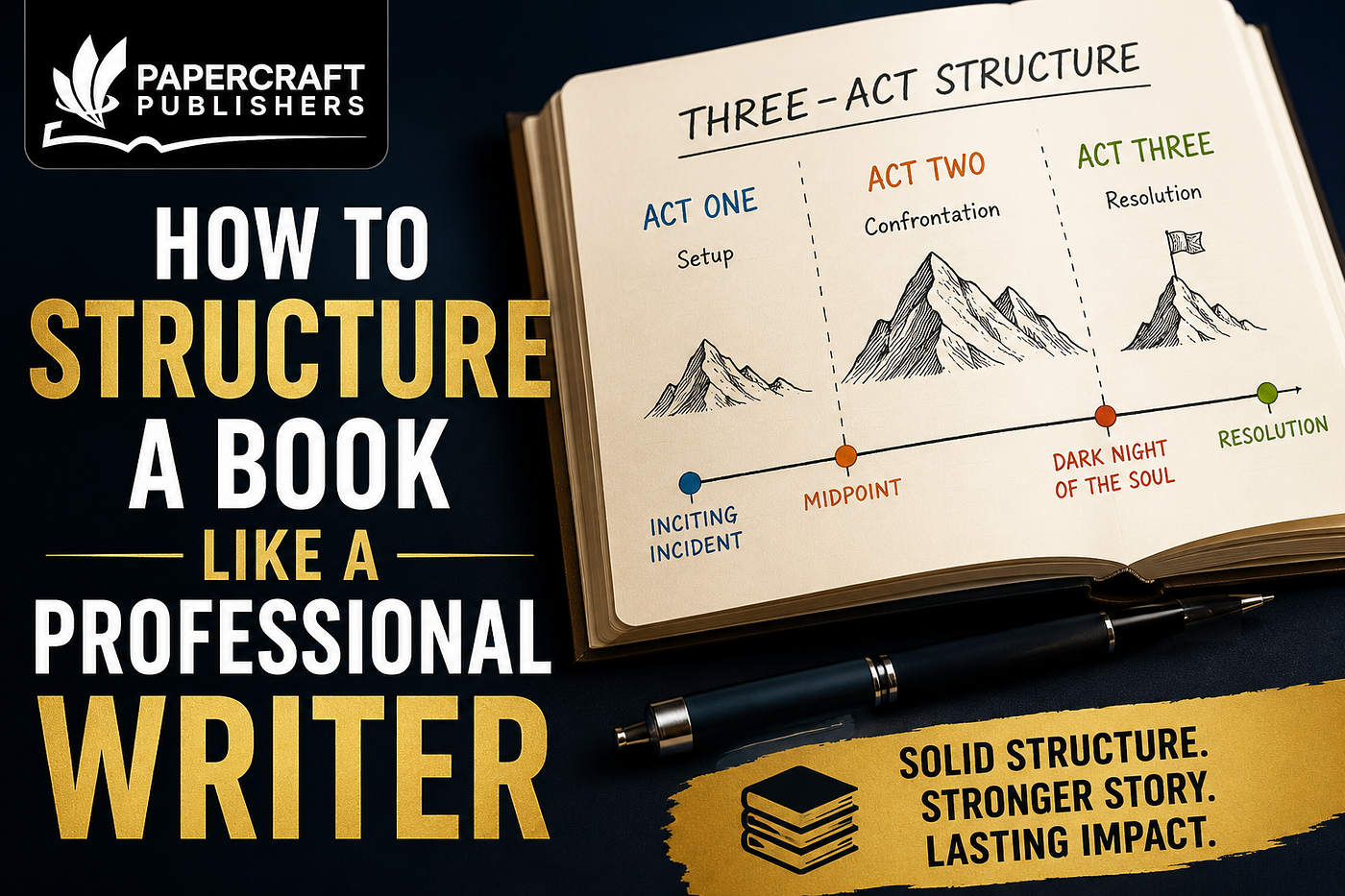
The three-act structure is the foundation of storytelling across every medium — novels, films, plays, memoirs. Understanding it is non-negotiable for any writer who wants to write books that hold together.
Act One sets up your world, your protagonist, and the central conflict. It ends with an inciting incident — the event that changes everything and makes the rest of the story inevitable. A good Act One answers the question: what does this story cost the main character, and why should we care?
Act Two is where the story lives. It’s the longest act — typically half the book — and it’s where your protagonist faces escalating obstacles, makes difficult choices, and is fundamentally tested. Act Two ends at its lowest point: the moment when all seems lost.
Act Three is the resolution. The protagonist takes what they’ve learned and makes a final, decisive move. This is where transformation is confirmed or denied. It answers the question the whole book has been asking.
Most structural problems in manuscripts happen in Act Two. Writers rush through it, pad it out, or lose the thread of escalation. Knowing this in advance lets you plan it deliberately.
Know Your Inciting Incident — and Place It Early
The inciting incident is the single most important structural event in your book. It’s the moment that sets the story in motion — the call to adventure, the disruption of the status quo, the question the rest of the book will answer.
Many first-time authors bury it too deep. They spend the first three chapters on backstory and world-building before anything actually happens. By that point, the reader has already moved on.
As a rule of thumb, your inciting incident should occur within the first 10–15% of your book. In a 300-page novel, that’s roughly the first 30–45 pages. In a shorter work, sooner is almost always better.
Everything before the inciting incident exists to make the reader care about the character it happens to. Keep that section lean, active, and full of personality.
Use the Midpoint to Prevent Act Two Sag
Act Two is where manuscripts most commonly lose momentum. Writers know their beginning and their ending but haven’t fully mapped the middle — and the middle starts to drift.
The midpoint fix is one of the most practical tools in professional storytelling. Roughly halfway through your manuscript, introduce a major turning point — a revelation, a reversal, a decision that raises the stakes significantly and gives the second half of Act Two a new direction to build toward.
The midpoint doesn’t resolve anything. It complicates everything. It should make the reader feel that the story has shifted gear — that what they thought they were reading has become something more urgent, more dangerous, or more emotionally charged.
With a strong midpoint, Act Two stops feeling like a long bridge between a beginning and an ending. It becomes a story in its own right.
Map Your Turning Points Before You Write
Professional writers — whether they’re natural plotters or instinctive pantsers — understand the structural turning points their story needs to hit. You don’t need a scene-by-scene outline. But you do need to know your major waypoints before you start.
At minimum, identify these five before writing chapter one:
Your opening image or scene — the world as it is before everything changes. Your inciting incident — the disruption that starts the story. Your midpoint — the pivot that reshapes the second half. Your dark night of the soul — the lowest point, just before Act Three. And your resolution — how the story ends, and what it means.
These five points are your map. Everything else is the territory you explore between them.
Structure Non-Fiction Differently — But Just as Deliberately
Everything above applies primarily to narrative fiction and memoir. Non-fiction books — guides, business books, self-help, academic texts — require their own structural thinking, but the principle is the same: every chapter should earn its place.
For non-fiction, think of your book as an argument. What is the central thesis? What does the reader need to understand first before they can understand the next thing? Each chapter should build on the last, moving the reader from where they are to where you want them to be.
A strong non-fiction structure answers one question per chapter and leaves the reader wanting the next answer. A table of contents that reads like a logical, satisfying progression is a sign of a well-structured book. If your chapters could be shuffled without the reader noticing, your structure needs work.
The Chapter Level: Rhythm, Hooks, and Endings
Structure isn’t just a macro concern. Every chapter has its own internal architecture.
A strong chapter opens with a hook — something that pulls the reader in and gives them a reason to keep going. It builds toward a moment of change, revelation, or decision. And it ends on a note that makes putting the book down feel difficult.
The chapter-ending hook is one of the most underused tools in a writer’s kit. It doesn’t need to be a cliffhanger. It can be a question left open, an emotion held in suspension, a revelation that reframes what came before. The goal is to make the next chapter feel necessary.
Read the last line of any chapter in a book you struggled to put down. That’s what a good chapter ending does.
Learn From the Structures That Already Work
The fastest way to internalise structure is to study it in books you admire. Pick a novel you love and map it. Where does the inciting incident fall? When is the midpoint? Where is the darkest moment? How much of the book is Act One, Act Two, Act Three?
You’ll start to see patterns — and more importantly, you’ll see how the best authors use structure as a foundation rather than a formula. They honour the underlying architecture while finding their own voice within it.
Craft resources like Jane Friedman’s publishing blog and K.M. Weiland’s guide to story structure are among the best free references available for writers at any stage. Both go deep on structure with practical, genre-specific guidance.
Structure Is What Gets Your Book Finished — and Published
A well-structured manuscript is easier to write, easier to edit, and far more likely to impress a publisher or resonate with readers. Structure gives you a framework that holds your story together when the middle gets hard and the end feels impossibly far away.
It also makes the publishing process smoother. At Papercraft Publishers — Pakistan’s №1 book publishing company with over 10,000 clients worldwide — the authors who arrive with clean, well-structured manuscripts move through the editing, layout, and professional book printing process with far greater ease. A structurally sound book is a gift to everyone who works on it after the author.
Whether you’re writing your first novel, a children’s book, or a professional non-fiction title, Papercraft’s custom publishing services are built to take a polished manuscript and turn it into a beautifully printed book, distributed globally.
Structure isn’t the enemy of creativity. It’s the reason creativity gets to the finish line.
Map your story. Know your turning points. Then write — with confidence, direction, and the quiet certainty that what you’re building will hold.
Ready to take your structured manuscript to print? Publish with Papercraft Publishers and bring your book to readers around the world.
메타데이터
- post_id
- 4a39f1828b08
- slug
- how-to-structure-a-book-like-a-professional-writer-4a39f1828b08
- url
- https://medium.com/@munazahgraphics/how-to-structure-a-book-like-a-professional-writer-4a39f1828b08
- canonical_url
- https://medium.com/@munazahgraphics/how-to-structure-a-book-like-a-professional-writer-4a39f1828b08
- author_url
- https://medium.com/@munazahgraphics
- status
- ok
- fetched_at
- 2026-07-17 06:16:19