IN DEFENCE OF SKIPPING SCHOOL
Cherki, Guardiola and the tactical logic of the rabona
IN DEFENCE OF SKIPPING SCHOOL
Cherki, Guardiola and the tactical logic of the rabona
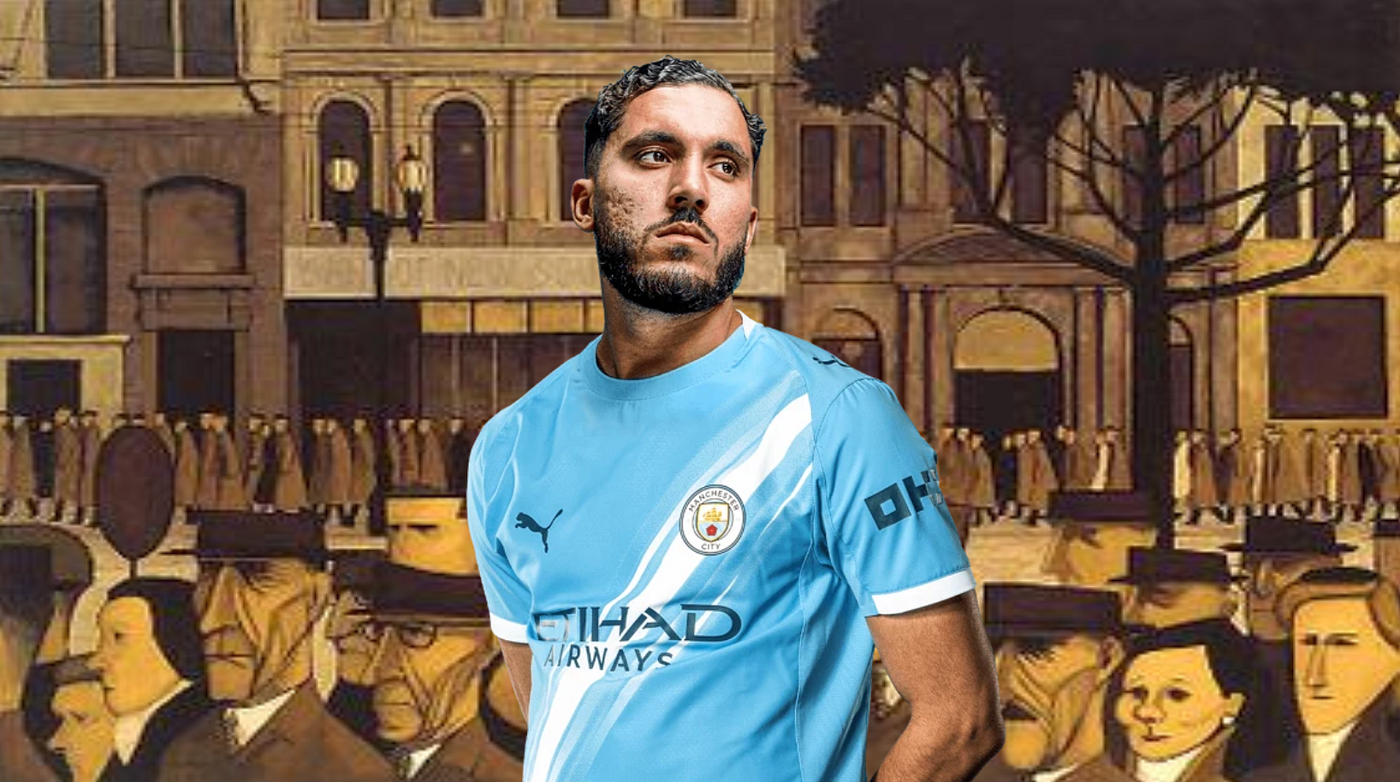
Rayan Cherki accelerates past Trai Hume. He pushes the ball towards the by-line, and as he scampers after it, he looks up, scanning the box for any information that might influence his next move. As he approaches the ball, he shapes to cross with his right foot. Cherki senses the speed and angle of Trai’s recovery sprint; he sees no immediate option for a low cross. He chops back against Trai’s momentum, a sort of half-Cruyff, tapping the ball behind his standing left leg but without the full exaggerated drag of the original 1974 Dutch masterpiece. Trai is thrown off balance by the misdirection. Cherki cushions the ball with his left foot and flicks his eyes toward the centre — a glance so quick it’s barely visible. Sadiki has taken a defensive position on the edge of the six-yard box, guarding the near post; Geertruida is a couple of metres behind him. The defenders are not off balance. The time it took Cherki to trick Hume allowed them to slow their retreat towards the goal and plant both feet. They hold solid defensive stances, ready to push off in a variety of directions. They have clean lines of vision; they can see the ball, Cherki and any possible City attackers arriving in the box. It looks as though Cherki is setting himself for a left-foot cross, but then something strange happens. He plants his left foot next to the ball. It is a jarring action, unusual, unexpected. For a fleeting second, the arrangement of Cherki’s limbs suggests he isn’t going to cross the ball at all. At this vital moment, Sadiki and Geertruida have their gazes fixed on the Frenchman, like snakes charmed by the notes of a mystic melody. All of a sudden, Cherki whips his right foot behind his left leg and makes contact with the ball. Impact is made with a jab of the right in-step, towards the bottom right of the ball’s face; this technique is known as a ‘rabona’. Sadiki and Geertruida remain stuck to the six-yard line, as the ball spins up towards them, they suddenly seem to snap out of their trance. But it’s too late. While their attentions were held by Cherki’s spell, Phil Foden had ghosted into heading range. The Sunderland defenders seemed surprised to see Foden there, as if he’d suddenly materialised out of thin air, conjured by the power of some occult incantation. Foden rose unopposed to meet Cherki’s cross, nodding the ball in off the crossbar.
It was a sequence of rare magic. Post-match, all the talk was of Cherki’s genius. Cherki’s manager, Pep Guardiola, was interviewed shortly after the final whistle. When the reporter asked about Cherki’s trickery, Guardiola seemed not to exude the enthusiasm one might expect from a coach whose player had just executed an assist of such beauty. There were compliments, of course, but there was also a substantial critique.
“What I like most about Rayan is not the skills...a cross is fine, it’s all good. It doesn’t matter if it’s with the right foot, the left, the outside of the boot, the head — it doesn’t matter. If it’s effective, fine. But if it doesn’t work, then there are problems. Then you’ll be in trouble.”
Guardiola suggested that Lionel Messi would never engage in such antics.
“I never saw Messi play and make a cross like he has done…Messi is the best player to have played the game, and I never saw these kinds of crosses… I like simplicity because I learned from Messi he never made a mistake, and never made a mistake with the simple things. Never. Simple things he does perfectly… And after dribble past four, five players.”
It would be easy to read Guardiola’s comments as the usual post-match grounding of a young player — a manager playing down the hype. The rabona takes its name from a 1948 piece in Argentine football magazine El Grafico. Ricardo Infante’s action was described with the phrase ‘hacerse la rabona’, which can be roughly translated as the act of ‘skipping school’. Guardiola isn’t shy about playing the nonplussed headmaster.
But beneath the surface lies a deeper tension, one that cuts to the heart of how football is understood.
For Guardiola, the manner of execution is irrelevant; he tells us that only the effectiveness matters. Left foot, right foot, with the head — it’s all the same. The simplest solution is the best: fewer errors, greater repeatability, a more stable foundation for future actions. Football is not gymnastics; there are no points awarded for aesthetic difficulty. So why contort yourself when a cleaner, more efficient option is available?
This, in essence, is the dominant logic of contemporary tactical theory: efficiency is treated as synonymous with effectiveness. Cherki’s rabona registers as a single assist on the data sheet, no different from a routine left-footed cross. So why introduce unnecessary complexity? Why expend more effort when the measurable outcome remains the same? Viewed through this lens, Cherki’s rabona becomes inefficient; an act of excess, a waste of resources.
But what if dismissing the manner in which actions are made was a mistake? What if the way in which the player’s body was arranged was what made the outcome of the action possible?
Take a simple example. Nico Schlotterbeck is known for his ability to play line-breaking passes from left centre-back. The value of these passes is reflected in metrics — pass completion, progressive passes, expected threat, packing rate, and so on. But what these numbers miss is that Schlotterbeck often relies on a particular tool to make these passes possible: deception.
Deception in football works through non-verbal communication. The angle of Schlotterbeck’s hips and the direction of his gaze send signals to teammates and opponents alike. He shapes to play a safe, simple pass out to the left back. The opponent’s defensive block reads the cues and begins to shuffle over. At the last moment, Schlotterbeck reverses his stance and plays forward, cutting back against the defender’s momentum.
Defenders build their actions on reading cues — anticipating intentions, adjusting their body position, and preparing to intercept or block. This is what we mean when we talk about “reading the play”. Think of how Paolo Maldini or Thiago Silva always seemed a step ahead: they were interpreting information before others even realised it was being sent.
If we accept this premise, it follows that the best attacking actions must disguise their intentions. Messi, Guardiola’s benchmark for perfection, has said as much:
“I try to trick the defender and find where the space is to escape from him… you bring him with you, then feint and move sideways. When he is unbalanced, that is the time to escape.”
It is no coincidence that Guardiola’s greatest, and by far most beautiful, team was built around players who consciously disguised their intentions. The coaching world drew geometric and structural lessons from that era, but its defining quality was something less codifiable: the ability to mislead, to wrong-foot, to make opponents look like fools by throwing them off balance.
Guardiola highlights the simplicity of Messi’s play, noting that he rarely relied on elaborate ‘skills’. And he’s right: Messi’s actions were, and still are, beguilingly minimal; he is techno as much as tango, his dribble oscillates between glitch and sway.
But Messi is Messi. Restraint, introversion and precision are extensions of his personality. The mistake is treating that personal, authentic minimalism as some universal template. Messi’s simplicity isn’t an idealised footballing form; it’s an expression of who he is. The fact that he achieves perfection through minimalism does not mean minimalism is the path to perfection.
Which is why Guardiola’s critique of Rayan Cherki reveals more about Guardiola than about Cherki. In Cherki’s rabona, the form enabled the function: the shape of his body played tricks with the defender’s perception, the unconventional contact produced a trajectory perfect for Foden; the aesthetic quality of the action was inseparable from its effectiveness. Yet Guardiola framed it as an unnecessary complication. In doing so, he simply privileged a different aesthetic — Messi’s aesthetic — over the underlying functional principle. Successful deception takes many forms, because players’ bodies, instincts, histories and expressive tendencies differ.
Guardiola links Messi’s simplicity with his consistency, his ability to never make mistakes. But how many players who follow this doctrine of apparent simplicity ever get close to playing like Messi? Maybe those actions aren’t so simple after all. More likely is that players regress towards the mean; they make fewer mistakes but lose the capacity to do what made them special in the first place; they lose their power to deceive.
Despite his appeals to pure functionality, the truth is that nobody is more obsessed with footballing form than Pep Guardiola. But for him, aesthetics is not the study and celebration of difference; it is the worship of a singular ideal. We see it in the relentless coaching of posture, like a sculptor working with living flesh. By disciplining a player’s body, all of their intentions can be shaped; turn the torso to control the gaze, position the hips to afford pass-direction. Football tactics are, first and foremost, a matter of embodied cognition.
Guardiola’s aestheticism extends beyond technique and into identity. He famously quipped that Rodri “doesn’t have tattoos or earrings, his hair, he looks like a holding midfielder!” A joke, yes, but revealing nonetheless; even personality markers become indicators of tactical correctness.
Pep Guardiola has said that Marcelo Bielsa is the greatest coach in the world. Perhaps, as it is for many, it is the Argentine savant’s unwavering authenticity that Guardiola finds so compelling. Bielsa is brutally self-aware and has said that ‘authenticity’ is the most important quality a coach can have; how can a coach expect to convince their players if they don’t believe in their ideas themselves? It’s a fair point. But why should the coach’s authenticity trump that of the players? Why condemn Cherki for failing to play like Messi?
Too often, deceptive actions are dismissed as indulgent. Of course, as with any artist, elaboration can go too far, but to make this accusation, you have to be precise; if you are not, you risk suppressing the deepest levels of game intelligence. It’s like telling the world’s funniest clown to change the way they make people laugh. If we’re playing the comparison game, perhaps Cherki is more Ronaldinho than Messi? Only a fool could fail to see that Ronaldinho’s breathtaking trickery was what gave him his competitive edge; would he have been a better player if he had listened to coaches who told him to ‘keep it simple’?
Rather than a luxury in football, deception is a core mechanism by which attacking actions succeed. And actions animated by genuine deceptive quality do not need to be sanded down into repeatable forms; in fact, their unpredictability is often what makes them so effective. Should Dennis Bergkamp have been kept after class for summoning a Cthulhu spin-flick against Nikos Dabizas? The onus should be on coaches to develop systems that function in harmony with these moments. Moving in the opposite direction sacrifices the possibility of surprise in favour of process consistency.
In many cases, aesthetics indicate an unusual sensitivity between the player and the game environment. When analysed through a specific lens, feelings of beauty or magic become signals that the highest levels of functionality are being accessed. It is our job as coaches and analysts to try to decode these messages. Guardiola looked at Cherki and saw unnecessary complexity. But the rabona was intelligence expressed in another dialect. And the game is richer when it is multilingual.
Deception is often the tactical concept powering the most exhilarating plays. We like to be shocked, because shock reveals that realities exist outside of our ability to predict them; at its best, novelty recalibrates our sense of what is possible. We love to be blindsided by an unexpected revelation, after all, what was Cherki’s rabona if not a dramatic twist that suddenly rewrote the rules of the scene?
And this is the point Guardiola seems to miss. The value of a creative action cannot be separated from the form that produces it. Cherki has said he plays to entertain, but in moments like this, what shows up as entertainment is not something frivolous. It is Cherki’s method of deception. His expression is his method. And that is why he is so good.
메타데이터
- post_id
- 4e2a19081ce9
- slug
- in-defence-of-skipping-school-4e2a19081ce9
- url
- https://medium.com/@stirlingj1982/in-defence-of-skipping-school-4e2a19081ce9
- canonical_url
- https://medium.com/@stirlingj1982/in-defence-of-skipping-school-4e2a19081ce9
- author_url
- https://medium.com/@stirlingj1982
- status
- ok
- fetched_at
- 2026-07-10 03:02:36