The Home Front: Why Housing is the Missing Centrepiece of Urban Climate Action
Across cities in the world, a powerful pattern is emerging — cities that treat affordable, low-carbon housing as a climate imperative are…
The Home Front: Why Housing is the Missing Centrepiece of Urban Climate Action
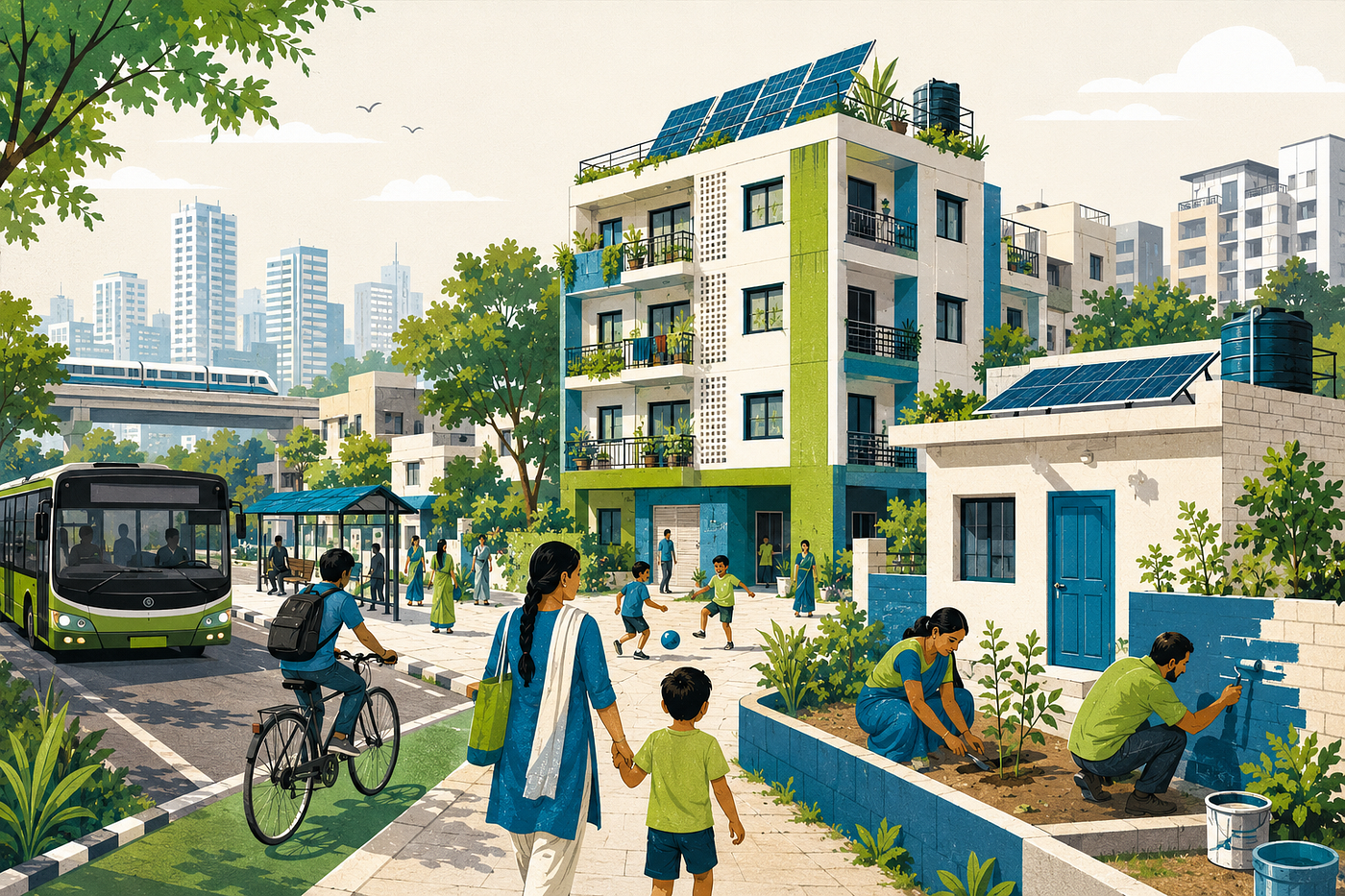
Across cities in the world, a powerful pattern is emerging — cities that treat affordable, low-carbon housing as a climate imperative are outpacing those that treat it as a social footnote.
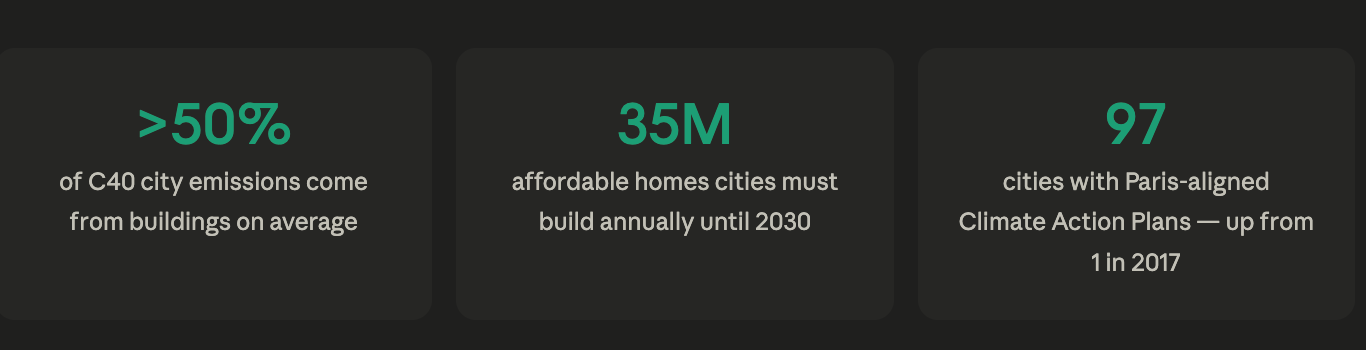
When we think of climate action in cities, we picture electric buses, solar panels, and green corridors. Housing — who lives where, in what condition, built of what materials — rarely commands the same headline. But read through the climate action plans of the C40 network and a clear pattern emerges: the cities making the boldest emissions cuts are the ones treating housing as a frontline climate intervention, not an afterthought.
This piece makes the case drawing on data, city examples, and other frameworks that housing is not merely adjacent to urban climate goals. It is the climate agenda.
Buildings are the emissions problem cities have to solve
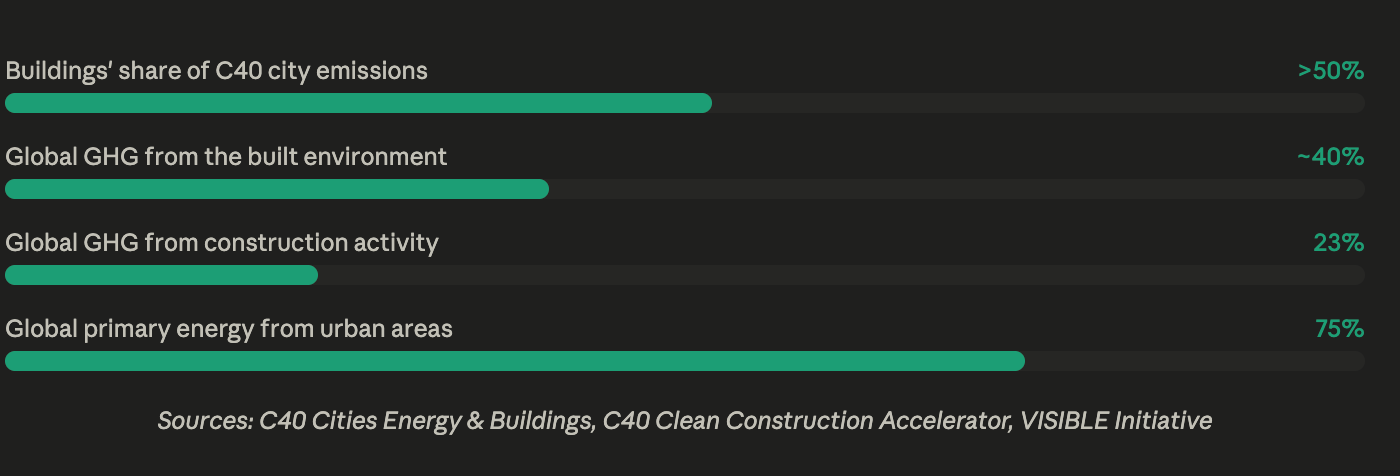
The arithmetic is blunt. Urban areas are responsible for approximately 75% of global primary energy consumption and 50–60% of global greenhouse gas emissionsmuch of it from heating, cooling, and powering buildings.¹ Within cities specifically, buildings account for over half of city emissions on average and around two-thirds of that comes from private buildings.²
The construction sector itself adds another layer: construction accounts for over 23% of global greenhouse gas emissions and consumes more than 30% of global resources.³ Meanwhile, the built environment as a whole contributes close to 40% of total global GHG emissions and 35% of total waste generation.⁴
Buildings last over 100 years. That means every home built today without a climate lens locks in emissions for generations. The C40 Net Zero Carbon Buildings Accelerator captures this urgency precisely: action today matters because buildings last for generations.⁵
Housing is explicitly inside the Climate Action Framework
C40’s Cities Climate Transition Framework — the architecture that shapes how member cities write and implement their climate action plans — identifies five essential components: emissions neutrality, building resilience, inclusivity and benefits, governance and mainstreaming, and monitoring progress.⁶
Housing touches every single one of these pillars. Comprehensive climate action plans are explicitly expected to connect climate goals with wider city priorities — and the list includes housing first, alongside economic development, public health, and social equity.⁷

The C40–UN-Habitat Urban Planning Accelerator goes further, recommending that cities mandate at least 20% of new development be assigned to adequate and affordable housing — framed explicitly as a resilience target for the most vulnerable.⁸ Cities in the accelerator are expected to prioritise regeneration over sprawl, foster mixed-use neighbourhoods near transit, restrict development in high-risk areas, and mandate adequate affordable housing.⁹
Why housing is the equity frontier of climate action
C40’s Inclusive Climate Action framework is unambiguous about who bears the cost of inaction. Low-income families, marginalised groups, and people already facing housing or health challenges suffer the most from extreme heat, unsafe air, and rising costs of living.¹⁰ Climate breakdown, in other words, is a housing crisis accelerant.
Without inclusive climate strategies, by 2030, 132 million people could be forced into extreme poverty. Those least responsible for emissions are hit hardest by the crisis.¹¹
“When mayors put fairness at the centre of climate action, they address the injustices concentrated in their cities. This way, inclusive climate action tackles both the climate crisis and the inequalities it worsens.”
— C40 Cities Inclusive Climate Action Framework
The C40 Land Use Planning Network bringing together urban planning directors, zoning officials, and climate adaptation teams from 39 cities — has made housing-climate intersection central to its agenda, with cities exchanging approaches to ensure housing is both climate-resilient and socioeconomically inclusive.¹²
What leading cities are actually doing
Across the C40 network, cities are not waiting for national governments to act. The most advanced plans integrate housing directly into sectoral climate strategies.
London, UK
Opened a new office dedicated to retrofitting social housing stock at scale — pairing net zero ambition with making homes warmer and more energy-efficient for the city’s most vulnerable residents. London’s Climate Action Plan links building decarbonisation with housing affordability throughout. →
Vancouver, Canada
Framing affordable housing, clean energy, and walkable neighbourhoods as a unified “just transition” package — Mayor Ken Sim explicitly commits to lifting every community through equitable access to sustainable homes. →
Toronto, Canada
Mayor Olivia Chow is integrating sustainability, resilience, and affordability targets into a single buildings strategy — showing that green retrofits and social housing are the same investment. →
Curitiba, Brazil
Implementing policies to reduce emissions simultaneously in transport and public housing — treating these as interdependent rather than separate sectoral silos. →
Los Angeles, USA
Installed over 21,000 free solar panel systems for low-income families — avoiding over 2 million tons of emissions while directly reducing housing energy costs for those least able to afford them. →
Multiple cities
C40’s VISIBLE initiative pilots affordable low-carbon housing delivery across cities — mandating whole life cycle carbon measurement in new developments, scaling retrofitting, and reusing materials in ways that are both climate-aligned and socially just. →
The common thread across these examples: housing is not a downstream beneficiary of climate action. It is the vehicle through which climate goals — decarbonisation, resilience, equity, green jobs — are delivered to real people in real places.
Transit-oriented development and the housing-mobility nexus
C40’s urban planning framework draws an explicit link between transit and housing: cities are pairing transit-oriented development policies with affordable housing requirements, tenant protections, and community land trusts. Planning regulations can mandate that a percentage of new development near transit includes affordable housing.¹³
This matters enormously for emissions. When low-income households are pushed to city peripheries — where land is cheaper but public transit is scarce — their transport emissions rise even as they have the smallest carbon footprints. Housing location is emissions policy.
“Cities are prioritising regeneration over sprawl, fostering mixed-use neighbourhoods near transit, restricting development in high-risk areas, securing land for nature, and mandating adequate affordable housing to improve resilience for the most vulnerable.”
— C40–UN-Habitat Urban Planning Accelerator
The Global South dimension
For cities in the Global South — including Chennai, Accra, Dar es Salaam, Bogotá, and Jakarta, all C40 members — housing is not a feature of climate plans. It is the plan. Rapid urbanisation means that the built environment being constructed today will define emission trajectories for decades. As C40 data shows, 78% of the 26 million people benefiting from adaptation programmes are in the Global South.¹⁴
Yet the Global South faces its own paradox: cities need to build more homes — rapidly, at scale — but must do so with low-carbon materials, climate-resilient design, and in locations that don’t expose residents to flood or heat risk. The Terwilliger Center for Innovation in Shelter’s work on alternative building materials is directly relevant here — because the material from which a home is built is a climate decision as much as a housing one.
Mayor of Bogotá Claudia López articulated the bind with precision: “Cities are driving an increase in public and private financing by creating a pipeline of projects and plans that deliver for the climate while also providing infrastructure, housing and other necessary means to a fair, equitable, green transition.”¹⁵
What the data on city performance tells us
The headline numbers from twenty years of C40 are instructive. Average per-capita emissions across C40 cities fell 7.5% between 2015 and 2024 — compared to a global average of just 1.5%.¹⁶ Cities that have consistently paired building decarbonisation with housing policy — Stockholm, Copenhagen, London — lead this trend. Stockholm and Copenhagen have already achieved reductions of over 40% since peak emissions, proving that urban growth and emissions can be decoupled.¹⁷
Research on C40 cities also shows that switching to sustainable building and infrastructure consumption approaches could cut emissions from buildings and infrastructure in C40 cities by 44% by 2050.¹⁸ That is not a marginal gain. That is structural transformation — and it runs through every home, office, school, and clinic built in the next twenty-five years.
Making the case: five reasons housing must lead climate action plans
The five arguments
01 · Scale of emissions impact. Buildings represent over 50% of city-level emissions on average. No net-zero city plan succeeds without decarbonising the housing stock — especially existing stock built before energy codes existed.
02 · Lock-in risk. Buildings last a century. A home built today with fossil fuel heating, poor insulation, or in a flood zone creates committed emissions and vulnerability for 2050 and beyond.
03 · Equity convergence. Climate and housing inequality are the same crisis. The households most exposed to heat, flooding, and air pollution are the same households in inadequate, overcrowded, or informally built homes.
04 · Green jobs co-benefit. Retrofitting and building low-carbon housing at scale is the single largest source of local green employment — directly linked to C40’s goal of 50 million good green jobs by 2030.
05 · Material innovation opportunity. The housing construction pipeline is the primary market for alternative building materials — compressed earth blocks, recycled aggregates, bio-based insulation — that can cut embodied carbon in the built environment.
What good looks like: a policy checklist
Drawing from C40’s recommendations across its Urban Planning Accelerator, Net Zero Carbon Buildings Accelerator, and VISIBLE programme, a housing-forward climate action plan should:
Mandate at least 20% affordable housing in all new developments
Require whole life-cycle carbon measurement in new buildings
Set net-zero standards for all new construction by 2030 and retrofitting pathways for existing stock
Pair transit investment with affordable housing protections — no displacement without replacement
Restrict construction in high-risk flood, heat, and landslide zones
Scale alternative and low-embodied-carbon building materials procurement through public housing programmes
Channel climate finance explicitly to affordable low-carbon housing in Global South cities
The home is where the climate crisis is felt most acutely — in rising energy bills, in floods that enter ground-floor rooms, in heat that makes sleep impossible in poorly ventilated apartments. It is also where climate solutions can be felt most immediately.
These network of cities is building the evidence base in real time. The message from London’s social housing retrofits, Vancouver’s just transition plans, Curitiba’s public housing emission cuts, and the Global South’s urgent construction pipeline is the same: we cannot halve urban emissions by 2030 without treating every new home as a climate project and every existing home as a retrofit opportunity.
Housing is not a co-benefit of climate action. It is the point.
메타데이터
- post_id
- 5bd807a9d00a
- slug
- the-home-front-why-housing-is-the-missing-centrepiece-of-urban-climate-action-5bd807a9d00a
- url
- https://medium.com/@sabareesh1303/the-home-front-why-housing-is-the-missing-centrepiece-of-urban-climate-action-5bd807a9d00a
- canonical_url
- https://medium.com/@sabareesh1303/the-home-front-why-housing-is-the-missing-centrepiece-of-urban-climate-action-5bd807a9d00a
- author_url
- https://medium.com/@sabareesh1303
- status
- ok
- fetched_at
- 2026-06-23 06:34:20