How to Break Through the Intermediate Plateau for Free
Level up your language with AI coaching
How to Break Through the Intermediate Plateau for Free
Level up your language with AI coaching
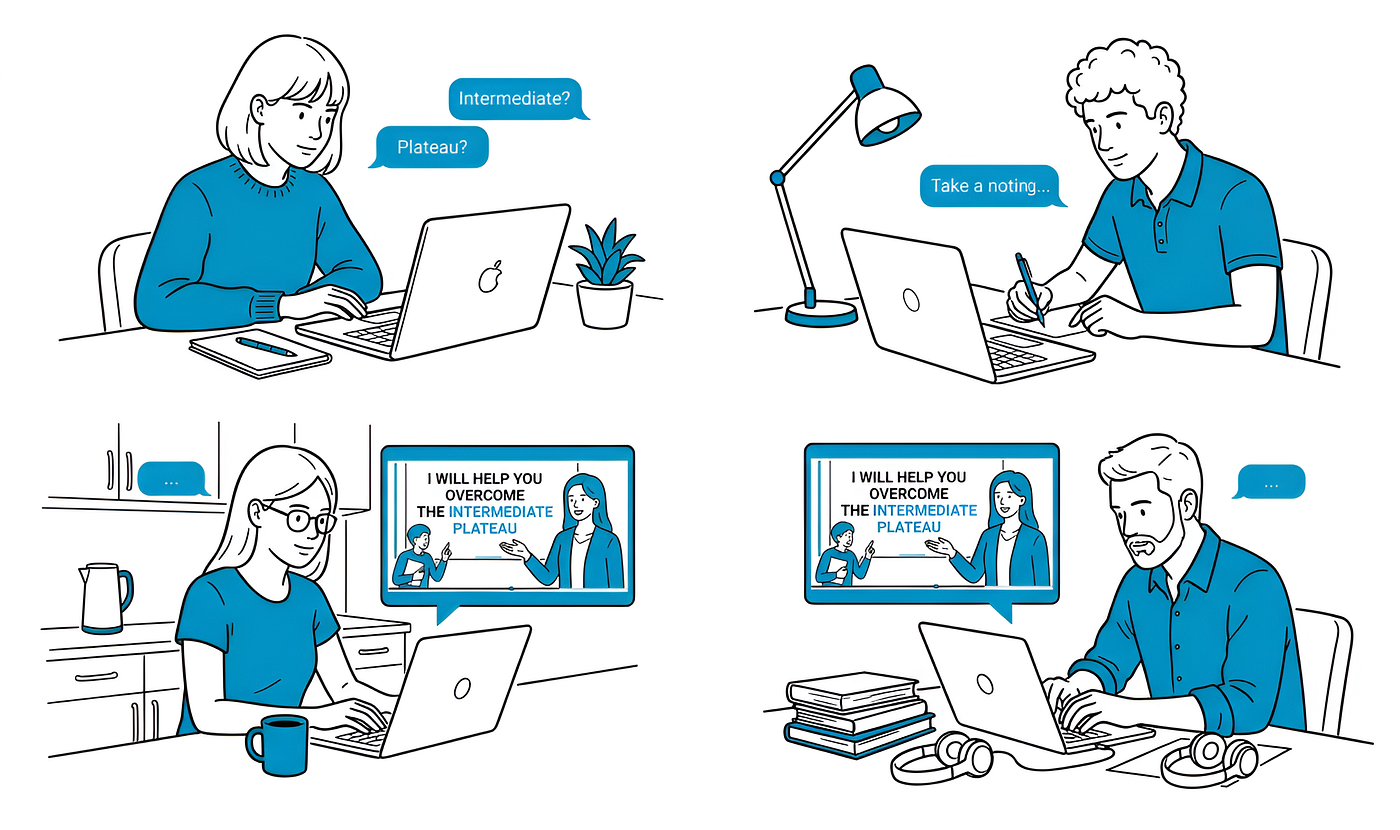
Image generated by the author with Gemini
80% of language learners quit before reaching fluency. Most of them quit at exactly the same stage — and nobody told them it had a name.
You’re not one of them.
You’re still here, still studying.
You opened this article to finally tackle that problem that’s been holding you back from chatting like a bird in French, German, or maybe another language entirely — the language itself doesn’t really matter.
What matters is that you’re ready to break through and actually start speaking.
You can survive a conversation, but you can’t yet own one. You understand maybe 70% of what native speakers say, and the other 30% is apparently where all the interesting things happen.
Most learners hit a wall around B1–B2. At B1, you can handle everyday conversations and understand most of what’s said, but speaking fluently in new situations feels hard. By B2, you can interact comfortably, yet gaps in vocabulary, idioms, and fast speech still block you.
This stage has a name: the intermediate plateau.
And it’s where language dreams go to die — unless you know what to do next.
Scary, right? I’m going to tell you exactly what to do.
For free.
Right now.
You’re Just at a Different Stage Now
I’ve been teaching Polish for over 8 years. My students arrive at the B1–B2 level with the same look, like someone who trained hard for a marathon and then showed up to find the finish line had moved.
The methods that carried them through the beginner stage worked beautifully for that stage.
Grammar tables, vocabulary apps, beginner podcasts — all great tools, all designed for a very specific window of learning.
At some point, that window closes, and the learner is left standing in front of a new door with the wrong key.
I know this from my own side too. Learning English, I remember the exact moment when flashcard apps and grammar exercises stopped feeling like progress.
I was learning about the language instead of actually using it.
Here’s what’s actually happening neurologically: your brain at the intermediate stage needs unpredictable, reactive, emotionally engaged output. You need to speak and write under pressure, make mistakes in real time, and get immediate feedback. The kind of practice that used to cost money — a tutor, a language exchange partner with a reliable schedule, a conversation class. A lot of money, often.
That barrier is now basically gone.
The Tool That Changes Everything
Modern AI language tools can do things that would have seemed ridiculous 5 years ago:
- Hold full voice conversations with you in English, Spanish, French, German, Italian, Portuguese, Polish, Japanese, Korean, Mandarin, Arabic, Turkish, Ukrainian — and adapt to your level mid-conversation.
- Correct your grammar in real time and actually explain the why.
- Role-play scenarios — a job interview in French, an argument with a landlord in Italian, small talk with a stranger in German.
- Analyse your writing for naturalness, register, and the kind of errors that textbooks never cover.
- Stay in character.
Tools like ChatGPT’s Voice Mode, Gemini Live, and chatbots like Character.ai can all do this.
Free tiers exist.
Your excuse budget just got significantly smaller.
AI will introduce you to that gap immediately and without mercy.
Practice. Step by Step
Here’s the exact weekly structure that moves the needle.
Ready?
One practical note before we dive in: if focus is a challenge, try the Pomodoro technique. Set a 25-minute timer. Then a 5-minute break. There are dozens of Pomodoro timer videos on YouTube with ambient sound and lo-fi music, depending on your vibe.
Pair one of those with a language session, and you’ve just turned what used to feel like a chore into something genuinely pleasant.
You have a choice — and choice is always awesome, isn’t it?
Choose one or better all together.
1. Every day — 25 minutes:
- Open your AI tool and start a voice or text conversation in your target language: one Pomodoro, one session.
- Set the context clearly upfront: “I’m B1 in Spanish. Let’s talk about my week. Correct my mistakes and explain them.”
- In the last five minutes, ask: “What grammar mistakes did I repeat most? Give me three examples with corrections.”
- That review at the end is where the real learning locks in — don’t skip it.
2. Three times a week — 25 minutes:
- Write a short paragraph on something uncomfortable — an opinion, a hypothetical argument.
- Ask the AI: “Edit this as a native speaker would. Explain every change you make.”
- Close the window. Rewrite it from scratch without looking at the corrections, then compare. The gap between your version and theirs is your current plateau — and it shrinks every time you do this.
3. Once a week — 25 minutes:
- Run a full scenario. “You’re a grumpy French bureaucrat. I need to extend my visa. Stay in character and don’t make it easy for me.” One focused Pomodoro of this is genuinely more valuable than an hour of passive listening.
- Record yourself during the scenario — a voice memo is enough. Listen back once. That discomfort is literally your brain rewiring.
As you can see, you have a choice: do everything, alternate, or mix it up.
Your choice: focus on speaking or just writing?
Do you want to speak confidently, or just have your mistakes corrected?
If you’re reading this article and you’ve already realized you’re stuck on the intermediate plateau, you probably already know the answer.
How to Talk to AI So It Actually Teaches You
Most people type “how do you say X” and wonder why it feels useless.
The trick is treating the AI like a demanding but patient tutor who happens to have infinite time and zero ego:
- “I’m B2 in German. Use vocabulary slightly above my level so I have to stretch — but correct me when I get lost.”
- “Don’t complete my sentences. Wait for me to finish, then give feedback.”
- “Give me three idioms a native French speaker would use here that I’d never find in a textbook.”
- “If I switch to English, respond only in Italian until I come back.”
For Romance language learners — Spanish, French, Italian, Romanian, Portuguese — that last instruction unlocks something surprisingly close to real immersion pressure. Your brain stops looking for the exit and starts solving the problem in the language.
Which is exactly the skill you’ve been trying to build.
Trust me.
And if you’re not sure which prompts work best for your learning, here’s a bonus for you:
[embed]How to Turn ChatGPT into a Language Tutor The R.A.C. formula that makes AI actually teachmedium.com
The One Thing Standing Between You and Fluency
25 minutes a day. That’s the whole answer.
The average person spends 2 hours and 27 minutes on social media daily. Somewhere inside that stretch of time, there are 25 minutes that could be in German, Japanese, or Polish instead.
You know exactly which 25 minutes I’m talking about.
The AI doesn’t cancel. It doesn’t judge your pronunciation or get bored when you ask it to explain the subjunctive for the fourth time. It’s available at 6 am, at midnight, and on Christmas.
The logistical barriers that used to make daily practice genuinely hard — they’re simply gone now.
Your next move (takes 3 minutes)
Open Claude, ChatGPT, or Gemini right now — whichever you have.
Type or say this:
I'm learning [language].
I'm at roughly [your level].
You are my [role, e.g., patient tutor, conversation partner, friendly native speaker].
Our context is [situation, e.g., a casual chat, a job interview, a travel scenario].
I want you to [action, e.g., correct my mistakes, suggest better ways to phrase things, give me idioms, stay in character].

Let me choose the topic: [I will give the topic, or you can suggest 2–3 options for me to pick from].
Speak naturally, respond as a native speaker would, and explain corrections briefly when needed.
That’s session one. Three minutes from now, you could already be in motion.
Eight years of teaching showed me one thing: the students who broke through the plateau were the ones who found a way to practice consistently, even imperfectly, even for 25 minutes, even when motivation was low.
The plateau is just a door you haven’t knocked on yet.
Knock! Knock!
메타데이터
- post_id
- 60aa0e6f3dc7
- slug
- how-to-break-through-the-intermediate-plateau-for-free-60aa0e6f3dc7
- url
- https://medium.com/language-mind/how-to-break-through-the-intermediate-plateau-for-free-60aa0e6f3dc7
- canonical_url
- https://medium.com/language-mind/how-to-break-through-the-intermediate-plateau-for-free-60aa0e6f3dc7
- author_url
- https://medium.com/@polskizleo
- status
- ok
- fetched_at
- 2026-06-12 07:40:50