The Triad Revolution: Seeing Reality Through Multiple Lenses
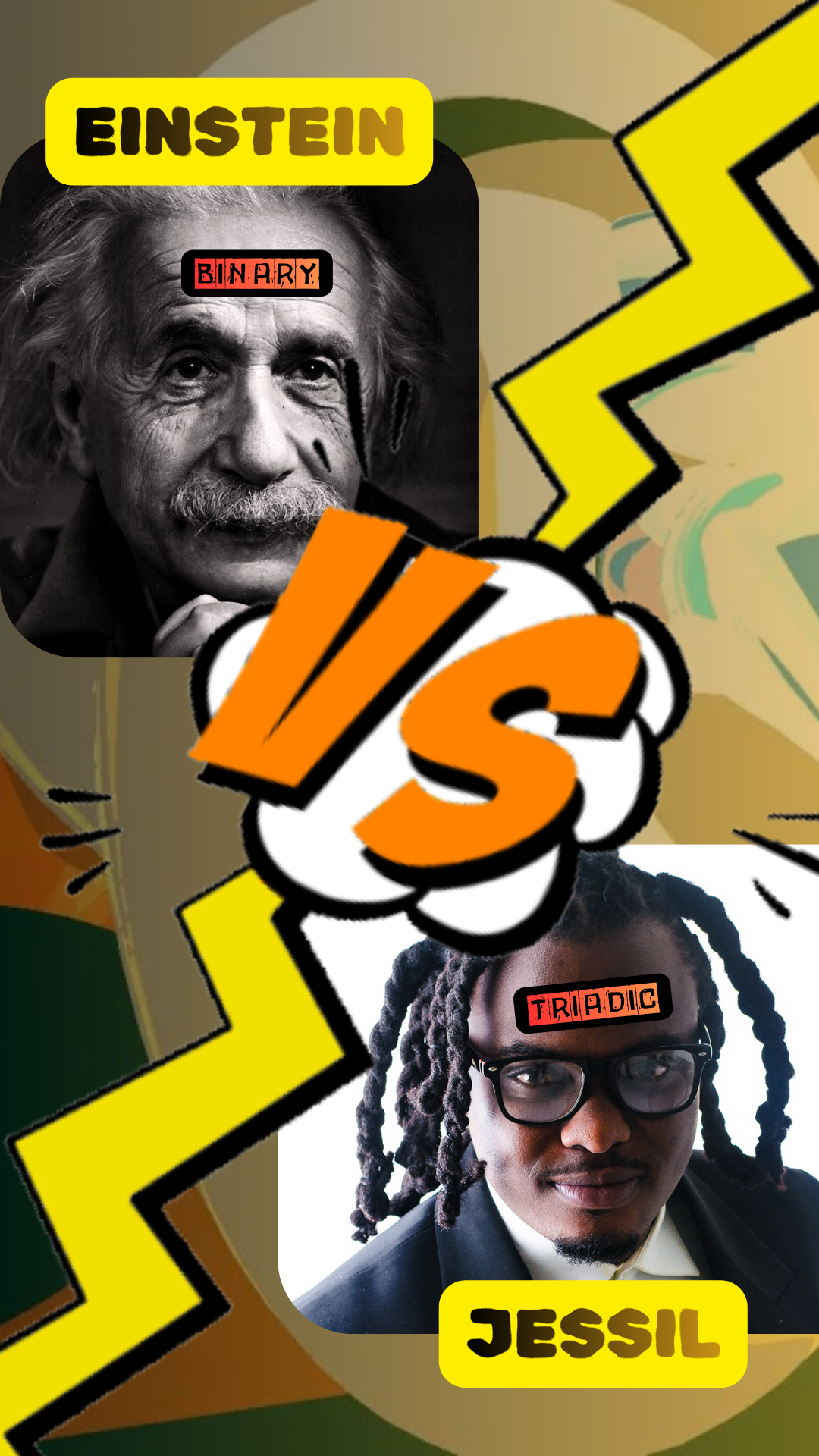
Binary frameworks are a cognitive and cultural shortcut. They are tools for efficiency, not truth.
The Triad Revolution: Seeing Reality Through Multiple Lenses
Binary frameworks are a cognitive and cultural shortcut. They are tools for efficiency, not truth.
· Binary Thinking asks: “Is it A or B?”
· Triadic Thinking asks: “What is the unique relationship between Source, Medium, and Receiver that makes this moment this and not that?”
No one operates in a binary: Emotions aren’t just happy/sad; they’re layered complexes. Motivation isn’t just lazy/productive; it’s a state influenced by energy, context, and meaning. A conversation isn’t just information transfer; it’s a dance of speaker, medium (words/intonation), and listener, each changing the other.
Structural Simplicity (Society’s Code): Legal systems (guilty/innocent), traditional gender roles, political binaries (left/right), even basic logic (true/false) are built for administrative ease and control. They create order, but at the cost of erasing spectra, nuance, and exceptions.
Prelude: The Instagram of Reality
Imagine if Instagram existed before science began. Instead of taking photos and applying one filter, we’d have captured everything every angle, every wavelength, every moment and saved the original. Then we’d create filters: a “Newton” filter that shows perfect mathematical motion, an “Einstein” filter that reveals how gravity bends space, a “Quantum” filter where everything dances with probability.
We don’t see reality. We see reality through something. Through our eyes (which only detect certain colors). Through our brains (which interpret based on experience). Through our theories (which focus on certain aspects and ignore others).
This is the starting point of Triad Theory.
Introduction: The Three Characters in Every Story of Reality
Every observation whether a scientist measuring a particle, a doctor diagnosing a patient, or you reading this sentence involves three inseparable characters:
The Three Players
- The Source: What you’re trying to observe (a star, an idea, a feeling)
- The Medium: The context it exists in (space, culture, language, air)
- The Receiver: Who’s observing (you, a camera, a measuring device)
Here’s the radical insight: These aren’t just passive roles they dance together. The medium changes what reaches you. Your expectations change what you notice. The act of observing changes what’s being observed.
The Simple Analogy: A Message Through Time
Think of ancient cave paintings:
· Source: The artist’s original intention and experience · Medium: The cave wall, 10,000 years of weathering, our modern perspective · Receiver: You, with your 21st-century brain
Do you see the original message? No. You see what survived the medium (time) filtered through your modern receiver (brain). This happens with everything we know.
Why This Matters Right Now
We’re drowning in information but starving for wisdom. We have:
· Climate models that disagree · Medical studies that contradict · News stories that show different realities
Triad Theory says: They’re all partially right, looking through different filters. The solution isn’t to find the “right” filter it’s to understand them all as perspectives.
The Core Idea: Filters, Not Facts
Traditional science works like this:
1. Have a theory 2. Design an experiment that tests it 3. Collect only the data that matters for that theory 4. Draw conclusions
This is like going to a concert with earplugs that only let through certain notes, then describing the music.
Triad Science flips the process:
1. Capture everything possible (all the notes, vibrations, emotions in the room) 2. Save the raw recording forever 3. Create filters that highlight different aspects 4. Compare what different filters reveal 5. Notice where filters disagree that’s where new understanding lives
Everyday Example: A Falling Leaf
Traditional view: Calculate its path using physics equations.
Triadic view(random examples):
· Raw capture: Video (all angles), sound, air currents, temperature, humidity, the tree’s health, seasonal patterns, nearby animals · Filter 1 (Physics): Predictable parabolic path · Filter 2 (Biology): End of life cycle, nutrient return · Filter 3 (Poetry): Beauty, impermanence, metaphor · Filter 4 (Ecology): Part of forest nutrient cycle
Which is “true”? All of them. They’re different perspectives on the same event.
The Practical Magic: Seeing Through Multiple Eyes
The Triad System I’m building works like this:
Step 1: The Reality Recorder
Imagine setting up 100 cameras around a phenomenon — not just visual cameras, but sensors for temperature, sound, vibration, electromagnetic fields, even quantum fluctuations. We record everything.
Step 2: The Filter Library
Like Instagram filters, but for understanding:
· Newton Filter: Shows clean mathematical motion · Chaos Filter: Reveals tiny differences that change everything · Quantum Filter: Shows probability waves · Ecology Filter: Shows connections to everything else · Your Custom Filter: Whatever perspective you want to try
Step 3: The Comparison Dashboard
You can:
· View all filters at once · See where they disagree (highlighted in red) · Watch how things look through different filters over time · Create hybrid filters (30% Newton, 40% Chaos, 30% Ecology)
Step 4: The “What Are We Missing?” Calculator
Every filter has a “Veiling Index” a number from 0–1 showing how much reality it ignores. High school physics has a high Veiling Index (it ignores air resistance, quantum effects, etc.). The system tells you what you’re not seeing.
Why This Changes Everything
For Science:
No more “my theory vs. your theory.” Now it’s “Let’s see what your filter shows that mine misses.”
For Medicine:
Instead of just blood tests, capture everything: genetics, environment, lifestyle, emotions, microbiome. Then apply different diagnostic filters.
For Society:
Understand that different political views are different filters on the same reality. The question becomes: “What does each filter reveal that others miss?”
For You Personally:
Realize that your perspective is a filter. You can consciously try other filters. Angry at someone? Apply the “They’re doing their best” filter. Stuck on a problem? Apply the “Beginner’s mind” filter.
The Simple Experiment You Can Try Now
The Triad Walk:
- Walk through your neighborhood
- First pass: Notice only colors (you’re the receiver, neighborhood is source, “color attention” is your filter)
- Second pass: Notice only sounds
- Third pass: Notice only textures
- Fourth pass: Notice how things are connected
You just experienced four different realities of the same place. Each was “true.” Each missed what the others captured.
That’s Triad Theory in practice.
The Triadic Reality System: A Comprehensive Implementation Plan
This revolutionary scientific framework called the Triadic Reality System (TRS) that treats all observations as filtered perspectives of raw reality streams. Unlike traditional scientific methods that begin with filtered data, TRS starts with maximal data capture and applies explicit, customizable filters creating a dynamic, multi-perspective understanding of phenomena.
*1. System Architecture (Work in progress): The Triad Stack*
Layer 0: The Raw Reality Stream
RRS = {Sₜ, Mₜ, Rₜ, Eₜ} for t = 0 → ∞
Where:
· Sₜ = Source state at time t (full quantum/classical description) · Mₜ = Medium state at time t (all contextual information) · Rₜ = Receiver state at time t (observer/instrument state) · Eₜ = Event at time t (what would be perceived with perfect instruments)
Implementation: Distributed sensor networks capturing data at highest possible resolution across all detectable dimensions.
Layer 1: The Triad Capture Engine
A real-time system that:
1. Ingests data from all available sensors 2. Time-synchronizes disparate data streams 3. Tags each data point with metadata about its source 4. Stores in a queryable “Reality Database”
Layer 2: The Filter Framework
Filter = { “id”: “newtonian_mechanics_v2.3”, “description”: “Classical mechanics approximation”, “kept_dimensions”: [“position”, “velocity”, “mass”, “force”], “discarded_dimensions”: [“quantum_fluctuations”, “air_molecules”, “observer_bias”], “transformations”: [“f=ma”, “vector_addition”], “assumptions”: [“c >> v”, “scale >> quantum”, “continuous_time”], “veiling_index”: 0.45, “applicability_score”: 0.92, “created_by”: “physics_department”, “version”: “2.3” }
Layer 3: The Perspective Engine
Generates multiple simultaneous views:
· Real-time filtering: Apply filters as data streams in · Temporal analysis: Compare filtered views across time · Comparative overlays: Visualize differences between filters · Anomaly detection: Identify where filters diverge significantly
Layer 4: The Interface Layer
A TikTok/Instagram-like interface for scientific exploration:
· Swipe between different theoretical filters · Layer multiple filters simultaneously · Animate through time with different filters applied · Share filter configurations and discoveries
2. Core Implementation: The Falling Leaf Example
Step 1: Maximal Capture Setup
SENSOR ARRAY FOR FALLING LEAF: ├── Physical Dimensions (30 sensors) │ ├── High-speed cameras (10,000 fps, 4K, multi-spectral) │ ├── LIDAR (sub-millimeter precision) │ ├── Quantum sensors (measure vacuum fluctuations) │ └── Material stress sensors (in ball and surface) ├── Environmental Dimensions (25 sensors) │ ├── Air flow sensors (3D turbulence mapping) │ ├── Temperature gradient mappers │ ├── Electromagnetic field sensors │ └── Acoustic sensors (ultrasonic to infrasonic) ├── Temporal Dimensions │ ├── Atomic clock synchronization │ └── Quantum-entangled timing (theoretical) └── Observer Dimensions ├── Biometric sensors on observers ├── Instrument calibration logs └── Historical context database
Step 2: Create Filter Library
FILTER LIBRARY STRUCTURE: ├── /filters/physics/ │ ├── newtonian_v1.json (keeps: mass, position, gravity) │ ├── aerodynamic_v2.json (+air drag, turbulence) │ ├── relativistic_v3.json (+time dilation, length contraction) │ └── quantum_gravity_experimental.json (all dimensions) ├── /filters/material_science/ │ ├── elasticity_v1.json (stress, strain, deformation) │ └── molecular_dynamics_v2.json (atomic interactions) ├── /filters/experimental/ │ ├── anomaly_detection.json (finds unexpected patterns) │ └── correlation_explorer.json (finds hidden relationships) └── /user_filters/ ├── custom_combination_1.json └── optimized_prediction_7.json
Step 3: The Multi-Perspective Analysis Dashboard
*REAL-TIME DISPLAY MODES:
- RAW VIEW: All sensor feeds simultaneously
- NEWTONIAN VIEW: Clean trajectory prediction (F=ma)
- AERODYNAMIC VIEW: Shows air vortices, drag effects
- QUANTUM VIEW: Shows probabilistic wavefunction evolution
- MATERIAL VIEW: Shows stress propagation through ball
- ANOMALY VIEW: Highlights where predictions diverge from reality
- CUSTOM VIEW: User-defined filter combination Step 4: Temporal Analysis Tools*
TIME-BASED ANALYSIS: ├── Animation Control: │ ├── Play/pause/reverse │ ├── Slow motion (10⁻⁹x to 1⁰⁹x speed) │ └── Frame-by-frame stepping ├── Comparison Mode: │ ├── Side-by-side different filters at same time │ ├── Overlay transparency adjustment │ └── Difference highlighting └── Statistical Analysis: ├── Prediction error over time for each filter ├── Veiling Index evolution during event └── Filter performance ranking by time segment 3. Technical Implementation Details
3.1 Data Pipeline Architecture
*1. Ingestion Layer:
- Apache Kafka clusters for real-time streaming
- 1 PB/second total ingest capacity
- Lossless compression with instant decompression*
*2. Processing Layer:
- NVIDIA quantum-classical hybrid processors
- Real-time filter application (sub-millisecond latency)
- Parallel processing of all filters simultaneously*
*3. Storage Layer:
- Quantum-encoded DNA storage for archival
- Holographic crystal storage for fast access
- Distributed blockchain for data integrity verification*
*4. Query Layer:
- Natural language interface: “Show me the ball’s fall through Newtonian, quantum, and aerodynamic filters from t=0 to impact”
- SQL-like syntax for advanced queries
- Machine learning query optimization*
3.2 The Filter Definition Language (FDL)
filter Quantum_Mechanical_View { version: “2.1” author: “Quantum Research Group”
// What to keep keep: { dimensions: [“position_probability”, “momentum_uncertainty”, “wavefunction_phase”], sensors: [“quantum_interference”, “entanglement_correlation”], time_resolution: “planck_time” }
// What to discard discard: { dimensions: [“definite_position”, “classical_trajectory”], assumptions: [“particle_ontology”, “deterministic_evolution”] }
// Transformations to apply transform: { method: “schrodinger_equation_solver”, parameters: { potential: “gravitational_field”, boundary: “experimental_chamber” } }
// Visualization settings visualize: { color_map: “probability_density”, opacity: “uncertainty”, animation: “wavefunction_collapse” }
// Metadata confidence: 0.78 last_calibrated: “2024–06–15” peer_review_score: 4.3/5.0 }
3.3 The Veiling Index Calculator
REAL-TIME VI COMPUTATION: function calculate_veiling_index(raw_data, filtered_view) { // Information-theoretic approach mutual_info = compute_mutual_information(raw_data, filtered_view); total_entropy = compute_shannon_entropy(raw_data);
// Dimensional reduction penalty dimensions_kept = count_dimensions(filtered_view); dimensions_total = count_dimensions(raw_data); dimension_ratio = dimensions_kept / dimensions_total;
// Temporal fidelity time_resolution_kept = get_time_resolution(filtered_view); time_resolution_raw = get_time_resolution(raw_data); time_fidelity = time_resolution_kept / time_resolution_raw;
// Composite Veiling Index VI = 1 — (mutual_info/total_entropy dimension_ratio time_fidelity calibration_factor);*
return VI; }
4. Scientific Workflow Revolution
Traditional Scientific Method:
Hypothesis → Design experiment (with built-in filters) → Collect filtered data → Analyze → Publish filtered results
Triadic Scientific Method:
**Phase 1: CAPTURE EVERYTHING
- Deploy maximal sensor array
- Record full reality stream
- Store in perpetually accessible Reality Database**
**Phase 2: FILTER EXPLORATION
- Apply multiple theoretical filters
- Compare predictions
- Identify anomalies and edge cases
- Calculate Veiling Indices for each filter**
**Phase 3: THEORY EVOLUTION
- Modify filters based on discrepancies
- Create new filters for unexplained phenomena
- Share filter improvements globally**
**Phase 4: KNOWLEDGE SYNTHESIS
- Understand which filters work when and why
- Build meta-understanding of reality’s structure
- Create adaptive filter systems for real-world applications**
Current Science:
· Data: Collected through pre-filtered instruments · Analysis: Single theoretical framework applied · Publication: Filtered results without context of alternatives · Reproducibility: Difficult due to hidden filtering choices
Triadic Science:
· Data: Raw reality stream preserved forever · Analysis: Multiple filters applied simultaneously · Publication: Filter configurations + results + alternatives · Reproducibility: Perfect anyone can apply any filter to raw data
The Triadic Manifesto for Science
- Capture First, Filter Second: Never discard data you don’t understand
- Multiple Realities Coexist: Different filters reveal different aspects
- Transparency in Filtering: Always document what you’re ignoring
- Evolution Through Discrepancy: When filters disagree, knowledge grows
- Democratize Perspective: Make all filters accessible to all researchers
- Quantify Ignorance: Veiling Index measures what we’re missing
- Embrace Perspective Stacking: Combine filters for deeper understanding
The Vision: A New Relationship with Reality
The Triadic Reality System isn’t just another scientific tool it’s a fundamental shift in how we interact with reality. Instead of asking “What theory is correct?” we ask:
“Which collection of filters gives the most useful perspective for this particular question at this particular time?”
We move from:
· Certainty → Contextual confidence · Single truth → Multiple complementary perspectives · Theory wars → Filter optimization · Hidden assumptions → Explicit filtering choices · Fragmented knowledge → Unified perspective framework
The ultimate goal: A global, living library of reality streams and filters where anyone can explore any phenomenon through any theoretical lens where science becomes not a search for The Answer, but an ongoing, participatory exploration of reality’s infinite facets.
We don’t discover reality. We choose how to dance with it.
Although this document serves as the comprehensive implementation plan for the Triadic Reality System. The revolution begins not with a new equation or billions of dollars , but with a new way of looking and a commitment to preserve what we’ve been trained to ignore.
Conclusion: Joining the Dance
We’ve been taught to search for The Single Truth. Triad Theory says: There are many truths, different perspectives on the same reality. The goal isn’t to find the one right view it’s to understand the dance between:
· What exists (Source) · The context it exists in (Medium) · How we perceive it (Receiver)
The system I’m building makes this explicit:
- Capture more (save the raw reality)
- Filter intentionally (choose your perspective consciously)
- Compare generously (learn from what other filters show)
- Stay humble (every view misses something)
This isn’t just another theory. It’s a new relationship with reality one that embraces complexity rather than fearing it, that sees disagreement as different camera angles rather than battles to be won.
The most exciting part? You’re already using Triad Theory every day. Every time you consider another person’s perspective, every time you realize your mood colors your experience, every time you understand that the same event looks different to different people you’re dancing with the triad.
The system I’m building just makes the invisible filters visible, so we can choose them wisely rather than being trapped in them unknowingly.
Where This Leads
Imagine a world where:
· Scientists share not just conclusions but their filter settings · News articles show not just one angle but multiple filtered views · You can toggle between how an expert, a beginner, an optimist, or a skeptic sees a situation · We measure not just what we know but how much we’re ignoring
That world starts with a simple recognition: We never see reality naked. We always see it dressed in some filter.
The question isn’t whether to use filters we can’t help it. The question is: Which filters will we choose? And will we have the humility to try on someone else’s?
That’s the Triad Revolution. Not a new answer, but a new way of asking questions. Not a final theory, but an infinite conversation with reality.
And you’re invited to join.
Next Steps for the Curious:
- Try the Triad Walk today
- Notice one situation where changing your “filter” changes what you see
- Ask someone: “What filter are you using right now?”
- Remember: Every argument is between people using different filters. The solution isn’t to prove yours right it’s to understand what theirs reveals that yours misses.
Welcome to the dance of perspectives. Welcome to Triad Theory.
Love Jessil
Follow me on
Instagram @ Dr.Jessil
메타데이터
- post_id
- 637d4bd5a7d4
- slug
- the-triad-revolution-seeing-reality-through-multiple-lenses-637d4bd5a7d4
- url
- https://medium.com/@jessilmoore/the-triad-revolution-seeing-reality-through-multiple-lenses-637d4bd5a7d4
- canonical_url
- https://medium.com/@jessilmoore/the-triad-revolution-seeing-reality-through-multiple-lenses-637d4bd5a7d4
- author_url
- https://medium.com/@jessilmoore
- status
- ok
- fetched_at
- 2026-07-13 09:09:44