Questions I Have About “Ex-Gay” Ministries
Notice I didn’t say ‘answers’
Questions I Have About “Ex-Gay” Ministries
Notice I didn’t say ‘answers’
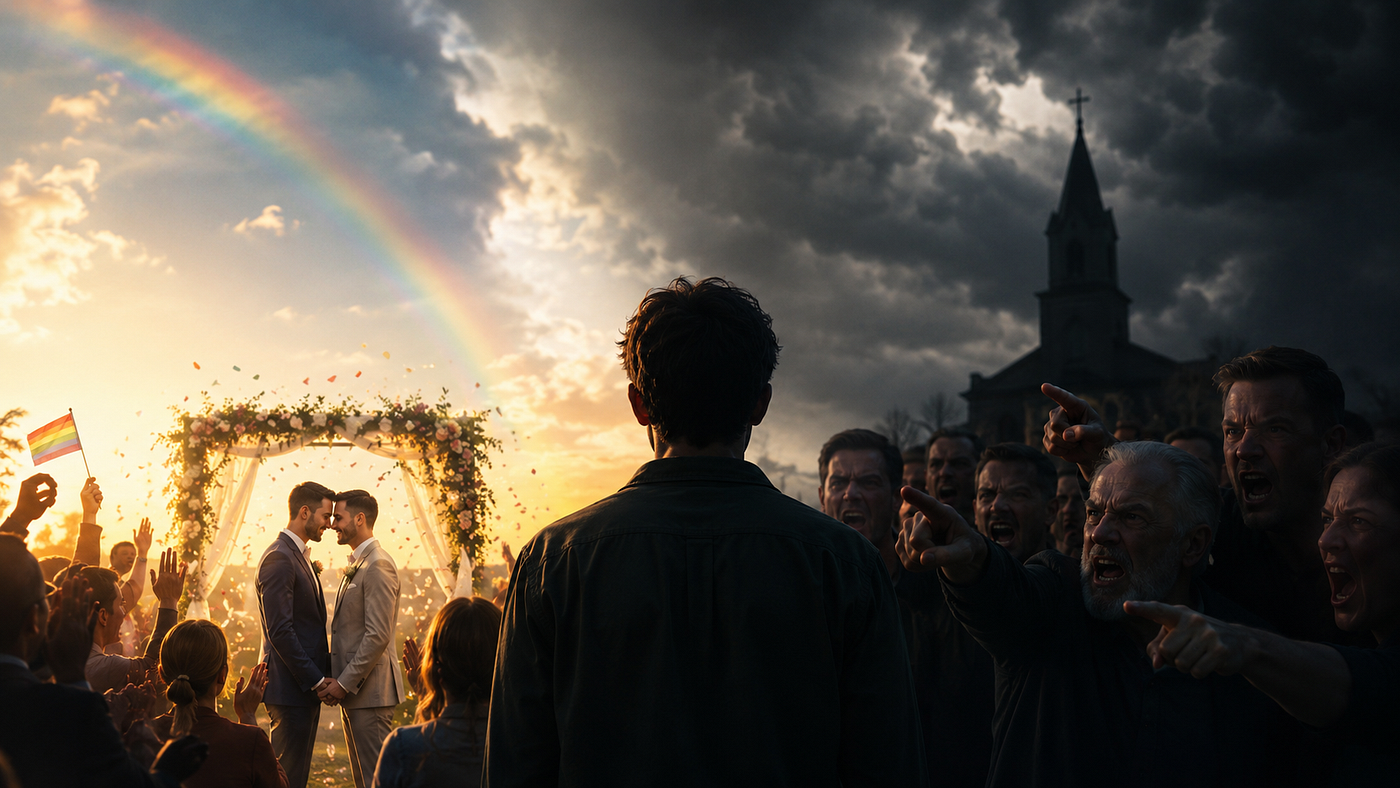
Photo by Artem Maltsev on Unsplash
Content warnings for religious trauma, mental health issues, and spiritual abuse.
My background and why I am so interested
I’ve been interested in ex-gay issues for probably about thirty years now. I first heard of them on an episode of Sally Jessy Raphael. When I was a kid in the 90s, days off from school were pretty much structured around daytime talk shows and Sally started us off at nine and ten am.
One morning, she had ex-gay members on her show claiming to be cured.
As someone growing up in a religious family and beginning to realize I wasn’t straight, I was fascinated by this concept and knew then that I wanted to write about it. Although I had no idea how.
Not only am I from a religious family, but I also grew up in a very Christian area. My town had three Baptist churches, two different kinds each of Lutheran and Methodists, two Catholic Churches and two Mormon temples. We even had a Kingdom Hall for the Jehovah’s Witnesses. It was the kind of school where you were asked if you were Christian or Catholic and where people told you that you were going to Hell for the wrong answer.
Oh, and telling people they’re going to hell isn’t judgement.
As a result, I got very good at arguing about the Bible at a really young age, mostly thanks to my parents. I am literally the child of an English teacher and theology major. We even had Bible trivia around the dinner table when my sister and I were growing up.
In community college, I knew LGBT people who were Christian and queer. It wasn’t until I came to university and found a larger LGBT world that I found the really strong anti-Christian bias in queer media. And it really bothered me. For me, the tension between core identities was painful and deeply personal. It wasn’t an eighty-three-minute movie with super obvious answers.
It was in response to this simplification of life changing decisions that I wrote the first version of my ex-gay play as an undergrad. It was a one act play performed as my Honor’s thesis about a college student in ex-gay ministry and his conflicts when he falls in love with a classmate.
After presenting another play with LBGT+ and Christian themes at an academic conference in early 2020 — when conferences were still possible — I later expanded my one act and incorporated it into a larger project of short plays about LGBT Christians in the US in the first twenty years of the 21st century.
For my research over the fifteen-ish years that I was directly working on this play, I’ve read the material put out by the organizations themselves, survivors, and queer people who are believers in these programs.
Despite decades of research into as many sides of this issue as possible, there are still many questions for me that I just cannot answer.
My main question is where does it come from?
Let’s start with the biggest picture questions.
According to Inside Ex-Gay:
“‘Ex-gay’ is a conservative religious response to same-sex attraction that has become popular in recent decades. Ex-gay can be defined as ‘any form of psychotherapy, counselling or pastoral care, whether formal or informal, that assumes that same-sex attraction is a disorder requiring treatment’”.
Missing for me is what are the theological underpinnings of ex-gay ministries? Not the handful of Bible verse that are used to defend them, but what is the theological logic that makes people think that sexuality can be changed or redirected?
There is so much fear at the root of these organizations. What are people in this world so afraid of and where is that fear coming from?
And why do ex-gay ministries and programs persist, even when they have failed time and time again to produce the advertised results? When founders have shut down their own ministries and declared them failures?
Exodus International, one of the largest ex-gay programs in the world, with a revenue estimated in the millions, closed down in 2012 when its cofounders came out as still gay.
Other leaders such as McCrae Game have come out as gay themselves and admitted failure.
But that hasn’t stopped the ex-gay movement. Groups such as Changed Ministries and Living Hope take advantage of social media, networking, and contemporary language to continue the legacy of older ministries.
CCN has a long article on the resurgence of these programs from October of 2025 Conversion therapy: Inside the dangerous resurgence of ‘ex-gay’ treatment | CNN .
Within the piece they also detail many of the dangers associated with these programs such as higher rates of depression and suicide ideation.
Why is the next one always going to be different?
One obvious question
One thing you notice right away is that almost no women are being saved from the horrors of homosexuality.
Why is it mostly men?
So much of the ex-gay rhetoric, especially in more evangelical circles, is about reclaiming masculinity. There is such an emphasis on the performance of masculinity that in extreme cases followers are urged to cut off contact with female friends and even female relatives to avoid becoming too feminine.
One question that I have always had is why is being a gay man so much worse than being a lesbian woman?
In Mormon and Catholic worlds, where there is less emphasis on complete change and more on control and learning to live with unwanted same sex attraction (SSA) as you would any other disability — I have heard it compared to being born blind or being born with missing limbs — you see more women represented but still far fewer and far less visibly than men.
Why is it so much more important for men to be saved?
Questions of abuse
Why does it continue when governing bodies consider it spiritual abuse?
Both the American Medical Association and the American Psychological Association have declared it dangerous and unethical.
Many survivors and trauma therapists call it spiritual abuse because it uses religion to isolate already vulnerable people, control their time, and uses fear of spiritual consequences to control behavior.
(For a more in-depth discussion of spiritual abuse in general, check out What Is Spiritual or Ritual Abuse? — Freedom Charity)
Between credible accusations of abuse and lack of successful outcomes, why do leaders feel that this actually helpful in the face of overwhelming contradictory evidence?
Why are there are still people who join?
One question that I have been fascinated with — in an almost obsessive way at times — is the minds and souls of the queer people who will defend these groups.
What is the psychology of gay people who participate in and support these programs?
Again, what is it that they are so afraid of? And why?
Many of the earlier pioneers, such as Game and the former leaders interviewed in the CNN article, came of age in the first waves of the AIDS crisis. Homosexuality was literally a death sentence when they were young. Others tell stories of losing friends to suicide or homophobic violence.
Many originally came to these ministries looking to help others and heal themselves.
But as I said, many of them have since admitted that these programs don’t work, so what is driving people now?
A point we don’t always like to make
I know from my own experience that part of what drives queer people into these programs is not just lack of welcome in queer communities, but often outright hostility. I’ve felt the rage that many have queer people have towards organized religion directed at the nearest targets, which sometimes happens to be other queer people who are in just as much as pain as they are.
Add in the movies, TV shows, and humor of queer spaces where Christians are greedy, repressed, unintelligent, superstitious stereotypes, and many Christian queer people get the message loud and clear that they are not welcome here either.
And one question that I have never even heard asked is what happens when the ex-gay therapy stops working but there is no space for queer Christians in the larger queer communities?
What are the choices?
Reparative and conversion therapies should be banned for minors, full stop. It has been overwhelmingly proven by every credible psychological, psychiatric, and pediatric governing body to be damaging to young people.
With adults, it’s greyer. There should be ways to protect young adults (18–25) who are dependent on parents or other family members for health insurance, educational funding, or food and shelter. This vulnerability leads to many being coerced into these therapies.
For adults in their thirties and older, it becomes really complicated. Blog after book after testimony tells of men who are deeply wounded by childhood abuse, childhood sexual abuse, drug use, abusive romantic relationships, and rejection from both religious and queer communities.
For many of them reparative therapy, or groups like Courage in the Catholic Church, were the first time they had access to mental health services and certainly the first time they had access to mental health services that affirmed their religious identities.
And some of them, many of them, do feel genuinely helped by these ministries. At least for a while.
I don’t judge anyone who leaves religious institutions of any kind. So many of them have been used to abuse and exploit people or to cover that abuse and exploitation. Religion, spirituality, faith, all of those must be personal choices freely made. Thus, the same grace must be given to those who choose to stay in organized religion, if it’s a choice they make and not coerced by social and family pressure.
We cannot control the souls of other people. We should extend to others the grace we wish extended to ourselves.
Some further reading:
Exodus International — Wikipedia
메타데이터
- post_id
- 64280330ce9e
- slug
- questions-i-have-about-ex-gay-ministries-64280330ce9e
- url
- https://medium.com/backyard-theology/questions-i-have-about-ex-gay-ministries-64280330ce9e
- canonical_url
- https://medium.com/backyard-theology/questions-i-have-about-ex-gay-ministries-64280330ce9e
- author_url
- https://medium.com/@dominicsmishler
- status
- ok
- fetched_at
- 2026-07-23 10:07:59