The Toy That’s Actually Making Your Puppy Bite More
You bought it to stop the mouthing but It’s doing the opposite. Here’s why — and what to use instead.
The Toy That’s Actually Making Your Puppy Bite More
You bought it to stop the mouthing but It’s doing the opposite. Here’s why — and what to use instead.
Photo by Nihar Reddy Jangam on Unsplash
Most new puppy owners go through the same phase. The biting starts, someone on a forum says “redirect to a toy,” you buy a toy, you try to redirect to the toy, and somehow the biting gets worse. Or the toy works for thirty seconds, then the puppy drops it and goes straight back to your hands.
So you buy a different toy. Maybe a squeaky one this time, or a rope or one of those long fleecy things that’s meant to keep them occupied. And it works, briefly, until it doesn’t. And you end up with a basket of toys that all had a thirty-second window and a puppy who still thinks your wrists are fair game.
Here’s what nobody tells you, it’s not the toy. It’s what the toy is doing to the energy in the room and some toys are making that energy worse, not better.
The arousal problem hiding in your toy basket
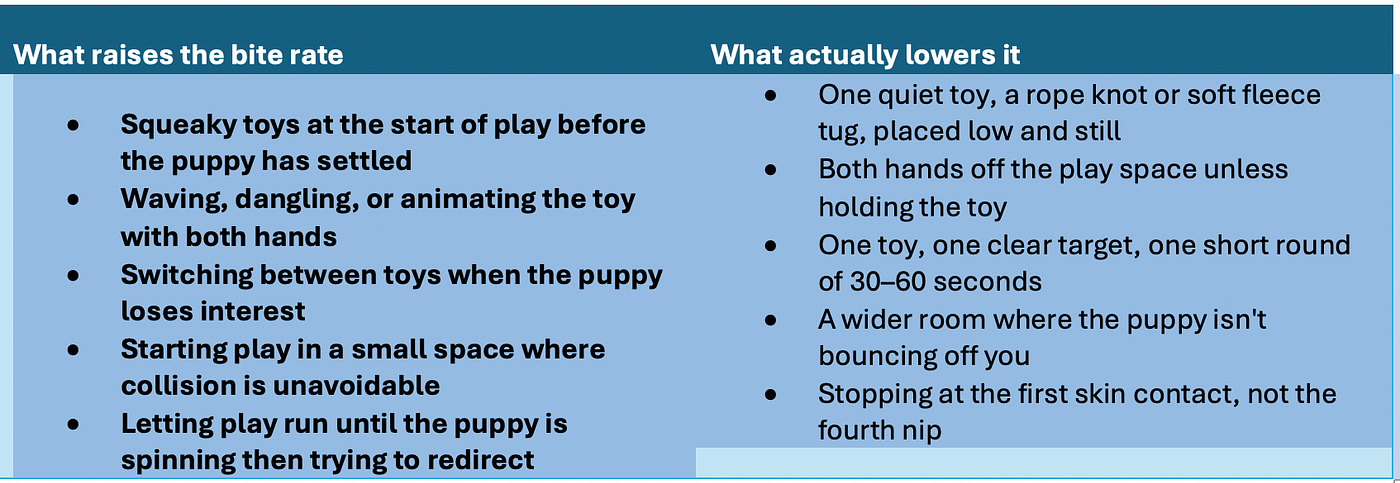
A squeaky toy does something specific to a puppy’s nervous system. The sound triggers the prey instinct, the same response that makes them chase, grab, and shake. That’s fun to watch, and it’s genuinely satisfying for the dog, but it also raises arousal, fast. And a puppy that was already wound up when play started is now more wound up, not less.
Then the toy gets boring because novelty wears off in about thirty seconds at that level of stimulation and the puppy looks around for the next moving target, which is you!
“The toy didn’t fail. It did exactly what it was designed to do. The timing was the problem, not the object.”
The same thing happens with anything that moves fast, makes noise, or involves you waving your hands around to make it interesting. The more you animate the toy, the more the toy becomes an extension of you and hands become part of the game by association. Your fingers, cuffs, sleeves, all of it starts to look like the toy.
What you’re doing with your hands is the actual problem
Think about how play usually starts in your home. Genuinely think about the physical sequence.
The puppy is already excited. You reach for a toy. The puppy sees your hand moving toward the toy basket and lunges. You try to get the toy out while also managing the puppy’s mouth. You’re now holding the toy in one hand, and your other hand is somewhere waving, steadying, gesturing and the puppy is trying to work out which moving thing to go for first.
This isn’t the puppy being chaotic. This is the puppy doing exactly what a fast-moving, stimulating, unpredictable environment tells them to do. Your hands are part of the game. They’ve always been part of the game. And the toy you introduced never gave a clear enough signal that they weren’t.
The “boring toy” principle and why it works
The cleaner start to play is almost insultingly dull. One toy held low and still, not thrown, not waved, not animated. Just placed in the puppy’s eye line as an obvious, available target and then left there while you keep the rest of your body quiet.
A puppy with a clear target is a puppy that isn’t hunting for one. When the first moving object they encounter is a rope knot at ground level and nothing else is moving, they go for the rope knot, teeth stay on the toy. You stay intact.
What the first 60 seconds of play should look like
You pick up one fleece tug before the puppy sees it. You lower it to the ground, hold it still, and let the puppy find it. They engage with the toy. You keep both hands on it but don’t wave or pull dramatically. Just enough resistance to make it satisfying. After 30–60 seconds, you stop. You don’t restart immediately. You wait for the mouth to soften before the next round begins.
This feels wrong at first because it feels boring — for you. But the puppy’s nervous system doesn’t need more stimulation. It needs a clear enough signal that it can stop hunting and start playing. There’s a difference. Hunting is frantic and escalating. Playing is engaged and manageable. The boring toy start is how you get from one to the other.
The rule that stops most mouthing within a week
Stop at the first skin contact not the second or after the puppy has really ramped up. Just the first.
This is the rule that most people know and almost nobody applies consistently, because the first contact is usually soft and easy to ignore. It’s a little nibble or a gentle mouth on a knuckle. Not painful, not dramatic, so play continues. And the puppy learns that the threshold for stopping is somewhere above that somewhere they’ll discover later. When they’re more wound up and the contact is harder to ignore, the session is already out of hand.
Stop at the first encounter very time. The game becomes boring the moment teeth touch skin. Stand up, look away, ten seconds of nothing. Then offer the toy again. You’re not punishing, you’re removing the reward for a specific behaviour. The feedback is immediate and completely clear. Most puppies get it within a few sessions. Not because they’ve been corrected, but because the pattern has changed enough that the old behaviour stops producing anything interesting.
The rule of 3 first touches — apply this today
Touch 1: Toy goes down first. Hands stay still. Puppy finds the toy.
Touch 2: Hands only move to hold the toy. Nothing else moves.
Touch 3: First skin contact = game stops, immediately every time.
If the puppy targets fabric twice in one session, reset before the next round and don’t push through it hoping they’ll tire out.
The toy you use matters less than you think. The timing of when you introduce it, the stillness of your hands when you do, and the consistency of stopping at first contact, those three things will do more than any toy purchase ever could.
The basket full of squeaky things isn’t the answer. One quiet toy, the right timing, and a clear rule about when play ends, THAT'S IT. The mouthing softens faster than most people expect, usually within the first week of doing this consistently, because the puppy finally has enough structure to play with instead of against.
The full five-method guide is on available.
The **Calm Puppy Bitting Before Play** covers how to set up the first minute of play, what to do at the hallway, how to handle the park crowd, and the reset sequence that stops a biting spiral mid-session. All in one short, practical ebook written for real home routines, not a training paddock.
메타데이터
- post_id
- 66b4364b68ff
- slug
- the-toy-thats-actually-making-your-puppy-bite-more-66b4364b68ff
- url
- https://medium.com/the-polished-paw/the-toy-thats-actually-making-your-puppy-bite-more-66b4364b68ff
- canonical_url
- https://medium.com/the-polished-paw/the-toy-thats-actually-making-your-puppy-bite-more-66b4364b68ff
- author_url
- https://medium.com/@fevzbest
- status
- ok
- fetched_at
- 2026-06-13 12:55:53