How Black Holes Grow Into Galactic Giants
The heavens are signs to reflect upon. Modern astronomy studies those signs and finds enormous black holes millions to billions of times…
How Black Holes Grow Into Galactic Giants
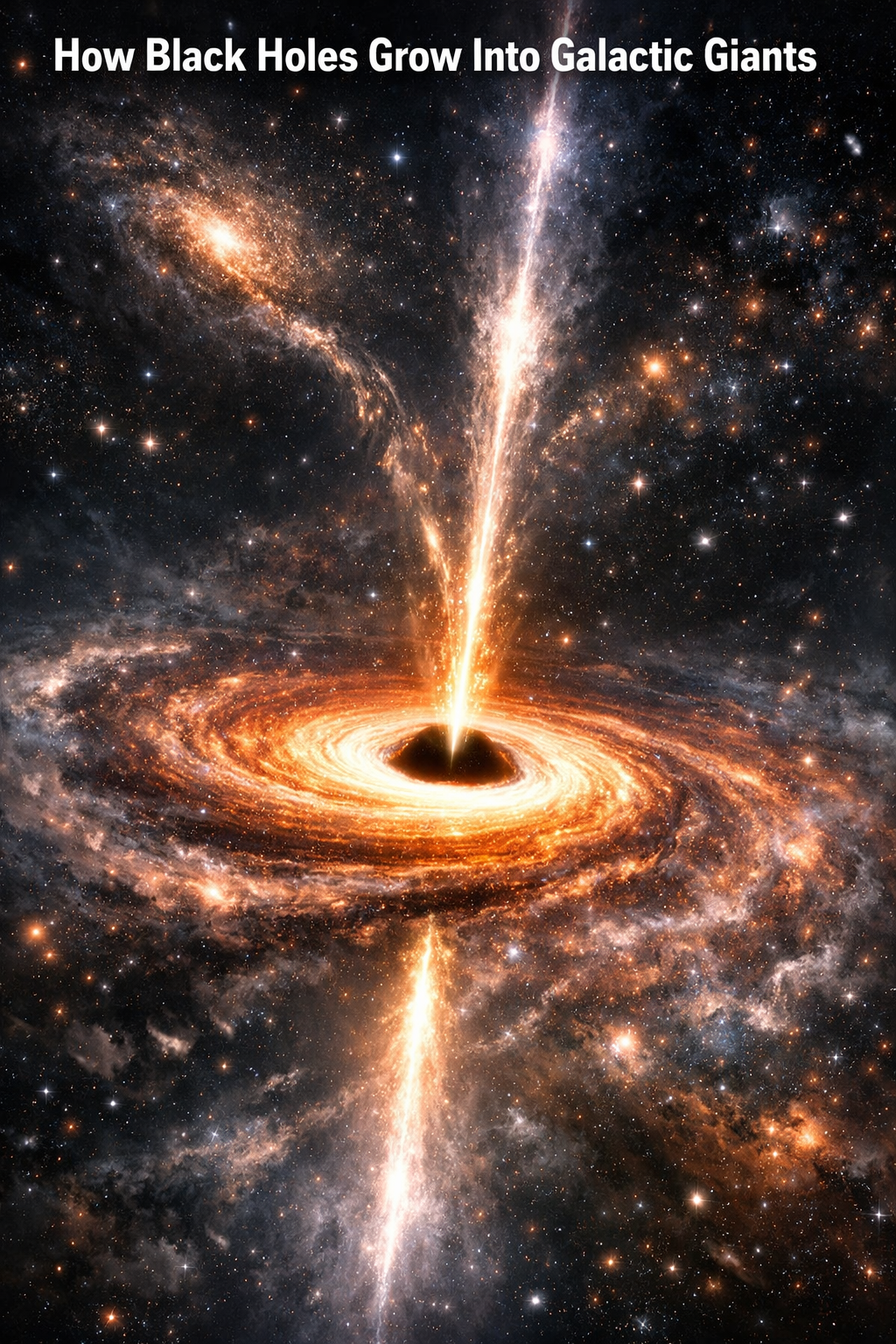
The heavens are signs to reflect upon. Modern astronomy studies those signs and finds enormous black holes millions to billions of times the Sun’s mass anchoring the centers of most large galaxies. They are not just curiosities; they help shape the galaxies around them. Science offers working models for how these giants grow, while ultimate knowledge belongs to Allah, and our understanding remains humble and provisional.
The seeds: how the first black holes began
Stellar remnants: The first generations of massive stars ended as black holes tens to hundreds of solar masses. With steady nourishment, such seeds can grow rapidly. Direct collapse: In special early environments with intense radiation and quiet turbulence, pristine gas may have collapsed directly into black holes of ~100,000 solar masses — head starts that help explain the earliest bright quasars. Dense star clusters: Runaway collisions in compact clusters can form intermediate‑mass black holes that later migrate to the center. Feeding the giants: gas, stars, and timing Black holes grow mainly by accretion gas spirals inward through a disk, heats up, and shines as an active galactic nucleus (AGN). Sometimes growth is steady; sometimes it surges in bright quasar phases. Key ideas:
Eddington limit: Radiation pushes back on infalling gas. This sets a typical “speed limit” for luminous growth, though short super‑Eddington episodes may occur. Fuel delivery: Galaxy mergers, bar instabilities, and tidal torques channel gas from kiloparsec scales down to the central parsec. At earlier times, cold streams along the cosmic web likely fed the cores efficiently. Hidden growth: Much accretion is dust‑obscured. X‑rays and infrared observations reveal buried AGN that optical telescopes miss. Mergers: when black holes join forces Galaxies often merge; their central black holes sink to the middle and eventually coalesce. The final plunge emits a burst of low‑frequency gravitational waves. Future space‑based detectors (like LISA) aim to “listen” to these events, turning distant mergers into precise tests of gravity and growth histories.
Feedback: the give‑and‑take with galaxies Growing black holes do not only consume they also influence their surroundings:
Quasar winds: Fast outflows can sweep gas from galactic centers, regulating star formation and preventing runaway growth. Radio jets: In massive halos and clusters, jets heat hot gas and carve cavities, preventing the gas from cooling too quickly. This helps explain why some giant galaxies are “quenched.” The M–σ relation: The tight correlation between black‑hole mass and a galaxy’s bulge velocity dispersion suggests long‑term co‑evolution — gravity and feedback maintaining balance (mizan) at galactic scales.
What observations are teaching us now
Event‑horizon imaging: The Event Horizon Telescope revealed the shadows of M87 and Sagittarius A, confirming strong‑gravity predictions and letting us probe accretion physics near the point of no return. Early growth with JWST: Infrared spectra show vigorous star formation and active black holes when the universe was very young, indicating efficient feeding and perhaps massive seeds. Gas flows with ALMA and Chandra: Cold inflows, warm outflows, and hot halos can be mapped together, giving a full picture of fueling and feedback. Why this matters Understanding how black holes grow helps explain when galaxies light up, when they rest, and how structure remains balanced over time. The picture that emerges invites awe and responsibility: creation is ordered, and our task is to seek beneficial knowledge with humility, remembering that the unseen is known to Allah alone.
Looking ahead
Deeper surveys, sharper images, and gravitational‑wave astronomy will link seeds to giants across cosmic time. As methods improve, our models will be refined step by step while we keep our reflections grounded in gratitude and care.
If you enjoyed this article, you can support me via crypto tips: 0xa67c656cdff6c636ea3c533fdd7c8e9bcd70afde
Writers, bring your chaos, your charm, and your half-baked drafts — ***Beyond Lines*** is ready for the beautiful mess. Let’s publish it!
메타데이터
- post_id
- 7393befec8bd
- slug
- how-black-holes-grow-into-galactic-giants-7393befec8bd
- url
- https://medium.com/beyond-lines/how-black-holes-grow-into-galactic-giants-7393befec8bd
- canonical_url
- https://medium.com/beyond-lines/how-black-holes-grow-into-galactic-giants-7393befec8bd
- author_url
- https://medium.com/@khurram002
- status
- ok
- fetched_at
- 2026-07-13 19:45:42