[LATEST] How I Passed the Claude Certified Architect Exam on My First Attempt + Complete Resources…
If you’re planning to take the Claude Certified Architect (CCA) exam in 2026, this article will give you everything you need, the exact…
[LATEST] How I Passed the Claude Certified Architect Exam on My First Attempt + Complete Resources & Step-by-Step Guide
If you’re planning to take the Claude Certified Architect (CCA) exam in 2026, this article will give you everything you need, the exact resources I used, a step-by-step preparation plan, what the exam actually tests, and the key mistakes to avoid. No need to hunt across scattered forums, GitHub repos, or YouTube videos. I’ve compiled it all here in one place.

Gave exam on 26th June, received Certificate on 4th July
Hello everyone!
My name is Jiten Bhalavat, and I recently passed the Claude Certified Architect-Foundations (CCA-F) exam on my very first attempt.
In this article, I’ll walk you through my entire journey, from understanding the exam structure to the exact resources I used, how I prepared, and the study strategy that worked for me.
If you’re planning to take the CCA-F exam, don’t worry, I’ll break everything down step by step. By following this guide, you can realistically prepare for the exam in just 5 days, spending only 5–6 hours per day.
Let’s get started!
What is the CCA-F Exam?
On March 12, 2026, Anthropic launched the Claude Certified Architect — Foundations (CCA-F) exam, making it the first official technical certification from a frontier AI company that goes beyond prompt-writing tutorials. It was launched as part of Anthropic’s $100 million Claude Partner Network investment.
This is not a completion badge you earn by clicking through slides. It is a closed-book, proctored, scenario-based exam that tests whether you can make the right architectural decisions when building production-grade Claude systems at enterprise scale.
The CCA-F validates your ability to design, deploy, and maintain production-grade applications using the Claude ecosystem — including the Claude Agent SDK, Claude Code, and the Model Context Protocol (MCP). It is an architecture-level credential that tests system design decisions, not everyday Claude usage or prompt trivia.
The exam is hosted on Anthropic’s Skilljar training platform ( also now on Pearson Test centre ) and is currently available through the Claude Partner Network, which any organization can join for free. The first 5,000 partner company employees get the $125 exam fee waived entirely. Broader public access is expected later in 2026.
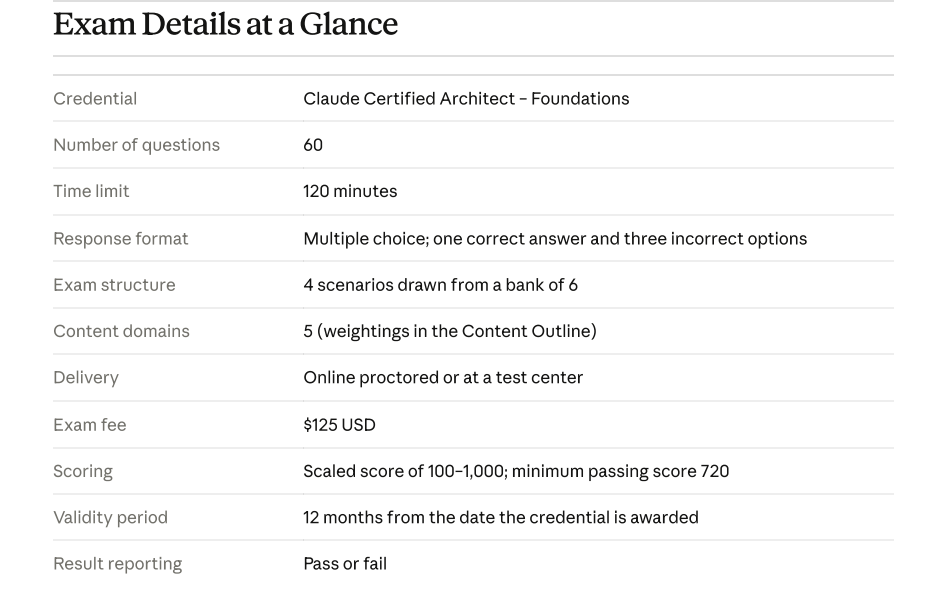
The format is 60 scenario-based multiple-choice questions, 120 minutes, with a passing score of 720 out of 1,000. Recommended experience is at least 6 months of hands-on work with the Claude API and Claude Code.
Understanding the Exam Pattern (Updated for July 2026)
Before jumping into the preparation strategy, let’s first understand what the Claude Certified Architect — Foundations (CCA-F) exam actually looks like. Anthropic recently updated the certification format, so if you’re reading older blogs or watching outdated YouTube videos, some of the information may no longer be accurate.
Here’s the latest exam structure as of July 2026:
Exam Format, Scoring & How to Register
In this section, I’ll explain the exam format, how the scoring system works, and the complete registration process so you know exactly what to expect before exam day.
Question Format
All 60 questions on the CCA-F exam are multiple choice, one correct answer and three distractors. The distractors are intentionally crafted to seem plausible, so you can’t rely on surface-level familiarity. Every question must be answered before you can move forward; the platform doesn’t allow skipping.
How You Can Take the Exam
As of July 4th, 2026, Anthropic moved the CCA-F exam from its original Skilljar + ProctorFree setup onto Pearson VUE. This means you now have two options:
- Online proctored: take it from home via Pearson VUE’s OnVUE platform under live supervision. No Claude, no documentation, no browser tabs. A room sweep is real, so prep your space in advance.
- Test center: visit a physical Pearson VUE test center near you for an in-person proctored experience.
Both options are fully closed-book. The knowledge has to be internalized, no shortcuts.
Exam Fee
The exam fee is now $125 USD, up from the original $99, paid through Anthropic Partner Academy before you’re directed to Pearson VUE to schedule. Partner discounts scale with your Claude Partner Network tier
Scoring
Your results are reported as a scaled score from 100 to 1,000. The minimum passing score is 720. Scaled scoring is used to ensure fairness, meaning your score is adjusted relative to the difficulty of the specific exam version you received, so a harder exam won’t unfairly penalize you compared to an easier one. The result is simply pass or fail.
Validity Period
The certification is valid for 12 months from the date you earn it, and you can renew with a free, non-proctored assessment on Partner Academy. This is an upgrade from the original 6-month validity period at launch.
Retake Policy
You can retake the exam up to 4 times per rolling 12 months. The waiting periods increase with each failed attempt: 14 days after the first fail, 30 days after the second, and 90 days after the third. Each retake requires the full exam fee.
[ IMPORTANT ]
Who Can Register? Eligibility & How to Sign Up
This is where most people get tripped up. The exam is currently gated through the Anthropic Partner Network.
The CCA-F is gated through the Anthropic Partner Network, which Anthropic announced on March 12, 2026 alongside a $100M commitment to partner-led delivery. If your employer is listed as a partner, your work email triggers an attestation flow on Skilljar. If your employer is not listed, you currently cannot register and the path is to wait for general access.
Here’s the step-by-step registration flow:
- Join the Claude Partner Network: Any organization actively building with Claude can apply for free at
claude.com/partners. Individual access is expected to open broader later in 2026. - Sign up on Anthropic’s Skilljar platform — Use your corporate email (personal emails are rejected). Complete the prerequisite Anthropic Academy courses.
- Submit the attestation form — Fill in your full name, company, and role, and acknowledge the partner agreement. Submission typically triggers an entitlement email within 1–3 business hours.
- Pay and schedule on Pearson VUE — Once confirmed, you’ll be directed to Pearson VUE to book your slot either online or at a test center.
Note: Broader public access is widely expected later in 2026, but no official timeline has been confirmed. If you’re an individual without a qualifying organization, you can still start the free Anthropic Academy preparation courses immediately.
The 5 Exam Domains & Their Weightings
The CCA-F exam is divided into five core domains, each covering a different aspect of building production-ready AI applications with Claude. Every domain carries a different weightage, so it’s important to understand what concepts are tested and where you should spend most of your preparation time.
In the following sections, I’ll explain each domain, what it covers, and the key topics you should focus on before taking the exam.
Domain 1: Agentic Architecture & Orchestration — 27%
This is the heaviest domain and the one most candidates find the hardest. It covers how you design and implement agentic loops, orchestrate multi-agent systems using coordinator-subagent patterns, manage session state, handle task decomposition, and enforce multi-step workflows. The core mental model you need to internalize is the agentic loop: send request → check stop_reason → execute tool → return result → repeat.
Domain 2: Tool Design & MCP Integration — 18%
This domain tests your ability to design effective MCP tool interfaces — writing clear, differentiated tool descriptions, handling structured error responses, distributing tools correctly across agents, and integrating MCP servers into Claude Code and agent workflows. A big focus here is on how tool descriptions directly drive tool selection reliability.
Domain 3: Claude Code Configuration & Workflows — 20%
Everything about configuring Claude Code for real team environments. This includes CLAUDE.md hierarchy (user, project, directory levels), path-specific rules using .claude/rules/ with glob patterns, custom slash commands and skills, when to use plan mode vs direct execution, and how to integrate Claude Code into CI/CD pipelines.
Domain 4: Prompt Engineering & Structured Output — 20%
This domain covers designing precise prompts with explicit criteria, applying few-shot prompting for consistency, enforcing structured output using tool_use with JSON schemas, implementing validation and retry loops, batch processing strategies using the Message Batches API, and multi-pass review architectures.
Domain 5: Context Management & Reliability — 15%
The smallest domain by weight but critically important in practice. It covers preserving critical information across long conversations, designing escalation and ambiguity resolution patterns, error propagation across multi-agent systems, managing context in large codebase exploration, human review workflows with confidence calibration, and maintaining information provenance in multi-source synthesis.
These five domains form the foundation of the CCA-F exam, and together they test whether you can design, build, and deploy production-ready AI systems using Claude. While some domains carry more weight than others, I highly recommend studying all five, as questions often combine concepts from multiple domains within the same scenario.
Now that you have a clear understanding of what each domain covers, let’s look at the scenario-based format of the exam and the types of real-world problems you can expect to solve during the test.
The Six CCA-F Scenarios: What You’ll Actually Be Tested On
The CCA-F exam is scenario-based, meaning every question is grounded in a realistic production context.
Note: The official exam blueprint describes that the exam consists of 4 scenarios randomly selected from a bank of 6 scenarios. Anthropic does not publicly disclose the exact six scenarios, so the list below reflects the six scenario categories candidates commonly encounter rather than official scenario titles.
Scenario 1: Customer Support Resolution Agent
You’re building a customer support agent using the Claude Agent SDK. It handles messy, high-ambiguity requests — returns, billing disputes, account issues — using MCP tools like get_customer, lookup_order, process_refund, and escalate_to_human. The target is 80%+ first-contact resolution while knowing exactly when to hand off to a human.
Core domains tested: Agentic Architecture, Tool Design & MCP Integration, Context Management & Reliability
Scenario 2: Code Generation with Claude Code
Your team uses Claude Code daily for code generation, refactoring, debugging, and documentation. You need to integrate it into your development workflow using custom slash commands, CLAUDE.md configurations, and understand when to use plan mode versus direct execution.
Core domains tested: Claude Code Configuration & Workflows, Context Management & Reliability
Scenario 3: Multi-Agent Research System
You’re building a coordinator-subagent research system where one agent searches the web, one analyzes documents, one synthesizes findings, and one generates reports — all orchestrated together to produce comprehensive, cited research outputs on any given topic.
Core domains tested: Agentic Architecture, Tool Design & MCP Integration, Context Management & Reliability
Scenario 4: Developer Productivity with Claude
You’re building tools to help engineers navigate unfamiliar codebases, understand legacy systems, generate boilerplate, and automate repetitive tasks. The agent uses Claude’s built-in tools — Read, Write, Bash, Grep, Glob — alongside MCP server integrations.
Core domains tested: Tool Design & MCP Integration, Claude Code Configuration & Workflows, Agentic Architecture
Scenario 5: Claude Code for CI/CD
You’re integrating Claude Code directly into your CI/CD pipeline for automated code reviews, test case generation, and pull request feedback. The challenge here is designing prompts that produce actionable, structured output while minimizing false positives that erode developer trust.
Core domains tested: Claude Code Configuration & Workflows, Prompt Engineering & Structured Output
Scenario 6: Structured Data Extraction
You’re building a system that extracts structured information from unstructured documents, validates outputs against JSON schemas, and handles edge cases gracefully. Accuracy and downstream system integration are the key concerns.
Core domains tested: Prompt Engineering & Structured Output, Context Management & Reliability
The key takeaway? No scenario lives in just one domain. Every scenario overlaps across multiple competency areas, which is exactly why surface-level knowledge won’t cut it, you need to think like a production architect, not just a Claude user.
How to Prepare for the CCA-F Exam
Before diving into resources and study plans, let’s be honest about one thing: how long you need to prepare depends entirely on where you’re starting from.
Track 1: You Already Build with Claude (5–7 Days)
If you’ve already built applications with Claude or have hands-on experience with Agentic AI, Claude Code, and the Claude API, you can realistically prepare for this exam in 5–7 days, studying just 2–3 hours per day. Since the exam focuses on architectural decision-making rather than memorization, your practical experience will give you a significant advantage.
To comfortably prepare in 5–7 days, you should already be familiar with topics such as:
- Building agents using the Claude Agent SDK
- Agentic loops and stop_reason (
tool_usevs.end_turn) - Multi-agent architectures, coordinator–subagent patterns, and task delegation
- Model Context Protocol (MCP), including MCP tools, resources, and server integration
- Claude Code, including CLAUDE.md, custom commands, skills, rules, and plan mode
- Error handling, escalation strategies, and human-in-the-loop workflows
If this is you, the exam is largely formalizing knowledge you’ve already built in production. Your preparation is mostly about learning Anthropic’s specific terminology, understanding the exact scenario types on the exam, and filling in any gaps across the five domains.
Track 2: You’re New to Claude & Agentic AI (2+ Months)
If you’re completely new to Claude, Agentic AI, MCP, or Claude Code, don’t expect to pass by studying for only a week. This certification is designed to evaluate real-world engineering judgment, not just theoretical knowledge. In that case, spend a few weeks, or even a couple of months, building hands-on projects, experimenting with Claude Code and the Agent SDK, and understanding how these concepts work together before scheduling the exam.
Before you even think about exam prep, you need to build a genuine foundation in:
- How LLMs work: context windows, tokens, stop reasons, system prompts
- Claude API basics: making API calls, handling responses, tool use
- What agents are: agentic loops, tool calling, when to use agents vs. simpler patterns
- MCP (Model Context Protocol): what it is, how tools and resources work, how to configure MCP servers
- Claude Code: how to use it,
CLAUDE.mdconfiguration hierarchy, plan mode vs. direct execution - Multi-agent systems: coordinator-subagent patterns, context passing, error propagation
Before You Start Studying — Know What’s NOT on the Exam
One of the biggest time-wasters when preparing for any certification is studying topics that simply won’t appear. The official exam guide is very explicit about what’s out of scope, so let’s save you that time upfront.
The following topics will NOT be tested on the CCA-F exam:
- Fine-tuning Claude models or training custom models
- Claude API authentication, billing, or account management
- Detailed implementation of specific programming languages or frameworks (beyond what’s needed for basic tool and schema configuration)
- Deploying or hosting MCP servers — infrastructure, networking, container orchestration
- Claude’s internal architecture, training process, or model weights
- Constitutional AI, RLHF, or safety training methodologies
- Embedding models or vector database implementation details
- Computer use — browser automation or desktop interaction
- Vision and image analysis capabilities
- Streaming API implementation or server-sent events
- Rate limiting, quotas, or API pricing calculations
- OAuth, API key rotation, or authentication protocol details
- Specific cloud provider configurations — AWS, GCP, or Azure
- Performance benchmarking or model comparison metrics
- Prompt caching implementation details (beyond knowing it exists)
- Token counting algorithms or tokenization specifics
The takeaway? Don’t go down rabbit holes on LLM internals, infrastructure setup, cloud deployments, or model training. The exam is purely focused on how you design, configure, and architect production systems using Claude, not how Claude works under the hood or how you deploy the servers that run it.
Now that you know what to skip, let’s talk about what actually matters.
Day 1: Complete the Official Anthropic Academy Courses
Before jumping into practice questions or the exam guide, your first day should be spent going through the official free courses on Anthropic Academy (Skilljar). These courses are designed by Anthropic themselves and give you the conceptual foundation you need before anything else.
The good news? All four courses are completely free and open to everyone, you don’t need partner access to start learning.
Here are the four courses to complete on Day 1:
1. Building with the Claude API 🔗 anthropic.skilljar.com/claude-with-the-anthropic-api
This is the flagship course and arguably the most important one. It covers how to make API calls, handle responses, work with tool use, manage conversation history, and understand stop reasons like tool_use and end_turn. If you only do one course, make it this one.
2. Claude 101 🔗 anthropic.skilljar.com/claude-101
A foundational overview of Claude — how it works, what it can do, and how to think about prompting and model behavior. If you’re already experienced with Claude, this will be a quick refresher. If you’re newer, this sets the right mental model before diving deeper.
3. Claude Code in Action 🔗 anthropic.skilljar.com/claude-code-in-action
This course covers Claude Code hands-on — how to use it effectively, how CLAUDE.md configuration files work, plan mode vs. direct execution, custom slash commands, and integrating Claude Code into real development workflows. Domain 3 of the exam (worth 20%) is built directly around this content.
4. Introduction to Agent Skills 🔗 https://anthropic.skilljar.com/introduction-to-agent-skills
This course walks you through how agentic systems are built using the Claude Agent SDK — agentic loops, tool calling, subagent spawning, and multi-agent coordination patterns. Domain 1 is the heaviest domain at 27%, and this course lays the groundwork for it.
5. Introduction to MCP 🔗 https://anthropic.skilljar.com/introduction-to-model-context-protocol
A dedicated course on the Model Context Protocol — what it is, how MCP tools and resources work, how to configure MCP servers, and how they integrate into Claude Code and agent workflows. Domain 2 (Tool Design & MCP Integration, 18%) pulls heavily from this content.
A note on time: These courses can be completed in a single focused day if you already have some background in AI. If you’re newer to the concepts, take an extra day and don’t rush — understanding these courses deeply is more valuable than finishing them quickly.
Day 2 & 3: Master the 27 Technical Primitives from 5 Domains
Once you’ve completed the official Anthropic Academy courses, the next two to three days should be spent going deep on the 27 technical primitives, the exact building blocks the CCA-F exam tests on.
A great free resource for this is **claudearchitectcertification.com/concepts**, which breaks down all 27 concepts domain by domain with diagrams, code examples, exam traps, and anti-pattern callouts. It’s independent and not affiliated with Anthropic, but it’s one of the most structured concept references available for this exam.
Domain 1 — Agentic Architecture & Orchestration (27%) · 7 Concepts
- D1.1: Agentic Loops
- D1.2: Subagents
- D1.3: Stop Reason
- D1.4: Session State & Persistence
- D1.5: Human-in-the-Loop Escalation
- D1.6: Subagent State Handoff
- D1.7: Agent Instruction Files (CLAUDE.md / AGENTS.md)
Domain 2 — Tool Design & MCP Integration (18%) · 5 Concepts
- D2.1: Tool Calling
- D2.2: Tool Choice
- D2.3: Model Context Protocol (MCP)
- D2.4: SDK Hooks (PreToolUse / PostToolUse)
- D2.5: Tool Evaluation & Testing
Domain 3 — Claude Code Configuration & Workflows (20%) · 4 Concepts
- D3.1: CLAUDE.md Hierarchy
- D3.2: Plan Mode
- D3.3: Skills
- D3.4: Checkpoints & Session Management
Domain 4 — Prompt Engineering & Structured Output (20%) · 9 Concepts
- D4.1: System Prompts & Instructions
- D4.2: Prompt Caching
- D4.3: Message Batches API
- D4.4: Structured Outputs
- D4.5: Vision & Multimodal
- D4.6: Streaming
- D4.7: Attention Engineering
- D4.8: 4D Framework
- D4.9: Prompt Engineering Techniques
Domain 5 — Context Management & Reliability (15%) · 2 Concepts
- D5.1: Context Window Management
- D5.2: Case Facts Block
How to approach these two days:
Don’t try to memorize everything, focus on understanding the tradeoffs. For every concept, ask yourself: when would I use this? What’s the wrong way to do it? What does the exam consider an anti-pattern? That’s exactly how the questions are structured.
Day 4 & 5: Mock Exams, Gap Analysis & Final Revision
By this point, you’ve completed the official Anthropic Academy courses and worked through all 27 technical primitives. Now it’s time to pressure-test your knowledge.
Step 1: Take a Full Mock Exam
Don’t treat mock exams as a formality. Sit down, set a 120-minute timer, and simulate real exam conditions, no notes, no tabs, no Claude. The goal is not just to see your score, but to understand why you got things wrong.
A great starting point is **claudearchitectcertification.com/concepts** — the same platform you used for the 27 primitives. Each concept module on this platform comes with its own MCQs. If you’ve been solving those as you go, you already have a head start. Now take the full timed simulation to see where you actually stand.
MOCK EXAM RESOURCES:
- Official Guide with Examples: HERE
- Anthropic Official Practice Exam: Available through Anthropic Academy (score 900+ before taking the live exam)
- https://examlab.net/en/certs/anthropic/cca-f/exam
- https://claudecertprep.com/
- https://www.anthropiccertifications.com/exam
- https://claudecertificationguide.com/mock-exam
- https://ccaf.cyberskill.world/
Well, that’s it! These are all the resources I used to prepare for the Claude Certified Architect-Foundations (CCA-F) exam.
If you go through these resources sincerely, understand the concepts instead of just memorizing them, and spend some time practicing with Claude Code and the official documentation, you’ll be in a very strong position to pass the exam. In my opinion, you won’t need to look anywhere else, these resources cover everything you need for the CCA-F.
The Golden Rule: Most people who pass on their first attempt follow this exact loop: Study concepts → Take mock exam → Identify weak spots → Revise → Repeat
Don’t schedule your real exam until you’re consistently scoring 85% or above [850–900+/1000] on mock exams. That buffer gives you enough room to handle the plausible distractors on the real thing.
Conclusion: Is the CCA-F Worth It?
If you’ve read this far, you already know the answer.
The Claude Certified Architect — Foundations is not just another AI badge. It’s Anthropic’s official signal to the industry that you can design, build, and operate production-grade Claude systems, not just use the chat interface. In a market flooded with people who claim AI expertise, this certification is one of the few credentials that actually filters for real architectural depth.
I hope this guide saves you dozens of hours of searching and helps you prepare more efficiently. Best of luck with your exam.
If you found this guide helpful, consider sharing it with someone who’s preparing for the Claude Certified Architect — Foundations (CCA-F) exam.
And if this guide helped you pass the exam, I’d really appreciate it if you came back to this article and leave a comment about your experience. Reading your success stories and feedback motivates me to create more in-depth guides like this. Also follow me on Medium and LinkedIn
Best of luck with your preparation, and I’ll see you on the other side as a Claude Certified Architect! 🚀
메타데이터
- post_id
- 8afd320512d3
- slug
- latest-how-i-passed-the-claude-certified-architect-exam-on-my-first-attempt-complete-resources-8afd320512d3
- url
- https://ai.gopubby.com/latest-how-i-passed-the-claude-certified-architect-exam-on-my-first-attempt-complete-resources-8afd320512d3
- canonical_url
- https://ai.gopubby.com/latest-how-i-passed-the-claude-certified-architect-exam-on-my-first-attempt-complete-resources-8afd320512d3
- author_url
- https://medium.com/@infinityai
- status
- ok
- fetched_at
- 2026-07-08 23:38:59