How First-Time Founders Should Actually Decide: Raise, Bootstrap, or Both
It starts innocently. You have a product, a few early customers, and a growing conviction that this thing could be real. And then almost…
How First-Time Founders Should Actually Decide: Raise, Bootstrap, or Both

It starts innocently. You have a product, a few early customers, and a growing conviction that this thing could be real. And then almost automatically a voice inside your head starts composing the pitch deck.
Not because someone told you to. Not even because you’ve done the math. Just because that’s the story you’ve absorbed about how startups work. You build something, you raise money, you grow fast, you raise again. Repeat until exit. The venture path feels less like a choice and more like the default script, that the one every conference panel, every founder podcast, and every breathless funding announcement has been quietly reinforcing.
Most first-time founders and I include my past self in this — don’t question the script soon enough. We conflate raising with progress, and dilution with ambition. We sign up for a governance structure, a pace requirement, and a specific definition of “winning” before we’ve honestly asked whether that definition fits the company we’re actually trying to build.
This post is about making that choice consciously. The capital decision isn’t really about money. It’s about the kind of company you’re choosing to become ..and in 2026, with AI having fundamentally compressed the cost of building and shipping a real product, you have more options than the script suggests. What follows is a framework for choosing the right one.
The Three Capital Paths in 2026
Every founder has access to roughly three capital architectures. The choice isn’t just financial — it’s psychological and strategic.
The Venture Path is built for speed and story. It works best when you’re in a winner-take-all or winner-take-most market, when your competitive moat requires infrastructure that costs more than revenue can fund in time, and when your exit scenario is a large acquisition or public offering. The psychological profile that fits it: founders who are comfortable with board governance, quarterly pressure, and a governance relationship that intensifies at every round. Raise well and execute, and venture capital is not just capital — it’s a signal, a network, and a forcing function for operational discipline.
The Revenue Path — sometimes called bootstrapping, though that undersells its sophistication and is built for control and durability. It works best when your unit economics are healthy from early on, your sales cycle is short enough that revenue compounds without external fuel, and your market doesn’t require you to be everywhere at once. The psychological profile: founders who derive genuine satisfaction from building a business, not just a company, and who are willing to grow at the pace the market will fund.
The Hybrid Path — what I call strategic capital with staged dilution and is increasingly how sophisticated first-time founders are approaching this. It combines an early, smaller raise (often pre-seed or seed with a tight SAFE structure) with a deliberate plan to hit revenue milestones before the next dilutive event, sometimes supplementing growth with revenue-based financing or venture debt. The goal isn’t to avoid all dilution; it’s to delay dilution until your leverage is highest.
What the ecosystem rarely teaches is that choosing between these paths is not a decision about ambition. It’s a decision about fit.
When the Path Chooses You ⚠️
Before you run any framework, a harder question: do you actually have a choice?
The three paths above assume optionality. Not every founder has it. If you’re building in a regulated market fintech, health, insurance — compliance infrastructure alone may price you out of the revenue path before you start. If you’re in hardware, deep tech, or any model with a long pre-revenue phase, bootstrapping isn’t a philosophy; it’s a slow exit by another name. If you’re operating in a geography where VC coverage is thin — parts of Eastern Europe, much of Africa, most of Southeast Asia outside Singapore — the venture path may not be available on terms worth taking.
And then there’s the question most frameworks are too polite to ask: what is your personal financial runway? A founder with a mortgage, dependents, and no savings cannot bootstrap the same way as someone with zero liabilities and six months of reserves. The market condition tells you which path is theoretically correct. Your personal balance sheet tells you which path you can actually survive long enough to execute.
Check both before you run the Capital Fitness Test below. The right answer on paper only counts if you can stay in the game long enough to act on it.
The Dilution Math They Don’t Show You 💰
Here’s what the standard venture-backed founder journey actually looks like and not just the pitch deck version, but the cap table version.
Two founders start at 100%. A 10% option pool gets carved out on day one, so the real starting point is already 90%. At seed, the investor takes ~20%, and the pool gets refreshed — priced pre-money, not post-money. That distinction matters: pre-money pricing means existing shareholders, not incoming investors, absorb the pool dilution. Based on Carta’s analysis of over 50,000 startups, the median founding team holds around 56% after a priced seed round.⁴
Series A takes another ~18–20%, with another pre-money pool top-up.⁴ The founders are now around 36% and no longer a majority, and the board dynamic has shifted substantively.¹³ᵃ Series B brings a further ~15–17% dilution. By close, the founding team collectively holds around 23%.¹³ᵃ By Series C, that’s typically 13–16%. By Series D, founders hold just 11–12% on average — meaning investors control approximately 88% of the company they helped build.¹³ᵃ
Three rounds in, and you may own less than a quarter of the company you started. The table below maps how it compounds:
📊 The Founder’s Equity Journey: Seed → Series D (Illustrative Two-Founder Model)
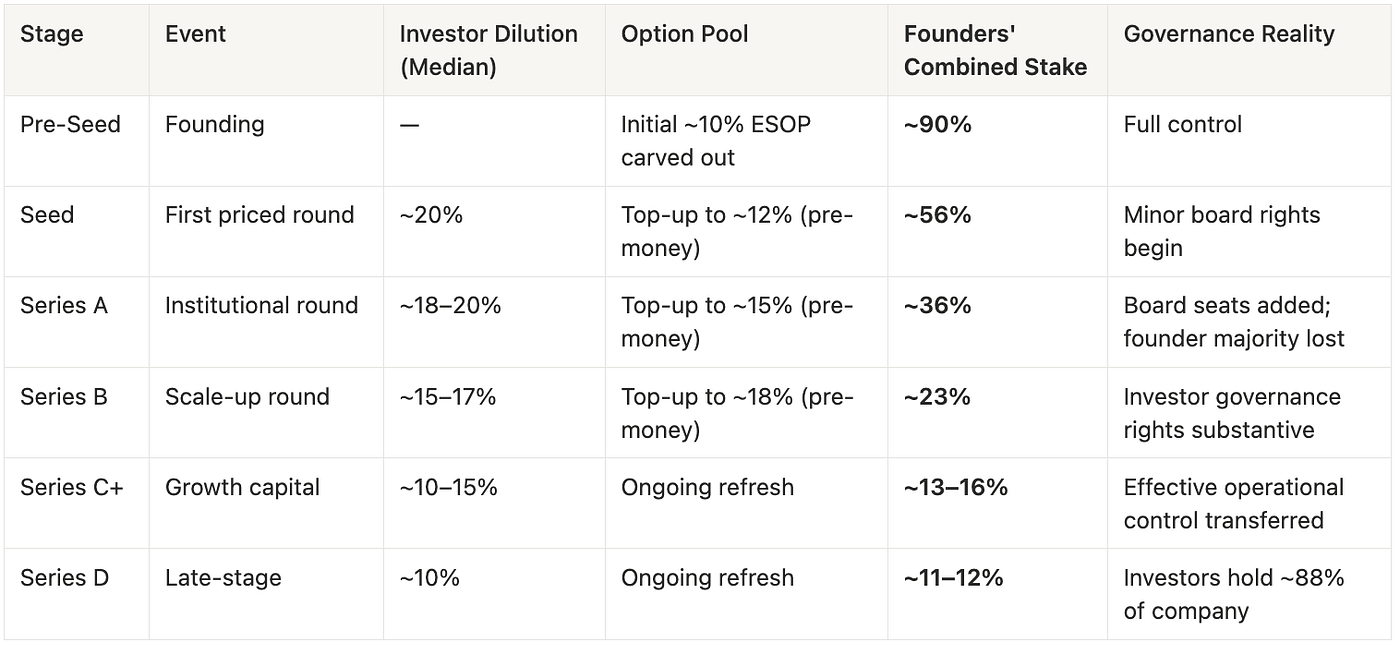
Sources: Carta Q1 2024 Dilution Data⁴; Carta State of Private Markets Q4 202⁴⁶; SaaStr analysis of 50,000 startups via Carta data¹³ᵃ
⚠️ The ownership thresholds that actually matter: Falling below 50% removes simple majority control. Falling below ~20% typically triggers loss of board representation and information rights under standard term sheets. A founder at 35% with clean governance may hold more real decision-making power than one at 51% facing aggressive protective provisions, drag-along clauses, or anti-dilution ratchets. The table shows the percentage — the term sheet determines what that percentage actually controls.
None of these numbers are scandalous in isolation. Venture math is supposed to work this way, a smaller slice of a much larger pie. The question worth sitting with is: how large does that pie actually need to be for you to win? And what does “winning” require you to become in the meantime?
Founders are typically shown the numerator , potential valuation without an honest accounting of the denominator: the governance pressure, the pace requirement, and the ownership stake at the actual end of the road. That’s the math nobody teaches.
The Path Fitness Test 🔍
Before you commit to a path, run the Fitness Test. Six questions that surface which of the three paths actually fits your business. Path selection is the first decision — execution readiness is a separate one and the subject of this week’s “The Leap Weekly” newsletter, where I’ll share the seven-lens CAPITAL diagnostic that stress-tests whether you’re ready to walk the path you’ve just chosen.
1. What is your market’s velocity? Is your market moving fast enough that a competitor with 12 months’ more capital can render your positioning irrelevant?If yes, the revenue path is likely too slow and you should be looking at venture or hybrid. If no, your market rewards depth, and capital alone won’t buy you the win.
2. What type of moat are you building? Network effect moats and infrastructure moats typically require capital before revenue can fund them. Data moats, brand moats, and expertise moats can often be built on revenue alone and are frequently stronger for it. This is arguably the most important strategic question in the capital decision.
3. How mature are your unit economics? Have you validated your unit economics, even directionally? If not, the revenue path may be where you build that proof. Capital can technically fund the search, but doing so on someone else’s dilution is an expensive way to learn what you don’t yet know about your own business.
4. What is your honest relationship with board governance? This is the question founders least want to answer honestly. Board governance, at its best, is a forcing function for clarity and accountability. At its worst, it introduces misaligned incentives from investors whose fund timelines don’t match your company’s natural rhythm. There is nothing wrong with wanting to build outside those dynamics. But you need to know that about yourself before you’re mid-raise.
5. What does “winning” look like for you — and when? A venture-backed company is implicitly committed to a liquidity event within a fund’s return horizon, typically seven to ten years. A revenue-built company can generate meaningful wealth on a different timeline and without a transaction. Neither is better. But they require different choices starting at round one.
6. What is your personal financial runway — honestly? This question doesn’t appear on most capital decision frameworks, which is precisely why it matters. A founder with dependents, a mortgage, or significant personal debt faces a fundamentally different risk profile than one with no liabilities and six months of savings. The revenue path requires the patience to grow slowly. The hybrid path requires surviving the gap between initial capital and product-market fit. The venture path compresses the timeline but accelerates governance pressure. None of these work if your personal situation forces a business decision before the company is ready to make it. Know your number before you choose your path.
🗺️ Path Fitness Test: Reading Your Results
Most founders will score a mix of signals. Use the table below to interpret the dominant pattern.
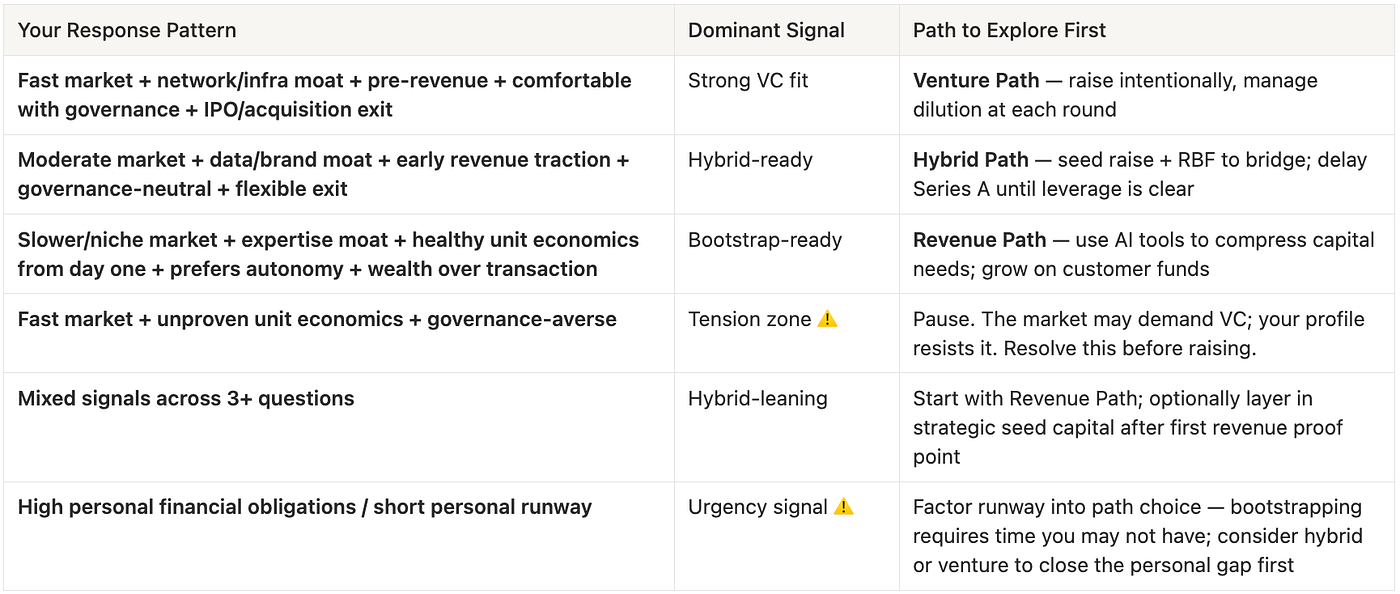
Note: These are directional signals, not verdicts. The test is most useful when answered with a co-founder or trusted advisor who will push back on comfortable answers.
The Fitness Test answers which path. It doesn’t answer whether you’re ready to walk it and that’s a different diagnostic, and it’s what we’ll work through on in this week’s “*The Leap Weekly*”. The path-fit question and the readiness question are sequential, not the same
The AI-Era Bootstrap Advantage 🤖
This is where the conversation gets genuinely new or or, increasingly, expected.
Until roughly three years ago, the minimum viable capital required to build a real company, to hire the engineering and growth functions, to test and iterate, to reach customers at scale was substantially higher than it is today. The cost structure of building forced most ambitions toward external funding. Not because founders were wrong, but because the math demanded it.
AI has changed that math in ways that are still being underestimated.
The top AI-native startups achieve $3.48M revenue per employee, nearly six times the average among other leading SaaS companies operate with 40% smaller teams, and reach unicorn status a full year faster than non-AI counterparts.⁷ These aren’t aspirational benchmarks. They’re structural outcomes of building with AI embedded from day one. And the most illustrative examples aren’t the billion-dollar labs, they’re the smaller, quieter companies demonstrating that extraordinary efficiency is now achievable without extraordinary capital.
The proof isn’t only in the AI tier. Zerodha, India’s largest retail brokerage, reported ₹4,700 crore in net profit on ₹8,320 crore of revenue in FY2024 , built over fourteen years with zero external equity capital.²
Midjourney, the AI image generation company, reportedly reached approximately $500M in annual revenue with around 40 employees and no institutional funding.¹ What both share isn’t sector or geography, it’s the same underlying principle: a lean, focused team compounding quietly will outperform a well-funded, unfocused one, if the business model allows it.
That last clause matters. 37% of venture-backed startup professionals report that AI lowered their customer acquisition cost, while 72% say AI improved their ability to upsell and cross-sell existing customers.⁸ But precision is required here: these efficiency gains concentrate in digital-only, software-marginal-cost businesses with strong organic distribution. A founder building a marketplace, a hardware-adjacent product, or any model requiring physical infrastructure will find the AI advantage real — but more bounded than the headline numbers suggest.
The founders who understand where the advantage holds have a path their predecessors didn’t. The founders who ignore it will default to patterns built for a pre-AI economy — patterns that were rational then, but may impose unnecessary dilution and governance costs now.
A Note on the Hybrid Path 🌍
One more thing that rarely gets discussed clearly: the hybrid path is not a consolation prize for founders who couldn’t raise a full round. Used well, it’s a sophisticated approach to staging dilution alongside value creation.
Revenue-based financing (RBF) is a non-dilutive funding model where investors provide capital in exchange for a percentage of future revenues until a set repayment cap is reached.⁹ Unlike traditional equity financing, founders retain ownership. Unlike fixed-term loans, repayments flex with performance. For a company with real, predictable revenue but not yet ready for institutional capital on favourable terms, RBF can extend runway, fund growth, and preserve the ownership structure that gives the next equity round genuine negotiating leverage.
The global RBF market reached approximately $5.78 billion in total volume in 2024, projected to exceed $40 billion by 2028.³ The infrastructure for this path is maturing rapidly and where you’re based shapes which providers and instruments are most accessible. See Bonus Notes B1–B3 in the references for a curated list of RBF starting points by region.
The Question That Matters Most
I want to leave you with a provocation rather than a conclusion.
The capital decision is ultimately a question about the relationship between ownership and ambition and most first-time founders, trained by an ecosystem that celebrates funding rounds as milestones, conflate the two. They assume that raising more means being more ambitious. In 2026, after AI has restructured the cost of building, that assumption deserves a harder look.
The most interesting founders I’m encountering right now aren’t asking “how much can I raise?” They’re asking “how little do I need to raise to get to the next real inflection point?” That reframe changes everything — the investor conversations, the hiring plan, the product prioritisation, and ultimately the kind of company that gets built.
Here’s the line that makes most investors uncomfortable when I say it in a room: a bad VC round is worse than no funding at all and most first-time founders can’t tell the difference until year three, when the governance pressure has already shaped the company into something they no longer fully recognise.
The dilution math was never just arithmetic. It was always a question about what you’re choosing to become. The AI era has given you more options. The question is whether you’ll actually choose — or just default.
If this framework sparked something, The Leap Weekly goes deeper each week — implementation-level insight for founders who want to build with intention, not just velocity. Subscribe at xleaps.beehiiv.com.
📚 References
- Midjourney revenue and headcount — Market Clarity, “Top 35 Most Profitable AI Startups in 2025”: https://mktclarity.com/blogs/news/ai-startups-top
- Zerodha FY2024 profit and revenue (₹4,700 crore net profit / ₹8,320 crore revenue, bootstrapped) — YourStory, “Zerodha posts Rs 4700 Cr profit in FY24; revenue crosses $1 billion”: https://yourstory.com/2024/09/zerodha-nithin-kamath-fy24-profit-revenue (Note: audited statutory net profit per some filings cited as ₹5,496 crore; ₹4,700 crore is the figure stated by co-founder Nithin Kamath in his official September 2024 blog post, excluding unrealised gains)
- Global RBF market volume 2024 and projection — re:cap, “7 Startup Debt Lenders You Need to Know in 2026”: https://www.re-cap.com/blog/debt-funding-saas-tech-provider
- Founder equity dilution benchmarks (Seed, Series A) — Carta Data, “Dilution is on the Decline” (Q1 2024): https://carta.com/data/dilution-q1-2024/
- Founder ownership by stage — Equitylist, “Founder Ownership by Round: How Equity Dilution Really Works”: https://www.equitylist.co/blog-post/founder-ownership-by-round
- Series B dilution rates 2024 — Carta, “State of Private Markets Q4 and 2024 in Review”: https://carta.com/data/state-of-private-markets-q4-2024/
- AI-native startup revenue per employee — HubSpot Startups, “AI Statistics Every Startup Should Know”: https://www.hubspot.com/startups/ai/ai-stats-for-startups
- AI’s impact on customer acquisition cost and upsell/cross-sell — HubSpot Startups, “AI in Startup GTM Report 2025 Pt. 1”: https://www.hubspot.com/startups/ai/ai-in-gtm-report-pt1
- Revenue-based financing model — Inc. / Founders Community Fund, “Why Venture-Backed Startups Are Looking to Revenue-Based Financing”: https://www.inc.com/johnmcintyre/venture-backed-startups-raising-revenue-based-financing/91193635
- India seed-stage capital decline H1 2025 — BrandTrendingNow, “India Startup Funding 2025: Key Insights, Top Sectors & Trends”: https://brandstrendingnow.com/india-startup-funding-trends-2025/
- Europe RBF landscape — Sifted, “Revenue-based financing in Europe: The competitors, compared”: https://sifted.eu/articles/revenue-based-financing-europe-competitors
- Europe startup funding guide 2026 — Grantbite, “Startup Funding in Europe (2026): Complete Guide”: https://www.grantbite.com/en/blog/startup-funding-in-europe
- Zerodha bootstrapped model — Business Standard, “Zerodha profit jumps 61.5% in FY24”: https://www.business-standard.com/companies/start-ups/zerodha-profit-jumps-61-5-in-fy24-ceo-warns-of-regulatory-challenges-124092501126_1.html
13a. Founder ownership data post-seed through Series D (56.2% → 36.1% → 23.0% → 11.4%) — SaaStr, “The Real State of Seed Today: Top 10 Learnings from 50,000 Startups via Carta”: https://www.saastr.com/the-state-of-seed-today-10-key-learnings-from-cartas-latest-data/
📍 Bonus Notes: RBF Starting Points by Region
B1 — 🇪🇺 European Founders Europe has 18+ RBF providers founded since 2019. The EIC Accelerator also offers blended finance — up to €2.5M in grants plus €10M in equity — one of the few public instruments that can anchor a genuine hybrid path for deep tech founders.
- re:cap — SaaS and subscription-focused, EU-based: re-cap.com
- Capchase — non-dilutive capital for recurring revenue businesses across Europe: capchase.com
- Outfund — eCommerce and SaaS, UK and Europe: out.fund
- EIC Accelerator (EU grants + equity): eic.ec.europa.eu
- Full landscape overview — Sifted: sifted.eu/articles/revenue-based-financing-europe-competitors
B2 — 🇺🇸 🇨🇦 North American Founders The most mature RBF market globally. Venture debt from specialised lenders remains a parallel option for VC-backed companies extending runway without a new equity round.
- Lighter Capital — SaaS-focused RBF, US: lightercapital.com
- Clearco — eCommerce and SaaS, US and Canada: clearco.com
- Founderpath — SaaS term financing, US: founderpath.com
- ECL (Efficient Capital Labs) — B2B SaaS, US and India: ecaplabs.com
- Broader RBF provider comparison — ECL: ecaplabs.com/blogs/revenue-based-financing-companies
B3 — 🇮🇳 Indian Founders India’s RBF ecosystem has grown rapidly alongside the SaaS and D2C boom. With seed-stage capital declining in H1 2025,¹⁰ non-dilutive alternatives are increasingly relevant for founders proving unit economics before a first equity raise.
- GetVantage — eCommerce and D2C-focused, Mumbai: getvantage.co
- Recur Club — SaaS and subscription, ₹1,200+ crore enabled to date: recurclub.com
- Velocity — eCommerce brands, up to ₹2 crore, no equity, no personal guarantees: velocity.in
- ECL India — B2B SaaS, INR and USD options: ecaplabs.com/blogs/revenue-based-financing-india
메타데이터
- post_id
- 8ba0762dced9
- slug
- how-first-time-founders-should-actually-decide-raise-bootstrap-or-both-8ba0762dced9
- url
- https://medium.com/@contact.jitendra07/how-first-time-founders-should-actually-decide-raise-bootstrap-or-both-8ba0762dced9
- canonical_url
- https://medium.com/@contact.jitendra07/how-first-time-founders-should-actually-decide-raise-bootstrap-or-both-8ba0762dced9
- author_url
- https://medium.com/@contact.jitendra07
- status
- ok
- fetched_at
- 2026-06-24 04:09:36