Switzer Fellowship Original Essay
Fresh gravel crunches underneath my trail shoes as I walk briskly on an isthmus, one of many strips of land that outline a grid in the…
Switzer Fellowship Original Essay

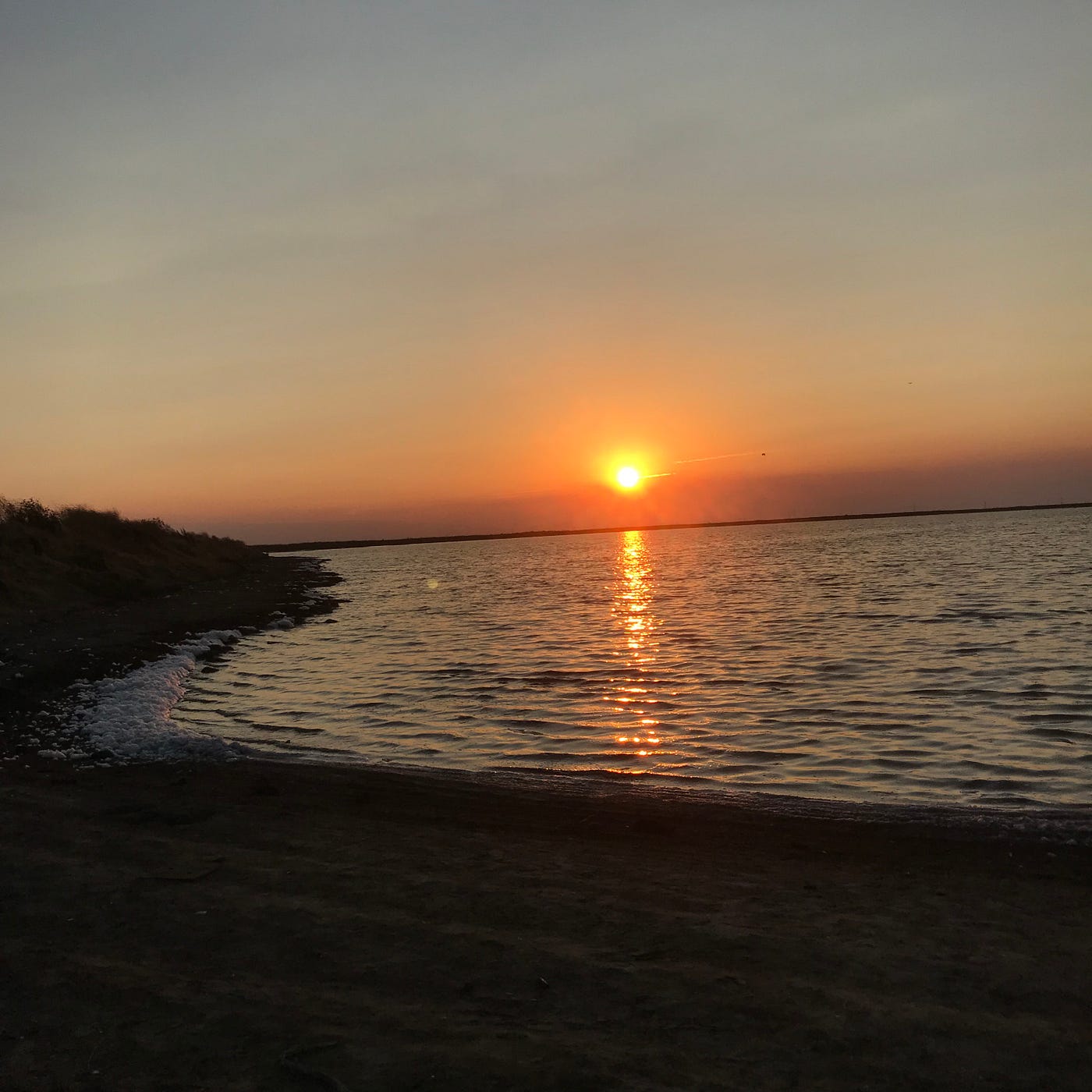
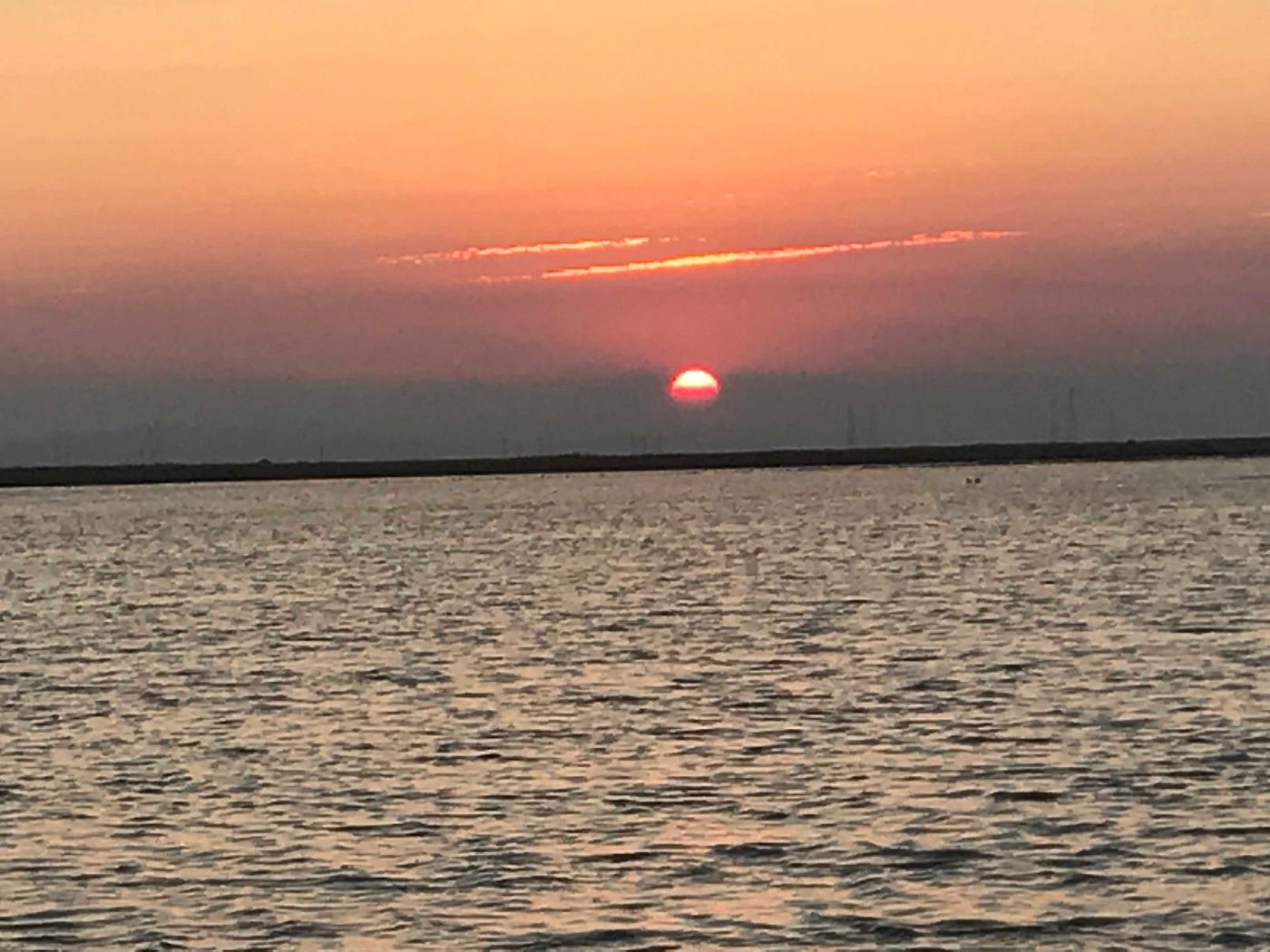
Fresh gravel crunches underneath my trail shoes as I walk briskly on an isthmus, one of many strips of land that outline a grid in the multicolored salt ponds that lie at the southernmost tip of the San Francisco Bay, an area known as Alviso, California. Even though this location is the lowest elevation point in the San Francisco Bay Area and prone to severe flooding, currently the water surface in each water basin is chopped into thousands of tiny tents marching quietly until they bump against the slanted sandy walls of the basin, not even ambitious enough to sprinkle a drop of water on my path. The wind moves swiftly from my left to my right so that my clothes are pressing on one side yet flapping on the other. Taking a deep breath, I fill my senses with the view, a sun setting on the distant gray water while throwing orange, pink, and purple flames against a darkening blue horizon. The flatness of the ponds and the subsequently invisible bay allows the sky to dominate the space until I feel that maybe a running leap could launch me near the sun. At first sight and sense, the scene feels new and holds the promise of adventure and discovery.
Of course, to even a slightly knowledgeable eye, obvious clues do away with the naivete and indicate that the landscape has been modified radically. The crushed stone pieces under my feet seem shiny and dirt free, spread neatly on the isthmus surface. A yellowish-brown, seemingly indissoluble cuff continuously deposits in fluffy rings along the basin walls by small, choppy waves. The water changes color from brown to purple to turtle green. The isthmi themselves, too low to the ground to be called levees, lie in straight lines to form convenient squares holding convenient amounts of water. Railroad tracks are clearly visible on the other side of my grid. Blocky warehouses and glass-covered tech office buildings menacingly intrude on a sweeping view just on the other side of the Bay’s tip.
A little historical knowledge shows that these basins are salt evaporation ponds that were formerly owned by Cargill Inc. To harvest salts from seawater, seawater was fed through the series of ponds from which increasing amounts of water could evaporate, leaving behind precipitated salts. A little scientific knowledge shows that the unusual colors of the water are produced by variable algal concentrations and microorganisms changing their hues due to the water’s salinity. The ponds were abandoned, and salt hasn’t been harvested in decades.
Before the salt ponds and the railroads, this land area was originally tidal marshland, the biggest estuary on the West Coast. Other than being the most biologically diverse area on the West Coast, or even the Western Hemisphere, and teeming with fish, mollusks, and water fowl, the extensive marsh system served as a barrier from floods, a sponge soaking up excess water when flooded. The region’s Native peoples, such as the Ohlone and Coast Miwok, utilized the estuary extensively for food, clothing, and transportation needs. They modified the estuary landscape for their needs by starting controlled burns to promote the prolific growth of native grasses.
Minimalist yet specifically labeled signs are posted periodically along the path I am walking on, tall enough to be seen if someone is interested in situating themselves but slight enough to slide under a sweeping vision. “Do Not Drink” they warn, under which they reiterate “No Beber.” “Stay on Trail” they advise, followed by “Do Not Feed Wildlife.” Today, about 15,000 acres of industrial salt ponds are under the South Bay Salt Pond Restoration Project, the largest tidal wetlands rehabilitation project west of the Mississippi River. After the state of California passed a measure to acquire the salty land, millions of dollars from state funds and community donations have been wisely budgeted to gradually yet thoroughly reverse the devastating effects of overirrigation, infill, and salt buildup, rehabilitating the land to a heavily altered version of its former wetland self. Gradually, the Bay’s water quality improves, habitat protection and maintenance allow migratory birds to find stability, native species have an opportunity to thrive, and most importantly, due to rising sea levels and increasing intensity of storms, the open space allows flood protection for residents living close to the Bay’s edge. Here, I am humbled by the scale of devastation we as a community are trying to reverse and understand the necessity of wise human intervention to alleviate the impacts of environmental destruction and a changing climate. I understand that to preserve our communities and lead healthy lives, we need to act in the climate fight. The answer may not always be restoration or rehabilitation as above, but our efforts to survive and build a just and sustainable society will depend on our abilities to innovate.
Three impulses drive my life choices: gravitation towards nature, hunger for knowledge, and passion for creating solutions. Spending long periods of time outdoors and taking rambling road trips allowed me to preserve an instinctual awe in the complexities of both powerfully visible and invisible natural formations and cycles, sparking my interest in studying Earth’s natural processes. I am also absorbed by a curiosity of how unseen particles shape my physical reality into the dynamic planet I depend on. Endeavoring to connect all my interests, I decided to channel my energy into pursuing chemistry and environmental science degrees at Santa Clara University not even ten miles down the road from Alviso Marina County Park.
In my undergrad, I pursued various activities and learning opportunities. While actively engaged in research in a stable isotope lab studying atmospheric rivers iconic to California winters, I also led a Sustainable Living Research team to draw up a proposal convincing the university to make the switch from classroom tube lights to a motion-sensor energy conserving lighting system. I interned at the adjacent Forge Garden as a garden educator for a few months, spending time with young children who had experienced domestic violence and needed a safe, relaxing, and educational environment. I often converted concise end-of-quarter class assignments into thoroughly researched projects with the blessings of my professors. Through these variety of opportunities, I produced, among other projects, an organized GIS database and an accompanying paper that predicted and visualized Coastal Redwoods on the move along the Pacific Coast due to climate change impacting habitat conditions; a lifecycle assessment and analysis of the chemical degradation of polyethylene terephthalate; and a discourse analysis of how the embedded institutional racism in the rhetoric of the Food Justice and Slow Food movement alienates people of color and low income communities from those very movements. By the time I graduated, I had operated and maintained a laser spectrometer for two years to produce valuable oxygen and hydrogen isotopic data that was the foundation of my research project investigating the temperature and humidity conditions at regions where atmospheric rivers were born. This topic was especially prescient due to the ongoing concern of the prolonged drought and extreme water shortages the state experienced for a few years.
Through my brief windows of experiences in various facets of climate change and issues of environmental devastation, I have decided that I will apply my academic, research, and leadership experiences to focus on innovating solutions on two fronts. The first front is climate mitigation, which is reducing our society’s carbon footprint and reversing environmental degradation. Specifically, how can we use our knowledge of carbon’s movement through the ecosphere to develop methods of enhancing carbon removal from the atmosphere into a form that reduces its impact on climate feedbacks? The second, equally important, category is climate adaptation, which is developing solutions that allow all members of society to thrive sustainably in the face of climate change and environmental degradation.
Truthfully, when I envision my future career, I don’t envision a cubicle in a glass building or a lab with shiny instruments. I envision my continued passion to study and solve environmental problems leading to many interdisciplinary projects with comprehensive plans and tangible, visible results. Dam removals. Urban gardens. Bioremediation of threatened habitats. Sustainable and affordable housing and transit options. Whether they require policy analysis, field work, or lab work is not yet my concern. Just like the cities of Sunnyvale, Santa Clara, San Jose, Milpitas, and Newark all converge at the Alviso County Marina Park and the nearby salt ponds, I, too, strive to focus on issues that converge the multiple fronts of the climate movement, which strives to build a just, more sustainable society.
During my walk, I turn back just after witnessing the final sliver of the glowing sun slide underneath the horizon. I see other signs more covertly posted among the tall brown grasses growing on the boggy land between the parking lot and the open water. “Do Not Disturb,” then “Tidal Wetland Restoration in Progress.” I am inspired.
메타데이터
- post_id
- 97ed9f5b4606
- slug
- switzer-fellowship-original-essay-97ed9f5b4606
- url
- https://medium.com/@1ayesha/switzer-fellowship-original-essay-97ed9f5b4606
- canonical_url
- https://medium.com/@1ayesha/switzer-fellowship-original-essay-97ed9f5b4606
- author_url
- https://medium.com/@1ayesha
- status
- ok
- fetched_at
- 2026-07-29 20:30:10




