The Dirty [Baker’s] Dozen: Thirteen School Technologies Most Destructive to Learning.
The “no screens,” “no phones,” and “just pencils and books” narratives are incredibly dangerous to children for a number of reasons. The…
The Dirty [Baker’s] Dozen: Thirteen School Technologies Most Destructive to Learning.
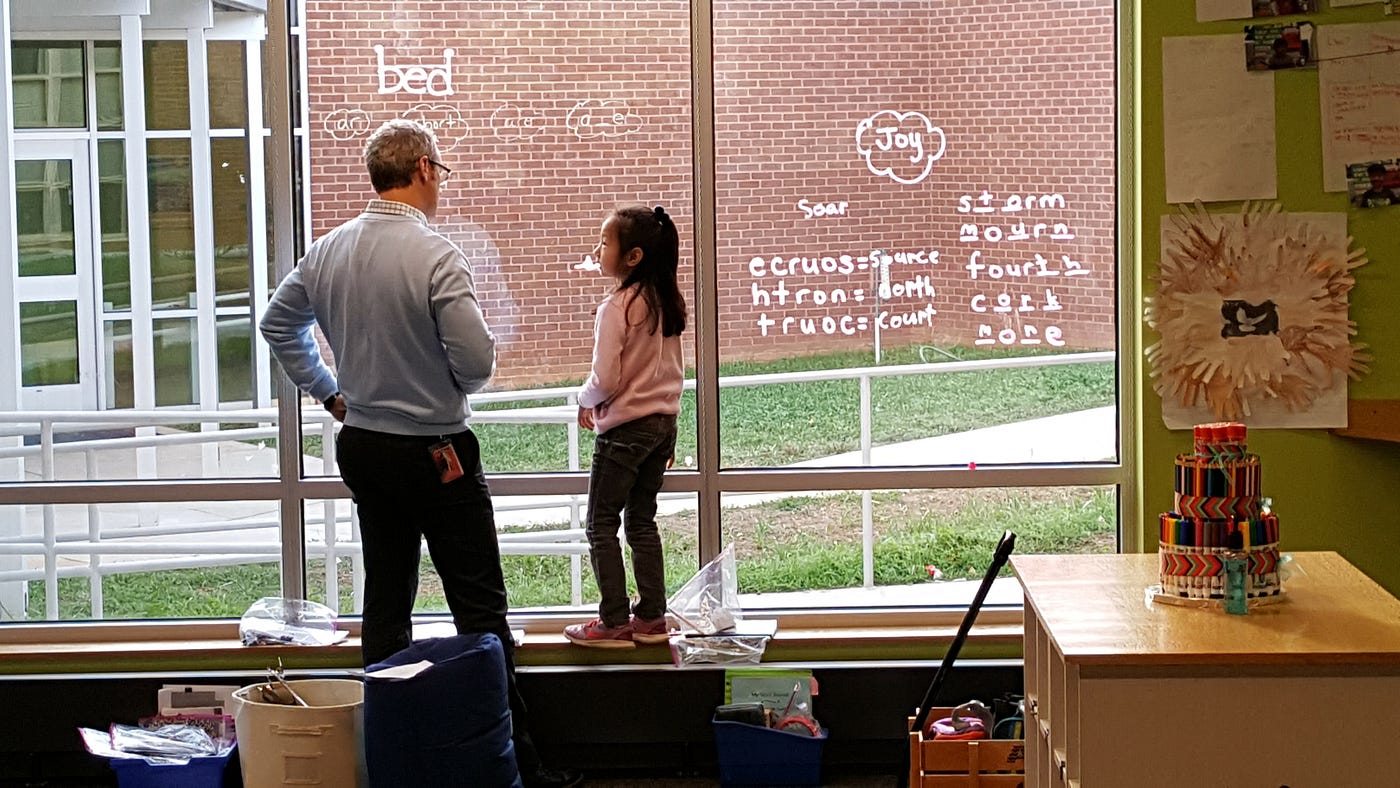
In a highly transparent K-5 learning space with 130 kids, six teachers, and almost no mass instruction.
The “no screens,” “no phones,” and “just pencils and books” narratives are incredibly dangerous to children for a number of reasons. The first is the vicious ableist attitudes of those promoting these ideas. They actually believe that it is in everyone’s best interests if all kids functioned the way they did — and those kids who can’t “be fixed” should simply be abandoned. The second is that they cannot even define “technology,” except as “stuff they don’t like.” Finally, the third is that they are blind to the world and blind to children.
“Technology” is, as Heidegger suggested, “the art of manipulating the world.” And humans, for their entire history, have been inventing and improving tools that give more people more power to manipulate the world to their and society’s advantage. (note — I know Heidegger was a Nazi, so I need to say that.)
Does that mean technologies are always used well, and for good? Of course not. Socrates was right when he said that literacy made our information less trustworthy and less humane. Gutenberg wiped out half the languages of Europe. It only took eleven years for the Wright Brothers’ incredible invention to be used as a weapon of war. Television, for all its wonders, enables people like Donald Trump just as radio enabled people like Hitler. Books and newspapers enable many of our most ridiculous — and anti-child- school initiatives.
More to read… ***Timeless Learning: How Imagination, Observation, and Zero-Based Thinking Change Schools (Socol, Moran, and Ratliff) [Designed to Fail: A History of Education in the United States](https://a.co/d/09ogzyWh) (Socol) [Real Learning, Real Accomplishment: Schools that Work for Kids](https://a.co/d/01J5Tn9K)*** (Moran and Socol, editors)
Many of the technologies people embraced (or not seen) by the “no tech crowd” are very dangerous to children, to adolescents, and to learning. Jonathan Haidt won’t write a book about them. No U.S. governor will sign a bill banning them, but every hour of every school day, these technologies do far more harm than any mobile phone.
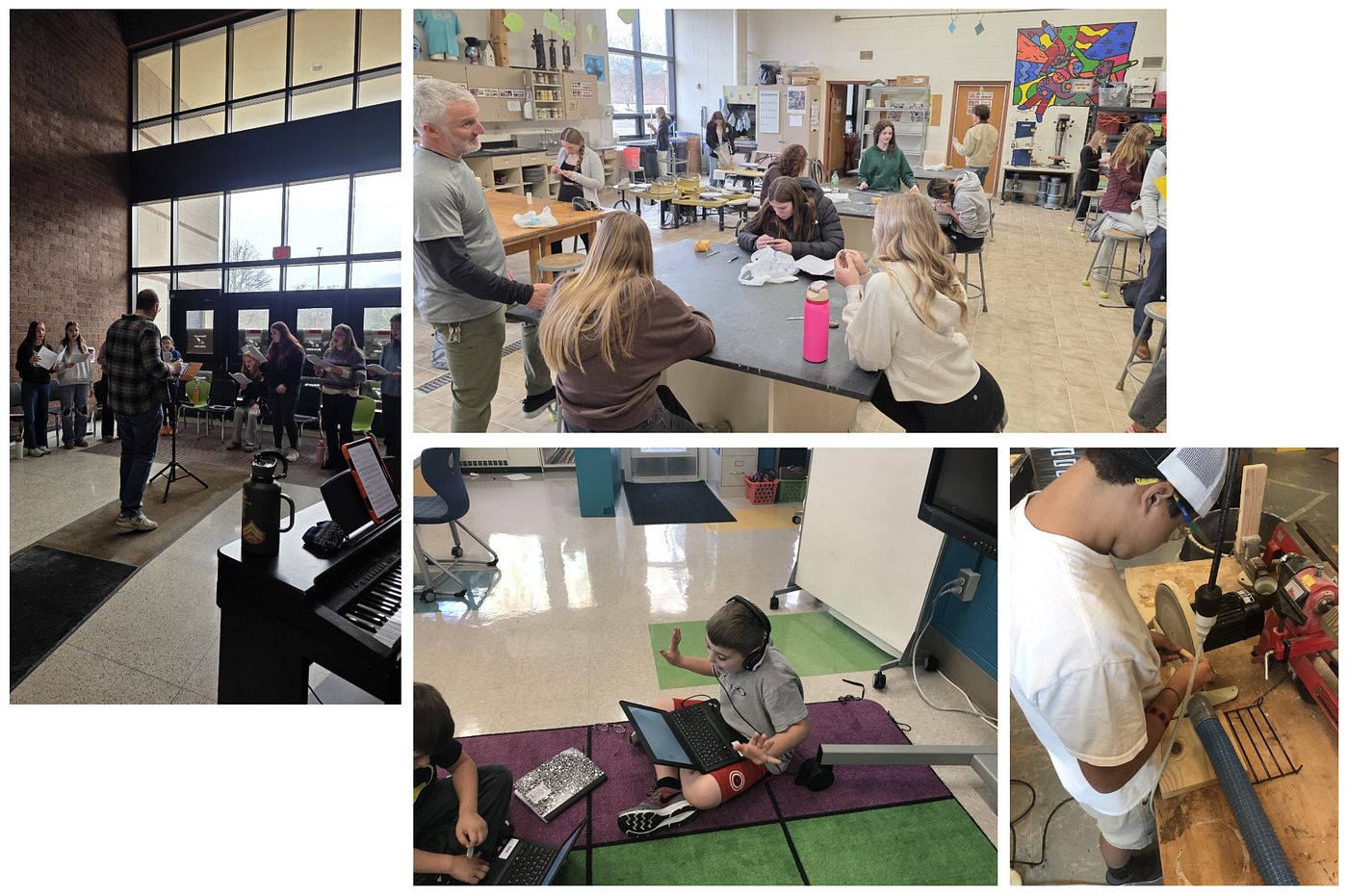
Here’s a list — it’s a partial list — of 13 of the worst:
- The School Schedule — nothing damages learning more than schedules imposed on children and teens for adult convenience. Kids sleep through these absurd days, only awakened for nonsensical shifts in topic and culture. As Chris Lehmann of Philadelphia’s Science Leadership Academy wrote in 2012. “As long as high school students have to travel to eight different classes where eight different teachers talk about grading/standards/learning in eight different ways, students will spend far too much trying to figure out the adults instead of figuring out the work. When that happens, too many students will fall through the cracks and fail.” And that’s before we get to secondary school start times before 9:00 am.
- The Classroom Chair — Research proves that standard classroom furniture does one of two things — destroys attention after five minutes or makes kids so uncomfortable they aren’t focused on anything but their discomfort. Two critical quotes, one from old friend, Dieter Breithecker: “If you’re under stimulated physically, you’re under stimulated neurally,“ the other from a much older friend, William Alcott: “To some children, five minutes [sitting still] would be long enough; and to most, ten minutes would be the full extent of what would be useful.”
- The Whiteboard/Blackboard — a brilliant discovery when Claudius Crozet brought it to West Point from France about 200 years ago, and a great idea when William Alcott brought it to the schoolhouse as a student collaborative learning space, but now an inaccessible relic that prioritizes the teaching wall and makes learning passive.
- Non-Transparent Classroom Walls — Kids need to see the outdoors, they need to see other kids — especially kids of different ages. Vision prompts curiosity. Solid walls are for prison cells. At a 2018 school security summit sponsored by the American Institute of Architects, I introduced myself this way, “I’ve spent the last ten years tearing down walls within school buildings and adding doors to the outside, and I am absolutely certain that this has not only made our schools safer, but has created great learning spaces that create great experiences for kids.”
- Literature and Information Provided in Only One 15th Century Form — we could require everyone to read Latin carved in stone or Ancient Egyptian in hieroglyphics on papyrus, but we’ve made other decisions. Over 500 years ago, Gutenberg made information and literature more accessible than they were when monks had to scribe every copy of every book. New technologies open the world to more people. That’s the way it’s always been. When we deny the increased accessibility created by technologies developed after your students’ grandparents were born, you are blocking learning for many — if not most — kids. Let us frame it simply: “*Reading is about the content and not the medium.”*
- Bells and Public Address Systems — Really? You choose to constantly interrupt your kids’ learning? It’s the mid-21st century, and the most sophisticated communication techniques you know are ringing bells and screaming through a loudspeaker? Ever consider texting the people you need to contact? No, of course not. “It takes an average of 23 minutes and 15 seconds to get back to the task,” according to a University of California — Irvine study. And yes, teachers and schools interrupt constantly. Locked classroom doors interrupt student time every hour as kids need to be let in. Teachers fragment learning time when they interrupt to try to (often pointlessly) demand attention from one student. Bells, and the subsequent room and subject switching, are huge, but the most ridiculous are PA announcements (about eight minutes for a class to recover).
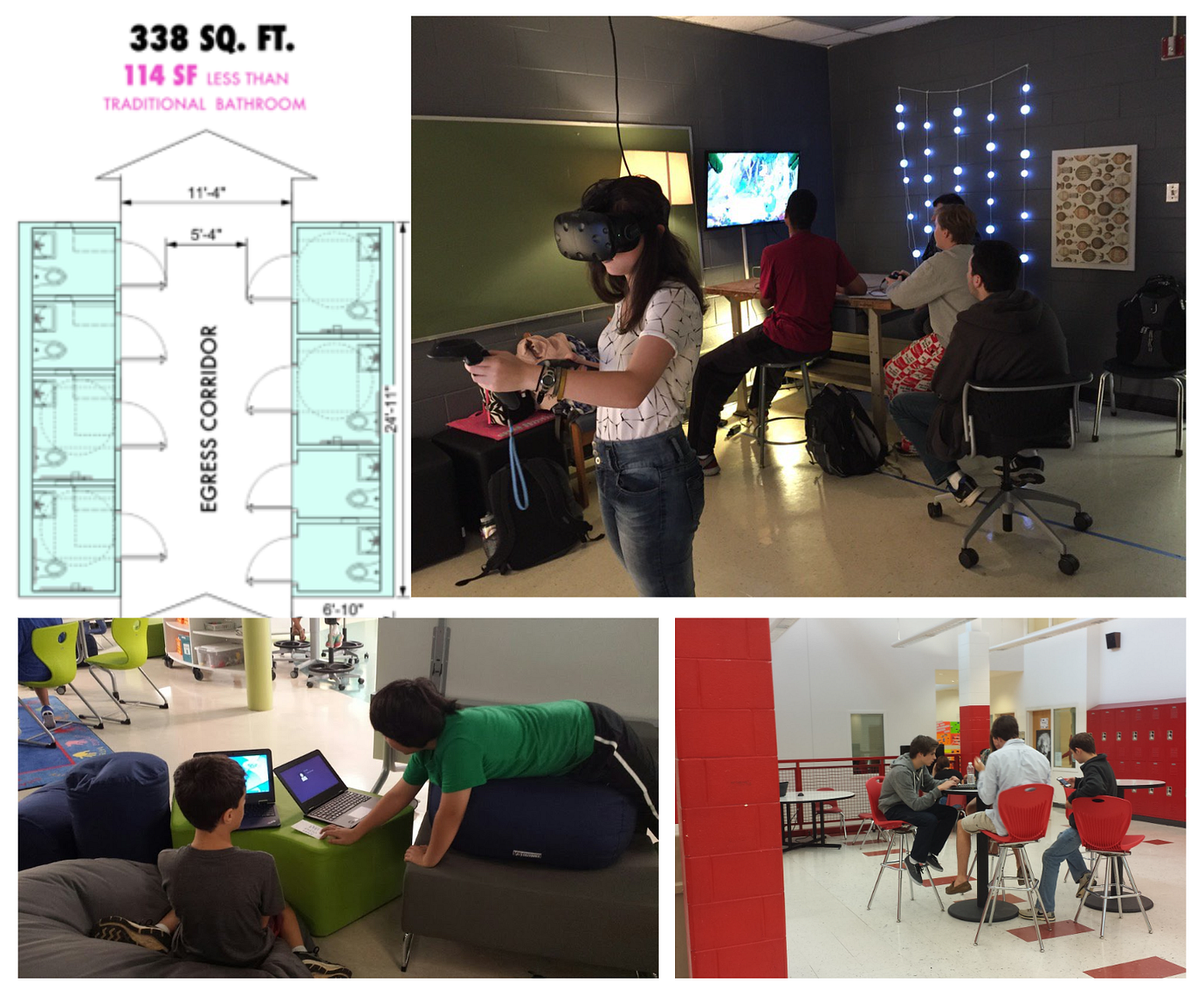
- School Corridors — massive amounts of space in schools- and construction funds — are wasted on circulation spaces used exclusively to limit student interaction and learning. Go outside. Watch learning outside of school — look at a city street, or a park. When we needed to add a six-classroom wing to an elementary school, we designed a space for 130 K-5 students and six teachers. One big, complex learning space. This created fabulous changes in a challenging school, but also, not building circulation space saved so much money that we could upgrade the furniture throughout the building and still came in under budget.
- School Toilets — enough said. If you can’t feel perfectly safe using a toilet, then you should not be in that building.
- Hall and “Bathroom” Passes — Are you helping your kids learn to live in the world or simply pushing them along the school-to-prison pipeline?
- Gradebooks — Learning measured on linear scales, learning judged comparatively, learning judged against a mythical age formula you can’t even explain (“all kids must be reading this way at age eight”), all this shuts kids down, because, why bother? Michael Lubelfeld: “Students in grades 5–8, those part of this process, clearly understand what it means when we educators talk about and describe assessment. While they don’t speak in the jargon-filled world we too often do, they have elegant simplicity and profound wisdom. They don’t want to be bored in school — there are many ways that they can show/demonstrate/illustrate their learning. Their collective plea to us — LISTEN please, listen and offer multiple perspectives and pathways in what we call assessment.”
- Writing Technologies Limited to Pre-1950 Inventions — Sure, we could teach you to chase the duck, pull the feather, cut the quill, and mix ash into ink, but we don’t. Keyboarding with our thumbs and dictating with our voice are both forms of writing. Stop being stupid.
- School buildings located in places that make it almost impossible for kids to walk or bike ON-THEIR-OWN to school — Your School building, 100-years-old or brand new, probably sucks. But if it’s been built since 1980, its location surely does. You force every kid to begin their day sitting passively watching the world go by — or — staring at their phones, instead of getting exercise and interacting with their peers — activities that would stimulate their brains.
- The Lesson Plan — When I taught pre-service teachers at Michigan State, I begged them to ignore many of their other instructors and choose to not write lesson plans. Lesson plans are a trap, not quite as bad and as anti-human as scripted instruction and enforced pacing guides, but almost as limiting. Come to a class time with “learning intentions” (what you hope kids will take from their time with you) and “learning resources” (what range of tools, resources, and experiences can you share to help your students). That lets the classroom meet the students where they are, and respond to the unexpected.
More than Honorable Mention
A. The Division of Children by Age — “*No one dares deny that the children of every grade differ widely in age, in acquirements, in aptitude, in physical endurance, in power of attention, in home advantages, in the rate of mental development, in the time of entering school, in regularity of attendance, and in many other ways affecting their progress. . . . Because of the manner of grading and promoting, the graded school of today keeps all the children of each grade in intellectual lock step, not only month after month, but year after year, for their whole school lives. . . . Is not individuality of more importance than evenness of grading?” — *William J. Shearer, Elizabeth, NJ Schools Superintendent, 1899
B. **The Division of Content into Silos** — “As Ella Flagg Young tried to point out, this was nonsensical and led to students “flitting” from subject to subject without putting anything together. Yet, we’ve never stopped doing it.”
- Ira Socol
메타데이터
- post_id
- 9d948163b8ea
- slug
- the-dirty-bakers-dozen-thirteen-school-technologies-most-destructive-to-learning-9d948163b8ea
- url
- https://medium.com/age-of-awareness/the-dirty-bakers-dozen-thirteen-school-technologies-most-destructive-to-learning-9d948163b8ea
- canonical_url
- https://medium.com/age-of-awareness/the-dirty-bakers-dozen-thirteen-school-technologies-most-destructive-to-learning-9d948163b8ea
- author_url
- https://medium.com/@irasocol
- status
- ok
- fetched_at
- 2026-07-31 12:33:20