What Information Overload Is Doing to me
I receive more information in my inbox DAILY than an 18th century woman would have received in a lifetime.
What Information Overload Is Doing to me
I receive more information in my inbox DAILY than an 18th century woman would have received in a lifetime.
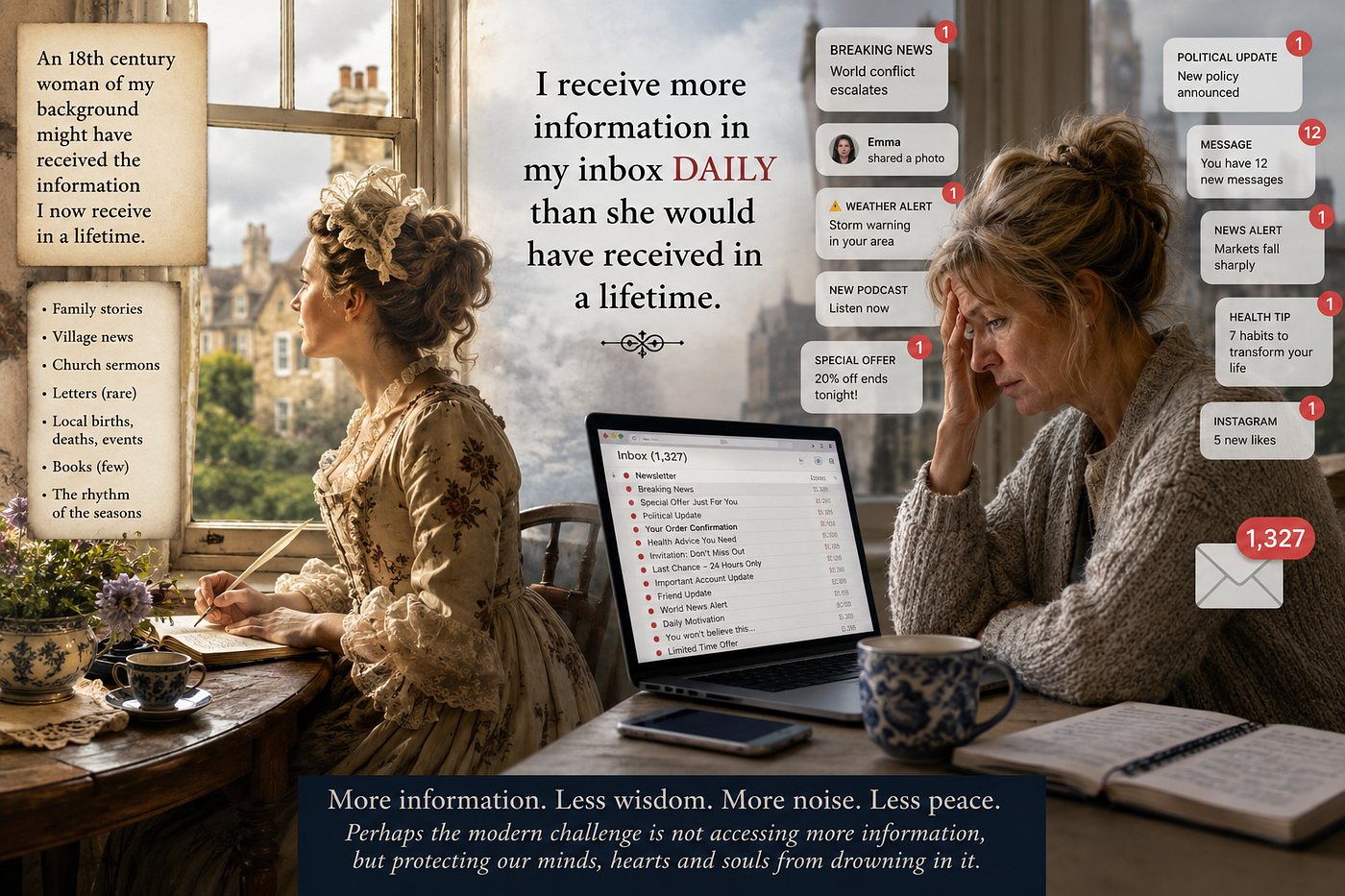
Created by the author using AI
And I began to wonder what impact this is having on my life.
The exact comparison varies depending on which study you read, but researchers and media theorists have argued for years that the average modern person now processes more information in a single day than someone in earlier centuries might have encountered in months, years — or even a lifetime.
For an 18th century woman of my background, information moved slowly and locally. Her world would likely have consisted of:
· family stories · village gossip · church sermons · perhaps a few books (if she was literate.) · seasonal rhythms · occasional letters · local births, deaths and scandals · maybe news arriving weeks or months late
She would not have known what wars were happening everywhere in the world, or in fact where some of those places were. She certainly would not know what strangers ate for breakfast or what politicians thought every hour. She would not know what many of her acquaintances were suffering emotionally, and would not be reading twenty-seven competing health opinions before noon, or that someone in California had five habits successful women use before sunrise.
In fact, she might not even be aware that successful women needed habits, or what a successful woman looked like. For her, surviving another day without adverse consequence was success as she struggled to keep herself, her home and her family alive.
By contrast, my inbox alone now contains:
· news alerts · marketing emails (far too many) · newsletters I have signed up to (and forgotten about; many unopened) · political commentary · world crises · social invitations · scams (far too many) · health advice · advertisements · updates from friends and family · updates from strangers
Some mornings I sit down at my desk intending to write a chapter, answer necessary messages or journal my thoughts. Before I know it, an hour has vanished. I have been distracted by a war, another political scandal, three marketing strategies, a health warning, an invitation to a webinar and several attempts to persuade me that my life would be transformed if only I bought somebody else’s course, or a kitchen gadget I have no need of.
Meanwhile, the chapter remains neglected, the weather outside my window has changed, and the cup of tea beside me has gone cold.
It is not that any single piece of information is harmful. It is the sheer accumulation of it. The thousand tiny demands on attention that arrive before the day has properly begun. And all of this provides endless opportunities for distraction.
As a writer, I have become increasingly aware that information and creativity are not the same thing.
Creativity requires space. It needs fallow ground in which ideas can germinate unseen. Yet modern life constantly tempts us to fill every empty moment. We scroll while waiting for the kettle to boil. We check emails while watching television. Quiet time with our loved ones in constantly interrupted by the relentless pinging of the phone.
No wonder so many people tell me they long to write, paint, sing, dance or simply think more clearly.
We have become consumers of information rather than creators of meaning.
The human nervous system simply did not evolve for this volume of stimulation.
Which leads me to the impact.
What Information Overload Is Doing to Us
1. It fragments attention We rarely stay with one thought long enough to deepen it. The mind becomes trained to skim rather than contemplate.
2. It creates chronic low-level anxiety The brain treats much incoming information as potential threat. Even supposedly harmless content keeps the nervous system slightly activated.
3. It exhausts decision-making Modern people make thousands of tiny mental decisions daily: Reply? Ignore? Click? Buy? Read? Watch? Save? Share? Mental fatigue accumulates invisibly.
4. It weakens intuition When external voices become constant, it becomes harder to hear our own inner knowing. Many people no longer know what they truly think or feel beneath the noise.
5. It encourages comparison and inadequacy We are exposed daily to curated versions of other people’s lives, success, beauty and certainty. The psyche was never meant to compare itself with thousands of people per hour.
6. It disrupts memory We outsource memory to devices because there is too much to retain. People increasingly remember less deeply because information is always retrievable elsewhere.
7. It shortens emotional recovery time Historically, grief, fear or shock might arrive occasionally. Now tragedies roll in hourly from across the globe before we have processed the previous one.
8. It reduces silence This is important because silence is not empty. Silence is where integration happens. Creativity. Meditation. Reflection. Meaning.
9. It creates the illusion of knowledge Being informed is not the same as being wise. People often consume enormous quantities of information without digesting any of it deeply. This leads to highly opinionated, loud people dominating the narrative without, necessarily, any truth or depth to those opinions.
10. It disconnects us from embodied life We live increasingly in the head, consuming abstractions while missing the physical reality directly around us: weather, meals, gardens, touch, breath, eye contact, ordinary beauty.
We now possess almost unlimited access to information, yet many feel more confused, overwhelmed and spiritually untethered than ever before.
And yet neither do I want to return to the world of my great grandmothers, whose lives were harsh and relentless.
Perhaps the modern challenge is learning how to protect our minds, hearts and souls from drowning in too much information.
Five Ways to Protect Yourself from Information Overload
1. Create small islands of silence every day Even ten minutes without a screen, podcast, television or phone allows the mind to settle. Silence is not wasted time. It is where thoughts connect, emotions settle and intuition returns.
2. Become more selective about what enters your world Not every newsletter deserves opening. Not every alert deserves attention. Curating information is self-care. Unsubscribe ruthlessly and choose quality over quantity.
3. Practise single-tasking Read one article. Have one conversation. Complete one task before moving to the next. Attention deepens when it is not constantly divided, and life feels richer when fully experienced.
4. Spend time in the physical world every day Walk outside. Tend a garden. Cook a meal. Hold a child’s hand. Watch the weather changing. The body understands things that the internet never can, and reality is often kinder than the news cycle suggests.
5. Leave space for your own thoughts Before reading another opinion, ask yourself what you think. Before seeking another expert, notice what your own experience is telling you. Wisdom grows not from consuming information, but from reflecting upon it.
Increasingly, I find myself craving something my great-grandmothers had in abundance and I have to fight to create: not the ignorance or isolation. Not overwork and constant anxiety about money and health.
Just Quiet. Space and Peace
Enough space to hear myself think. To write. To meditate. To notice the trees whispering outside my window, the ducks arguing over the food we have left out, the small voice of my inner knowing which is buried beneath the rubble of information overload.
Perhaps the modern challenge is not learning how to access more information.
Perhaps it is learning how to protect our minds, hearts and souls from drowning in it.
메타데이터
- post_id
- 9d9680090bc4
- slug
- what-information-overload-is-doing-to-me-9d9680090bc4
- url
- https://medium.com/@bellianita2/what-information-overload-is-doing-to-me-9d9680090bc4
- canonical_url
- https://medium.com/@bellianita2/what-information-overload-is-doing-to-me-9d9680090bc4
- author_url
- https://medium.com/@bellianita2
- status
- ok
- fetched_at
- 2026-06-15 20:49:13