2/2 Encoding : Sending Bits Over the Air
Every time a device sends data wirelessly whether it’s a phone streaming video or an IoT sensor reporting temperature, it performs…
2/2 Encoding : Sending Bits Over the Air

Every time a device sends data wirelessly whether it’s a phone streaming video or an IoT sensor reporting temperature, it performs something almost invisible yet sophisticated. It takes simple binary data like 110101101 and transforms it into a signal that travels through the air as electromagnetic waves.
Understanding this transformation means looking at how signals are generated and how bits are encoded onto them. At the heart of wireless communication is the RF transmitter that converts digital data into a radio signal.
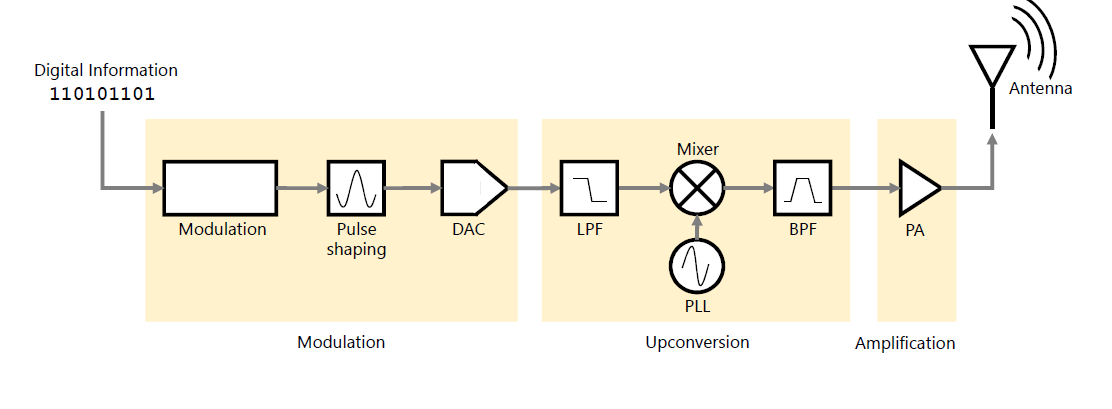
Process of RF Transmitter
The process begins with raw digital bits entering the modulation stage, where they are mapped into signal patterns. Instead of directly sending 1s and 0s, the system expresses them through variations in a waveform. This signal is then refined through pulse shaping ensuring it stays within bandwidth limits and avoids interference with nearby signals.
Next comes the Digital-to-Analog Converter (DAC) which turns the digital signal into a continuous waveform because electromagnetic signals are analog waves. This signal is still at a low frequency and to transmit it wirelessly, it must be shifted to a higher frequency band. This is done through upconversion where a mixer combines the signal with a carrier wave generated by a local oscillator (PLL).
Filters remove unwanted components, the signal is boosted using a power amplifier and finally the antenna radiates it into space. At this point the original binary data has become a radio wave carrying encoded information.
Why Radio Frequency ?
Wireless systems rely on radio frequencies (RF) because they strike the perfect balance between safety, range and ease of generation. Unlike higher frequency waves like UV/ X Ray or Gamma Ray, RF signals travel effectively through air and obstacles, can be generated using electronic circuits and most importantly are safe for everyday communication
This makes the Radio Freqency ideal for technologies like WiFi, Bluetooth and IoT systems .
Encoding Data Using Modulation
Once we have a carrier signal, the next challenge is embedding data into it. This is done through modulation where certain properties of the wave are modified to represent bits.
1)Amplitude Shift Keying (ASK)
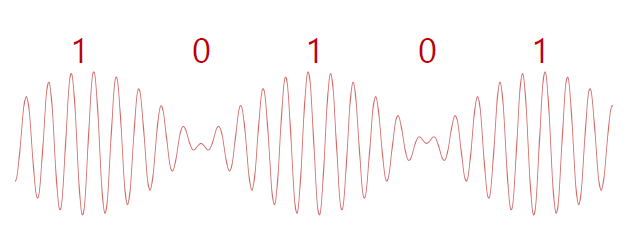
ASK encodes data by changing the strength of the signal. A strong signal represents a 1 while a weak or absent signal represents a 0. It is simple and inexpensive but highly sensitive to noise since interference can easily affect signal strength.
2) Frequency Shift Keying (FSK)
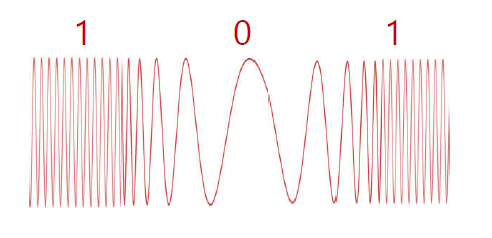
FSK uses different frequencies to represent bits. One frequency corresponds to 1 and another to 0. This makes it more robust than ASK especially in noisy environments though it consumes more bandwidth.
3) Phase Shift Keying (PSK)
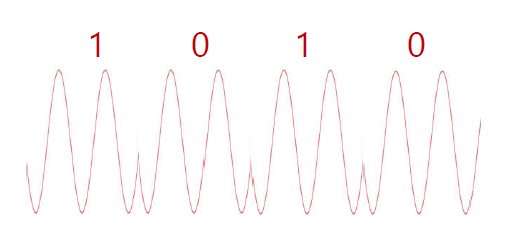
PSK encodes data by changing the phase of the signal. Instead of altering strength or frequency, it shifts the position of the wave. This improves power efficiency and reliability though it increases system complexity.
4) Phase Amplitude Modulation (PAM)
To send more data efficiently, modern systems combine both amplitude and phase changes.
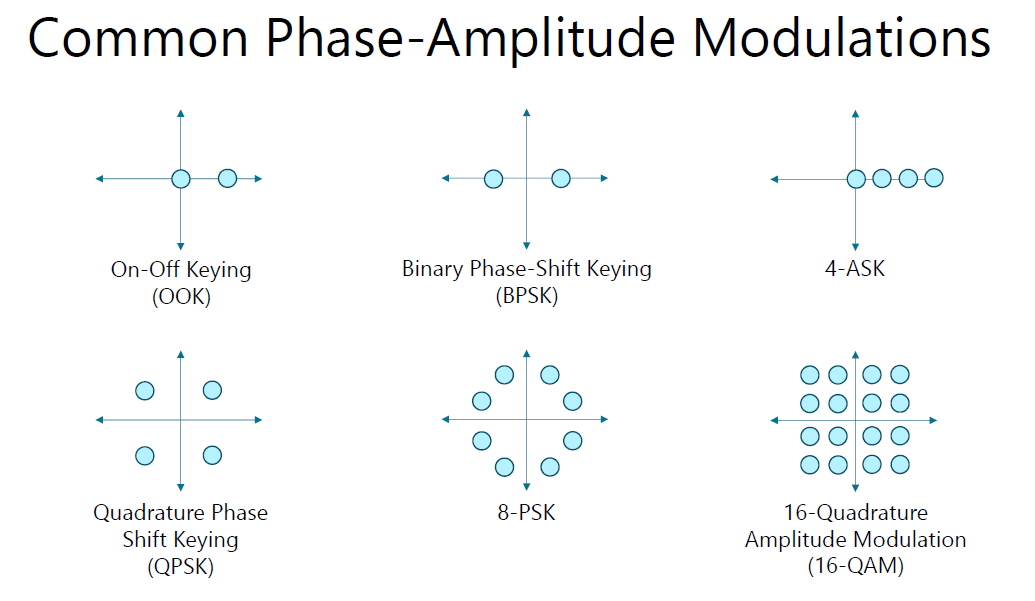
For an example, In QAM, both amplitude and phase vary simultaneously and each symbol represents multiple bits
For example: 4-QAM → 2 bits per symbol 16-QAM → 4 bits per symbol 64-QAM → 6 bits per symbol
This allows systems like WiFi and LTE to achieve very high data rates within limited bandwidth. However there’s a trade-off as Higher-order QAM is more sensitive to noise and requires better signal quality.
Different technologies use different modulation schemes depending on their needs to balances power, speed and reliability. NFC uses ASK for simplicity, Bluetooth uses FSK for robustness, Zigbee uses QPSK for efficiency and WiFi uses QAM for high data rates etc.
Encoding bits over the air is not perfect. Systems must deal with noise and interference, multipath propagation and limited RF spectrum. Because of these constraints, designing efficient encoding technique for the given application is also critical.

👋 If you find this helpful, please click the clap 👏 button below a few times to show your support for the author 👇
🚀Join FAUN.dev() & get similar stories in your inbox each week for free!
메타데이터
- post_id
- a7d3ad04e058
- slug
- 2-2-encoding-sending-bits-over-the-air-a7d3ad04e058
- url
- https://faun.pub/2-2-encoding-sending-bits-over-the-air-a7d3ad04e058
- canonical_url
- https://faun.pub/2-2-encoding-sending-bits-over-the-air-a7d3ad04e058
- author_url
- https://medium.com/@vishvadiniravihari
- status
- ok
- fetched_at
- 2026-06-22 00:13:37