The Allergy That Shouldn’t Exist: Vaccines, Gelatin, and the Strange Origins of Alpha-Gal Syndrome
An examination of the peer-reviewed evidence surrounding a condition with no historical precedent and a documented pharmaceutical origin.
The Allergy That Shouldn’t Exist: Vaccines, Gelatin, and the Strange Origins of Alpha-Gal Syndrome
An examination of the peer-reviewed evidence surrounding a condition with no historical precedent and a documented pharmaceutical origin.
Travis Johnson DDS
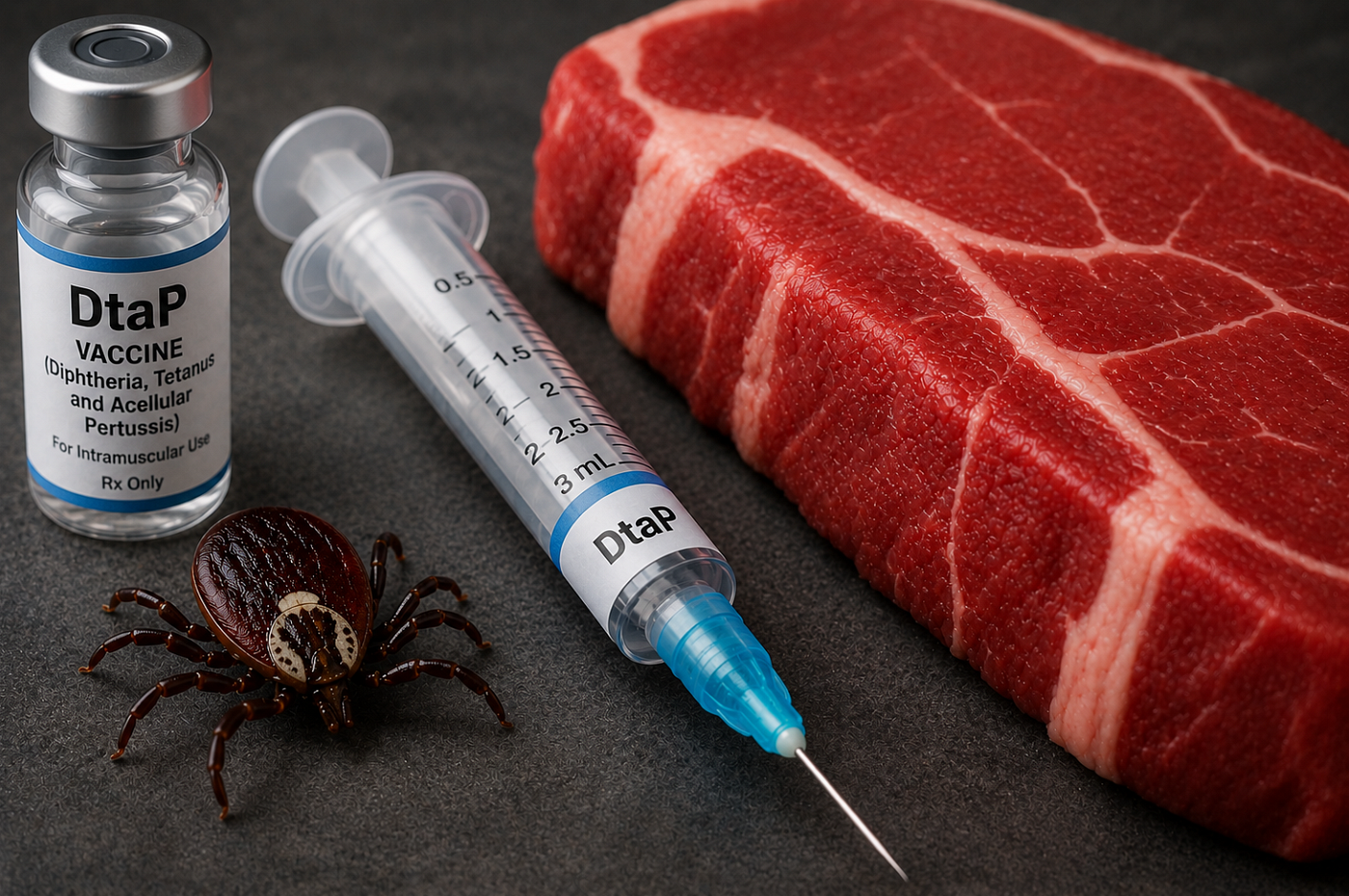
A Condition With No Past
The history of food allergies is long and detailed. Ancient Roman writers noted that what nourishes one person may poison another. Medieval physicians documented reactions to fish and dairy. 18th-century medical texts recorded deaths from shellfish. The 19th century catalogued urticaria from strawberries and eggs. By the early 20th century, scratch-test diagnosis of food allergies was established medicine.
Shellfish allergy. Peanut allergy. Egg allergy. Milk allergy. Each has a documented history stretching back generations, in some cases centuries. Patients reacted, physicians recorded, patterns emerged.
There is one conspicuous absence from this entire archive.
Nowhere in pre-1990 medical literature — not in ancient texts, not in medieval treatises, not in 19th-century dermatology, not in the early immunological literature of the 20th century — is there a single documented case of allergy to mammalian meat or gelatin.
Not one.
Humanity has been eating venison, beef, pork, and lamb for its entire history. Gelatin — derived from the boiled connective tissue of those same animals — has been a nourishing component of foods, medicines, and confections for centuries. Yet the immune reaction now known as Alpha-Gal Syndrome, which makes the consumption of these foods potentially fatal, appears nowhere in the historical record before approximately 2002.
What Alpha-Gal Syndrome Is
Galactose-alpha-1,3-galactose — abbreviated alpha-gal — is a sugar molecule found on the surface of cells in virtually all non-primate mammals. It is present in beef, pork, lamb, venison, rabbit, and the derived products of these animals including gelatin, dairy, and certain pharmaceutical preparations. It is not produced by humans or other Old-World primates; this evolutionary divergence occurred approximately 28 million years ago when a mutation silenced the relevant gene in a primate ancestor.
Alpha-Gal Syndrome (AGS) is a condition in which the human immune system produces IgE antibodies specifically targeting this molecule. When a sensitized person subsequently consumes mammalian meat or gelatin, those IgE antibodies trigger an allergic cascade that can range from urticaria and gastrointestinal distress to anaphylaxis and death. Unusual among food allergies, the reaction is delayed by two to ten hours after consumption.
The condition was formally identified and named in the late 2000s and early 2010s, with foundational papers published by researchers in Australia, the United States, and Europe working largely in parallel. It has since been documented on every inhabited continent. The United States Centers for Disease Control and Prevention currently estimates that as many as 450,000 Americans may be affected.
The official explanation for how people become sensitized is a tick bite. Certain tick species carry alpha-gal in their saliva — acquired from the blood of the mammals on which they feed. When a tick bites a human, it injects this alpha-gal subcutaneously, bypassing the oral tolerance mechanisms of the gut. The immune system, encountering a foreign antigen introduced directly into tissue, mounts an IgE response. Subsequent dietary exposure to alpha-gal then triggers allergic reactions.
The Japanese Evidence
In 1996, researchers at Japan’s National Institute of Health in Tokyo published a paper in the Journal of Allergy and Clinical Immunology that has received far less attention than it deserves.
Dr. Masahiro Sakaguchi and colleagues had been investigating an unusual cluster of anaphylactic reactions among Japanese children who had received standard childhood vaccines — specifically the measles, mumps, and rubella (MMR) vaccine and the varicella vaccine. These reactions had been assumed to involve egg proteins, a known allergen present in some vaccines. But Sakaguchi’s team found something different.
Of twenty-six children who had experienced immediate-type systemic allergic reactions including anaphylactic shock following vaccination, twenty-four were found to carry IgE antibodies to gelatin. Not eggs. Gelatin. The porcine-derived gelatin used as a stabilizer in those vaccines.
More significantly: in seven children who subsequently developed reactions to gelatin-containing foods, five had developed the food allergy only after the vaccine reaction. The vaccine had not revealed a pre-existing sensitivity. It had created one.
These were children in Tokyo — a dense urban environment where tick exposure is effectively zero. They had no history of tick bites. They had no unusual dietary exposures. The only relevant variable in their histories was the receipt of vaccines containing porcine gelatin.
A follow-up paper by Sakaguchi in 1999 examined the cross-reactivity of the IgE antibodies in these children and found that they reacted to gelatins derived from multiple mammalian species. This is precisely the immunological signature of alpha-gal sensitization, in which the immune response targets the conserved carbohydrate epitope common across all non-primate mammalian tissues rather than any species-specific protein.
These children had, in immunological terms, alpha-gal syndrome. In 1996. In Tokyo. Without a single tick bite between them.
The DTaP Connection
The critical question is: how were these children sensitized in the first place? Before they ever received the MMR vaccine that triggered their anaphylaxis — was addressed in a 1999 paper by Nakayama and colleagues, also from Tokyo.
The answer was the DTaP vaccine: the combined diphtheria, tetanus, and acellular pertussis immunization given to infants in the first year of life.
In Japan, the vaccination schedule changed in 1994. Before that year, children received the MMR vaccine first, followed by DTaP. After 1994, the order was reversed: DTaP was administered to infants beginning at three months of age, before the subsequent live virus vaccines.
The DTaP vaccines in use at the time in Japan contained porcine gelatin as a stabilizer.
The consequence was a natural experiment of extraordinary clarity. When MMR was given before DTaP, there were no reports of anaphylaxis among 974,000 recipients of the Kitasato Institute’s MMR vaccine — despite the fact that this vaccine contained the same gelatin at the same concentration as the vaccine given after 1994. When DTaP containing gelatin was given first, sensitizing infants to porcine gelatin in the first months of life, subsequent administration of gelatin-containing MMR produced anaphylaxis at a dramatically elevated rate.
Same vaccine. Same gelatin. Same concentration. The only variable was whether the immune system had been previously primed by parenteral injection of gelatin through DTaP.
Nakayama’s conclusion was direct: the gelatin-containing DTaP vaccine had a causal relationship to the development of gelatin allergy in the children who subsequently reacted to MMR.
This conclusion was confirmed by intervention. When Japanese vaccine manufacturers progressively removed or replaced gelatin in DTaP vaccines — a process completed by February 1999 — reports of anaphylaxis and allergic reactions to live measles vaccines fell dramatically and had almost entirely ceased by the end of 1998.
Why Mechanism Matters
The tick-bite explanation for alpha-gal sensitization rests on a specific immunological mechanism: alpha-gal delivered parenterally — injected directly into tissue rather than consumed orally — bypasses the gut’s tolerance pathways and drives IgE production. This is why eating red meat throughout a lifetime does not sensitize people to alpha-gal, while a tick bite can. The route of exposure determines the immune response type.
The vaccine pathway operates through an identical mechanism. Porcine gelatin injected intramuscularly or subcutaneously in infancy bypasses oral tolerance entirely. The infant immune system, encountering alpha-gal as a foreign antigen in tissue rather than in the digestive tract, does what immune systems do with novel parenteral antigens: it mounts an adaptive response. Given the adjuvant environment of a vaccine formulation and the Th2-skewing tendency of the neonatal immune system, that response is IgE.
The tick and the vaccine are, mechanistically, the same event. Both introduce alpha-gal beneath the skin. Both circumvent the oral tolerance that normally prevents dietary mammalian proteins from becoming allergens. Both produce IgE sensitization that subsequently makes consumption of mammalian products dangerous.
The difference is that one of them is a wild arthropod encountered opportunistically in outdoor environments, and the other is a pharmaceutical product administered systematically to the entire childhood population on a coordinated schedule.
The Timing Problem Revisited
The first documented case of gelatin allergy in the Western medical literature appears to be 1991, when a 17-year-old girl in California developed anaphylaxis within minutes of receiving an MMR vaccine and reported previous throat pruritus and tongue swelling developed after she ate Jell-O. This case was published in 1993 by Kelso and colleagues — the same period in which Japanese researchers were beginning to document the same phenomenon in Tokyo children.
In the United States, the earliest collection of meat allergy cases began in 1989 in Athens, Georgia, when physician Antony Deutsch and colleague Sandra Latimer documented ten patients with delayed anaphylaxis to mammalian meat and noted a preceding history of tick bites. This connection was presented to the Georgia Allergy Society and to the CDC in 1991. No follow-up was issued.
Both streams of evidence — the Japanese vaccine-mediated gelatin sensitization and the American tick-associated meat allergy — begin at the same moment: the late 1980s to early 1990s.
Before this period, across the entire documented history of human medicine, there is no record of either condition.
This is not an absence attributable to diagnostic limitations. Food allergy had been diagnosed, characterized, and published for decades before 1989. The IgE antibody was first described in 1967. By the 1970s and 1980s, allergy testing was standard practice in academic medical centers worldwide. If patients had been experiencing delayed anaphylaxis to beef or immediate anaphylaxis to gelatin, those cases would have appeared in the literature. They did not.
Something changed in the late 1980s.
What Changed
The answer documented in the Japanese literature is the composition of childhood vaccines.
Gelatin was introduced into vaccine formulations as a stabilizer — a molecule that protects live viral components from degradation during storage and transport, particularly in warm climates where cold chain maintenance is unreliable. Its introduction into widely distributed childhood vaccines was a practical solution to a manufacturing and distribution problem.
The consequence was the systematic, global administration of porcine-derived alpha-gal to infants, injected directly into tissue, in the first months of life, in quantities sufficient to induce IgE sensitization in a proportion of recipients.
This is not a theoretical inference. It is the documented conclusion of Japanese researchers who confirmed it through a controlled natural experiment with a clear dose-response relationship and a successful intervention. When the sensitizing agent was removed, the disease it caused disappeared.
The Question the Literature Has Not Asked
The Japanese episode is presented in the scientific literature as a resolved historical anomaly — a Japan-specific problem identified, investigated, and corrected in the 1990s. The gelatin was removed from DTaP. The cases of vaccine-related gelatin allergy declined. The matter, in the framing of subsequent publications, was closed.
Alpha-Gal Syndrome then emerged separately in the late 2000s as a tick-borne disease, its origins attributed to the lone star tick in the United States and to various Ixodes species in Europe, Australia, and Asia. The connection between vaccine-mediated gelatin sensitization and the broader Alpha-Gal Syndrome epidemic has received minimal attention in the mainstream literature.
Several questions follow from the evidence reviewed here that have not been formally examined.
First: gelatin remains a component of multiple vaccines administered globally, including MMR, varicella, zoster, yellow fever, some influenza vaccines, and others. While DTaP in Japan was reformulated in 1999, the international vaccine schedule continues to include gelatin-containing preparations. The question of whether these vaccines contribute to the pool of alpha-gal-sensitized individuals — not through the dramatic anaphylaxis mechanism documented in Japan, but through subclinical sensitization that later manifests as Alpha-Gal Syndrome — has not been studied.
Second: the proportion of the estimated 450,000 Alpha-Gal Syndrome cases in the United States attributable to tick bites versus other parenteral exposures to alpha-gal has not been determined. Studies documenting the tick-bite histories of Alpha-Gal Syndrome patients consistently note that a substantial minority of patients have no recalled tick exposure. These cases are typically attributed to forgotten or unrecognized bites. The alternative hypothesis — that some proportion of sensitization occurs through medical or pharmaceutical exposure to mammalian-derived alpha-gal — has not been systematically investigated.
Third: the complete absence of documented gelatin or mammalian meat allergy before the late 1980s, combined with the simultaneous appearance of such cases across multiple countries at the precise moment when gelatin-containing vaccines were being introduced or their schedules reorganized, constitutes a temporal correlation that has not been formally addressed in the alpha-gal literature.
What the Evidence Supports
Anaphylaxis to mammalian meat products as a clinically significant, diagnosable condition did not exist in the documented medical literature before approximately 1989–1991. This is not a gap in historical recognition — it is an absence across centuries of detailed food allergy documentation.
Porcine gelatin in vaccines contains alpha-gal and, when injected parenterally, can sensitize recipients to alpha-gal through IgE production. This is not a hypothesis; it is the peer-reviewed finding of Japanese researchers published in major allergy journals between 1996 and 2003, confirmed by an intervention study.
The sensitization mechanism operative in vaccine-related gelatin allergy is immunologically identical to the mechanism proposed for tick-bite-induced AGS. Both involve parenteral introduction of alpha-gal, both bypass oral tolerance, and both produce IgE-mediated sensitivity to mammalian meat and gelatin products.
The tick-bite explanation for AGS is supported by epidemiological correlation and biological plausibility but lacks direct causal proof in humans as acknowledged by researchers in the field. It does not account for all documented cases, particularly those in urban populations with no plausible tick exposure.
What the evidence does not support is the conclusion that tick bites are the sole, or necessarily the primary, mechanism by which the global population of alpha-gal-sensitized individuals was created.
In fact, it is mechanistically possible for the two to be working together. Researchers studying how tick bites produce IgE to alpha-gal have identified two candidate mechanisms.
The first hypothesis suggests that in the context of Th2 cell-mediated immunity induced by tick saliva, alpha-gal expressed on tick saliva proteins is presented to antigen-presenting cells and B cells, triggering differentiation into plasma cells producing anti-alpha-gal IgE antibodies.
The second hypothesis suggests that tick saliva contains factors like PGE2 that could induce class switch recombination of pre-existing B cell clones producing anti-alpha-gal IgM and/or IgG to produce IgE.
The second mechanism is saying the tick doesn’t need to sensitize the person to alpha-gal from scratch. It only needs to find pre-existing anti-alpha-gal B cells already in circulation and switch them from producing IgG or IgM to producing IgE. The PGE2 in tick saliva is the switch. The tick is switching existing B cells. It is not necessarily creating them.
This is confirmed by Platts-Mills — one of the field’s founding researchers — who states directly: the subsequent IgE response to alpha-gal involves T cells that are specific for tick proteins and have a strong Th2 signal; those T cells are almost certainly responsible for the switch to IgE of the existing IgG or IgM committed B cells in the circulation.
Where the Literature Stops Short
The published framework assumes those pre-existing anti-alpha-gal IgG and IgM B cells come from two sources: the natural anti-alpha-gal antibodies all humans carry, and exposure to gut microbiota bearing structurally similar antigens. It might be envisaged that exposure to gut microbes leads to basal anti-alpha-gal IgG levels, whereas later exposure to alpha-gal via tick bites in the context of basophil-derived IL-4 might induce further class switch recombination in anti-alpha-gal memory B cell clones, leading to the production of IgE antibodies.
The literature treats this gut microbiome exposure as the source of the pre-existing B cell pool that ticks then switch to IgE. It has not asked whether parenteral exposure to alpha-gal through vaccination might create a substantially larger, more reactive pool of those same B cells — making the individual far more susceptible to class switching when a tick bite occurs.
Why the Vaccine Priming Hypothesis Is More Explanatory
My proposed model of vaccine priming creates the pre-existing IgG pool, tick bite switches it to IgE — and actually resolves several anomalies the conventional model struggles with.
Why do only some tick-bitten people develop alpha-gal syndrome? If the tick were the sole sensitizer, conversion rates should be higher and more predictable. From a statistical point of view, there seems to be a direct relationship between the levels of IgG and the possibility of developing AGS. Under my model, individuals with higher pre-existing anti-alpha-gal IgG — elevated through prior parenteral vaccine exposure — would be disproportionately susceptible to tick-bite-induced class switching. Those without the elevated IgG baseline would be much less likely to convert even after multiple tick bites.
Why are multiple tick bites are required? Strong evidence suggests that in susceptible individuals, class switch to IgE occurs after several tick bites. Multiple bites delivering multiple rounds of PGE2 are needed to complete the class switch in most people. Under my model, someone who received multiple doses of gelatin-containing DTaP in infancy — raising their anti-alpha-gal IgG substantially — would require fewer tick bites to complete the switch than someone whose only prior exposure was gut microbiota.
Why do urban patients without tick exposure still develop alpha-gal syndrome? Under my model these patients received sufficient parenteral alpha-gal through vaccination to drive IgE production directly, without needing the tick’s PGE2 class-switching step — particularly if the vaccine adjuvant environment was sufficient to drive IgE production on its own, as the Japanese DTaP cases demonstrated it could be.
Why the condition emerged when it did. The natural anti-alpha-gal IgM and IgG antibodies that all humans carry have existed for 28 million years. Gut microbiota have always exposed humans to structurally similar antigens. Ticks have always bitten humans. None of these factors changed in the late 1980s. The Japanese DTaP schedule changed.
What the Model Predicts
If my hypothesis is correct — a vaccine creates the sensitized B cell pool, a tick bite switches it to IgE — then several testable predictions follow that have not been examined in the literature:
People who received more doses of gelatin-containing vaccines in infancy should have higher baseline anti-alpha-gal IgG and should convert to IgE with fewer tick bites. alpha-gal syndrome prevalence should correlate not just with tick density but with prior vaccination history including gelatin-containing formulations. Countries that removed gelatin from their DTaP schedules earlier should show lower alpha-gal syndrome incidence than predicted by tick density alone. And critically — people developing alpha-gal syndrome in tick-endemic areas should, on average, have higher pre-existing anti-alpha-gal IgG than people bitten by ticks who do not develop alpha-gal syndrome.
None of these comparisons have been made in the published literature. The vaccine history of alpha-gal syndrome patients is not routinely collected or analyzed. The question has not been asked.
The Summary
I have identified that the tick, in the second and arguably more mechanistically supported model of alpha-gal syndrome development, is not a sensitizer. It is a class-switch inducer. It takes pre-existing anti-alpha-gal B cells and converts them from harmless IgG production to dangerous IgE production using PGE2 as the molecular switch.
The conventional assumption is that those pre-existing B cells come from gut microbiota. My hypothesis is that they come — in greater numbers and at higher titers — from parenteral injection of porcine or bovine gelatin in early infancy through DTaP or other vaccinations.
The mechanism is established. The molecular switch is established. The only thing the literature has not done is replace “gut microbiota” with “gelatin-containing vaccine” as the source of the pre-existing B cell pool — and then ask what that substitution predicts about who develops alpha-gal syndrome, when, and why.
Conclusion
Mammalian meat allergy is a real, serious, and increasingly prevalent condition. The suffering it causes is not in dispute. The tick-bite mechanism that the scientific community has identified as its primary cause is biologically plausible and epidemiologically supported in tick-endemic populations.
But the condition has no historical precedent. It appears in the literature at a specific moment in the late 1980s, in multiple countries simultaneously, at a time when gelatin-containing vaccines were being introduced into childhood immunization schedules worldwide. Japanese researchers documented, confirmed through intervention, and published the direct causal relationship between gelatin-containing DTaP vaccines and alpha-gal sensitization in children who had never been exposed to ticks.
That evidence is in the peer-reviewed record. It has been there since 1996.
The question of whether the introduction of mammalian-derived gelatin into the parenteral vaccine supply contributed to — or in some populations created — the sensitized population that now experiences alpha-gal syndrome is not a fringe hypothesis. It is a reasonable scientific question arising directly from the published literature that has yet to receive a formal, systematic answer.
Primary sources referenced:
Sakaguchi et al. (1996), J Allergy Clin Immunol 98:1058;
Sakaguchi et al. (1999), Immunology 96:286;
Nakayama et al. (1999), J Allergy Clin Immunol 103:321;
Nakayama & Aizawa (2000), J Allergy Clin Immunol 106:591;
Sakaguchi et al. (2000), Vaccine 18:2346;
van Nunen (2014), Curr Treat Options Allergy 1:262;
Commins et al. (2011), J Allergy Clin Immunol 127:1286;
John M. Kelso, R.T. Jones, J.W. Yunginger (1993), J Allergy Clin Immunol 91:4,867–872;
Román-Carrasco P, Hemmer W, Cabezas-Cruz A, Hodžić A, de la Fuente J and Swoboda I (2021) The α-Gal Syndrome and Potential Mechanisms. Front. Allergy 2:783279. doi: 10.3389/falgy.2021.783279
Joral A, Azketa N, Sanchez P, Vélez-del-Burgo A, Aranzabal-Soto M-A, Lizarza S, Martínez J, Postigo I. The Quantification of IgG Specific to α-Gal Could Be Used as a Risk Marker for Suffering Mammalian Meat Allergy. Foods. 2022; 11(3):466
T. A. E.Platts-Mills, R. S.Gangwar, L.Workman, and J. M.Wilson, “The Immunology of Alpha-Gal Syndrome: History, Tick Bites, IgE, and Delayed Anaphylaxis to Mammalian Meat,” Immunological Reviews332, no. 1 (2025): e70035
Perusko M, Grundström J, Eldh M, Hamsten C, Apostolovic D and van Hage M (2024) The α-Gal epitope — the cause of a global allergic disease. Front. Immunol. 15:1335911. doi: 10.3389/fimmu.2024.1335911
메타데이터
- post_id
- ae0b9e3fdc01
- slug
- the-allergy-that-shouldnt-exist-vaccines-gelatin-and-the-strange-origins-of-alpha-gal-syndrome-ae0b9e3fdc01
- url
- https://medium.com/@travisjohnsondds/the-allergy-that-shouldnt-exist-vaccines-gelatin-and-the-strange-origins-of-alpha-gal-syndrome-ae0b9e3fdc01
- canonical_url
- https://medium.com/@travisjohnsondds/the-allergy-that-shouldnt-exist-vaccines-gelatin-and-the-strange-origins-of-alpha-gal-syndrome-ae0b9e3fdc01
- author_url
- https://medium.com/@travisjohnsondds
- status
- ok
- fetched_at
- 2026-06-09 15:37:30