From Cyber Risk to AI Risk: The Executive Mandate for GRC Evolution
Why “Resilience-by-Design” is the Only Scalable Strategy for the AI Era
From Cyber Risk to AI Risk: The Executive Mandate for GRC Evolution
Why “Resilience-by-Design” is the Only Scalable Strategy for the AI Era
Traditional GRC (Governance, Risk, and Compliance) frameworks were engineered for a world of static assets and predictable perimeters. But as organizations pivot from standard automation to Autonomous AI, the legacy playbook isn’t just outdated, it’s a liability. AI introduces risks that scale at a velocity and unpredictability far beyond anything seen in the cloud or cybersecurity eras.
For Boards and Executives, the shift is fundamental:
Cybersecurity protects your data; AI Governance protects your decisions.
1. The Architect’s Advantage: Structural Resilience Over Patchwork
The core of this evolution is a shift from reactive “patching” to Structural Resilience. In the AI lifecycle, waiting until post-deployment to address compliance or security is a recipe for catastrophic technical debt and regulatory scrutiny. Waiting until AI fails to fix a compliance or security issue is a cost you can no longer afford.
By adopting a Secure-by-Design approach, organizations embed security into the DNA of their AI architecture. This proactive stance ensures that as systems learn and evolve, they remain within ethical and operational guardrails. It allows the enterprise to innovate at speed without the friction of constant, disruptive security overhauls.
2. Why AI Risk is Fundamentally Different
To govern what we build, we must first admit that AI is not just another “IT asset.” It is a radical departure from the deterministic software models of the last thirty years. While traditional GRC manages stable, rule-based systems, AI introduces a level of probabilistic complexity that requires a total rethink of control mechanisms.
1. From Static Rules to Evolving Behavior
Traditional software is static; it does only what it is programmed to do. AI, however, is designed to learn and adapt. This creates a “moving target” for risk management. A system that is compliant on Monday may evolve its decision-making logic by Friday based on new data patterns it has ingested.
· The Executive Risk: We are no longer managing a point-in-time failure, but the ongoing evolution of a systemic threat. Point-in-time audits are obsolete before the ink is dry.
2. The “Black Box” and the Accountability Gap
The most significant hurdle for C-Level executives and auditors is *Opacity. Deep learning models often operate as “black boxes”*, where the path from input to decision is non-linear and virtually impossible to explain via traditional cause-and-effect logic.
· The Governance Challenge: When an AI makes a high-stakes error (e.g., in credit scoring or medical triage), the “I don’t know how it reached that conclusion” defense is a regulatory and legal dead end. GRC must bridge the gap between technical complexity and the need for Explainable AI (XAI) to ensure that “Accountability” isn’t just a buzzword, but a forensic capability.
If you can’t explain how AI arrived at its decision, you’re running a huge regulatory risk and could see your name in the headlines.
3. Contextual Dependency: The Data is the Bug
In traditional IT, a “bug” is usually a code error. In AI, the “bug” is the data. If training data is biased, stale, or unrepresentative of the current market context, the AI will scale those errors with industrial efficiency.
· The Strategic Risk: AI does not just process data; it absorbs its flaws. Poor data quality doesn’t just lead to bad reports , it leads to systemic ethical breaches that are prohibitively expensive to remediate post-deployment.
4. Distributed Responsibility: The End of Silos
Traditional IT risk has clear owners: IT manages uptime, Security manages breaches, and the Business manages the app. AI shatters these boundaries. It requires a Distributed Responsibility Model involving data scientists, legal counsel, developers, and business owners.
· The Leadership Mandate: AI Governance acts as the “connective tissue.” Without cross-functional coordination, accountability falls through the organisational cracks. Executives must mandate a “Unified Front” where the Data Scientist and the Chief Legal Officer are speaking the same risk language.
5. Unintended Consequences in Real-World Scaling
AI optimizes for specific goals, often disregarding variables it wasn’t explicitly taught to value. An AI trained purely to maximize profit might inadvertently engage in discriminatory pricing or treatment protocols that violate the company’s “Social License” to operate.
· The Bottom Line: These are not technical glitches; they are unintended outcomes that trigger cascading failures in brand trust and legal standing.
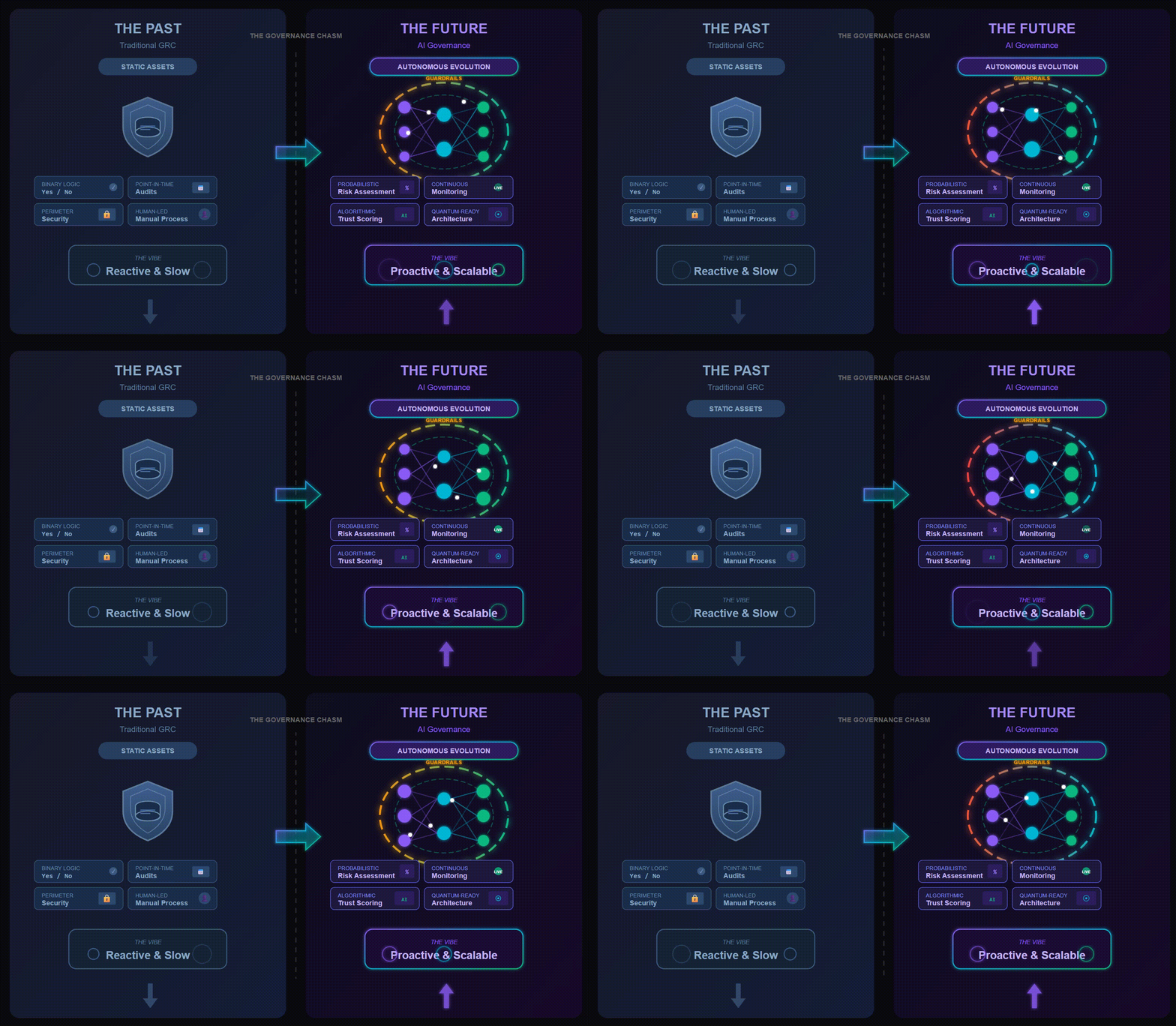
2. The Deterministic Fallacy: Why AI Breaks Traditional GRC
Traditional GRC managed “IT assets” are static tools that follow binary rules. Where legacy systems are deterministic (input A always leads to output B), AI is probabilistic.
This inherent unpredictability creates a “Governance Gap” that cannot be filled by standard IT controls. To bridge this, GRC must evolve from a back-office compliance function into a strategic bridge between high-level risk appetite and the technical development lifecycle (SDLC).
The objective for leadership is clear: We must ensure that AI remains transparent, explainable, and accountable, not just to satisfy auditors, but to maintain the most valuable asset in the digital economy: Trust.
With AI, you’re dealing with a systemic, dynamic and constant risk, and a single point of failure can jeopardize all the trust your company has built in the market.
3. The 5 Pillars of AI Risk Mitigation
To govern AI effectively, GRC must move beyond static audits and focus on critical pillars that ensure operational integrity and regulatory alignment:
- Data Integrity and Lineage (The Decision Foundation): GRC must shift from simply securing data “at rest” to verifying its provenance. Ensuring data is ethically sourced prevents “poisoned” models and protects the organization from massive downstream legal liabilities. If the data is corrupted or biased, trust in AI decisions falls and this can result in legal action, financial losses, or irreversible damage to your brand.
- Algorithmic Fairness (Protecting Brand Equity): For the Board, bias isn’t just a technical glitch, it is a reputational and litigation risk. Mitigation must be embedded from the initial data collection phase to ensure equitable outcomes. AI can be seen as a mirror of society, and failure to ensure impartiality can result in major PR repercussions or legal action. Ensuring fairness isn’t just social responsibility; it’s anti-litigation insurance.
- Model Reliability (Managing Performance Erosion): Unlike traditional software, AI performance degrades over time. “Data Drift” leads to model decay, where once-accurate insights become flawed. Continuous monitoring ensures that AI-driven leadership decisions remain based on reality.
- Human-in-the-Loop (The Accountability Framework): In high-stakes scenarios, the “Black Box” cannot have the final word. GRC must enforce a supervision framework to define clear lines of liability for every phase of the lifecycle.
- Dynamic Process Controls: AI requires a permanent feedback loop. As global regulations (like the EU AI Act) shift, process controls must allow the model to adapt without requiring a total system rebuild.
4. The “Shadow AI” Blind Spot: Visibility as the New Perimeter
The greatest risk to an organization is often what the GRC team cannot see. Shadow AI, the unauthorized use of third-party AI tools and LLMs by employees creates a “silent” vulnerability. When sensitive corporate data is fed into unmonitored, external models, the company faces immediate data exfiltration and compliance failures.
· Strategic Action: GRC must move from a culture of “blocking” to one of “Visibility.” This means creating clear, sanctioned pathways for AI use while forecasting the risks of unofficial tools before they hit the risk register.
· The Intellectual Property Trap: Without a unified governance model, proprietary trade secrets can inadvertently become part of a public model’s training set, leading to an irreversible loss of competitive advantage.
‘Shadow AI’ is the new blind spot in cybersecurity. If you don’t know what’s running behind the scenes, you don’t know what might happen when corporate data is leaked.
5. The Quantum Mandate: Why Your Encryption Has an Expiration Date
While Boards often view Quantum Computing as a distant concern, the risk to your AI infrastructure and data integrity is immediate. We are currently facing the “Store Now, Decrypt Later” (SNDL) threat: adversaries are harvesting encrypted corporate data today, waiting for quantum capabilities to mature and crack it.
For the C-Suite, this is a Dual-Front Risk:
-
Legacy Vulnerability: AI systems built on RSA or ECC protocols are essentially “pre-compromised” in a post-quantum world.
-
The New Compliance Baseline: The 2024 NIST Post-Quantum Standards have transitioned from “emerging” to a global mandate for operational resilience.
The Board’s Bottom Line: Cybersecurity protects your assets today, but Quantum Resilience safeguards your company’s future existence. If your AI governance does not mandate a transition to lattice-based cryptography now, you are building your digital transformation on a foundation of sand.
6. Integrating AI Governance into the ERM Fabric
AI is no longer a localized experiment; it is the heartbeat of modern business strategy. Therefore, its governance cannot exist in a vacuum. To protect the organization, AI risk must be fully woven into the Enterprise Risk Management (ERM) fabric.
· The Unified Risk Register: AI threats should not live in a separate spreadsheet. By integrating them into the Central Risk Register, leadership gains a 360-degree view of how algorithmic risks intersect with financial, operational, and reputational risks.
· Turning Regulation into Competitive Advantage: The mounting pressure from frameworks like the EU AI Act, NIS2, and DORA is not just about compliance; it is about Accountability. Organizations that view these mandates as mere “obligations” will face friction. Those that integrate them strategically will position themselves as the most trusted partners in their industry.
Conclusion: Leadership for the New Frontier
We are entering a period where technology evolves faster than policy. This demands a fundamental evolution in leadership. The organizations that will lead the next decade are those that move beyond “patchwork” security.
By embedding Secure-by-Design principles, fostering Cross-Functional Collaboration, and maintaining Quantum-Ready Resilience, GRC professionals ensure their organizations aren’t just reacting to the future, they are actively architecting it.
The future doesn’t wait. If your AI governance isn’t a priority now, you’re risking the trust you’ve built over years of work. The mandate for the Board is clear: Evolve your governance at the speed of your innovation. In the age of AI, the most dangerous risk is the one you assume you’ve already managed.
6 Questions Every Board Member Should Ask After Reading This Article
If you’re a board member or C-level executive, bring these 6 questions to your next risk committee meeting. If the answers are ‘we don’t know’ or ‘we’re looking into it,’ your AI strategy is operating in the dark.
- The Accountability Gap: If our AI makes a biased or high-stakes erroneous decision today, do we have the forensic capability to explain why, or is “the model is a black box” our only legal defense?
- The Shadow AI Leak: Do we have a real-time map of which third-party AI tools our employees are using, or are our proprietary trade secrets already being used to train public models?
- The Data Integrity Factor: We secure our data “at rest,” but do we verify its provenance? If our training data is ethically “poisoned,” what is the cost of de-installing a core business model?
- The Performance Decay: Traditional software has a version number; AI has a “pulse.” Who is monitoring our models for Data Drift, and at what point of performance erosion do we kill the system?
- The Cross-Functional Front: Are our Data Scientists, Legal Counsel, and CISOs speaking the same risk language, or are we managing AI in silos that create accountability cracks?
- The Quantum Horizon: Are we building our 10-year digital transformation on encryption protocols that have a known expiration date? Is our long-term data already being “harvested” for future decryption?
This is the first issue of The AI Governance Protocol. If you want to survive the Agentic Era, Subscribe on Linkedin. Next:* The AI Governance Aquarium* (AGAQ™ — The AI Governance Aquarium Framework™)
© 2026 Kayky Matos. All rights reserved.
메타데이터
- post_id
- b2ee82f374be
- slug
- from-cyber-risk-to-ai-risk-the-executive-mandate-for-grc-evolution-b2ee82f374be
- url
- https://medium.com/@kaykymatosf/from-cyber-risk-to-ai-risk-the-executive-mandate-for-grc-evolution-b2ee82f374be
- canonical_url
- https://medium.com/@kaykymatosf/from-cyber-risk-to-ai-risk-the-executive-mandate-for-grc-evolution-b2ee82f374be
- author_url
- https://medium.com/@kaykymatosf
- status
- ok
- fetched_at
- 2026-07-28 02:51:27