REG2025: Deep Dive into MICCAI’s Challenge on Generating Pathology Reports from Whole Slide Images
This article was written with Claude Code (Claude Opus 4.6) and reviewed/edited by a human.
REG2025: Deep Dive into MICCAI’s Challenge on Generating Pathology Reports from Whole Slide Images
This article was written with Claude Code (Claude Opus 4.6) and reviewed/edited by a human.
Understand This Challenge in 3 Minutes

REG2025: A challenge to automatically generate pathology reports from gigapixel whole slide images.
Key Facts
- Full Name: REport Generation in pathology using Pan-Asia Giga-pixel WSIs (REG2025)
- Venue: MICCAI 2025 (Daejeon, Korea, September 2025)
- Task: Automatically generate structured pathology reports from gigapixel WSIs
- Data Scale: ~10,500 cases (train 8,494 / test ~1,000 per phase)
- Organs: Breast, bladder, cervix, colon, lung, prostate, stomach (7 organs)
- Data Sources: 6 institutions across 5 countries (Korea, Japan, India, Turkey, Germany)
- Participating Teams: 26
- Winning Score: 0.8397 (ICGI / Oslo University Hospital)
- Platform: Grand Challenge
The Task
Input: A TIFF whole slide image (WSI) at 20x magnification — a single image that can be several gigapixels.
Output: A structured pathology report in JSON format, covering organ site, procedure, histological type, and malignancy grade.
In one sentence: read a massive pathology slide image and write the kind of diagnostic report a pathologist would write.
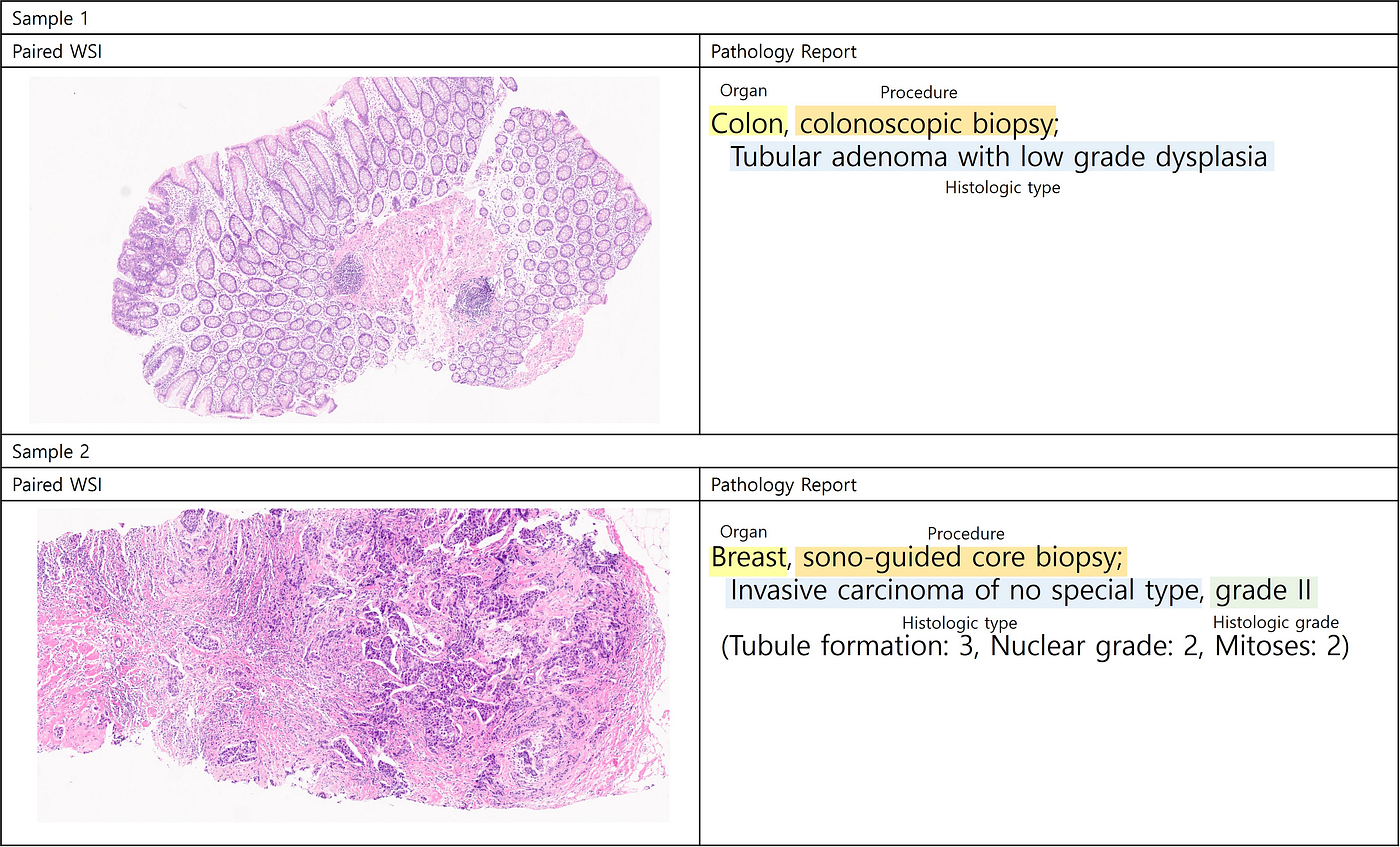
A WSI (left) paired with its corresponding pathology report (right).
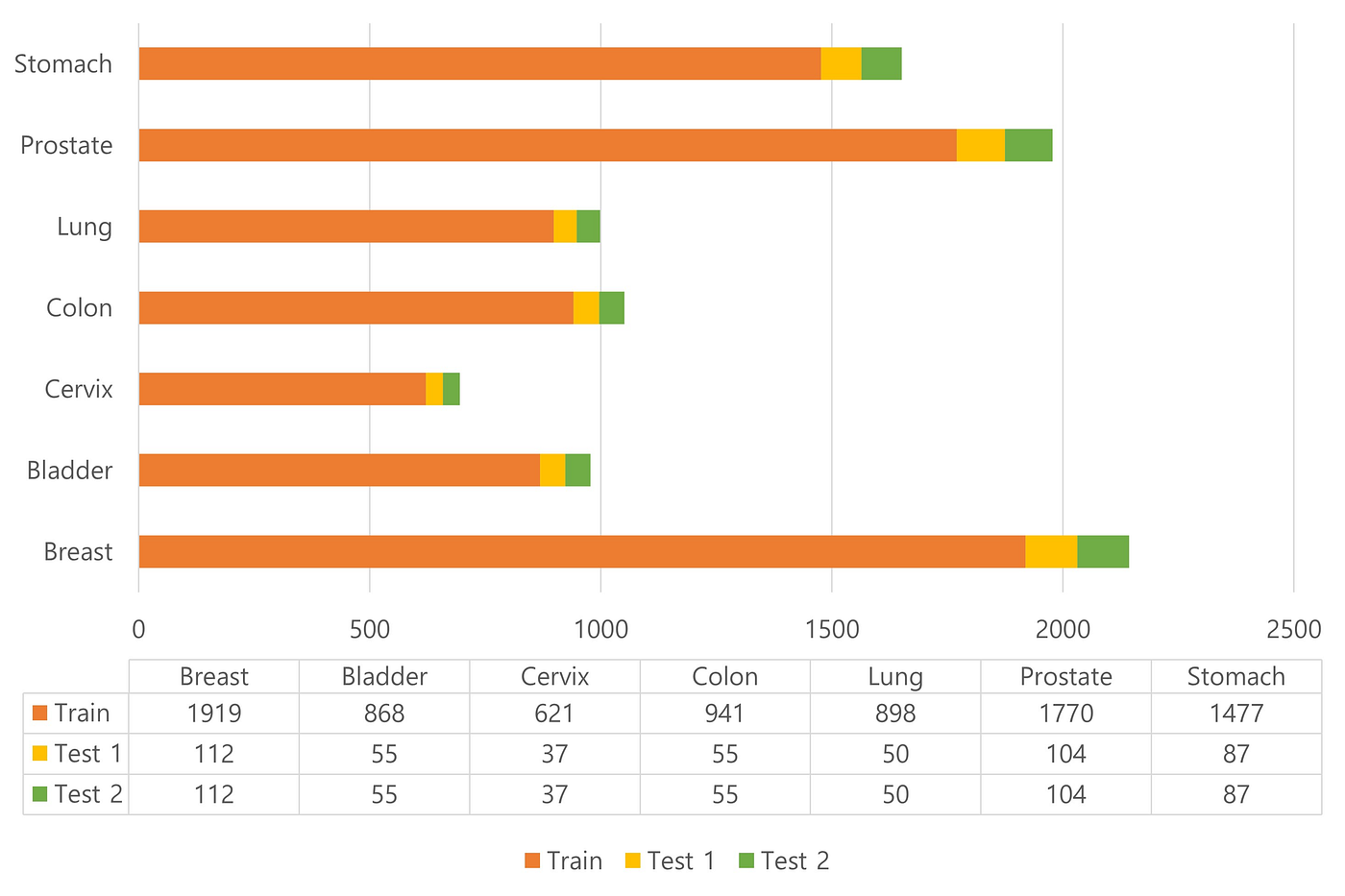
Case distribution across 7 organs: breast, bladder, cervix, colon, lung, prostate, and stomach.
Evaluation Metric
Final Score = 0.15 × ROUGE-L + 0.15 × BLEU-4 + 0.40 × KEY + 0.30 × EMB
- KEY (Jaccard) — 40%: Overlap of medical keywords between generated and ground-truth reports
- EMB (Cosine similarity) — 30%: Semantic similarity of sentence embeddings
- ROUGE-L — 15%: Longest common subsequence
- BLEU-4–15%: 4-gram precision
The key insight: BLEU and ROUGE are minor players here. KEY score (medical keyword matching) accounts for 40%, so the challenge fundamentally rewards generating the correct medical terminology over fluent prose.
Why This Problem Is Hard — and How to Think About It
The Scale Problem
A whole slide image (WSI) is a digitized glass slide that pathologists examine under a microscope. A single WSI can contain billions of pixels — imagine a satellite photograph of an entire city at street-level resolution. No AI model can process this as a single input. Teams must split each WSI into thousands of small tiles, process them individually, then somehow synthesize a coherent report from the pieces.
The Three Capabilities Framework
Generating a pathology report from a WSI requires three distinct capabilities:
- See — Extract meaningful features from WSI tiles, using pathology foundation models (H-Optimus-1, UNI, etc.)
- Aggregate — Synthesize thousands of tile features into a slide-level representation, using attention / MIL (Multiple Instance Learning)
- Write — Generate a structured report from the aggregated representation, using LLMs (BioBART, LLaMA, Qwen, etc.)
Every team’s approach differs in how they combine these three components. As you read the solutions below, ask: “Where did this team differentiate — in seeing, aggregating, or writing?”
Final Leaderboard
- 🥇 ICGI — 0.8397 (Oslo University Hospital / H-Optimus-1)
- 🥈 ICL_PathReport — 0.8202
- 🥉 IMAGINE Lab — 0.8047 (Ranked 1st in Phase 2 alone with 0.8494)
- ADCT — 0.7973
- IUCompPath — 0.7900 (Ranked 2nd in Phase 1)
- TrustPath — 0.7815
- TeamTiger@REG2025–0.7766
- MedInsight-ViseurAI — 0.7539
- katherlab — 0.7290
- MTS_REG_2025–0.7276
Final ranking = Phase 1 (20%) + Phase 2 (80%) weighted average. Rankings shifted between phases, showing that robustness to distribution shifts — not just raw performance — was essential.

REG2025 final leaderboard: NARWHAL (ICGI team) wins with 0.839.
Winning Solution: ICGI / NARWHAL
The winning team ICGI (Oslo University Hospital, Norway) built a system called NARWHAL. Here’s how it maps to the See–Aggregate–Write framework.
WSI → [Preprocessing: TRIDENT] → [See: H-Optimus-1] → [Aggregate: Attention] → [Write: Report Generation]Preprocessing: Tiling the WSI (TRIDENT)
The gigabyte-scale WSI is sliced into small 256×256 pixel tiles (patches). A single WSI yields thousands to tens of thousands of tiles. This is necessary because no model can process the full image at once.
Tool: TRIDENT — an open-source preprocessing toolkit by Bioptimus.
See: H-Optimus-1 (Tile → Feature Vector)
Each tile is passed through H-Optimus-1, which converts the raw image into a numerical feature vector — a compressed representation of “what’s in this image.” The model recognizes tissue structures, cell morphology, and pathological patterns without being explicitly told what to look for.
H-Optimus-1 at a glance:
- Developer: Bioptimus (French AI startup)
- Parameters: 1.1 billion (ViT-g/14 architecture)
- Training Data: 1M+ H&E-stained slides from 800K+ patients, 4,000 institutions, 50 organ types
- Training Method: Self-supervised learning (no labels needed)
- License: Apache 2.0 (open, commercial use allowed)
- Availability: Free on HuggingFace
Why H-Optimus-1 won out: The team compared five pathology foundation models.
ModelOrgan CoverageREG2025 7-Organ FitResultH-Optimus-150 organsAll 7 coveredBest scoreUNI20+ organsNearly full coverageRunner-upCONCHLimitedPossible gapsLower
The deciding factor was training data diversity, not model size. REG2025 includes 7 organs from 5 countries, so a model trained on 50 organs across 4,000 institutions could handle whatever slide appeared — Korean stomach tissue, Indian breast biopsies, German lung samples. Being Apache 2.0 also means anyone can reproduce this approach.
Aggregate: Attention Pooling (Tiles → Slide Representation)
Thousands of tile feature vectors are collapsed into a single slide-level summary using attention pooling. The model automatically assigns high weights to diagnostically important tiles (tumor regions, atypical cells) and low weights to background or normal tissue.
This mirrors how pathologists work: they don’t examine every cell equally — they scan at low magnification, then zoom into suspicious areas.
Write: Report Generation (Slide Representation → Text)
The aggregated slide representation is decoded into a structured pathology report containing organ site, procedure type, histological classification, and grade.
Generating fluent text isn’t enough. Because KEY score (40% of the evaluation) demands exact medical keyword matches, the model must produce precise terms like “adenocarcinoma,” “moderately differentiated,” and “pT2” without omission.
Why This Design Won
- See: H-Optimus-1’s 50-organ coverage handled all 7 target organs with minimal domain shift. Open model.
- Aggregate: Attention pooling auto-focused on diagnostically relevant regions, filtering out noise.
- Write: Custom generation module optimized for KEY score (40%) via keyword-aware generation. Narrow victory.
How Other Teams Approached the Problem
Here’s how different approaches combined the See–Aggregate–Write capabilities. The first two are confirmed REG2025 participants; the latter two are related research published after the challenge.
ICGI (1st place) — H-Optimus-1 → Attention pooling → Custom module. Generalization via diverse FM. Paper (2026.2)
MPath (Phase 2: 4th) — CONCH + Titan → Visual prefix → BioBART. Lightweight and interpretable. Paper (2025.12)
RANGER (related work) — UNI + PLIP → RAG retrieval → MoE decoder. Generate by referencing similar past reports. Paper (2026.3)
HiPath (related work) — UNI2 → Hierarchical alignment → Qwen3. Freeze everything, train only 15M params. Paper (2026.3)
Note: RANGER and HiPath have not been confirmed as REG2025 participants. HiPath’s authors include Imperial College London researchers, potentially matching the 2nd-place team “ICL_PathReport.”
MPath (Phase 2: 4th) — The Practical Route
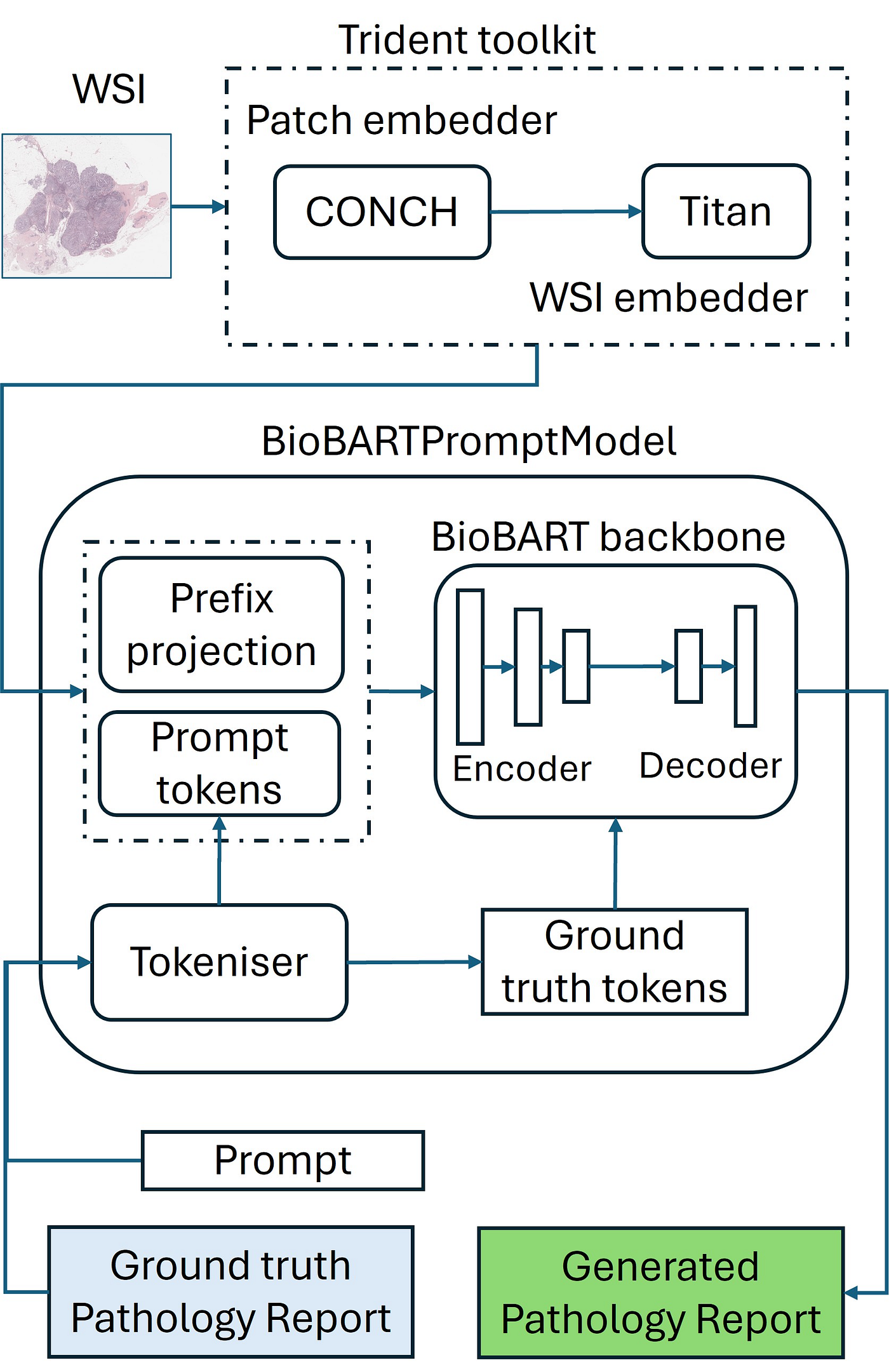
MPath pipeline overview.
MPath was designed to work with limited GPU resources.
- Extract features using two foundation models (CONCH + Titan)
- Inject these features as a visual prefix into the LLM input — essentially telling the model “here’s what the image looks like” before asking it to write
- Generate the report using BioBART — a lightweight model pre-trained on biomedical literature
The notable choice here is using BioBART instead of large LLMs like LLaMA-3. MPath traded peak accuracy for practicality and still placed 4th in Phase 2.
Related Work Published After the Challenge
RANGER — “Write by Referencing Past Reports” (March 2026)

RANGER full pipeline.
RANGER mimics how experienced pathologists work: when writing a report, they draw on memory of similar cases they’ve seen before. RANGER implements this via RAG (Retrieval-Augmented Generation).
- Extract features from the WSI (UNI + PLIP)
- Retrieve similar WSIs’ reports from the training data
- Generate a new report using a Mixture-of-Experts (MoE) decoder, guided by the retrieved reports
This is an elegant approach to the KEY score problem. By referencing ground-truth reports from similar cases, the model has direct access to the correct medical terminology, reducing keyword omission.
HiPath — “Freeze the Models, Train Only a Thin Bridge” (March 2026)
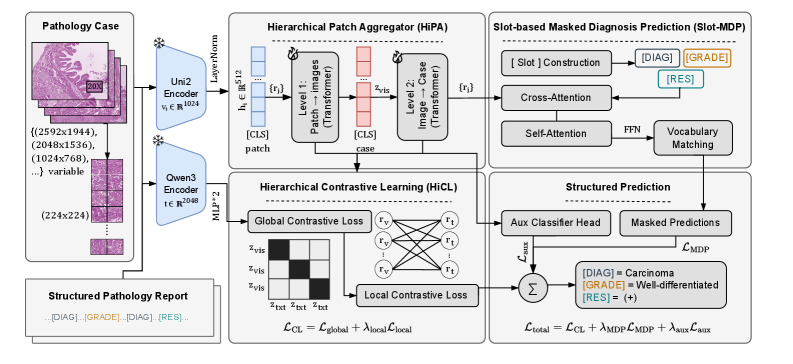
HiPath architecture: UNI2 and Qwen3 are frozen; only the lightweight alignment modules (15M parameters) are trained.
HiPath takes an extreme efficiency approach. It freezes both UNI2 (the latest pathology foundation model) and Qwen3 (Alibaba’s general-purpose LLM), training only a 15-million-parameter bridge module between them. Fewer trainable parameters means less overfitting, which helps with generalization across multi-institution data.
Note: HiPath’s authors include Imperial College London researchers, potentially matching the 2nd-place “ICL_PathReport” (score: 0.8202) on the leaderboard.
Model Catalog
Key models used in this task, organized by the See–Aggregate–Write framework.
See — Pathology Foundation Models
These models convert raw tile images into feature vectors. Training data diversity is the key selection criterion, not just parameter count.
- H-Optimus-1 (Bioptimus, 2024) — 1.1B params / 1M slides, 50 organs. Apache 2.0. Winning team’s choice.
- UNI2 (Harvard Mahmood Lab, 2025) — ViT-H / 200M+ images, 350K+ WSI. Research license (request). Successor to UNI.
- CONCH (Harvard Mahmood Lab, 2024, Nature Medicine) — ViT / 1.17M image-text pairs. Research license (request). Joint vision-language training.
- Prov-GigaPath (Microsoft / Providence, 2024, Nature) — ViT / 1B+ tiles, 170K+ WSI. MIT license. Large-scale, open.
- Virchow2 (Paige.AI, 2024) — 632M params / 3.1M WSIs. Research license. Strongest external generalization.
Aggregate — Slide-Level Pooling
Modules that collapse thousands of tile features into a single slide representation.
- ABMIL (Amsterdam UMC, 2018, ICML) — Lightweight, learnable weight layers. OSS. Most widely used baseline.
- CLAM (Harvard Mahmood Lab, 2021, Nature BME) — ABMIL-based with clustering constraint. OSS. Interpretable.
- TITAN slide encoder (Harvard Mahmood Lab, 2025, Nature Medicine) — Pre-trained on 335K WSIs. Research license (request). Directly supports report generation.
Write — Text Generation LLMs
An interesting pattern: general-purpose LLMs compete with medical-specific models. LLaMA-3 and Qwen3 were not designed for medicine, but lightweight fine-tuning (LoRA) adapts them effectively to pathology report generation.
- BioBART (Microsoft Research, 2022) — 140M params / PubMed-trained. MIT. Medical-specific, runs on modest GPUs.
- BioGPT (Microsoft Research, 2023) — 1.5B params / 15M PubMed abstracts. MIT. Medical-specific GPT.
- LLaMA-3 series (Meta, 2024) — 8B–70B. Llama 3 License. General → medical via LoRA.
- Qwen3 (Alibaba, 2025) — 0.6B–235B. Apache 2.0. General → frozen + lightweight modules.
Performance Analysis
KEY Score (40%) Dominates the Evaluation
The heaviest component of the evaluation is KEY score (Jaccard similarity of medical keywords) at 40%. This means a report that is less fluent but uses all the right terms will outscore a beautifully written report that misses key diagnoses.
The organizers stated that weights were “set based on clinical expert advice.” The reasoning: for pathologists, diagnostic information completeness matters more than prose quality.
What the evaluation code reveals: Keyword extraction uses scispaCy (the en_core_sci_lg NER model), which automatically identifies medical named entities of 3+ characters, then computes Jaccard similarity via exact string matching. This means scispaCy-recognized terms directly boost scores. It also means the metric is brittle to surface-form variation — "adenocarcinoma" and "adenoca." are treated as different terms.
Top-team strategies for KEY score:
- Medical term dictionaries — Pre-built keyword lists per organ and pathology type. Prevents omission of essential terms.
- Constrained Beam Search — Forces specific tokens to appear during text generation. Guarantees keyword presence.
- RAG (Retrieval-Augmented Generation) — Retrieves similar past reports as generation context. Directly reuses correct terminology.
- Organ-specific LoRA — Fine-tunes separate adapter weights for each of 7 organs. Captures organ-specific vocabulary.
The Margin Is Razor-Thin: 0.02 Between 1st and 4th
The gap between 1st place (0.839) and 4th place (0.828) is just 0.011. The broad technical approach has converged — the difference comes down to foundation model selection (diversity over size) and the precision of keyword generation strategies.
Handling 5 Countries and 6 Institutions
The pan-Asian, multi-institutional dataset poses a specific challenge: the same organ looks different depending on where and how the slide was prepared.
- Staining variation — Color profiles differ by institution and scanner. Mitigation: Macenko stain normalization.
- Report style variation — Same finding described differently across sites. Mitigation: terminology standardization, data augmentation.
- Organ diversity — 7 organs each with distinct tissue architecture. Mitigation: shared backbone + organ-specific LoRA adapters.
Takeaways
REG2025 tested whether AI can read a massive pathology slide and write a clinically useful diagnostic report — simultaneously demanding the ability to see, aggregate, and write.
What we learned:
- Foundation model selection is the foundation. Training data diversity (how many organs, how many institutions) mattered more than parameter count. The winning model, H-Optimus-1, was trained on 50 organs across 4,000 institutions — and it’s Apache 2.0 open source.
- KEY score (40%) is the game. The evaluation’s medical keyword Jaccard matching via scispaCy rewards precise terminology over fluency. RAG and medical dictionaries are effective countermeasures.
- The top teams are separated by just 0.02. Between 1st (0.839) and 4th (0.828), the difference is 0.011. The macro-level architecture has converged; fine-grained engineering decides the winner.
- General-purpose LLMs now compete with medical models. LLaMA-3 and Qwen3, adapted through LoRA or frozen-weight approaches, perform comparably to purpose-built medical text generators like BioBART.
What remains unknown:
The leaderboard (team names + composite scores) is public, but the breakdown is not. The official challenge summary paper has not been released as of April 2026.
- Score component breakdown (individual ROUGE-L / BLEU-4 / KEY / EMB values) is not published — we can’t tell whether the winner dominated on KEY, EMB, or both.
- Organ-level performance is unknown — we don’t know which of the 7 organs proved most difficult.
Resources
Related Papers
- HistGen — MICCAI 2024–2403.05396
- WsiCaption — MICCAI 2024 Oral — 2311.16480
- TITAN — Nature Medicine 2025–2411.19666
- PRISM — Paige.AI 2024–2405.10254
- WSI-LLaVA — 2024–2412.02141
- SlideChat — CVPR 2025–2410.11761
- CPath-Omni — CVPR 2025–2412.12077
- PolyPath — Modern Pathology 2025–2502.10536
Challenge Participants & Related Research
- ICGI (1st place) — Enabling clinical use of foundation models in histopathology — 2602.22347
- MPath (Phase 2: 4th) — MPath: Multimodal Pathology Report Generation — 2512.11906
- RANGER (related work) — Sparsely-Gated MoE for Pathology Report Generation — 2603.04348
- HiPath (related work) — Hierarchical Vision-Language Alignment — 2603.19957
Note: The official challenge summary paper (organizers’ overview of all teams) has not been published as of April 2026.
GitHub Repositories
- mahmoodlab/CLAM — Attention MIL
- mahmoodlab/TITAN — Slide foundation model
- mahmoodlab/UNI — Pathology foundation model
- mahmoodlab/CONCH — Vision-language foundation model
- dddavid4real/HistGen — WSI report generation
- cpystan/Wsi-Caption — MI-Gen
- uni-medical/SlideChat — WSI dialogue system
Official Links
메타데이터
- post_id
- b8908e4c7655
- slug
- reg2025-deep-dive-into-miccais-challenge-on-generating-pathology-reports-from-whole-slide-images-b8908e4c7655
- url
- https://medium.com/@suguuuu/reg2025-deep-dive-into-miccais-challenge-on-generating-pathology-reports-from-whole-slide-images-b8908e4c7655
- canonical_url
- https://medium.com/@suguuuu/reg2025-deep-dive-into-miccais-challenge-on-generating-pathology-reports-from-whole-slide-images-b8908e4c7655
- author_url
- https://medium.com/@suguuuu
- status
- ok
- fetched_at
- 2026-07-11 20:15:18